


What is the Laboratory AI Market Size and Overview?
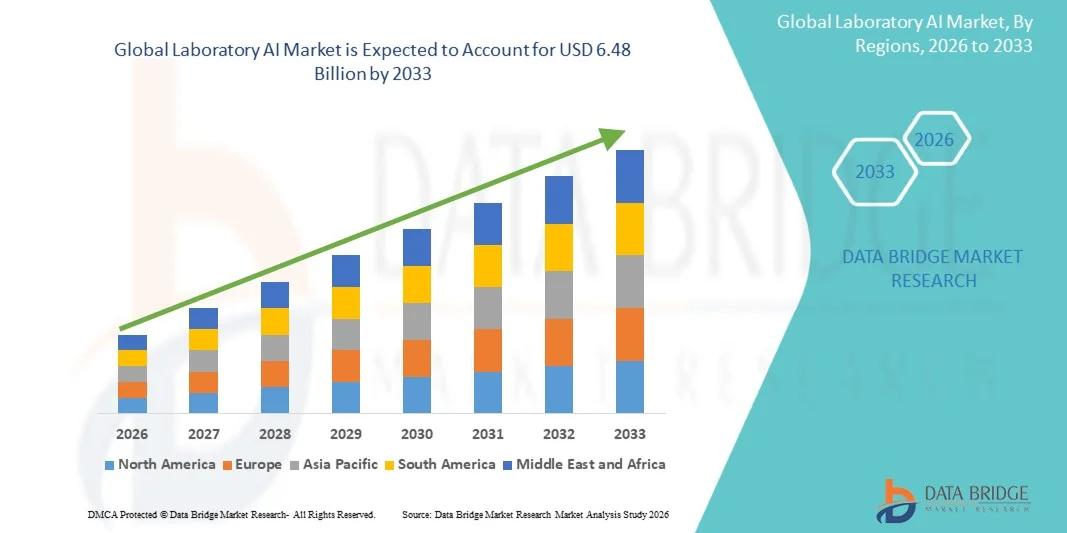
As per Data Bridge Market Research analysis The laboratory AI market was valued at USD 2.18 billion in 2025 and is projected to reach USD 6.48 billion by 2033, growing at a CAGR of 14.60% from 2026 to 2033. The market is experiencing consistent growth driven by increasing adoption of artificial intelligence for laboratory automation, rising demand for faster drug discovery and clinical diagnostics, and growing integration of AI into laboratory workflows for data analysis, quality control, and workflow optimization.
The growing need to improve laboratory throughput, reduce manual errors, and address shortages of skilled laboratory personnel is encouraging pharmaceutical companies, clinical laboratories, and research organizations to deploy AI-powered hardware and software solutions. AI-enabled analytical instruments, automated sample processing systems, and intelligent laboratory information platforms are increasingly replacing conventional laboratory processes, enabling higher operational efficiency, improved regulatory compliance, and accelerated scientific research across life sciences, pharmaceuticals, and industrial testing applications.
Market Size & Forecast
- Global Market Value (2025): USD 2.18 Billion
- Expected Market Value (2033): USD 6.48 Billion
- Forecast CAGR (2026–2033): 14.60%
- Leading Region in 2025: North America
- Fastest Growing Region: Asia Pacific
Key Market Trends & Insights
- North America dominated the laboratory AI market with the largest revenue share of 38.9% in 2025, supported by advanced pharmaceutical and biotechnology research infrastructure, widespread laboratory automation, and early adoption of artificial intelligence across clinical diagnostics and life sciences.
- The machine learning (ML) segment led the market with a 34% share in 2025, driven by ts widespread deployment across laboratory automation, predictive analytics, molecular modeling, and experimental optimization workflows.
- Asia-Pacific is expected to be the fastest-growing region at an CAGR of 15.2% from 2026 to 2033, fueled by expanding pharmaceutical manufacturing, increasing investments in biomedical research, and accelerating AI adoption across China and India
- Generative AI (GenAI) is the fastest-growing technology type, projected to register a CAGR of 16.5%, reflecting the surge in use of large language models and generative foundation models for scientific research and laboratory automation.
- The hardware equipment segment dominated the component category with a 35.6% revenue share in 2025, led by increasing deployment of AI-integrated analytical instruments, imaging systems, robotic sample handlers, and automated laboratory platforms
- Life sciences accounted for 54.0% of the market, preferred by increasing adoption of AI for drug discovery, genomics research, biomarker identification, diagnostic testing, and laboratory workflow automation
- The chemicals and pharmaceuticals segment is the fastest-growing application category, with a CAGR of 14.0%, driven by increasing use of AI for molecular modeling, process optimization, predictive quality control, and materials discovery.
Report Scope and Laboratory AI Market Segmentation
|
Attributes |
Laboratory AI Key Market Insights |
|
Segments Covered |
|
|
Countries Covered |
North America
Europe
Asia-Pacific
Middle East and Africa
South America
|
|
Key Market Players |
|
|
Market Opportunities |
|
|
Value Added Data Infosets |
|
What is the Key Trend in the Laboratory AI Market?
Trend: Rise of AI-Driven Laboratory Automation and Self-Driving Laboratories
Pharmaceutical companies, clinical laboratories, and research organizations are increasingly deploying artificial intelligence to automate experiment design, sample analysis, workflow optimization, and scientific data interpretation, improving laboratory throughput, reproducibility, and operational efficiency. The convergence of AI, robotics, and laboratory automation is enabling self-driving laboratories capable of autonomously conducting experiments, optimizing workflows, and accelerating drug discovery and materials research across life sciences and industrial laboratories. For instance, researchers introduced Claude-Light in 2025, a lightweight self-driving laboratory platform integrating machine learning, laboratory automation, and large language models to prototype autonomous experimentation and AI-driven workflows.
The rapid evolution of AI-powered laboratory automation is transforming conventional laboratories into autonomous research environments, significantly improving scientific productivity, experimental consistency, and research efficiency.
Laboratory AI Market Dynamics
Key Market Driver: Growing Adoption of AI for Drug Discovery and Laboratory Workflow Optimization
The growing need to accelerate drug discovery, improve laboratory throughput, and reduce manual analytical workloads is driving widespread adoption of AI-enabled laboratory solutions. Pharmaceutical companies, biotechnology firms, and clinical laboratories are integrating AI into molecular analysis, experiment optimization, quality control, and diagnostic workflows to shorten development timelines, improve analytical accuracy, and address skilled workforce shortages while enhancing overall laboratory productivity. For instance, Takeda Pharmaceutical expanded its AI-driven drug discovery strategy through a multi-year collaboration with Iambic Therapeutics, using AI models to accelerate small-molecule drug discovery and optimize early-stage pharmaceutical research.
As pharmaceutical R&D becomes increasingly data intensive, AI-enabled laboratory platforms are emerging as a critical foundation for accelerating scientific discovery, improving laboratory efficiency, and enhancing research quality.
Key Restraint/Challenge: Data Integrity, Traceability, and Regulatory Approval Barriers
A significant restraint in the laboratory AI market is the complexity of validating AI-generated outputs and integrating AI platforms with existing laboratory information management systems, analytical instruments, and legacy data infrastructures. Laboratories operating in regulated environments must ensure that AI-driven workflows comply with quality, traceability, and data integrity requirements while maintaining compatibility with established laboratory processes. These requirements increase implementation costs, extend deployment timelines, and create technical barriers for organizations seeking to modernize laboratory operations with artificial intelligence. For instance, in May 2024, the Medicines and Healthcare products Regulatory Agency (MHRA) launched the AI Airlock regulatory sandbox to help developers identify and address regulatory challenges associated with AI-enabled medical devices before commercialization, highlighting the growing complexity of validating and deploying AI technologies in regulated healthcare and laboratory environments.
While AI offers significant benefits in laboratory automation and data analysis, regulatory validation requirements and integration with legacy laboratory systems remain critical challenges that can slow adoption and increase deployment complexity across regulated research and diagnostic environments.
Key Market Opportunity: Expansion of Self-Driving Laboratories and Decentralized AI-Enabled Testing
The expansion of self-driving laboratories, AI-powered point-of-care diagnostics, and decentralized laboratory testing presents significant market opportunities. AI integrated with robotics, intelligent laboratory instrumentation, and cloud-enabled workflow orchestration supports autonomous experimentation, real-time decision-making, and scalable laboratory operations, creating new opportunities across pharmaceutical research, clinical diagnostics, and advanced materials development. For instance, researchers developed A-Lab GPSS, an autonomous robotic laboratory that combines agentic AI reasoning with robotic synthesis to autonomously discover and characterize air-sensitive solid-state materials, demonstrating the commercial potential of next-generation self-driving laboratories.
The convergence of AI, robotics, and intelligent laboratory infrastructure is creating scalable autonomous laboratory ecosystems, positioning self-driving laboratories as a major long-term growth opportunity for the Laboratory AI market.
Laboratory AI Market Scope
The laboratory AI market is segmented on the basis of technology, application, component, and end user.
- By Technology
On the basis of technology, the laboratory AI market is segmented into machine learning (ML), deep learning (DL), computer vision, natural language processing (NLP), and generative AI (GenAI). The machine learning (ML) segment dominated the market with an estimated share of 34% in 2025, driven by its widespread deployment across laboratory automation, predictive analytics, molecular modeling, and experimental optimization workflows. Machine learning algorithms are extensively used to identify patterns in large scientific datasets, improve laboratory decision-making, and optimize analytical processes. Pharmaceutical and biotechnology companies increasingly rely on ML models to accelerate drug discovery and biomarker identification. The technology also supports predictive maintenance of laboratory equipment and intelligent workflow orchestration. Its relatively mature ecosystem, proven reliability, and broad applicability continue to support leadership across research and diagnostic laboratories. Growing investments in AI-driven scientific computing are further strengthening adoption.
The generative AI (GenAI) segment is projected to register the fastest growth at an estimated CAGR of 16.5% from 2026 to 2033, driven by increasing use of large language models and generative foundation models for scientific research and laboratory automation. GenAI platforms can assist researchers in hypothesis generation, protocol development, scientific documentation, and experimental design. Continuous improvements in multimodal AI systems are enhancing laboratory productivity and accelerating knowledge discovery. The technology is increasingly being integrated into laboratory information management systems and autonomous research platforms. Rising investment in AI-assisted drug discovery and self-driving laboratories is creating significant growth opportunities. Expanding adoption across pharmaceutical, academic, and industrial research environments is expected to sustain rapid market expansion.
- By Component
On the basis of component, the laboratory AI market is segmented into hardware equipment and software and system. The hardware equipment segment dominated the market with a 35.6% share in 2025, driven by increasing deployment of AI-integrated analytical instruments, imaging systems, robotic sample handlers, and automated laboratory platforms. Laboratories are investing heavily in intelligent instrumentation to improve throughput, accuracy, and workflow efficiency. AI-enabled hardware supports real-time monitoring, automated sample processing, and advanced analytical capabilities across pharmaceutical and clinical laboratories. Growing demand for laboratory automation and robotics is further supporting segment growth. Continuous innovation in sensors, imaging technologies, and laboratory robotics is strengthening adoption. The segment benefits from increasing investment in modern laboratory infrastructure worldwide.
The software and system segment is expected to witness the fastest growth at an estimated CAGR of 13.5% from 2026 to 2033, driven by rising adoption of AI-powered data analytics, laboratory information management systems, workflow orchestration tools, and predictive modeling platforms. Laboratories are increasingly utilizing software solutions to manage growing volumes of experimental and diagnostic data. AI-enabled software improves operational efficiency while supporting scientific decision-making and compliance requirements. Cloud-based deployment models are expanding accessibility and scalability. Growing integration of generative AI capabilities is accelerating innovation across laboratory software ecosystems. The shift toward data-driven laboratory operations continues to support strong long-term growth.
- By Application
On the basis of application, the laboratory AI market is segmented into life sciences, chemicals and pharmaceuticals, semiconductors and electronics, and others. The Life Sciences segment dominated the market with a 54.0% share in 2025, led by increasing adoption of AI for drug discovery, genomics research, biomarker identification, diagnostic testing, and laboratory workflow automation. Life sciences organizations generate large volumes of complex biological data that require advanced analytical tools. AI enables researchers to accelerate scientific discovery while improving accuracy and reproducibility. Pharmaceutical and biotechnology companies are leveraging AI to optimize research pipelines and reduce development timelines. Rising investments in precision medicine and personalized healthcare are further strengthening demand. The segment continues to benefit from growing adoption of AI-driven research platforms and laboratory automation technologies.
The chemicals and pharmaceuticals segment is expected to register the fastest growth at an estimated CAGR of 14.0% from 2026 to 2033, driven by increasing use of AI for molecular modeling, process optimization, predictive quality control, and materials discovery. Organizations are adopting AI to accelerate innovation while reducing operational costs and development risks. AI-assisted compound screening and formulation development are improving research efficiency. Expanding investments in industrial digitalization and smart manufacturing are further supporting growth. The technology also enables improved regulatory compliance and process monitoring. Rising competitive pressure to accelerate product development is expected to sustain demand.
- By End User
On the basis of end user, the laboratory AI market is segmented into hospitals, pharmaceutical companies, research laboratories, and food and beverage companies. The pharmaceutical companies segment dominated the market with an estimated share of 42% in 2025, driven by extensive adoption of AI for drug discovery, clinical research, molecular screening, and laboratory automation. Pharmaceutical organizations generate vast scientific datasets that require advanced AI capabilities for analysis and interpretation. AI technologies are helping companies accelerate development timelines while improving research productivity. Increasing investment in AI-enabled drug development platforms is further strengthening market demand. Strategic partnerships between pharmaceutical companies and AI developers continue to expand implementation. The segment remains the largest adopter of laboratory AI technologies globally.
The research laboratories segment is anticipated to witness the fastest growth at an estimated CAGR of 15.2% from 2026 to 2033, driven by growing deployment of self-driving laboratories, AI-assisted experimentation platforms, and autonomous research systems. Academic institutions, government laboratories, and industrial research centers are increasingly integrating AI into scientific workflows. The technology supports data-intensive research activities while improving experimental reproducibility and operational efficiency. Growing investments in autonomous laboratory infrastructure are creating new growth opportunities. Expansion of interdisciplinary AI research initiatives is accelerating adoption. The emergence of next-generation intelligent laboratories is expected to drive sustained market expansion.
Laboratory AI Market Regional Analysis
North America dominated the laboratory AI market with the largest revenue share of 38.9% in 2025, supported by advanced pharmaceutical and biotechnology research infrastructure, widespread laboratory automation, and early adoption of artificial intelligence across clinical diagnostics and life sciences. The region also benefits from early adoption of artificial intelligence across drug discovery, clinical diagnostics, and laboratory workflow optimization. Growing deployment of AI-enabled analytical instruments, laboratory information management systems, and automated sample processing platforms is accelerating market expansion. Increasing emphasis on improving laboratory throughput, reducing analytical errors, and addressing skilled workforce shortages continues to strengthen North America's leadership position in the global market.
U.S. Laboratory AI Market Insight
The U.S. laboratory AI market is witnessing strong growth due to rising investments in AI-driven drug discovery, laboratory automation, and precision medicine technologies. The country's mature pharmaceutical, biotechnology, and healthcare research ecosystem, along with increasing adoption of machine learning-powered analytics, intelligent laboratory information systems, and automated research platforms, is driving demand across clinical, academic, and industrial laboratories. In addition, growing emphasis on accelerating scientific discovery, improving laboratory productivity, and reducing research timelines is supporting broader adoption of laboratory AI solutions. In July 2024, Pfizer entered into a Master Collaborative Research Agreement with Telescope Innovations to develop self-driving laboratories using artificial intelligence, robotics, and laboratory automation to accelerate pharmaceutical R&D.
Europe Laboratory AI Market Insight
The Europe laboratory AI market remains a major contributor to global revenue, driven by strong research funding, technological innovation, and increasing demand for AI-powered laboratory solutions. The widespread adoption of artificial intelligence across pharmaceutical development, genomics research, and clinical diagnostics is supporting market expansion throughout the region. Increasing investments in laboratory digitalization technologies, coupled with a highly developed life sciences ecosystem and supportive innovation programs, continue to strengthen laboratory AI adoption across Europe. The European Molecular Biology Laboratory has established EMBL AI, a Europe-wide initiative dedicated to integrating artificial intelligence and machine learning into biological research, including genomics, structural biology, image analysis, proteomics, biomarker discovery, and multimodal scientific data analysis. The initiative also builds AI research groups, data engineering teams, and AI infrastructure to accelerate life sciences research across Europe.
U.K. Laboratory AI Market Insight
The U.K. laboratory AI market is experiencing steady growth, supported by rising adoption of artificial intelligence technologies in biomedical research, drug discovery, and laboratory informatics applications. Increasing investments in computational biology, digital laboratory infrastructure, and intelligent scientific research platforms are contributing to market growth. Furthermore, integration of machine learning, predictive analytics, and generative AI technologies is improving research efficiency and scientific decision-making, positioning the U.K. as a key innovation hub within the laboratory AI industry. In May 2024, the Medicines and Healthcare products Regulatory Agency launched the AI Airlock regulatory sandbox to support testing and validation of AI-enabled healthcare technologies, strengthening the ecosystem for laboratory AI deployment and innovation.
Germany Laboratory AI Market Insight
The Germany laboratory AI market is expanding steadily due to the country's strong pharmaceutical manufacturing base, advanced research infrastructure, and increasing adoption of intelligent laboratory technologies. Pharmaceutical companies, biotechnology firms, and research institutes are increasingly utilizing AI for laboratory automation, molecular analysis, and scientific data interpretation. Continuous advancements in machine learning, laboratory robotics, and computational research technologies, along with strong government support for innovation and digital transformation, are further contributing to market growth in Germany. Merck KGaA continues to expand the use of artificial intelligence, machine learning, and digital technologies across research, laboratories, manufacturing, and life sciences through its UPTIMIZE data and AI ecosystem and Smartfacturing program, accelerating scientific innovation and laboratory digitalization.
Asia-Pacific Laboratory AI Market Insight
The Asia-Pacific laboratory AI market is expected to witness rapid growth, driven by expanding pharmaceutical manufacturing, increasing biomedical research investments, and rising adoption of laboratory automation technologies across countries such as China, India, and Japan. Growing demand for faster drug discovery, improved diagnostic capabilities, and scalable laboratory operations is supporting regional market expansion. In addition, increasing government initiatives promoting artificial intelligence and healthcare innovation are accelerating laboratory AI adoption across public and private research organizations. In February 2026, Insilico Medicine and China Medical System Holdings (CMS) announced multiple AI-powered drug discovery collaborations in central nervous system and autoimmune diseases, leveraging Insilico's AI platform to jointly advance pharmaceutical R&D. This highlights the growing adoption of AI-enabled laboratory research infrastructure across the Asia-Pacific region
Japan Laboratory AI Market Insight
The Japan laboratory AI market is witnessing consistent growth due to rising investments in laboratory automation, pharmaceutical innovation, and advanced biomedical research technologies. Research institutions, healthcare organizations, and pharmaceutical companies are increasingly adopting AI-powered solutions for molecular analysis, drug discovery, and diagnostic applications. Moreover, increasing integration of robotics, machine learning, and advanced analytics technologies, combined with the country’s focus on healthcare modernization and scientific excellence, is further contributing to market growth. In August 2024, Fujitsu announced a strategic partnership with Paradigm Health to accelerate the digitalization of clinical trials by combining its Healthy Living Platform and Fujitsu Kozuchi AI technologies, supporting AI-enabled biomedical research and pharmaceutical development in Japan
China Laboratory AI Market Insight
The China laboratory AI market is growing rapidly, driven by expanding pharmaceutical manufacturing, increasing clinical laboratory capacity, and strong government support for artificial intelligence and biomedical innovation. Growing adoption of AI-enabled laboratory platforms, automated analytical systems, and intelligent research technologies across pharmaceutical, academic, and healthcare sectors is significantly boosting market demand. In addition, rising investments in life sciences research and rapid technological advancements are positioning China as one of the fastest-growing laboratory AI markets globally. XtalPi Intelligent Digital R&D Platform utilizes artificial intelligence, robotics, and automation technologies to accelerate pharmaceutical research, molecular discovery, and laboratory operations, reflecting China's growing investment in AI-enabled scientific infrastructure.
Which are the Top Companies in Laboratory AI Market?
The laboratory AI industry is primarily led by well-established companies, including:
- Thermo Fisher Scientific Inc. (U.S.)
- Agilent Technologies, Inc. (U.S.)
- Waters Corporation (U.S.)
- Revvity, (U.S.)
- Illumina, Inc. (U.S.)
- Bio-Rad Laboratories, Inc. (U.S.)
- Danaher (U.S.)
- Siemens Healthineers AG (Germany)
- Hoffmann-La Roche Ltd (Switzerland)
- QIAGEN (Netherlands)
- Merck KGaA (Germany)
- Sartorius AG (Germany)
- ABB Ltd (Switzerland)
- Fujitsu Limited (Japan)
- NVIDIA Corporation (U.S.)
- Insilico Medicine, Inc. (Hong Kong)
- Recursion Pharmaceuticals, Inc. (U.S.)
- Schrödinger, Inc. (U.S.)
- Benchling, Inc. (U.S.)
- LabVantage Solutions, Inc. (U.S.)
Latest Developments in Laboratory AI Market
- In May 2025, Persist AI launched its Cloud Lab platform, enabling pharmaceutical companies to remotely access AI-driven robotic laboratories for drug formulation development. The platform combines laboratory robotics, automation, and artificial intelligence to shorten formulation development timelines while improving laboratory productivity and research efficiency.
- In April 2025, the Icahn School of Medicine at Mount Sinai launched its AI Small Molecule Drug Discovery Center. The center integrates artificial intelligence, chemical biology, and biomedical data science to identify and design novel therapeutics more efficiently, supporting faster laboratory-based drug discovery for diseases including cancer and neurodegenerative disorders.
- In March 2025, Roche announced the launch of the Roche Genentech Innovation Center Boston at Harvard’s Enterprise Research Campus. The new center brings together experts in disease biology, engineering, data science, and artificial intelligence to accelerate laboratory research and drug discovery, reinforcing Roche’s investment in AI-enabled biomedical innovation
- In January 2025, Daiichi Sankyo announced the establishment of a Smart Research Laboratory in San Diego, California, dedicated to developing robotics, automation, and advanced software to accelerate drug discovery. The facility is designed to automate laboratory workflows, generate high-quality experimental data, and strengthen AI-based drug discovery by integrating intelligent laboratory technologies into pharmaceutical research
- In July 2024, Siemens Healthineers introduced new AI-enabled laboratory automation capabilities at ADLM 2024 Clinical Lab Expo. The company expanded its Atellica portfolio with advanced analytics, workflow automation, and intelligent laboratory technologies designed to improve operational efficiency, reduce manual intervention, and enhance clinical laboratory performance

- Interactive Data Analysis Dashboard
- Company Analysis Dashboard for high growth potential opportunities
- Research Analyst Access for customization & queries
- Competitor Analysis with Interactive dashboard
- Latest News, Updates & Trend analysis
- Harness the Power of Benchmark Analysis for Comprehensive Competitor Tracking
Data collection and base year analysis are done using data collection modules with large sample sizes. The stage includes obtaining market information or related data through various sources and strategies. It includes examining and planning all the data acquired from the past in advance. It likewise envelops the examination of information inconsistencies seen across different information sources. The market data is analysed and estimated using market statistical and coherent models. Also, market share analysis and key trend analysis are the major success factors in the market report. To know more, please request an analyst call or drop down your inquiry.
The key research methodology used by DBMR research team is data triangulation which involves data mining, analysis of the impact of data variables on the market and primary (industry expert) validation. Data models include Vendor Positioning Grid, Market Time Line Analysis, Market Overview and Guide, Company Positioning Grid, Patent Analysis, Pricing Analysis, Company Market Share Analysis, Standards of Measurement, Global versus Regional and Vendor Share Analysis. To know more about the research methodology, drop in an inquiry to speak to our industry experts.
Data Bridge Market Research is a leader in advanced formative research. We take pride in servicing our existing and new customers with data and analysis that match and suits their goal. The report can be customized to include price trend analysis of target brands understanding the market for additional countries (ask for the list of countries), clinical trial results data, literature review, refurbished market and product base analysis. Market analysis of target competitors can be analyzed from technology-based analysis to market portfolio strategies. We can add as many competitors that you require data about in the format and data style you are looking for. Our team of analysts can also provide you data in crude raw excel files pivot tables (Fact book) or can assist you in creating presentations from the data sets available in the report.













