


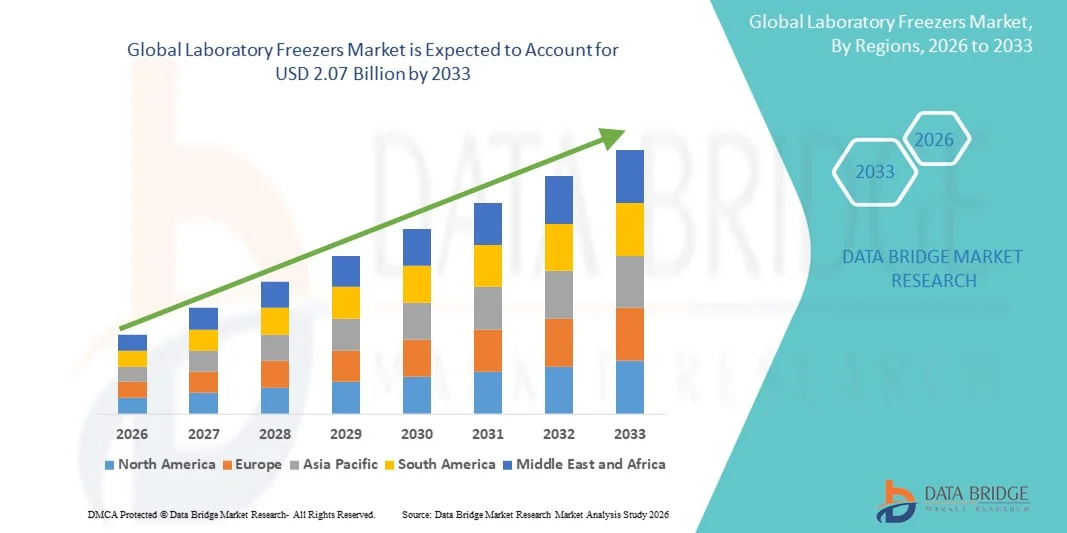
Laboratory Freezers Market Size
- The global laboratory freezers market size was valued at USD 1.32 billion in 2025 and is expected to reach USD 2.07 billion by 2033, at a CAGR of 5.80% during the forecast period
- The market growth is largely fueled by the increasing demand for efficient and reliable sample storage solutions in hospitals, research laboratories, pharmaceutical companies, and biotechnology facilities, leading to widespread adoption of advanced laboratory freezers for maintaining sample integrity and stability
- Furthermore, rising requirements for temperature-sensitive storage, including vaccines, biological samples, and reagents, along with technological advancements in ultra-low and energy-efficient freezers, are establishing laboratory freezers as essential equipment in both clinical and research settings. These converging factors are accelerating the uptake of Laboratory Freezers solutions, thereby significantly boosting the industry's growth
Laboratory Freezers Market Analysis
- Laboratory freezers, essential for storing biological samples, reagents, vaccines, and other temperature-sensitive materials, are increasingly vital components in clinical, pharmaceutical, and research settings due to their ability to maintain sample integrity and support advanced scientific workflows
- The escalating demand for laboratory freezers is primarily fueled by the rising prevalence of biobanking, pharmaceutical research, and vaccine production, along with technological advancements in ultra-low temperature freezers, energy efficiency, and digital temperature monitoring systems
- North America dominated the laboratory freezers market with the largest revenue share of 42.5% in 2025, driven by well-established healthcare infrastructure, high R&D expenditure, and the presence of key industry players. The U.S. experienced significant growth in laboratory freezer installations across hospitals, research institutions, and pharmaceutical companies, supported by innovations in ultra-low temperature and energy-efficient models
- Asia-Pacific is expected to be the fastest-growing region in the laboratory freezers market during the forecast period, owing to expanding healthcare infrastructure, increasing laboratory setups, growing pharmaceutical and biotech research activities, and rising disposable incomes in countries such as China, India, and Japan
- The Freezers segment dominated the market with the largest revenue share of approximately 52.4% in 2025, driven by their critical role in preserving temperature-sensitive biological samples, vaccines, enzymes, and reagents
Report Scope and Laboratory Freezers Market Segmentation
|
Attributes |
Laboratory Freezers Key Market Insights |
|
Segments Covered |
|
|
Countries Covered |
North America
Europe
Asia-Pacific
Middle East and Africa
South America
|
|
Key Market Players |
|
|
Market Opportunities |
|
|
Value Added Data Infosets |
In addition to the insights on market scenarios such as market value, growth rate, segmentation, geographical coverage, and major players, the market reports curated by the Data Bridge Market Research also include in-depth expert analysis, patient epidemiology, pipeline analysis, pricing analysis, and regulatory framework. |
Laboratory Freezers Market Trends
Rising Adoption of Ultra-Low Temperature Freezers for Research and Clinical Applications
- A key trend in the global laboratory freezers market is the increasing adoption of ultra-low temperature (ULT) freezers across research institutions, hospitals, and pharmaceutical companies. These freezers provide reliable storage for biological samples, vaccines, enzymes, and other temperature-sensitive materials
- For Instance, In 2022, Thermo Fisher Scientific launched the Forma ULT Freezer series with improved energy efficiency and noise reduction, widely adopted in North American and European research labs for sample preservation
- Modern laboratory workflows are increasingly dependent on consistent cold chain maintenance, which has led to a higher demand for advanced freezers with precise temperature control and energy efficiency
- Automation integration, including sample inventory management and remote monitoring, is becoming more common in high-volume research and diagnostic labs. Expansion of biotechnology, pharmaceutical R&D, and clinical testing programs is further driving the need for high-performance laboratory freezers
- Enhanced reliability, compact designs, and energy-efficient operations are influencing purchasing decisions, particularly in laboratories facing space and budget constraints. Global collaborations in biomedical research and the surge in clinical trials necessitate robust cold storage solutions, reinforcing this trend
- Regulatory emphasis on maintaining sample integrity in clinical and research labs is further supporting market expansion
Laboratory Freezers Market Dynamics
Driver
Increasing Demand for Biobanking, Vaccine Storage, and Research Applications
- The Laboratory Freezers market is primarily driven by the growing need for safe and reliable storage of biological samples in hospitals, diagnostic laboratories, research institutes, and pharmaceutical companies
- For Instance, In 2021, the Indian Council of Medical Research (ICMR) deployed multiple ultra-low temperature freezers in regional vaccine storage centers to maintain the integrity of COVID-19 vaccine samples during nationwide immunization drives
- Vaccine storage requirements, especially during large-scale immunization campaigns, are pushing healthcare providers to invest in specialized laboratory freezers
- Advances in biotechnology, precision medicine, and personalized healthcare are fueling the need for reliable sample preservation solutions
- Expansion of pharmaceutical R&D and clinical research laboratories is boosting demand for laboratory freezers with advanced features such as precise temperature uniformity and rapid cooling capabilities
- Regulatory standards for storage of clinical trial materials, biologics, and infectious agents are increasing the emphasis on compliant, monitored storage systems. Market growth is supported by technological developments, including energy-efficient compressors, environmentally friendly refrigerants, and digital temperature monitoring systems
- High adoption rates in emerging economies are being driven by expanding laboratory infrastructure and rising awareness of proper sample handling. Integration with laboratory information management systems (LIMS) for tracking and audit purposes is becoming increasingly important, encouraging investment in advanced freezer units
Restraint/Challenge
High Initial Investment and Operational Costs
- The relatively high purchase cost of advanced laboratory freezers, particularly ultra-low temperature units, poses a challenge for small laboratories and research centers with limited budgets
- For Instance, In 2020, a small diagnostic lab in Kenya delayed expanding its sample storage capacity due to the high upfront cost of ultra-low temperature freezers and the ongoing electricity expenses required to maintain stable -80°C conditions
- Energy consumption is a significant concern, as maintaining ultra-low temperatures requires substantial power, increasing operational costs. Maintenance and service requirements for high-performance laboratory freezers can also be costly and may limit adoption in resource-constrained settings
- Temperature fluctuations caused by frequent door openings, improper maintenance, or aging compressors can compromise sample integrity, creating hesitancy among smaller institutions
- Despite improvements in energy-efficient technologies, some laboratories continue to face high electricity costs, impacting total cost of ownership
- Training and proper handling are essential to avoid freezer malfunctions, adding indirect costs and operational complexity
- Addressing these challenges through cost-effective models, low-maintenance designs, and improved energy efficiency is vital for wider market penetration and long-term adoption
Laboratory Freezers Market Scope
The market is segmented on the basis of product type, end user, and target audience.
- By Product Type
On the basis of product type, the Laboratory Freezers market is segmented into Freezers, Refrigerators, and Cryopreservation Systems. The Freezers segment dominated the market with the largest revenue share of approximately 52.4% in 2025, driven by their critical role in preserving temperature-sensitive biological samples, vaccines, enzymes, and reagents. Freezers are widely used in hospitals, research laboratories, blood banks, and pharmaceutical facilities due to their reliable low-temperature storage capabilities. Rising investments in biotechnology, pharmaceutical R&D, and healthcare infrastructure have further boosted demand. In addition, improvements in energy efficiency, precise temperature control, and safety features such as alarms and backup systems make freezers the preferred choice in clinical and research applications. Growing government initiatives for vaccination campaigns, coupled with the expansion of laboratory networks, support sustained market leadership. Freezers are also increasingly integrated with digital monitoring systems for real-time temperature tracking, ensuring compliance with regulatory standards. The recurring requirement for ultra-low temperature storage in diagnostics and research strengthens long-term adoption. Moreover, partnerships between freezer manufacturers and large healthcare institutions contribute to stable revenue growth in this segment.
The Cryopreservation Systems segment is projected to witness the fastest CAGR of 11.6% from 2026 to 2033, fueled by increasing demand in stem cell research, fertility clinics, and biobanking applications. These systems enable long-term preservation of biological materials, including stem cells, gametes, and tissue samples, under highly controlled cryogenic conditions. Rising investments in regenerative medicine and personalized therapies are accelerating the adoption of cryopreservation technologies. Technological advancements such as automated sample handling, liquid nitrogen-free cryopreservation, and improved monitoring systems are making these systems more accessible and reliable. Growing awareness among research institutes, hospitals, and fertility centers about safe and efficient storage is further driving market growth. The expansion of biobanking facilities globally, coupled with increasing clinical trials, supports the rapid adoption of cryopreservation solutions.
- By End User
On the basis of end user, the Laboratory Freezers market is segmented into Blood Banks, Pharmaceutical and Biotechnology Companies, Academic and Research Institutes, Medical Laboratories, Hospitals, and Pharmacies. The Pharmaceutical and Biotechnology Companies segment accounted for the largest market revenue share of approximately 45.7% in 2025, as these organizations require reliable low-temperature storage for biologics, vaccines, and experimental compounds. The segment is further supported by stringent regulatory standards for sample preservation, which necessitate the use of high-performance laboratory freezers. Expansion in drug development pipelines, increased R&D spending, and a growing focus on biologics and cell-based therapies contribute to sustained demand. The adoption of ULT freezers, cryogenic storage, and energy-efficient models is becoming standard in these facilities. Collaborations between freezer manufacturers and pharmaceutical companies, along with technological advancements in monitoring and alarm systems, strengthen segment dominance. High-volume sample storage needs, integration with laboratory automation, and compliance with GMP standards further enhance the segment’s market leadership. In addition, the expansion of biopharma manufacturing hubs in North America, Europe, and Asia-Pacific continues to drive adoption.
The Blood Banks segment is expected to witness the fastest CAGR of 12.1% from 2026 to 2033, driven by increasing awareness of safe blood storage, growing demand for blood and plasma products, and expansion of national blood donation programs. Blood banks require consistent low-temperature environments to preserve red blood cells, platelets, and plasma. Modern freezer solutions with temperature alarms, redundancy systems, and remote monitoring are being widely adopted. Government initiatives to improve blood supply chain infrastructure and enhance storage facilities further accelerate growth. Technological advancements in portable and modular freezers, combined with increasing funding for blood preservation programs, make this segment a high-growth opportunity. Rising establishment of blood banks in emerging markets also contributes to rapid market expansion.
- By Target Audience
On the basis of target audience, the Laboratory Freezers market is segmented into Laboratory Equipment Manufacturers, Laboratory Freezer Manufacturers, Original Equipment Manufacturers (OEMs), Suppliers and Distributors of Laboratory Freezers, Hospitals, Healthcare Service Providers, Diagnostic Centers, Laboratories, Medical Institutes, Blood Banks, Research and Consulting Firms, and Others. The Laboratory Freezer Manufacturers segment dominated the market with a revenue share of 38.9% in 2025, due to their direct involvement in producing specialized storage solutions for multiple industries. Manufacturers offer a range of freezers, cryogenic systems, and refrigerators that meet diverse storage requirements. Rising investments in R&D, technological innovation, and partnerships with hospitals and research institutes drive segment leadership. Continuous product upgrades, including improved energy efficiency, digital temperature monitoring, and compliance with international quality standards, support strong revenue growth.
The Suppliers and Distributors of Laboratory Freezers segment is projected to register the fastest CAGR of 11.5% from 2026 to 2033, driven by their expanding regional reach and the ability to serve remote and underdeveloped areas. Strong collaborations with local healthcare providers, logistics improvements, and customized service offerings are opening new market opportunities. The increasing trend of outsourcing procurement and distribution to specialized vendors allows laboratories, hospitals, and blood banks to maintain uninterrupted freezer supply chains. Growth is also supported by the rising number of healthcare infrastructure projects and expansion of research facilities in emerging markets.
Laboratory Freezers Market Regional Analysis
- North America dominated the laboratory freezers market with the largest revenue share of 42.5% in 2025, supported by its well-established healthcare infrastructure, substantial investments in research and development, and the strong presence of leading industry players
- The region’s advanced hospitals, research institutions, and pharmaceutical companies are increasingly adopting state-of-the-art ultra-low temperature and energy-efficient freezer systems, driving the demand for reliable and high-capacity storage solutions
- In addition, ongoing technological innovations, rigorous regulatory standards, and the growing focus on maintaining sample integrity are further strengthening North America’s leadership in the laboratory freezers market
U.S. Laboratory Freezers Market Insight
The U.S. laboratory freezers market captured the largest revenue share within North America, fueled by the rapid adoption of ultra-low temperature and energy-efficient freezers across hospitals, research institutions, and pharmaceutical companies. The market growth is supported by increasing demand for secure storage of biological samples, vaccines, and reagents. Advanced freezer technologies, coupled with improved workflow efficiency, are enabling laboratories to store larger volumes of samples safely, while maintaining regulatory compliance. Rising investments in biopharmaceutical research and clinical laboratories further contribute to the expansion of the U.S. market, making it a key driver for North America’s dominance.
Europe Laboratory Freezers Market Insight
The Europe laboratory freezers market is expected to grow at a significant CAGR during the forecast period, driven by advanced healthcare infrastructure, stringent regulatory standards, and rising demand for ultra-low temperature and energy-efficient freezers. Countries such as Germany, the U.K., and France are witnessing steady growth due to increased laboratory setups in hospitals, research facilities, and pharmaceutical companies. The focus on energy efficiency, sample integrity, and reliability is driving the adoption of modern laboratory freezer systems across the region.
U.K. Laboratory Freezers Market Insight
The U.K. laboratory freezers market is anticipated to grow at a noteworthy CAGR during the forecast period, driven by rising healthcare expenditure, expanding research facilities, and increasing adoption of ultra-low temperature and energy-efficient freezer systems. Hospitals, clinical laboratories, and pharmaceutical companies are prioritizing secure and reliable storage solutions for biological samples, vaccines, and reagents. Additionally, government initiatives supporting healthcare modernization, coupled with growing investments in biotechnology and clinical research, are further accelerating market growth. The focus on sample integrity, energy efficiency, and compliance with stringent regulatory standards is encouraging widespread adoption of advanced laboratory freezers across the country.
Germany Laboratory Freezers Market Insight
The Germany laboratory freezers market is expected to expand at a considerable CAGR during the forecast period, supported by the country’s strong healthcare infrastructure, emphasis on research and development, and adoption of advanced laboratory technologies. Hospitals, pharmaceutical companies, and academic research institutions are increasingly implementing ultra-low temperature and energy-efficient freezers to ensure secure storage of biological samples, reagents, and vaccines. Germany’s focus on sustainability and energy conservation, combined with rigorous regulatory compliance and growing biotechnology research, is further propelling the demand for technologically advanced laboratory freezer systems across both residential and commercial healthcare and research facilities.
Asia-Pacific Laboratory Freezers Market Insight
The Asia-Pacific laboratory freezers market is anticipated to be the fastest-growing region with a CAGR from 2026 to 2033, driven by expanding healthcare infrastructure, rising disposable incomes, and increasing research and biotechnology activities in countries such as China, India, and Japan. Growing laboratory setups, government initiatives to modernize healthcare and research, and the increasing demand for ultra-low temperature freezers for biological sample storage are key factors propelling market growth. The affordability and accessibility of advanced freezer systems in the region are also encouraging widespread adoption.
Japan Laboratory Freezers Market Insight
The Japan laboratory freezers market is experiencing steady growth due to the country’s technologically advanced healthcare system, high emphasis on research and laboratory efficiency, and increasing need for reliable sample storage. Hospitals, research institutes, and pharmaceutical companies are investing in energy-efficient and ultra-low temperature freezers to ensure sample preservation and compliance with regulatory standards.
China Laboratory Freezers Market Insight
The China laboratory freezers market accounted for the largest share in Asia-Pacific in 2025, driven by rapid urbanization, a growing middle-class population, and increasing healthcare investments. The expansion of hospitals, research facilities, and pharmaceutical companies, along with strong domestic manufacturing of laboratory freezer systems, is supporting the market. Rising demand for reliable, high-capacity, and energy-efficient freezer systems is fueling growth in both public and private healthcare and research institutions.
Laboratory Freezers Market Share
The Laboratory Freezers industry is primarily led by well-established companies, including:
- Thermo Fisher Scientific (U.S.)
- PHC Holdings Corporation (Japan)
- VWR International (U.S.)
- Eppendorf AG (Germany)
- Haier Biomedical (China)
- Azbil Corporation (Japan)
- Labconco Corporation (U.S.)
- Chart Industries, Inc. (U.S.)
- Arctiko (Denmark)
- BlueFrontiers (U.S.)
- BioMedical Freezer Systems (China)
- Sanyo (Japan)
- Sabroe (Denmark)
- Helmer Scientific (U.S.)
- Scientific Equipment of Houston (U.S.)
- PHCbi (Japan)
- Fisher Scientific (U.S.)
- Scinics (U.S.)
- Labtop (U.S.)
- Haier Life Sciences (China)
Latest Developments in Global Laboratory Freezers Market
- In April 2024, Thermo Fisher Scientific launched its TSX Universal Series of ENERGY STAR‑certified ultra-low temperature (ULT) freezers. These new freezers offer tighter temperature control, faster recovery times, and about 33% energy savings, reinforcing the company’s commitment to sustainability and high-performance cold storage
- In May 2023, PHC Corporation (PHCbi brand) introduced the VIP ECO SMART ultra-low temperature freezer series. The product emphasizes energy-saving performance, trusted usability, and security for sample storage in academic labs, medical facilities, and biopharma
- In October 2022, Thermo Fisher Scientific added a new eco-friendly unit to its green freezer portfolio: the TDE Series -80 °C chest freezer. This model uses natural (hydrocarbon) refrigerants, achieves rapid temperature recovery, and reduces energy use by ~25% compared to earlier models

- Interactive Data Analysis Dashboard
- Company Analysis Dashboard for high growth potential opportunities
- Research Analyst Access for customization & queries
- Competitor Analysis with Interactive dashboard
- Latest News, Updates & Trend analysis
- Harness the Power of Benchmark Analysis for Comprehensive Competitor Tracking
Data collection and base year analysis are done using data collection modules with large sample sizes. The stage includes obtaining market information or related data through various sources and strategies. It includes examining and planning all the data acquired from the past in advance. It likewise envelops the examination of information inconsistencies seen across different information sources. The market data is analysed and estimated using market statistical and coherent models. Also, market share analysis and key trend analysis are the major success factors in the market report. To know more, please request an analyst call or drop down your inquiry.
The key research methodology used by DBMR research team is data triangulation which involves data mining, analysis of the impact of data variables on the market and primary (industry expert) validation. Data models include Vendor Positioning Grid, Market Time Line Analysis, Market Overview and Guide, Company Positioning Grid, Patent Analysis, Pricing Analysis, Company Market Share Analysis, Standards of Measurement, Global versus Regional and Vendor Share Analysis. To know more about the research methodology, drop in an inquiry to speak to our industry experts.
Data Bridge Market Research is a leader in advanced formative research. We take pride in servicing our existing and new customers with data and analysis that match and suits their goal. The report can be customized to include price trend analysis of target brands understanding the market for additional countries (ask for the list of countries), clinical trial results data, literature review, refurbished market and product base analysis. Market analysis of target competitors can be analyzed from technology-based analysis to market portfolio strategies. We can add as many competitors that you require data about in the format and data style you are looking for. Our team of analysts can also provide you data in crude raw excel files pivot tables (Fact book) or can assist you in creating presentations from the data sets available in the report.













