


Laboratory Glassware Market Size
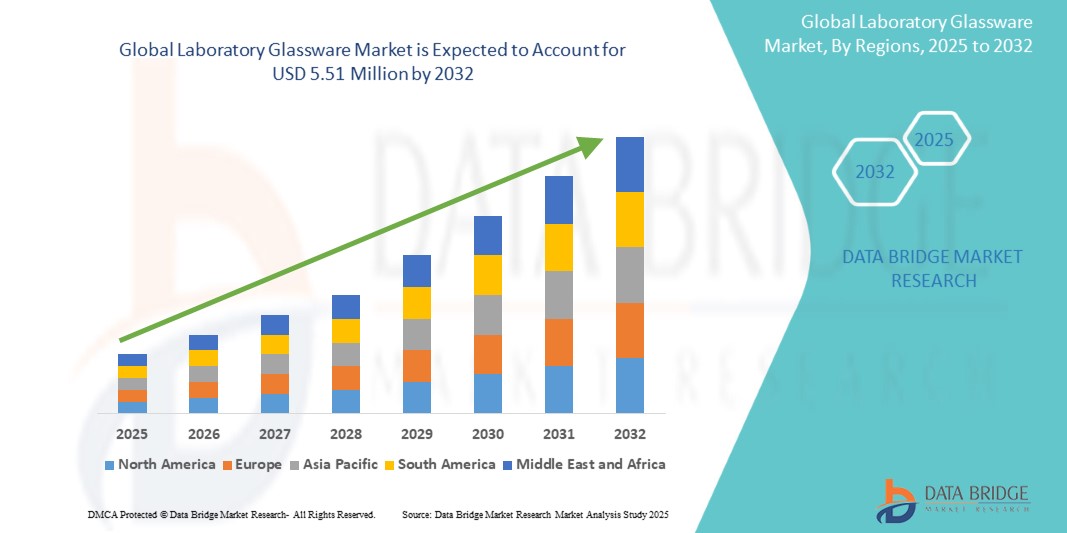
- The global laboratory glassware market size was valued at USD 3.77 billion in 2024 and is expected to reach USD 5.51 billion by 2032, at a CAGR of 4.85% during the forecast period
- This growth is primarily driven by the increasing demand for research and development (R&D) in pharmaceuticals, biotechnology, and diagnostics, fueled by advancements in life sciences and healthcare
- Furthermore, the rise in R&D activities across various industries necessitates extensive use of laboratory glassware for experiments, laboratory proficiency testing, and analysis. These converging factors are accelerating the uptake of laboratory glassware solutions, thereby significantly boosting the industry's growth
Laboratory Glassware Market Analysis
- Laboratory glassware, including pipettes, burettes, beakers, flasks, petri dishes, and storage containers, is a critical component in pharmaceutical, biotechnology, academic, and industrial laboratories, valued for its precision, chemical resistance, and reliability in research, analysis, and quality control
- The growing demand for laboratory glassware is primarily fueled by increasing research and development (R&D) activities, expanding pharmaceutical and biotechnology production, and rising need for standardized laboratory equipment across academic and industrial laboratories
- North America dominated the laboratory glassware market with the largest revenue share of 37.3% in 2024, driven by advanced R&D infrastructure, high investment in healthcare and scientific research, and the presence of major laboratory glassware manufacturers, with the U.S. leading in adoption for pharmaceutical and chemical research applications
- Asia-Pacific is expected to be the fastest-growing region in the laboratory glassware market during the forecast period due to rapid industrialization, expansion of pharmaceutical and biotechnology sectors, and increasing government and private investments in scientific research and higher education laboratories
- Pipettes and pipette tips segment dominated the laboratory glassware market with a market share of 30.5% in 2024, owing to their extensive use across research, clinical, and industrial laboratories, coupled with technological advancements such as electronic and multichannel pipettes that improve precision and efficiency
Report Scope and Laboratory Glassware Market Segmentation
|
Attributes |
Laboratory Glassware Key Market Insights |
|
Segments Covered |
|
|
Countries Covered |
North America
Europe
Asia-Pacific
Middle East and Africa
South America
|
|
Key Market Players |
|
|
Market Opportunities |
|
|
Value Added Data Infosets |
In addition to the insights on market scenarios such as market value, growth rate, segmentation, geographical coverage, and major players, the market reports curated by the Data Bridge Market Research also include in-depth expert analysis, pricing analysis, brand share analysis, consumer survey, demography analysis, supply chain analysis, value chain analysis, raw material/consumables overview, vendor selection criteria, PESTLE Analysis, Porter Analysis, and regulatory framework. |
Laboratory Glassware Market Trends
Growing Adoption of Automated and High-Precision Glassware
- A significant trend in the global laboratory glassware market is the increasing adoption of automated, electronic, and high-precision glassware, such as electronic pipettes, digital burettes, and volumetric flasks with integrated measurement systems. This trend is enhancing accuracy, efficiency, and reproducibility in laboratory experiments across pharmaceutical, biotechnology, and academic research laboratories
- For instance, electronic pipettes with multichannel capability enable high-throughput sample processing while reducing human error, improving workflow efficiency in research and diagnostic labs. Similarly, digital burettes and titration systems are being increasingly integrated into chemical and quality control laboratories for precise reagent dispensing
- High-precision laboratory glassware helps ensure consistent experimental results, reduces material wastage, and supports regulatory compliance in analytical and clinical testing. Some leading manufacturers, such as Eppendorf and Gilson, have developed pipettes with digital readouts and automated calibration features that further enhance laboratory productivity
- The integration of laboratory glassware with laboratory information management systems (LIMS) and automated workstations allows centralized monitoring and streamlined experimental workflows, reducing manual intervention and increasing overall operational efficiency
- This trend toward automated and high-precision glassware is reshaping expectations for laboratory operations, prompting manufacturers to develop advanced, user-friendly, and highly accurate products to meet evolving research demands
- The demand for sophisticated laboratory glassware is growing rapidly across pharmaceutical, biotech, academic, and industrial laboratories, as users increasingly prioritize precision, efficiency, and regulatory compliance in experimental workflows
Laboratory Glassware Market Dynamics
Driver
Increasing R&D Activities and Quality Control Requirements
- The rising investment in research and development, particularly in pharmaceuticals, biotechnology, and academic institutions, is a major driver for the growing demand for laboratory glassware
- For instance, expanding clinical trials, new drug development, and analytical testing in 2024 have accelerated the need for high-quality glassware such as pipettes, flasks, and beakers to ensure accuracy and reproducibility in experiments
- The growing emphasis on quality control and standardization across industrial, pharmaceutical, and food testing laboratories is further fueling market growth
- Laboratory glassware provides precise measurement and reliable results, which are critical in regulated environments, supporting compliance with international standards and protocols
- The increasing trend of outsourcing research to contract research organizations (CROs) is driving the demand for laboratory glassware, as CROs require high-quality, reliable glassware to support multiple client projects efficiently
- The expansion of personalized medicine and biotechnology research is creating additional demand for specialized laboratory glassware to perform complex assays and experiments
Restraint/Challenge
Breakage Risk and High Cost of Specialized Glassware
- Laboratory glassware is inherently fragile and prone to breakage, which can lead to increased replacement costs and potential disruption of laboratory operations, representing a key challenge for users and suppliers
- For instance, high-precision volumetric flasks and glass pipettes require careful handling and proper storage to prevent damage, and breakage can result in loss of expensive reagents and experimental data
- In addition, specialized or high-precision glassware often comes at a premium price, which can be a barrier for small laboratories, academic institutions with limited budgets, or emerging market laboratories
- While efforts to develop more durable borosilicate glass and protective coatings are underway, cost and fragility remain significant concerns
- Inconsistent quality and lack of standardization among low-cost laboratory glassware manufacturers can lead to errors in experiments, creating challenges for laboratories in emerging markets
- Logistical challenges in transporting fragile laboratory glassware across regions, especially to remote or underdeveloped areas, increase operational costs and limit market penetration
- Addressing these challenges through improved material engineering, cost-effective alternatives, and user education on proper handling is essential for sustained market adoption and growth
- Ensuring compliance with global regulatory standards and certifications for laboratory glassware remains a challenge, particularly for new market entrants seeking to establish credibility
Laboratory Glassware Market Scope
The market is segmented on the basis of product type, end-user, and distribution channel.
- By Product Type
On the basis of product type, the laboratory glassware market is segmented into pipettes and pipette tips, burettes, storage containers, beakers, flasks, petri dishes, and others. The pipettes and pipette tips segment dominated the market with the largest revenue share of 30.5% in 2024, driven by their critical role in precise liquid handling across research, clinical, and industrial laboratories. Laboratories rely heavily on pipettes and tips for chemical analysis, pharmaceutical testing, and biotechnology research, ensuring reproducibility and accuracy in experiments. The adoption of electronic and multichannel pipettes is further boosting the segment by increasing throughput and operational efficiency. In addition, stringent quality control standards and regulatory compliance make pipettes a necessity in academic, industrial, and contract research settings. The versatility of pipettes across workflows, combined with frequent replacement cycles, reinforces this segment’s market dominance.
The flasks segment is anticipated to witness the fastest growth rate from 2025 to 2032, fueled by increasing applications in chemical reactions, sample storage, titration, and microbial culture processes. Types such as Erlenmeyer, volumetric, and Florence flasks are widely adopted due to their durability and ability to withstand thermal and chemical stress. The growth is driven by expanding pharmaceutical, biotechnology, and chemical research laboratories that require precise and standardized glassware. Automation-compatible flasks integrated with laboratory robotics are also accelerating adoption. Educational and industrial laboratories increasingly rely on flasks for standard experiments and protocol adherence, making this segment the fastest-growing in the market.
- By End-User
On the basis of end-user, the laboratory glassware market is segmented into research and academic institutes, hospitals and diagnostic centers, pharmaceutical and biotechnology industries, contract research organizations, food and beverage industry, and other end-users. The research and academic institutes segment dominated the market in 2024 due to extensive usage of glassware in experiments, teaching, and laboratory research activities. Universities, colleges, and government-funded research facilities maintain large inventories of pipettes, beakers, flasks, and petri dishes for academic and experimental purposes. Standardized laboratory glassware ensures reproducibility and compliance with research protocols. Replacement and upgrade cycles in educational laboratories sustain continuous demand. Government funding and grants for research infrastructure further reinforce the segment’s dominance. Curriculum-based laboratory exercises and student training programs also contribute to consistent market consumption.
The pharmaceutical and biotechnology industries segment is expected to witness the fastest growth rate from 2025 to 2032 due to increasing demand for precise and sterile glassware in drug development, clinical trials, and quality control operations. Advanced R&D activities, biologics development, and personalized medicine initiatives are driving the need for specialized laboratory glassware. Contract research organizations (CROs) supporting pharmaceutical companies also boost demand. Automation and high-throughput testing in pharmaceutical laboratories further accelerate growth. Regulatory compliance and precision requirements in laboratory processes reinforce the segment’s rapid expansion. Emerging markets with expanding biotech and pharmaceutical facilities are expected to drive adoption further.
- By Distribution Channel
On the basis of distribution channel, the laboratory glassware market is segmented into online and offline channels. The offline segment dominated the market with approximately 64.5% share in 2024, driven by laboratories’ preference to inspect and verify product quality physically before purchase. Established relationships with distributors ensure reliability and immediate availability of products. Technical support and in-person guidance enhance customer confidence for high-value glassware. Bulk procurement by academic, industrial, and government laboratories also favors offline channels. Proper packaging, handling, and transportation reduce the risk of breakage. Long-standing supplier-laboratory relationships reinforce offline dominance in the market.
The online segment is anticipated to witness the fastest growth rate from 2025 to 2032, fueled by the convenience of digital ordering, wider product selection, and competitive pricing. Laboratories can compare specifications, pricing, and supplier credibility easily via e-commerce platforms. Startups, small laboratories, and remote research facilities are increasingly adopting online channels. Online marketplaces offer specialized or hard-to-find glassware not readily available in local markets. Real-time inventory tracking, doorstep delivery, and efficient logistics further enhance adoption. Growing trust in secure online payments and reliable shipping services contributes to rapid growth of the online channel.
Laboratory Glassware Market Regional Analysis
- North America dominated the laboratory glassware market with the largest revenue share of 37.3% in 2024, driven by advanced R&D infrastructure, high investment in healthcare and scientific research, and the presence of major laboratory glassware manufacturers, with the U.S. leading in adoption for pharmaceutical and chemical research applications
- Laboratories in the region extensively use high-quality glassware such as pipettes, flasks, and beakers for research, quality control, and academic purposes. The preference for precise, standardized, and automation-compatible glassware supports this dominance
- The widespread adoption is further supported by advanced laboratory infrastructure, high investments in life sciences and chemical research, and the strong presence of key glassware manufacturers and distributors. This combination ensures North America remains a leading consumer of laboratory glassware across both academic and industrial sectors
U.S. Laboratory Glassware Market Insight
The U.S. laboratory glassware market accounted for the largest share within North America in 2024, driven by high demand from pharmaceutical, biotechnology, and academic research laboratories. The adoption of advanced glassware for analytical testing, sample preparation, and high-throughput research is boosting market growth. Government-funded research programs, expansion of contract research organizations (CROs), and increasing investments in innovation-intensive sectors further propel demand. In addition, the trend of laboratory automation and the need for standardized, high-precision glassware are supporting sustained market growth across residential, commercial, and industrial research applications.
Europe Laboratory Glassware Market Insight
The Europe laboratory glassware market is projected to grow at a substantial CAGR during the forecast period, driven by rising R&D activities, stringent regulatory compliance, and the increasing presence of pharmaceutical and biotech companies. Germany, France, and the U.K. are major contributors, with laboratories demanding high-quality glassware for drug development, quality control, and academic research. The emphasis on sustainability and innovation in laboratory operations, combined with urbanization and advanced infrastructure, supports the adoption of specialized glassware. In addition, universities and research institutions across Europe continuously upgrade laboratory equipment, further fueling demand.
U.K. Laboratory Glassware Market Insight
The U.K. laboratory glassware market is anticipated to grow steadily due to rising demand from academic institutions, research laboratories, and the pharmaceutical sector. Increasing government investment in life sciences, expansion of biotech clusters, and the trend of laboratory modernization are key growth drivers. Laboratory glassware is widely adopted for chemical analysis, sample handling, and quality testing. The U.K.’s well-established supply chain and e-commerce infrastructure also support easy procurement and distribution of high-quality laboratory glassware across the country.
Germany Laboratory Glassware Market Insight
The Germany laboratory glassware market is expected to expand at a considerable CAGR, fueled by growing R&D activities, advanced pharmaceutical and chemical industries, and strong academic research infrastructure. Laboratories prioritize high-precision, durable, and eco-friendly glassware for experiments, quality control, and analytical testing. The country’s focus on innovation, sustainability, and technological advancement promotes the adoption of automated and standardized laboratory glassware. Integration with laboratory automation systems is increasingly prevalent, reflecting Germany’s emphasis on efficiency and quality in research applications.
Asia-Pacific Laboratory Glassware Market Insight
The Asia-Pacific laboratory glassware market is poised to grow at the fastest CAGR during the forecast period, driven by increasing investments in pharmaceutical, biotechnology, and chemical research in countries such as China, India, and Japan. Rapid urbanization, rising disposable incomes, and the expansion of research institutions and CROs are fueling demand. The growing trend of laboratory modernization and automation, coupled with government initiatives supporting scientific research, is accelerating adoption. In addition, APAC’s emergence as a manufacturing hub for laboratory equipment is increasing accessibility and affordability of high-quality glassware.
Japan Laboratory Glassware Market Insight
The Japan laboratory glassware market is gaining momentum due to the country’s high-tech research environment, strong focus on pharmaceutical and biotechnology R&D, and growing laboratory automation. The demand for precise, reliable, and durable glassware is rising across academic, commercial, and industrial laboratories. Integration of glassware with automated systems and robotics enhances productivity and accuracy. Japan’s emphasis on innovation, quality control, and standardization further drives market expansion, while initiatives promoting advanced scientific research encourage adoption of specialized laboratory glassware.
India Laboratory Glassware Market Insight
The India laboratory glassware market accounted for the largest share in Asia-Pacific in 2024, driven by rapid urbanization, a growing middle class, and increasing R&D activities in pharmaceuticals and biotechnology. The country’s expanding research infrastructure, government initiatives promoting scientific research, and the availability of cost-effective glassware products support market growth. Laboratories across educational institutions, CROs, and industrial sectors are adopting high-quality glassware for precise experimentation and quality testing. Furthermore, the presence of domestic manufacturers and increasing focus on laboratory automation are key factors propelling the market in India.
Laboratory Glassware Market Share
The laboratory glassware industry is primarily led by well-established companies, including:
- Corning Incorporated (U.S.)
- Thermo Fisher Scientific Inc. (U.S.)
- Eppendorf SE (Germany)
- Merck & Co., Inc. (U.S.)
- Gerresheimer AG (Germany)
- Ace Glass Incorporated (U.S.)
- DWK Life Sciences (Germany)
- At-Mar Glass (U.S.)
- BioChemWare (U.S.)
- Glassco Laboratory Equipments Pvt. Ltd. (India)
- Borosil Limited (India)
- Omsons Glassware Pvt. Ltd. (India)
- Fuso Glass India (India)
- Durolab Glass Manufacturing Co. (India)
- JOANLAB Equipment CO., LTD (China)
- Shanghai Heqi Glassware Co., Ltd. (China)
- Yancheng Rongtai Labware (China)
- Lianyungang GLS Quartz Material Co., Ltd. (China)
- SICHUAN MACHINERY IMP.& EXP.CORP. (China)
- Yancheng Xieying Machinery Co., Ltd. (China)
What are the Recent Developments in Global Laboratory Glassware Market?
- In January 2025, ZAGENO, an AI-powered marketplace for lab supplies, partnered with Hatch.Bio Labs, a biotech incubator, to simplify the procurement process for lab supplies. The collaboration offers Hatch.Bio residents discounted rates and an Amazon-such as shopping experience, aiming to reduce administrative roadblocks for biotech startups
- In June 2024, Borosil Scientific made its debut on the stock exchanges following its strategic demerger from Borosil Limited. This move created a dedicated entity focused on the scientific and industrial products business. The demerger was part of a larger strategy to unlock value and provide a clearer business focus for both companies, allowing Borosil Scientific to accelerate its growth and innovation in the laboratory equipment and glassware market
- In December 2023, Eppendorf announced a partnership with Neste to develop laboratory products made from renewable plastic materials. The new line of Eppendorf Consumables BioBased includes tubes, screw caps, and pipette tips manufactured using Neste RE™, a feedstock produced from 100% renewable raw materials. This collaboration aims to reduce the environmental impact of laboratory consumables by replacing traditional plastics with bio-based alternatives
- In October 2023, SCHOTT AG launched its new FIOLAX® Pro glass tubing. This specialized glass tubing was engineered to have enhanced chemical resistance and improved mechanical properties. It is specifically designed to meet the stringent requirements of the pharmaceutical industry, ensuring that it can withstand various sterilization processes and maintain the integrity of drug products, thereby improving safety and reliability in critical applications
- In May 2023, DWK Life Sciences acquired Assem-Pak, Inc. This strategic acquisition was made to enhance DWK's capabilities and streamline supply chain management. By integrating Assem-Pak's expertise in custom packaging and assembly, DWK aimed to better support its clients throughout their development processes and expand its range of bundled offerings for laboratory solutions

- Interactive Data Analysis Dashboard
- Company Analysis Dashboard for high growth potential opportunities
- Research Analyst Access for customization & queries
- Competitor Analysis with Interactive dashboard
- Latest News, Updates & Trend analysis
- Harness the Power of Benchmark Analysis for Comprehensive Competitor Tracking
Data collection and base year analysis are done using data collection modules with large sample sizes. The stage includes obtaining market information or related data through various sources and strategies. It includes examining and planning all the data acquired from the past in advance. It likewise envelops the examination of information inconsistencies seen across different information sources. The market data is analysed and estimated using market statistical and coherent models. Also, market share analysis and key trend analysis are the major success factors in the market report. To know more, please request an analyst call or drop down your inquiry.
The key research methodology used by DBMR research team is data triangulation which involves data mining, analysis of the impact of data variables on the market and primary (industry expert) validation. Data models include Vendor Positioning Grid, Market Time Line Analysis, Market Overview and Guide, Company Positioning Grid, Patent Analysis, Pricing Analysis, Company Market Share Analysis, Standards of Measurement, Global versus Regional and Vendor Share Analysis. To know more about the research methodology, drop in an inquiry to speak to our industry experts.
Data Bridge Market Research is a leader in advanced formative research. We take pride in servicing our existing and new customers with data and analysis that match and suits their goal. The report can be customized to include price trend analysis of target brands understanding the market for additional countries (ask for the list of countries), clinical trial results data, literature review, refurbished market and product base analysis. Market analysis of target competitors can be analyzed from technology-based analysis to market portfolio strategies. We can add as many competitors that you require data about in the format and data style you are looking for. Our team of analysts can also provide you data in crude raw excel files pivot tables (Fact book) or can assist you in creating presentations from the data sets available in the report.













