


What is the Oncology Laboratory Proficiency Testing Market Size and Overview ?
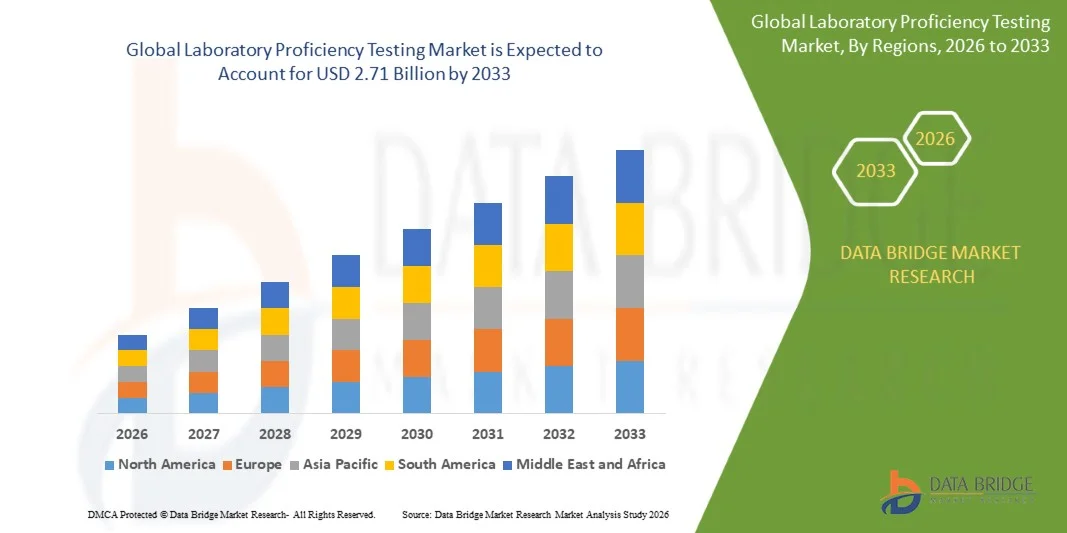
As per Data Bridge Market Research Analysis the Laboratory Proficiency Testing Market was valued at USD 1.60 billion in 2025 and is projected to reach USD 2.71 billion by 2033, growing at a CAGR of 6.80% from 2026 to 2033. The market is experiencing steady growth driven by increasing emphasis on laboratory quality assurance, rising regulatory requirements for accreditation and compliance, and growing demand for accurate and reliable diagnostic, pharmaceutical, environmental, and food testing services.
The expanding complexity of laboratory testing procedures, coupled with stricter international standards such as ISO/IEC 17025 and ISO 15189, is encouraging laboratories across healthcare, biotechnology, food safety, and environmental sectors to participate in proficiency testing programs. These programs help laboratories evaluate analytical performance, identify testing inconsistencies, and maintain compliance with regulatory and accreditation requirements. In addition, advancements in molecular diagnostics, increasing clinical testing volumes, and growing globalization of laboratory services are further driving demand for proficiency testing solutions. The market is also benefiting from rising investments in laboratory modernization, automation technologies, and quality management systems, supporting the adoption of comprehensive proficiency testing programs across both public and private laboratories worldwide.
Market Size & Forecast
- Global Market Value (2025): USD 1.60 Billion
- Expected Market Value (2033): USD 2.71 Billion
- Forecast CAGR (2026–2033): 6.80%
- Leading Region in 2025: North America
- Fastest Growing Region: Asia-Pacific
What are the Major Takeaways of Decorations and Inclusions Market ?
- North America dominated the laboratory proficiency testing market with the largest revenue share of 38.7% in 2025, supported by a strong regulatory framework, high adoption of quality assurance programs, well-established laboratory infrastructure, and widespread participation in external quality assessment schemes across clinical, pharmaceutical, and environmental testing laboratories.
- Asia-Pacific is expected to be the fastest-growing region, recording a CAGR of 9.1% from 2026 to 2033. Growth is driven by rapid expansion of diagnostic laboratories, increasing healthcare investments, rising awareness of laboratory quality standards, and growing adoption of molecular diagnostics and food safety testing across emerging economies.
- The Clinical Diagnostics segment held the largest market revenue share of approximately 31.6% in 2025, driven by the rising volume of diagnostic testing, increasing prevalence of chronic and infectious diseases, and stringent regulatory requirements for laboratory accreditation and quality assurance. Continuous expansion of clinical laboratory networks and growing demand for accurate disease detection further strengthen segment dominance.
- The Pharmaceuticals and Biologics segment is projected to register the fastest growth at a CAGR of 9.2% from 2026 to 2033, driven by increasing drug development activities, expansion of biopharmaceutical pipelines, and rising need for strict quality control in analytical testing. Growing adoption of advanced molecular assays and regulatory compliance requirements in drug manufacturing are accelerating segment expansion.
- The Chromatography segment held the largest market revenue share of approximately 28.4% in 2025, driven by its widespread use in pharmaceutical analysis, environmental testing, and food safety applications. High accuracy, reproducibility, and regulatory acceptance of chromatographic methods continue to support segment leadership.
- The PCR segment is projected to register the fastest growth at a CAGR of 10.1% from 2026 to 2033, driven by increasing adoption in molecular diagnostics, infectious disease detection, and genomic research. Expanding use of real-time PCR and next-generation molecular testing platforms is significantly boosting demand for proficiency testing in this category.
- The Diagnostic Laboratories segment held the largest market revenue share of approximately 33.9% in 2025, driven by high testing volumes, rising demand for routine diagnostics, and mandatory participation in external quality assessment programs for accreditation compliance.
- The Pharmaceutical and Biotechnology Companies segment is projected to register the fastest growth at a CAGR of 9.5% from 2026 to 2033, driven by increasing R&D investments, expansion of biopharmaceutical manufacturing, and rising reliance on advanced analytical testing for drug development and quality assurance.
Report Scope and Laboratory Proficiency Testing Market Segmentation
|
Attributes |
Laboratory Proficiency Testing Key Market Insights |
|
Segments Covered |
|
|
Countries Covered |
North America
Europe
Asia-Pacific
Middle East and Africa
South America
|
|
Key Market Players |
|
|
Market Opportunities |
|
|
Value Added Data Infosets |
In addition to the insights on market scenarios such as market value, growth rate, segmentation, geographical coverage, and major players, the market reports curated by the Data Bridge Market Research also include in-depth expert analysis, pricing analysis, brand share analysis, consumer survey, demography analysis, supply chain analysis, value chain analysis, raw material/consumables overview, vendor selection criteria, PESTLE Analysis, Porter Analysis, and regulatory framework. |
What is the Key Trend in the Oncology Laboratory Proficiency Testing Market?
Trend: Expansion Of Digital Proficiency Testing Platforms And Advanced Molecular Diagnostics Assessment
The increasing complexity of laboratory testing procedures and growing emphasis on quality assurance are driving demand for digital and technology-enabled proficiency testing solutions across clinical, pharmaceutical, environmental, and food testing laboratories. Traditional paper-based and manually managed proficiency testing programs often involve longer reporting cycles and limited analytical insights, encouraging laboratories to adopt digital platforms that improve efficiency, data management, and performance benchmarking.
Laboratories are increasingly utilizing cloud-based proficiency testing systems, For instance for automated result submission, real-time performance evaluation, and centralized quality monitoring across multiple testing locations. In molecular diagnostics, proficiency testing providers are expanding programs covering next-generation sequencing (NGS), polymerase chain reaction (PCR), and genomic testing applications to support growing adoption of precision medicine and advanced diagnostic technologies. These solutions help laboratories identify analytical inconsistencies while ensuring compliance with international accreditation requirements.
The rapid expansion of personalized medicine, infectious disease surveillance, and genetic testing services is further increasing demand for specialized proficiency testing programs. In addition, regulatory agencies and accreditation bodies continue to strengthen quality assurance requirements for laboratories performing high-complexity testing. Industry data from 2025 showed increasing participation in molecular proficiency testing programs across North America and Europe, with several major providers reporting double-digit growth in enrollment for genomic and molecular diagnostics assessment schemes.
Laboratory Proficiency Testing Market Dynamics
Key Market Driver: Increasing Regulatory Compliance Requirements And Laboratory Accreditation Programs
Laboratories worldwide are facing growing regulatory pressure to demonstrate analytical accuracy, testing reliability, and compliance with internationally recognized quality standards. Accreditation frameworks such as ISO/IEC 17025, ISO 15189, and various national laboratory quality programs require regular participation in proficiency testing programs to validate laboratory performance and maintain certification status.
Clinical laboratories, pharmaceutical testing facilities, environmental laboratories, and food safety testing organizations are increasingly participating in proficiency testing programs to ensure consistent analytical performance and regulatory compliance. For instance, laboratories involved in diagnostic testing, pharmaceutical quality control, and environmental monitoring rely on external proficiency assessments to identify performance gaps and improve testing accuracy. The growing volume of laboratory testing activities globally is further strengthening demand for proficiency testing services.
Similarly, public health agencies and regulatory authorities continue expanding quality assurance requirements for laboratories involved in disease surveillance, food safety monitoring, and environmental analysis. Real-world laboratory accreditation programs across North America and Europe reported continued growth in proficiency testing participation during 2024, with thousands of accredited laboratories required to complete periodic external quality assessments as part of compliance programs.
Key Restraint/Challenge: High Program Costs And Operational Complexity For Specialized Testing
The implementation of proficiency testing programs can involve significant costs, particularly for laboratories conducting highly specialized or low-volume testing procedures. Participation fees, sample distribution expenses, data management requirements, and corrective action processes can create financial and operational burdens for smaller laboratories with limited resources.
In addition, developing proficiency testing schemes for emerging diagnostic technologies, rare analytes, and advanced molecular assays presents technical challenges for program providers. For instance, maintaining sample stability, ensuring result comparability, and producing statistically valid performance evaluations require substantial technical expertise and infrastructure investments. Laboratories operating in developing regions may also face challenges associated with limited access to specialized proficiency testing programs.
Commercial laboratory quality assessments indicate that participation costs for advanced molecular and genomic proficiency testing programs can be significantly higher than conventional chemistry or microbiology assessments, creating affordability concerns for smaller laboratories while potentially limiting participation in highly specialized testing categories.
Key Market Opportunity: Growing Adoption Of Molecular Diagnostics And Precision Medicine Testing
Modern healthcare systems are increasingly adopting molecular diagnostics, genomic sequencing, companion diagnostics, and precision medicine approaches that require exceptionally high levels of analytical accuracy and quality assurance. As testing complexity continues to increase, demand is growing for specialized proficiency testing programs capable of evaluating laboratory performance across advanced diagnostic platforms.
Laboratories are increasingly seeking proficiency testing solutions, For instance for next-generation sequencing, oncology biomarkers, infectious disease diagnostics, and pharmacogenomics testing, to support expanding precision medicine initiatives. In pharmaceutical and biotechnology sectors, growing research activity and biologics development are creating additional demand for advanced laboratory quality assessment services. Rising adoption of laboratory automation and digital quality management systems is further supporting market opportunities.
In addition, advancements in artificial intelligence-assisted diagnostics, genomic medicine, and decentralized testing models are creating new proficiency testing requirements across healthcare and life sciences markets. Industry participation data from 2025 indicated strong growth in enrollment for molecular diagnostics proficiency testing programs globally, with several international providers reporting significant increases in demand for genomic sequencing and precision medicine-related quality assessment services.
How is the Oncology Laboratory Proficiency Testing Market Segmented ?
The market is segmented on the basis of industry type, technology, and end-user.
- By Industry Type
On the basis of industry type, the laboratory proficiency testing market is segmented into Clinical Diagnostics, Microbiology, Pharmaceuticals, Biologics, Cosmetics, Cannabis/Opioids, Food and Animal Feed, Commercial Beverages, Water, Environmental, and Dietary Supplements and Nutraceuticals. The Clinical Diagnostics segment held the largest market revenue share of approximately 31.6% in 2025, driven by the rising volume of diagnostic testing, increasing prevalence of chronic and infectious diseases, and stringent regulatory requirements for laboratory accreditation and quality assurance. Continuous expansion of clinical laboratory networks and growing demand for accurate disease detection further strengthen segment dominance.
The Pharmaceuticals and Biologics segment is projected to register the fastest growth at a CAGR of 9.2% from 2026 to 2033, driven by increasing drug development activities, expansion of biopharmaceutical pipelines, and rising need for strict quality control in analytical testing. Growing adoption of advanced molecular assays and regulatory compliance requirements in drug manufacturing are accelerating segment expansion.
- By Technology
On the basis of technology, the laboratory proficiency testing market is segmented into Spectrophotometry, Chromatography, ELISA, PCR, Cell Culture, Immunoassays, and Other. The Chromatography segment held the largest market revenue share of approximately 28.4% in 2025, driven by its widespread use in pharmaceutical analysis, environmental testing, and food safety applications. High accuracy, reproducibility, and regulatory acceptance of chromatographic methods continue to support segment leadership.
The PCR segment is projected to register the fastest growth at a CAGR of 10.1% from 2026 to 2033, driven by increasing adoption in molecular diagnostics, infectious disease detection, and genomic research. Expanding use of real-time PCR and next-generation molecular testing platforms is significantly boosting demand for proficiency testing in this category.
- By End-User
On the basis of end-user, the laboratory proficiency testing market is segmented into Hospitals, Contract Research Organizations, Pharmaceutical and Biotechnology Companies, Academic Research, Diagnostic Laboratories, Independent Laboratories, and Speciality Laboratories. The Diagnostic Laboratories segment held the largest market revenue share of approximately 33.9% in 2025, driven by high testing volumes, rising demand for routine diagnostics, and mandatory participation in external quality assessment programs for accreditation compliance.
The Pharmaceutical and Biotechnology Companies segment is projected to register the fastest growth at a CAGR of 9.5% from 2026 to 2033, driven by increasing R&D investments, expansion of biopharmaceutical manufacturing, and rising reliance on advanced analytical testing for drug development and quality assurance.
Which Region Holds the Largest Share of the Oncology Imaging Software Market?
North America Laboratory Proficiency Testing Market Insight
North America dominated the laboratory proficiency testing market with the largest revenue share of 38.7% in 2025, supported by a well-established laboratory infrastructure, stringent regulatory frameworks, and high adoption of quality assurance and accreditation programs. The region benefits from strong participation of clinical, pharmaceutical, and environmental laboratories in external quality assessment schemes, driven by mandatory compliance requirements such as ISO/IEC 17025 and ISO 15189. Increasing demand for accurate diagnostic testing, growing prevalence of chronic diseases, and rising investment in laboratory modernization further strengthen market growth across hospitals, independent laboratories, and diagnostic networks.
U.S. Laboratory Proficiency Testing Market Insight
The U.S. laboratory proficiency testing market captured the largest revenue share in 2025 within North America, driven by extensive clinical testing volumes, advanced healthcare infrastructure, and strict regulatory oversight by agencies such as CLIA and CAP. Laboratories across the country are increasingly participating in proficiency testing programs to ensure analytical accuracy, maintain accreditation, and comply with federal quality standards. The growing adoption of molecular diagnostics, expansion of hospital-based laboratories, and rising demand for high-complexity testing such as PCR and genomic analysis are further supporting market expansion.
Europe Laboratory Proficiency Testing Market Insight
The Europe laboratory proficiency testing market is expected to witness the fastest growth rate from 2026 to 2033, primarily driven by stringent laboratory accreditation requirements, increasing healthcare expenditure, and rising demand for standardized testing across clinical and environmental sectors. The region’s strong regulatory environment, supported by frameworks such as ISO standards and EU quality directives, is encouraging widespread participation in proficiency testing programs. Growing adoption of advanced diagnostic technologies and expansion of pharmaceutical and biotechnology research activities are further accelerating market growth across Europe.
U.K. Laboratory Proficiency Testing Market Insight
The U.K. laboratory proficiency testing market is expected to witness steady growth from 2026 to 2033, driven by increasing demand for laboratory accreditation, rising focus on diagnostic accuracy, and strong regulatory oversight from national healthcare bodies. The expansion of clinical laboratory networks, growing adoption of molecular diagnostics, and rising emphasis on quality assurance in public health testing are contributing to market expansion. In addition, the U.K.’s strong biotechnology and pharmaceutical research ecosystem is further supporting participation in proficiency testing programs.
Germany Laboratory Proficiency Testing Market Insight
The Germany laboratory proficiency testing market is expected to witness strong growth from 2026 to 2033, fueled by a highly developed laboratory infrastructure, strong regulatory compliance culture, and increasing adoption of advanced analytical technologies. German laboratories place significant emphasis on precision, quality control, and accreditation standards, driving consistent participation in proficiency testing schemes. The expansion of pharmaceutical manufacturing, environmental testing, and food safety analysis is further strengthening market demand across the country.
Asia-Pacific Laboratory Proficiency Testing Market Insight
The Asia-Pacific laboratory proficiency testing market is expected to witness the fastest growth rate from 2026 to 2033, supported by rapid expansion of healthcare infrastructure, increasing diagnostic testing volumes, and growing awareness of laboratory quality standards. Countries such as China, India, and Japan are investing heavily in laboratory modernization and accreditation programs. Rising prevalence of infectious and chronic diseases, along with increasing adoption of molecular diagnostics and food safety testing, is significantly boosting demand for proficiency testing services across the region.
Japan Laboratory Proficiency Testing Market Insight
The Japan laboratory proficiency testing market is expected to witness strong growth from 2026 to 2033 due to advanced healthcare systems, high diagnostic accuracy requirements, and strong emphasis on laboratory quality assurance. Japanese laboratories actively participate in proficiency testing programs to maintain international accreditation and ensure reliability in clinical and research testing. Increasing adoption of molecular diagnostics, aging population-driven healthcare demand, and expansion of precision medicine initiatives are further driving market growth.
China Laboratory Proficiency Testing Market Insight
The China laboratory proficiency testing market accounted for the largest market revenue share in Asia-Pacific in 2025, attributed to rapid expansion of diagnostic laboratories, strong government focus on healthcare quality standards, and increasing adoption of advanced testing technologies. The country’s growing pharmaceutical and biotechnology sectors, along with rising demand for food safety and environmental testing, are driving widespread participation in proficiency testing programs. Continuous healthcare infrastructure development and increasing regulatory enforcement are key factors propelling market growth in China.
Which are the Top Companies in Oncology Imaging Software Market?
The Laboratory Proficiency Testing industry is primarily led by well-established companies, including:
•LGC Limited (U.K.)
• Randox Laboratories Ltd. (U.K.)
• Bio-Rad Laboratories, Inc. (U.S.)
• Merck KGaA (Germany)
• Waters Corporation (U.S.)
• QACS (Greece)
• AOAC International (U.S.)
• Weqas (U.K.)
• BIPEA (France)
• NSI Lab Solutions (U.S.)
• Absolute Standards Inc. (U.S.)
• TRILOGY ANALYTICAL LABORATORIES (U.S.)
• Fera Science Limited (U.K.)
• ATCC (U.S.)
• FLUXANA GmbH & Co. KG (Germany)
• NEOGEN CORPORATION (U.S.)
What are Latest Developments in Oncology Laboratory Proficiency Testing Market?
- In November 2024, College of American Pathologists (CAP), a leading organization in laboratory quality assurance, introduced a new Proficiency Testing (PT) report for in vitro diagnostics (IVD) companies. The development is aimed at improving understanding of customer requirements, enhancing diagnostic accuracy, and strengthening overall laboratory performance standards, thereby supporting higher quality compliance across global clinical testing networks.
- In June 2024, BIPEA, a France-based proficiency testing provider, launched the experimental PT 56A program focused on microbiology testing in flour samples with artificial contamination. The initiative is designed to improve laboratory detection capabilities for microbial contaminants in food products, enhance food safety monitoring, and strengthen quality control practices across food testing laboratories, ultimately supporting more reliable and standardized testing outcomes globally.
- In February 2025, Cormay Diagnostics, a Poland-based in vitro diagnostics company, partnered with Randox Laboratories through the Randox International Quality Assessment Scheme (RIQAS). The collaboration is aimed at evaluating diagnostic solutions within one of the world’s largest external quality assessment frameworks covering over 70,000 laboratories worldwide. This partnership strengthens global laboratory benchmarking, improves diagnostic reliability, and enhances adoption of standardized proficiency testing practices across clinical laboratories.

- Interactive Data Analysis Dashboard
- Company Analysis Dashboard for high growth potential opportunities
- Research Analyst Access for customization & queries
- Competitor Analysis with Interactive dashboard
- Latest News, Updates & Trend analysis
- Harness the Power of Benchmark Analysis for Comprehensive Competitor Tracking
Global Laboratory Proficiency Testing Market, Supply Chain Analysis and Ecosystem Framework
To support market growth and help clients navigate the impact of geopolitical shifts, DBMR has integrated in-depth supply chain analysis into its Global Laboratory Proficiency Testing Market research reports. This addition empowers clients to respond effectively to global changes affecting their industries. The supply chain analysis section includes detailed insights such as Global Laboratory Proficiency Testing Market consumption and production by country, price trend analysis, the impact of tariffs and geopolitical developments, and import and export trends by country and HSN code. It also highlights major suppliers with data on production capacity and company profiles, as well as key importers and exporters. In addition to research, DBMR offers specialized supply chain consulting services backed by over a decade of experience, providing solutions like supplier discovery, supplier risk assessment, price trend analysis, impact evaluation of inflation and trade route changes, and comprehensive market trend analysis.
Data collection and base year analysis are done using data collection modules with large sample sizes. The stage includes obtaining market information or related data through various sources and strategies. It includes examining and planning all the data acquired from the past in advance. It likewise envelops the examination of information inconsistencies seen across different information sources. The market data is analysed and estimated using market statistical and coherent models. Also, market share analysis and key trend analysis are the major success factors in the market report. To know more, please request an analyst call or drop down your inquiry.
The key research methodology used by DBMR research team is data triangulation which involves data mining, analysis of the impact of data variables on the market and primary (industry expert) validation. Data models include Vendor Positioning Grid, Market Time Line Analysis, Market Overview and Guide, Company Positioning Grid, Patent Analysis, Pricing Analysis, Company Market Share Analysis, Standards of Measurement, Global versus Regional and Vendor Share Analysis. To know more about the research methodology, drop in an inquiry to speak to our industry experts.
Data Bridge Market Research is a leader in advanced formative research. We take pride in servicing our existing and new customers with data and analysis that match and suits their goal. The report can be customized to include price trend analysis of target brands understanding the market for additional countries (ask for the list of countries), clinical trial results data, literature review, refurbished market and product base analysis. Market analysis of target competitors can be analyzed from technology-based analysis to market portfolio strategies. We can add as many competitors that you require data about in the format and data style you are looking for. Our team of analysts can also provide you data in crude raw excel files pivot tables (Fact book) or can assist you in creating presentations from the data sets available in the report.













