


Laboratory Robotics Market Overview
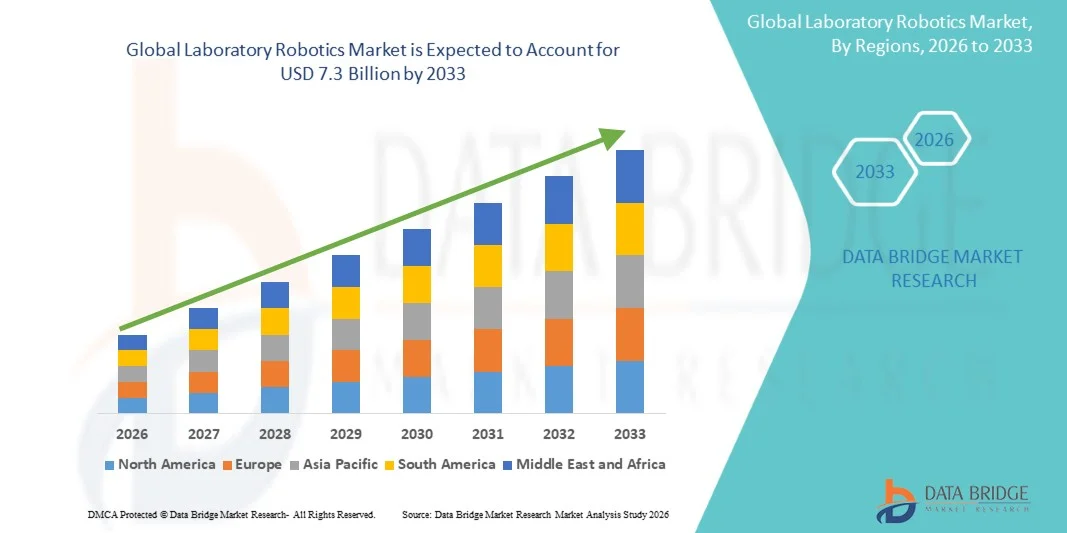
As per Data Bridge Market Research Analysis the laboratory robotics market was valued at USD 3.29 billion in 2025 and is projected to reach USD 7.3 billion by 2033, growing at a CAGR of 10.50% during the forecast period.
Laboratory robotics refers to the use of robotic systems and automated technologies to perform scientific research, experiments, and diagnostic testing with minimal human intervention. These systems are designed to handle repetitive tasks such as liquid handling, sample preparation, plate manipulation, and high-throughput screening with precision, speed, and reproducibility. The market is experiencing significant growth driven by the rising adoption of automation in research and diagnostic laboratories, technological advancements in artificial intelligence and machine learning, and the expanding demand for high-throughput screening in drug discovery and clinical diagnostics. Pharmaceutical and biotechnology companies are increasingly investing in robotic solutions to reduce human error, accelerate research timelines, and improve operational efficiency.
Market Size & Forecast
- Global Market Value (2025): USD 3.29 Billion
- Expected Market Value (2033): USD 7.3 Billion
- Forecast CAGR (2026–2033): 10.50%
- Leading Region in 2025: North America
- Fastest Growing Region: Asia-Pacific
Key Market Trends & Insights
- North America dominated the laboratory robotics market with the largest revenue share of 42.3% in 2024, supported by strong R&D investments, advanced healthcare infrastructure, and the presence of major market players. The U.S. laboratory robotics market was estimated at USD 708.3 Thousand in 2025.
- Europe accounted for a significant share of the laboratory robotics market, supported by strong pharmaceutical and biotechnology research, advanced healthcare infrastructure, increasing laboratory automation, and favorable government funding for life science research.
- Asia-Pacific is expected to witness the fastest growth during the forecast period, driven by rapid industrialization, increasing healthcare expenditure, and growing demand for automation in research laboratories. China, the world's second-largest economy, is forecast to reach a projected market size of US$652.8 Thousand by 2032, trailing a CAGR of 5.9%.
- The automated liquid handling robots segment dominated the product type category with a 38.46% share of the laboratory robotics market, driven by their critical role in high-throughput screening, genomics, proteomics, and drug discovery applications.
- The clinical diagnostics segment contributed the largest share of 41% to the laboratory robotics market in 2024, as hospitals consolidated sample processing under high-throughput lines.
- The genomics solutions segment is projected to register the highest cagr of 11.20% through 2030, outperforming all other applications, driven by the growing demand for robotic liquid handlers in library preparation for oncology and rare-disease panels.
- Clinical laboratories represented the largest end-use segment, driven by the increasing volume of diagnostic testing, rising adoption of automated laboratory workflows, and the growing need for accurate, high-throughput sample processing.
Report Scope and Laboratory Robotics Market Segmentation
|
Attributes |
Laboratory Robotics Key Market Insights |
|
Segments Covered |
|
|
Countries Covered |
North America
Europe
Asia-Pacific
Middle East and Africa
South America
|
|
Key Market Players |
|
|
Market Opportunities |
|
|
Value Added Data Infosets |
In addition to the insights on market scenarios such as market value, growth rate, segmentation, geographical coverage, and major players, the market reports curated by the Data Bridge Market Research also include in-depth expert analysis, patient epidemiology, pipeline analysis, pricing analysis, and regulatory framework. |
Laboratory Robotics Market Trends
Trend: AI and Machine Learning Integration
The integration of artificial intelligence and machine learning capabilities in robotics systems is a defining trend reshaping the laboratory robotics market. AI-driven robotic systems can optimize pipetting protocols, analyze data for quality control, and provide unmatched decision-making support in research environments. These advancements improve efficiency, accuracy, and scalability in laboratory processes, particularly in fields like drug discovery and genomics.
For instance, in January 2025, ABB Robotics and Agilent Technologies signed a collaboration agreement to deliver automated laboratory solutions. The partnership combines Agilent's advanced analytical instrumentation and laboratory software with ABB's robotics to automate repetitive tasks such as sample handling, testing, and data processing, enabling faster time-to-market and higher productivity across pharma, biotechnology, energy, and food and beverage sectors. In January 2025, Tecan unveiled Veya™, a transformative liquid handling platform that combines AI-enhanced automation, prebuilt workflows, and an intuitive analytics interface to simplify complex tasks, including multiomics workflows, while meeting regulatory standards such as CE-IVD and IVDR.
Laboratory Robotics Market Dynamics
Key Market Driver: Skilled Labor Shortage and Need for Automation
A persistent shortage of skilled technicians is accelerating the adoption of laboratory robotics to ensure operational consistency and efficiency. According to the American Society for Clinical Pathology's 2024 Vacancy Survey, anatomic pathology departments experienced a substantial vacancy rate of 28.5%, highlighting the critical staffing shortages that demand robotic solutions to sustain throughput. Automation alleviates this pressure by handling labor-intensive, repetitive tasks, enabling limited personnel to concentrate on complex analysis and mitigating burnout.
For instance, at the German Congress of Laboratory Medicine (DKLM) 2025 in Leipzig, a study on implementing a hybrid robotic system in a tertiary care hospital laboratory was presented, revealing strategies for overcoming staffing shortages and meeting growing diagnostic demands through automation. Additionally, E Tech Group launched its Laboratory Automation and Industrial Robotics (LAIR) workflow orchestration platform, reporting that it can reduce turnaround time by up to 40% in pharmaceutical, biotechnology, and clinical diagnostic laboratories.
Key Restraint/Challenge: High Initial Investment and Maintenance Costs
High initial investment and ongoing maintenance costs represent a significant challenge for the laboratory robotics market. Implementing robotic automation requires substantial capital expenditure for advanced equipment, infrastructure modifications, and software integration, which can be prohibitive for small and mid-sized laboratories. According to the International Federation of Robotics, while sales of robots for medical laboratory analysis surged by 610% in 2024, financial and technical constraints continue to hinder adoption among smaller institutions.
For instance, a leading global pharmaceutical company that implemented a mobile robot-supported Drug Discovery platform developed by Labman required a development cycle of two years, representing a substantial investment in both time and resources. This highlights the significant capital and time commitment required for advanced laboratory automation systems, which smaller organizations may find challenging to undertake.
Key Market Opportunity: AI and Cloud-Based Solutions
The integration of AI-driven workflow optimization and cloud-based data analysis platforms presents significant growth opportunities. AI-powered robotic systems can enhance precision, reduce human error, and accelerate research processes. Cloud-based platforms enable real-time data sharing, remote monitoring, and collaborative research across multiple locations. Vendors that bundle software, instruments, and validation support continue to capture wallet share. For instance, XtalPi Holdings deployed a large-scale AI robot laboratory for JW, a leading South Korean pharmaceutical company. The deployment included high-throughput automated synthesis workstations, AI reaction optimization systems, and intelligent analysis platforms, enabling full-process intelligent and automated R&D from candidate molecule screening to synthesis and process optimization. In August 2025, a fully automated, uninterrupted organic synthesis robot developed in Yichang, China, was exported to the Singapore Institute of Materials Research and Engineering, marking the first export of an AI chemistry robot from China. The single device can complete up to 800 experiments per day, equivalent to the workload of 40 PhD researchers.
Laboratory Robotics Market Scope
The Laboratory Robotics market is segmented on the basis of product, application, end use, and region.
- By Product Type
On the basis of product, the market is segmented into automated liquid handling robots, automated plate handlers, robotic arms, and others. Automated liquid handling robots held the largest market share of 38.4% in 2025, driven by their extensive use in high-throughput screening, genomics, proteomics, and drug discovery applications. These systems improve laboratory efficiency by reducing human error, increasing throughput, and ensuring accurate and reproducible sample preparation. Automated liquid handlers are essential for library preparation in next-generation sequencing, ensuring uniform and reproducible results. The integration of advanced technologies like artificial intelligence and robotic arms enhances their adaptability and accuracy, supporting miniaturization of assays and reducing reagent costs. Robotic arms, which automate complex and repetitive tasks requiring precise manipulation and control, are increasingly integrated with other laboratory automation systems, streamlining workflow continuity by automating sequential tasks and data transfer between interconnected instruments.
- By Application Type
On the basis of application, the market is segmented into drug discovery, clinical diagnosis, microbiology solutions, genomics solutions, and proteomics solutions. Clinical diagnosis accounted for the largest market share of 41% in 2024, driven by increasing diagnostic testing volumes and the growing adoption of laboratory automation for high-throughput sample processing. Hospitals are increasingly consolidating sample processing under high-throughput lines, leveraging robotics to manage large volumes of diagnostic tests efficiently and accurately. Genomics solutions are expected to register the fastest growth during the forecast period due to the rising use of robotic liquid handling systems in next-generation sequencing and precision medicine applications. Drug discovery remains a significant application segment, involving highly complex, labor-intensive processes that benefit from automation.
- by End Use
On the basis of end use, the market is segmented into clinical laboratory and research laboratory. Research laboratories accounted for the largest market share of approximately 60%, driven by increasing investments in drug discovery, genomics, proteomics, and life science research. The growing complexity of research workflows and the need for error-free operations have made robotics essential in research laboratory settings. Clinical laboratories are also witnessing significant growth owing to rising diagnostic testing volumes, increasing adoption of laboratory automation, and the growing demand for accurate, high-throughput sample processing. The clinical laboratory segment's growth is driven by the demand for efficient and streamlined laboratory processes in hospitals and diagnostic labs. The adoption of laboratory robots is increasing across pharmaceutical, biotechnology, and academic research institutions, as these organizations seek to enhance productivity, reduce turnaround times, and improve overall operational efficiency.
- By Region
On the basis of region, the market is segmented into North America, Europe, Asia-Pacific, Latin America, and Middle East & Africa. North America dominated the laboratory robotics market in 2024, supported by strong R&D investments, advanced healthcare infrastructure, and the presence of leading market players. The region's dominance is further reinforced by high adoption of automation in research and diagnostic laboratories, driven by the need for high-throughput screening and precision in drug discovery and clinical diagnostics. Europe represents a significant market owing to increasing investments in pharmaceutical and biotechnology research, growing laboratory automation, and favorable regulatory support. Asia-Pacific is expected to witness the fastest growth during the forecast period due to increasing healthcare expenditure, expanding biotechnology and pharmaceutical industries, rising laboratory automation, growing CRO activities, and supportive government initiatives across China, India, Japan, and South Korea. The region's rapid industrialization and growing demand for automation in research laboratories are key factors driving market expansion.
Laboratory Robotics Market Regional Analysis
North America Laboratory Robotics Market Insight
North America dominated the laboratory robotics market with the highest share of 42.3% in 2024. The region's dominance is supported by a strong biopharmaceutical ecosystem, advanced healthcare infrastructure, significant R&D investments, and the presence of major market players. The U.S. laboratory robotics market generated a revenue of USD 832.6 million in 2023 and is expected to reach USD 1,319.0 million by 2030. The U.S. market is expected to grow at a CAGR of 6.8% from 2024 to 2030. The region benefits from the increasing adoption of automation in research and diagnostic laboratories, driven by the need for high-throughput screening and precision in drug discovery and clinical diagnostics.
Europe Laboratory Robotics Market Insight
Europe represents a significant market for laboratory robotics, supported by strong pharmaceutical research, advanced healthcare infrastructure, and stringent regulatory frameworks. Countries such as Germany, the United Kingdom, France, and Switzerland are major contributors to the European market. The region's growth is driven by increasing investments in pharmaceutical and biotechnology research, laboratory automation, precision medicine, and favorable regulatory support. The region is driven by stringent regulatory requirements and focus on research and development.
Asia-Pacific Laboratory Robotics Market Insight
Asia-Pacific is expected to witness the fastest growth during the forecast period, driven by increasing healthcare expenditure, expanding biotechnology and pharmaceutical industries, rising laboratory automation, growing CRO activities, and supportive government initiatives across China, India, Japan, and South Korea. The Asia-Pacific region is poised for an 8.18% CAGR on the back of government-backed modernization programs. The China market is forecast to grow at a 5.1% CAGR and is expected to achieve a market value of $177.6 million by 2031. The market in India is also experiencing significant growth due to the increasing demand for automation in research and clinical laboratories.
Middle East & Africa Laboratory Robotics Market Insight
The Middle East and Africa region represents an emerging market for laboratory robotics, with demand primarily concentrated in the Gulf Cooperation Council countries and South Africa. Governments across the region are increasing investments in healthcare infrastructure and research capabilities to diversify their economies. The region offers advantages such as growing pharmaceutical markets and increasing healthcare investments, but limited manufacturing infrastructure and economic volatility compared to more developed regions continue to restrain market growth.
South America Laboratory Robotics Market Insight
South America represents an emerging market for laboratory robotics, with growing demand influenced by increasing healthcare investments, expanding pharmaceutical markets, and rising adoption of automation in research laboratories. Brazil dominates the South American market, driven by the country's large economy, growing healthcare sector, and increasing government focus on expanding access to advanced healthcare technologies. However, market growth is currently constrained by limited infrastructure and economic volatility compared to more developed regions.
Laboratory Robotics Market Share
The laboratory robotics industry is primarily led by well-established companies, including:
- ABB Ltd (Switzerland)
- Tecan Group Ltd (Switzerland)
- Thermo Fisher Scientific Inc. (U.S.)
- Danaher Corporation (U.S.)
- Agilent Technologies, Inc. (U.S.)
- Hamilton Company (U.S.)
- Yaskawa Electric Corporation (Japan)
- Universal Robots A/S (Denmark)
- Labcorp Holdings Inc. (U.S.)
- Anton Paar GmbH (Austria)
- HighRes Biosolutions, Inc. (U.S.)
- Aurora Biomed Inc. (Canada)
- Aerotech Inc. (U.S.)
- Biosero, Inc. (U.S.)
- Hudson Robotics, Inc. (U.S.)
- Beckman Coulter, Inc. (U.S.)
- PerkinElmer, Inc. (U.S.)
- Siemens Healthineers AG (Germany)
- Hoffmann-La Roche Ltd (Switzerland)
- Eppendorf SE (Germany)
Latest Developments in Laboratory Robotics Market
- In January 2025, ABB Robotics and Agilent Technologies signed a collaboration agreement to deliver automated laboratory solutions. The partnership combines Agilent's advanced analytical instrumentation and laboratory software with ABB's robotics to automate repetitive tasks such as sample handling, testing, and data processing. This collaboration aims to enable faster time-to-market and higher productivity across sectors including pharma, biotechnology, energy, and food and beverage.
- In January 2025, Tecan unveiled Veya™, a transformative liquid handling platform designed to bring efficiency, precision, and compliance to laboratories of all sizes. The platform was showcased at the Society for Laboratory Automation and Screening (SLAS) international conference in San Diego. Veya combines AI-enhanced automation, prebuilt workflows, and an intuitive analytics interface to simplify complex tasks, including multiomics workflows, while meeting regulatory standards such as CE-IVD and IVDR.
- In March 2025, Thermo Fisher Scientific introduced the Thermo Scientific Vulcan Automated Lab, a groundbreaking system integrating robotic sample handling, artificial intelligence, and electron microscopy. The system is designed to help semiconductor manufacturers enhance productivity, increase yields, reduce costs, and ensure high quality.
- In April 2025, Obuda University, Stanford University, and the National University of Singapore launched a 3-year joint research and innovation project (MedLaBotX) focused on breakthroughs in medical and laboratory robotics. The consortium is developing advanced robotic algorithms for semi-autonomous surgical robotics and translational laboratory automation, based on collaborative robot and digital twin technologies.
- In September 2025, diaago partnered with Peak Analysis & Automation (PAA) to expand its automation portfolio, addressing growing demand for laboratory automation solutions. The partnership combines PAA's decades of expertise in laboratory robotics with diaago's distribution network to provide research laboratories with scalable, flexible automation solutions.

- Interactive Data Analysis Dashboard
- Company Analysis Dashboard for high growth potential opportunities
- Research Analyst Access for customization & queries
- Competitor Analysis with Interactive dashboard
- Latest News, Updates & Trend analysis
- Harness the Power of Benchmark Analysis for Comprehensive Competitor Tracking
Data collection and base year analysis are done using data collection modules with large sample sizes. The stage includes obtaining market information or related data through various sources and strategies. It includes examining and planning all the data acquired from the past in advance. It likewise envelops the examination of information inconsistencies seen across different information sources. The market data is analysed and estimated using market statistical and coherent models. Also, market share analysis and key trend analysis are the major success factors in the market report. To know more, please request an analyst call or drop down your inquiry.
The key research methodology used by DBMR research team is data triangulation which involves data mining, analysis of the impact of data variables on the market and primary (industry expert) validation. Data models include Vendor Positioning Grid, Market Time Line Analysis, Market Overview and Guide, Company Positioning Grid, Patent Analysis, Pricing Analysis, Company Market Share Analysis, Standards of Measurement, Global versus Regional and Vendor Share Analysis. To know more about the research methodology, drop in an inquiry to speak to our industry experts.
Data Bridge Market Research is a leader in advanced formative research. We take pride in servicing our existing and new customers with data and analysis that match and suits their goal. The report can be customized to include price trend analysis of target brands understanding the market for additional countries (ask for the list of countries), clinical trial results data, literature review, refurbished market and product base analysis. Market analysis of target competitors can be analyzed from technology-based analysis to market portfolio strategies. We can add as many competitors that you require data about in the format and data style you are looking for. Our team of analysts can also provide you data in crude raw excel files pivot tables (Fact book) or can assist you in creating presentations from the data sets available in the report.













