


Laboratory Sterilizer Market Size
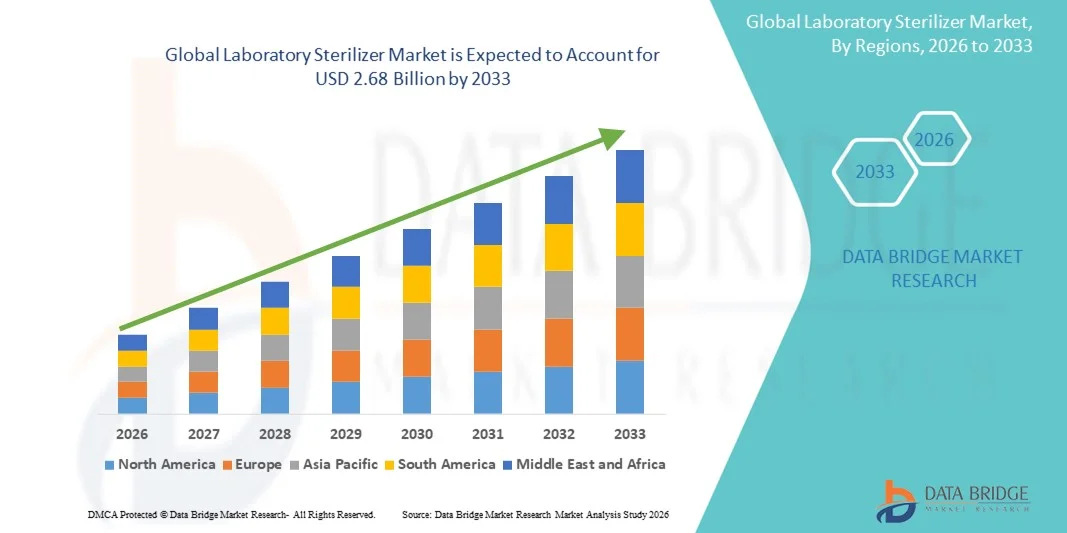
- The global laboratory sterilizer market size was valued at USD 1.40 billion in 2025 and is expected to reach USD 2.68 billion by 2033, at a CAGR of 8.38% during the forecast period
- The market growth is largely fueled by the increasing emphasis on sterilization to maintain safety and hygiene across healthcare, pharmaceutical, biotechnology, and research laboratory environments, stringent regulatory standards for contamination control, and the rising adoption of advanced sterilization technologies such as automated and IoT‑enabled sterilizers
- Furthermore, rising global demand for effective, reliable, and efficient sterilization solutions to support clinical diagnostics, research accuracy, and infection prevention is establishing laboratory sterilizers as an essential component of modern laboratory infrastructure. These converging factors are accelerating the uptake of sterilizer solutions, thereby significantly boosting the industry’s growth
Laboratory Sterilizer Market Analysis
- Laboratory sterilizers, providing automated and reliable sterilization of laboratory equipment, instruments, and consumables, are increasingly vital components of modern laboratory safety and workflow management in healthcare, pharmaceutical, biotechnology, and research environments due to their efficiency, precision, and ability to maintain stringent hygiene standards
- The escalating demand for laboratory sterilizers is primarily fueled by growing regulatory requirements for contamination control, rising adoption of advanced sterilization technologies and the increasing need for safe and reproducible laboratory operations
- North America dominated the laboratory sterilizer market with the largest revenue share of 40.7% in 2025, characterized by stringent safety regulations, high adoption of automated laboratory solutions, and a strong presence of key industry players, with the U.S. experiencing substantial growth in sterilizer installations, particularly in healthcare facilities and pharmaceutical manufacturing units, driven by innovations in high-capacity and energy-efficient sterilizers
- Asia-Pacific is expected to be the fastest growing region in the laboratory sterilizer market during the forecast period due to expanding healthcare infrastructure, increasing pharmaceutical and research investments, and rising awareness of infection prevention standards
- Steam sterilizers dominated the laboratory sterilizer market with a market share of 45.4% in 2025, driven by their reliability, broad applicability across laboratory setups, and ease of integration into existing laboratory workflows
Report Scope and Laboratory Sterilizer Market Segmentation
|
Attributes |
Laboratory Sterilizer Key Market Insights |
|
Segments Covered |
|
|
Countries Covered |
North America
Europe
Asia-Pacific
Middle East and Africa
South America
|
|
Key Market Players |
|
|
Market Opportunities |
|
|
Value Added Data Infosets |
In addition to the insights on market scenarios such as market value, growth rate, segmentation, geographical coverage, and major players, the market reports curated by the Data Bridge Market Research also include in-depth expert analysis, patient epidemiology, pipeline analysis, pricing analysis, and regulatory framework |
Laboratory Sterilizer Market Trends
Automation and Low-Temperature Technology Adoption
- A significant and accelerating trend in the global laboratory sterilizer market is the growing adoption of automated and low-temperature sterilization technologies across healthcare, pharmaceutical, and research laboratories to ensure effective sterilization of heat-sensitive instruments and materials
- For instance, several laboratory facilities are increasingly deploying hydrogen peroxide vapor and filtration-based low-temperature sterilizers to support advanced diagnostics and biologics research without compromising material integrity
- Automation in laboratory sterilizers enables features such as programmable sterilization cycles, real-time monitoring, and digital documentation, improving process consistency and compliance with stringent regulatory standards. For instance, modern steam and ultraviolet sterilizers now offer automated loading, cycle validation, and error alerts to minimize human intervention
- The integration of laboratory sterilizers with laboratory information management systems (LIMS) and digital monitoring platforms facilitates centralized oversight of sterilization processes, enhancing operational efficiency and traceability across multiple laboratory departments
- This trend toward more intelligent, efficient, and contamination-free sterilization solutions is reshaping laboratory infrastructure planning. Consequently, manufacturers are focusing on developing compact, energy-efficient, and digitally enabled sterilizers tailored for diverse laboratory environments
- The demand for advanced and automated laboratory sterilizers is growing steadily across healthcare facilities, scientific research institutions, and pharmaceutical companies, as organizations increasingly prioritize safety, compliance, and workflow optimization
- Increasing focus on energy-efficient and environmentally sustainable sterilization systems is emerging as a key trend, as laboratories aim to reduce operational costs and meet sustainability goals without compromising sterilization efficacy
- Growing demand for compact and modular laboratory sterilizers is gaining traction, particularly among space-constrained laboratories and contract research organizations seeking flexible and scalable sterilization solutions
Laboratory Sterilizer Market Dynamics
Driver
Rising Regulatory Standards and Expansion of Laboratory Infrastructure
- The increasing enforcement of strict regulatory standards for infection control, contamination prevention, and laboratory safety is a major driver fueling demand for laboratory sterilizers across healthcare, pharmaceutical, and research settings
- For instance, regulatory agencies worldwide continue to mandate validated sterilization protocols in clinical diagnostics, drug manufacturing, and research laboratories, compelling facilities to invest in reliable sterilization technologies
- As laboratory testing volumes increase and research activities expand, sterilizers play a critical role in maintaining sterile environments, protecting personnel, and ensuring the accuracy and reproducibility of experimental results
- Furthermore, the rapid expansion of pharmaceutical manufacturing, biotechnology research, and clinical laboratories is increasing the need for high-capacity and efficient sterilization solutions capable of supporting continuous operations
- The growing focus on laboratory accreditation, quality assurance, and compliance with global safety standards is further accelerating the adoption of laboratory sterilizers across both developed and emerging markets
- The rising incidence of hospital-acquired infections (HAIs) and contamination-related risks is reinforcing the importance of robust sterilization practices, thereby driving consistent demand for laboratory sterilizers
- Increasing public and private investments in healthcare modernization and life sciences research infrastructure are further supporting market growth by expanding the installed base of laboratories requiring advanced sterilization systems
Restraint/Challenge
High Capital Costs and Operational Complexity
- The high initial investment and installation costs associated with advanced laboratory sterilizers pose a significant challenge, particularly for small and mid-sized laboratories with limited capital budgets
- For instance, low-temperature and ionizing radiation sterilization systems often require specialized infrastructure, trained personnel, and regular validation, increasing total ownership costs
- Operational complexity, including maintenance requirements, calibration needs, and compliance documentation, can also hinder adoption, especially in facilities lacking skilled technical staff
- In addition, downtime during sterilizer maintenance or validation can disrupt laboratory workflows, impacting productivity in high-throughput healthcare and research environments
- Addressing these challenges through cost-effective product designs, simplified operation, comprehensive training, and service support will be essential for wider adoption and sustained growth of the laboratory sterilizer market
- Limited awareness and technical expertise regarding advanced sterilization technologies in emerging markets can slow adoption and prolong decision-making cycles for laboratory upgrades
- Variability in regulatory requirements across regions creates compliance complexity for manufacturers and end users, potentially delaying product approvals and market entry for new sterilization technologies
Laboratory Sterilizer Market Scope
The market is segmented on the basis of technology, product type, and end users.
- By Technology
On the basis of technology, the global laboratory sterilizer market is segmented into low-temperature sterilization, filtration sterilization, ionizing radiation sterilization, and heat sterilization. The heat sterilization segment dominated the market with the largest revenue share in 2025, driven by its long-standing reliability, wide applicability, and cost-effectiveness across laboratory environments. Heat sterilization is extensively used in healthcare facilities, pharmaceutical companies, and research laboratories due to its proven efficacy in eliminating a broad range of microorganisms. The widespread availability of steam-based systems and their compatibility with standardized laboratory workflows further reinforce dominance. In addition, regulatory bodies globally recognize heat sterilization as a validated and dependable method, supporting its continued adoption. The relatively lower operational complexity and maintenance requirements compared to advanced alternatives also contribute to its strong market position.
The low-temperature sterilization segment is expected to witness the fastest growth during the forecast period, fueled by increasing use of heat-sensitive instruments and advanced laboratory materials. Low-temperature technologies enable effective sterilization without compromising material integrity, making them essential for biotechnology, diagnostics, and life sciences research. Growing investments in cell and gene therapy research are accelerating demand for such sterilization solutions. Regulatory emphasis on contamination control in sensitive laboratory environments further supports adoption. Technological advancements improving cycle efficiency and safety are enhancing acceptance. As laboratories modernize, low-temperature sterilization is becoming a critical growth driver.
- By Product Type
On the basis of product type, the market is segmented into steam sterilizers, ultraviolet sterilizers, and others. The steam sterilizers segment dominated the market in 2025 with a market share of 45.4%, supported by their extensive use across healthcare, pharmaceutical, and research laboratories. Steam sterilizers are highly effective, reliable, and capable of handling large volumes of laboratory instruments and consumables. Their compatibility with heat sterilization technology and standardized protocols makes them a preferred choice globally. The availability of automated and high-capacity steam sterilizers further enhances operational efficiency. Regulatory acceptance and ease of validation also strengthen their dominance. Moreover, relatively lower costs compared to alternative technologies sustain strong demand.
The ultraviolet sterilizers segment is projected to grow at the fastest rate during the forecast period, driven by increasing demand for rapid and chemical-free sterilization solutions. Ultraviolet sterilizers are gaining traction in laboratories requiring surface and air sterilization with minimal downtime. Their ease of installation and low energy consumption make them attractive for modern laboratory settings. Growing awareness of cross-contamination risks is accelerating adoption. Technological improvements enhancing UV efficacy are expanding application scope. As laboratories prioritize efficiency and sustainability, ultraviolet sterilizers are emerging as a high-growth segment.
- By End Users
On the basis of end users, the market is segmented into healthcare facilities, scientific research, pharmaceutical companies, medical care, and others. The healthcare facilities segment accounted for the largest market share in 2025, driven by the critical need for stringent infection control and patient safety. Hospitals and diagnostic laboratories rely heavily on sterilizers to prevent contamination and comply with regulatory standards. High testing volumes and continuous laboratory operations necessitate reliable sterilization systems. Increasing healthcare infrastructure investments further support dominance. Regulatory audits and accreditation requirements reinforce sustained demand. The growing burden of hospital-acquired infections strengthens the importance of effective sterilization.
The pharmaceutical companies segment is expected to register the fastest growth over the forecast period, owing to expanding drug development and manufacturing activities. Sterilization is essential in pharmaceutical laboratories to ensure product quality and regulatory compliance. Growth in biologics, vaccines, and sterile injectables is increasing reliance on advanced sterilization technologies. Stringent global regulatory frameworks are compelling pharmaceutical firms to upgrade sterilization systems. Rising R&D investments further accelerate demand. As pharmaceutical production scales globally, this end-user segment is set to drive significant market growth.
Laboratory Sterilizer Market Regional Analysis
- North America dominated the laboratory sterilizer market with the largest revenue share of 40.7% in 2025, characterized by stringent safety regulations, high adoption of automated laboratory solutions, and a strong presence of key industry players
- Laboratories across the region place strong emphasis on compliance, operational efficiency, and contamination prevention, leading to widespread use of automated and validated sterilization systems across healthcare facilities and pharmaceutical laboratories
- This broad adoption is further supported by substantial healthcare and life sciences investments, a well-established laboratory infrastructure, and continuous innovation in sterilization technologies, positioning laboratory sterilizers as essential equipment in modern North American laboratory environments
U.S. Laboratory Sterilizer Market Insight
The U.S. laboratory sterilizer market captured the largest revenue share within North America in 2025, driven by strict regulatory requirements, high healthcare spending, and the strong presence of pharmaceutical, biotechnology, and research laboratories. Laboratories increasingly prioritize validated sterilization systems to ensure compliance, safety, and contamination control. The growing volume of clinical testing, drug development, and life sciences research continues to fuel demand for advanced sterilizers. Moreover, the adoption of automated and energy-efficient sterilization technologies is significantly contributing to market expansion across healthcare and pharmaceutical settings.
Europe Laboratory Sterilizer Market Insight
The Europe laboratory sterilizer market is projected to expand at a substantial CAGR throughout the forecast period, primarily driven by stringent regulatory frameworks, high standards for infection prevention, and increasing investments in healthcare and research infrastructure. Rising laboratory testing volumes and expanding pharmaceutical manufacturing are fostering steady adoption of sterilization systems. European laboratories emphasize efficiency, sustainability, and regulatory compliance, supporting demand for advanced sterilization technologies. Growth is evident across healthcare facilities, scientific research institutions, and pharmaceutical laboratories, supported by both new installations and equipment upgrades.
U.K. Laboratory Sterilizer Market Insight
The U.K. laboratory sterilizer market is anticipated to grow at a noteworthy CAGR during the forecast period, driven by increasing healthcare modernization, expanding research activities, and a strong focus on infection control. Concerns regarding laboratory-acquired infections and regulatory compliance are encouraging healthcare and research facilities to invest in reliable sterilization solutions. The country’s well-established pharmaceutical and biotechnology sectors further support market growth. In addition, rising investments in diagnostic laboratories and clinical research are expected to sustain demand.
Germany Laboratory Sterilizer Market Insight
The Germany laboratory sterilizer market is expected to expand at a considerable CAGR during the forecast period, fueled by strong industrial research capabilities, advanced healthcare infrastructure, and strict quality and safety standards. Germany’s emphasis on precision, efficiency, and sustainability supports the adoption of technologically advanced sterilization systems. Pharmaceutical manufacturing and scientific research laboratories are key contributors to demand. The integration of automated and energy-efficient sterilizers aligns well with the country’s focus on innovation and environmental responsibility.
Asia-Pacific Laboratory Sterilizer Market Insight
The Asia-Pacific laboratory sterilizer market is poised to grow at the fastest CAGR during the forecast period, driven by rapid expansion of healthcare infrastructure, increasing pharmaceutical production, and rising investments in scientific research across countries such as China, Japan, and India. Growing awareness of infection control and regulatory compliance is accelerating adoption. The region’s expanding diagnostics and life sciences sectors are creating strong demand for reliable sterilization solutions. In addition, the increasing presence of local manufacturers is improving affordability and accessibility across emerging markets.
Japan Laboratory Sterilizer Market Insight
The Japan laboratory sterilizer market is gaining momentum due to the country’s advanced healthcare system, strong research ecosystem, and emphasis on precision and safety. Demand is driven by growing laboratory testing volumes and increased investments in pharmaceutical and biotechnology research. Japanese laboratories prioritize high-quality, reliable sterilization systems to maintain strict hygiene standards. Furthermore, technological advancements and automation in laboratory equipment are supporting steady market growth across healthcare and research settings.
India Laboratory Sterilizer Market Insight
The India laboratory sterilizer market accounted for a significant revenue share in Asia Pacific in 2025, supported by rapid expansion of healthcare facilities, growing pharmaceutical manufacturing, and increasing diagnostic testing volumes. Rising awareness of infection prevention and regulatory compliance is driving adoption across laboratories. India’s growing biotechnology and research sectors further strengthen demand. Government initiatives to improve healthcare infrastructure, along with the availability of cost-effective sterilization solutions from domestic manufacturers, are key factors propelling market growth.
Laboratory Sterilizer Market Share
The Laboratory Sterilizer industry is primarily led by well-established companies, including:
- STERIS plc (U.S.)
- Getinge AB (Sweden)
- Belimed AG (Switzerland)
- Tuttnauer (U.S.)
- MMM Group GmbH (Germany)
- Astell Scientific Ltd (U.K.)
- Priorclave Ltd (U.K.)
- PHC Holdings Corporation (Japan)
- Yamato Scientific Co., Ltd. (Japan)
- ZIRBUS technology GmbH (Germany)
- BMM Weston Ltd. (U.K.)
- Adolf Wolf SANOclav (Germany)
- IBK Industriebedarf GmbH (Germany)
- HP Labortechnik GmbH (Germany)
- UniEquip Laborgerätebau & Vertriebs GmbH (Germany)
- SciCan GmbH (Germany)
- Fedegari Group S.p.A. (Italy)
- Sakura Seiki Co., Ltd. (Japan)
- Shinva Medical Instrument Co., Ltd. (China)
- Stericox India Private Limited (India)
What are the Recent Developments in Global Laboratory Sterilizer Market?
- In November 2025, Getinge introduced an updated version of its Solsus 66 steam sterilizer designed for Central Sterile Supply Departments (CSSDs), featuring enhanced usability, flexible steam generation options, an intuitive control system, and reduced environmental impact, supporting modern hospital and laboratory sterilization workflows
- In November 2025, Getinge announced integration of a modern open visualization system (SIMATIC WinCC Unified) in its new generation of washers and sterilizers for cleanrooms, which enhances digital monitoring, simplifies controls, and improves operational efficiency in lab and pharmaceutical environments
- In October 2025, healthcare facilities worldwide increased adoption of advanced steam sterilization systems such as high-capacity pulsed steam sterilizers and vertical autoclaves to meet rising hygiene standards and infection control requirements, enhancing efficiency and safety in both hospitals and laboratories
- In June 2024, Getinge launched the Poladus 150, a low-temperature vaporized hydrogen peroxide sterilizer for heat-sensitive instruments, offering advanced contamination control and connectivity with lifecycle management tools, marking a step forward in flexible sterilization technologies for sensitive lab and clinical tools
- In January 2024, UltraViolet Devices Inc. (UVDI) debuted an expanded UV-C surface disinfection portfolio including the UVDI-360 room sanitizer and UVDI-GO™ LED surface sanitizer with cloud-connected reporting and rapid pathogen inactivation capabilities, advancing UV-based sterilization technology in healthcare and laboratory settings

- Interactive Data Analysis Dashboard
- Company Analysis Dashboard for high growth potential opportunities
- Research Analyst Access for customization & queries
- Competitor Analysis with Interactive dashboard
- Latest News, Updates & Trend analysis
- Harness the Power of Benchmark Analysis for Comprehensive Competitor Tracking
Data collection and base year analysis are done using data collection modules with large sample sizes. The stage includes obtaining market information or related data through various sources and strategies. It includes examining and planning all the data acquired from the past in advance. It likewise envelops the examination of information inconsistencies seen across different information sources. The market data is analysed and estimated using market statistical and coherent models. Also, market share analysis and key trend analysis are the major success factors in the market report. To know more, please request an analyst call or drop down your inquiry.
The key research methodology used by DBMR research team is data triangulation which involves data mining, analysis of the impact of data variables on the market and primary (industry expert) validation. Data models include Vendor Positioning Grid, Market Time Line Analysis, Market Overview and Guide, Company Positioning Grid, Patent Analysis, Pricing Analysis, Company Market Share Analysis, Standards of Measurement, Global versus Regional and Vendor Share Analysis. To know more about the research methodology, drop in an inquiry to speak to our industry experts.
Data Bridge Market Research is a leader in advanced formative research. We take pride in servicing our existing and new customers with data and analysis that match and suits their goal. The report can be customized to include price trend analysis of target brands understanding the market for additional countries (ask for the list of countries), clinical trial results data, literature review, refurbished market and product base analysis. Market analysis of target competitors can be analyzed from technology-based analysis to market portfolio strategies. We can add as many competitors that you require data about in the format and data style you are looking for. Our team of analysts can also provide you data in crude raw excel files pivot tables (Fact book) or can assist you in creating presentations from the data sets available in the report.













