


What is the Lactate Market Size and Growth Rate?
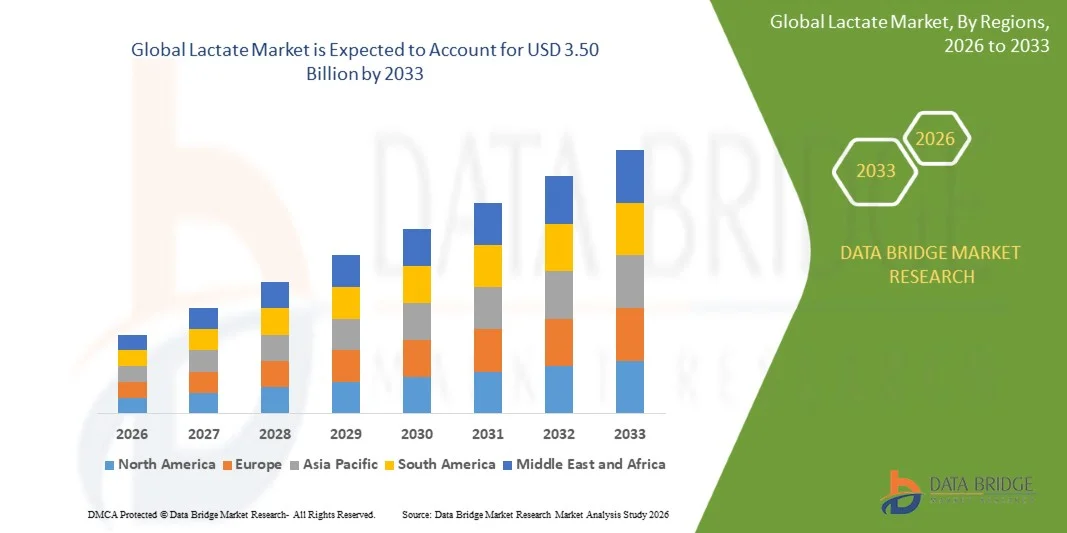
- As per Data Bridge Market Research analysis, the lactate market was valued at USD 1.71 billion in 2025 and is projected to reach USD 3.50 billion by 2033, growing at a CAGR of 9.40% from 2026 to 2033.
- The market is experiencing consistent growth driven by rising demand for lactate-based ingredients across food and beverages, pharmaceuticals, personal care, and industrial applications, along with increasing adoption of lactate salts and lactate esters in diverse end-use industries.
- The growing demand for clean-label and functional food ingredients, expanding pharmaceutical and personal care industries, and increasing use of lactate esters as environmentally preferable solvents are supporting market expansion. Rising consumption of processed foods, increasing applications of calcium and sodium lactate, and growing demand for bio-based and sustainable chemical alternatives are further strengthening market growth.
Market Size & Forecast
- Global Market Value (2025): USD 1.71 Billion
- Expected Market Value (2033): USD 3.50 Billion
- Forecast CAGR (2026–2033): 9.40%
- Leading Region in 2025: North America
- Fastest Growing Region: Asia Pacific
What are the Major Takeaways of the Lactate Market?
- North America dominated the lactate market with the largest revenue share of 36.0% in 2025, supported by strong industrial demand, environmental regulations, and increasing adoption of lower-toxicity and biodegradable solvents.
- Asia-Pacific is expected to be the fastest-growing region at a CAGR of 6.5% from 2026 to 2033, fueled by expanding food and beverage, pharmaceutical, personal care, and industrial applications of lactates.
- The lactic acid segment led the market with a 58.4% share in 2025, driven by its extensive use across food and beverages, pharmaceuticals, personal care, and biodegradable polymer production.
- Lactate esters are the fastest-growing product type, projected to register a CAGR of 4.0%, reflecting the surge in demand for environmentally preferable solvents.
- The natural segment dominated the source type category with a 72.1% revenue share in 2025, led by widespread production of lactates through fermentation using renewable carbohydrate feedstocks
- Liquid accounted for 65.1% of the market share in 2025, preferred by its extensive use across food processing, pharmaceuticals, personal care, and industrial formulations
- The functional & nutritional foods segment is the fastest-growing application category, with a CAGR of 8.5%, driven by increasing consumer demand for fortified, health-oriented, and nutritionally enhanced foods.
Report Scope and Lactate Market Segmentation
|
Attributes |
Lactate Key Market Insights |
|
Segments Covered |
|
|
Countries Covered |
North America
Europe
Asia-Pacific
Middle East and Africa
South America
|
|
Key Market Players |
|
|
Market Opportunities |
|
|
Value Added Data Infosets |
In addition to the insights on market scenarios such as market value, growth rate, segmentation, geographical coverage, and major players, the market reports curated by the Data Bridge Market Research also include in-depth expert analysis, pricing analysis, brand share analysis, consumer survey, demography analysis, supply chain analysis, value chain analysis, raw material/consumables overview, vendor selection criteria, PESTLE Analysis, Porter Analysis, and regulatory framework |
What is the Key Trend in the Lactate Market?
- The growing shift toward bio-based and environmentally preferable lactates is becoming a key market trend, as manufacturers increasingly seek biodegradable alternatives to conventional petrochemical-derived chemicals across solvents, food ingredients, pharmaceuticals, and personal care applications.
- For instance, in December 2023, Corbion announced the mechanical completion of its new circular lactic acid plant in Rayong, Thailand. The facility uses a proprietary circular process that recycles processing chemicals, eliminates lime use, and reduces the formation of gypsum by-product, supporting the shift toward more sustainable lactate production.
- Lactate esters, particularly ethyl lactate, are gaining traction as green solvents because of their biodegradability, relatively low toxicity, and suitability for paints, coatings, electronics, pharmaceuticals, cosmetics, and industrial cleaning applications.
- Demand for circular and renewable lactate production is also increasing as manufacturers explore alternative feedstocks and production processes that reduce waste, resource consumption, and dependence on conventional fossil-based inputs.
- Food manufacturers are increasingly using sodium, potassium, and calcium lactates as multifunctional ingredients because they provide antimicrobial, pH-control, flavor-enhancing, firming, and stabilizing functions in processed foods and beverages.
- For instance, in August 2024, Praj Industries announced the production of its first batch of 90% lactic acid at its newly established demonstration plant in Jejuri, India. The facility has a capacity of 100 tonnes per annum of lactic acid and is designed to advance integrated lactic acid and polylactic acid (PLA) technologies, supporting the shift toward bio-based and sustainable lactate production.
- Polylactic acid (PLA) applications are creating additional demand for high-purity lactic acid, particularly as brands and manufacturers seek bio-based and biodegradable alternatives to conventional plastics and expand sustainable packaging applications.
What are the Key Drivers of the Lactate Market?
- The expanding use of lactates as functional food ingredients is driving market growth, as sodium, potassium, and calcium lactates provide antimicrobial, pH-control, flavor-enhancing, humectant, firming, and stabilizing properties across processed food applications.
- For instance, in March 2021, Corbion announced multiple capacity-expansion projects across its production facilities in the Netherlands, Thailand, Brazil, and Spain, together expected to add output roughly equivalent to a new production site, in response to increasing customer demand for lactic acid and lactic-acid derivatives.
- Rising demand for sustainable and biodegradable solvents is accelerating adoption of ethyl lactate across paints, coatings, pharmaceuticals, electronics, cosmetics, and industrial cleaning, supported by its renewable feedstock potential and environmental advantages.
- The expanding pharmaceutical and personal care industries are increasing consumption of lactate-based ingredients and solvents because manufacturers require versatile, lower-toxicity materials for formulations, processing, extraction, and specialty chemical applications.
- Growing adoption of bio-based polymers and sustainable packaging is strengthening demand for high-purity lactic acid, which serves as the principal monomer for PLA and other biodegradable polymer applications.
- For instance, in January 2021, Corbion announced a roughly 40% expansion of its North American lactic acid production capacity to meet growing demand for natural ingredients across multiple industries. The investment was specifically intended to address increasing customer requirements for lactic acid and its derivatives, providing direct evidence of demand-driven market expansion.
- Increasing investment in circular production technologies and alternative feedstocks is improving the sustainability profile of lactate manufacturing while creating opportunities to reduce waste and strengthen raw-material security.
Which Factors are Challenging the Growth of the Lactate Market?
- High production and downstream purification costs remain a major challenge for lactate manufacturers, particularly where high-purity lactic acid is required for pharmaceutical, medical, and polymer-grade applications.
- For instance, in July 2025, a study published in Bioresources and Bioprocessing identified high raw-material costs, substrate variability, contamination risk, and expensive pretreatment as persistent barriers to economically producing lactic acid from agricultural waste at scale. The study also highlighted that inconsistent feedstock composition can affect fermentation performance, making large-scale production more difficult.
- Conventional fermentation can require expensive sugar-based feedstocks, nutrients, pH-control chemicals, and energy-intensive recovery processes, increasing overall production costs and limiting competitiveness against conventional chemical alternatives.
- The use of food-based feedstocks creates concerns around competition with food and feed resources, while agricultural and food-waste feedstocks can introduce variability in composition, pretreatment requirements, and fermentation performance.
- For instance, in October 2024, a study published in Separation & Purification Reviews highlighted downstream purification as a major economic challenge for large-scale lactic acid production, noting that recovery and purification require technologies such as precipitation, adsorption, extraction, esterification, and membrane separation to obtain high-quality lactic acid.
- Separation and purification remain significant technical bottlenecks, with conventional precipitation processes involving multiple processing stages, chemical consumption, and solid-waste generation, particularly when high optical purity is required for advanced applications.
How is the Lactate Market Segmented?
The lactate market is segmented on the basis of product type, source, form, and application.
- By Product Type
On the basis of product type, the lactate market is segmented into lactic acid, lactate salts, and lactate esters. The lactic acid segment dominated the market with a 58.4% share in 2025, supported by its extensive use across food and beverages, pharmaceuticals, personal care, and biodegradable polymer production. Lactic acid is widely used as an acidulant, preservative, pH regulator, and formulation ingredient in processed foods. It is also the primary feedstock for polylactic acid (PLA), creating significant demand from sustainable packaging and bioplastics. Growing applications in pharmaceutical formulations and cosmetics are further supporting consumption. Its broad end-use base and established production infrastructure continue to make lactic acid the leading product category globally.
The lactate esters segment is projected to register the fastest growth at a CAGR of 4.0% from 2026 to 2033, driven by increasing demand for environmentally preferable solvents. Ethyl lactate is particularly attractive because of its biodegradability, relatively low toxicity, and effective solvency characteristics. It is increasingly used in paints and coatings, electronics, pharmaceuticals, cosmetics, adhesives, and industrial cleaning. Its solvent properties allow manufacturers to replace selected conventional solvent systems with more environmentally preferable alternatives. Increasing regulatory pressure on volatile organic compounds is further supporting substitution. Growing adoption of bio-based solvents across industrial applications is also strengthening demand. These factors are expected to accelerate growth of the lactate esters segment.
- By Source
On the basis of source, the lactate market is segmented into natural and synthetic. The natural segment dominated the market with a 72.1% share in 2025, supported by widespread production of lactates through fermentation using renewable carbohydrate feedstocks. Natural-source lactates are extensively used in food and beverage, pharmaceutical, nutritional, and personal care applications. Increasing consumer preference for naturally derived and clean-label ingredients is encouraging manufacturers to adopt fermentation-derived ingredients. Natural lactic acid is also an important feedstock for PLA and other bio-based polymers. Increasing sustainability commitments among food, chemical, and packaging companies are further supporting renewable-source production. These factors collectively strengthen the natural segment's position in the global lactate market.
The synthetic segment is expected to register the fastest growth at a CAGR of 8.0% during the forecast period, supported by demand for consistent and specification-controlled lactate products in specialized applications. Synthetic production can provide greater control over product characteristics and purity. This is particularly relevant for selected pharmaceutical, industrial, and specialty chemical applications. Manufacturers can tailor synthetic processes to meet specific formulation requirements. Increasing demand for specialty lactate derivatives is creating additional opportunities for synthetic production. Industrial applications requiring standardized chemical performance are supporting the segment. However, natural fermentation remains strongly preferred in food and clean-label applications.
- By Form
On the basis of form, the lactate market is segmented into liquid, powder, and others. The liquid segment dominated the market with a 65.0% share in 2025, owing to its extensive use across food processing, pharmaceuticals, personal care, and industrial formulations. Liquid lactates provide convenient dosing, rapid incorporation, and high solubility in aqueous formulations. Liquid sodium lactate is widely used for food preservation, pH regulation, moisture retention, and antimicrobial functionality. Its compatibility with continuous manufacturing processes further supports widespread industrial adoption. The format is particularly suitable for applications requiring uniform distribution within formulations. The combination of functionality and ease of handling continues to make liquid the leading form.
The powder segment is projected to register the fastest growth at a CAGR of 7.2% during the forecast period, supported by increasing demand for stable and convenient ingredients in dry formulations. Powdered lactates are suitable for dry food mixes, functional foods, nutritional supplements, pharmaceutical products, and specialty formulations. Their lower moisture content can improve storage stability and transportation efficiency. Growing demand for functional and nutritional foods is creating opportunities for powdered calcium and other lactate salts. Powder formats are also convenient for controlled dosing and dry blending in pharmaceutical and food manufacturing. Advances in drying and formulation technologies are improving powder stability and handling properties. These advantages are expected to support faster adoption of powdered lactates.
- By Application
On the basis of application, the lactate market is segmented into bakery products, beverages, functional & nutritional foods, confectionery products, dairy products, and others. The bakery products segment dominated the market with a 31.6% share in 2025, supported by widespread use of lactates as preservatives, acidity regulators, moisture-retention agents, and formulation stabilizers. Lactates help control microbial growth and can extend the shelf life of selected bakery products. Rising consumption of packaged bread, cakes, pastries, and other processed bakery products is sustaining demand for functional ingredients. Commercial bakeries increasingly require ingredients that provide consistent performance during high-volume production. Lactates can also support product quality and formulation stability in various bakery applications. Expansion of industrial bakery production is therefore expected to maintain the segment's leading position.
The functional & nutritional foods segment is projected to register the fastest growth at a CAGR of 8.5% during the forecast period, driven by increasing consumer demand for fortified, health-oriented, and nutritionally enhanced foods. Lactate salts such as calcium lactate and potassium lactate can provide mineral supplementation while also contributing functional properties to food formulations. Growing consumption of sports nutrition, dietary supplements, functional beverages, and fortified foods is creating additional demand. Rising health awareness is encouraging manufacturers to incorporate functional minerals into convenient food products. Product innovation is expanding the use of lactates beyond traditional preservation applications. Increasing demand for nutrient-enriched foods across emerging economies is also supporting market expansion. Consequently, functional and nutritional foods are expected to remain one of the fastest-growing application categories.
Which Region Holds the Largest Share of the Lactate Market?
- North America dominated the Lactate market with the largest revenue share of 36.0% in 2025, supported by strong industrial demand, environmental regulations, and increasing adoption of lower-toxicity and biodegradable solvents.
- The region also benefits from established food-processing and pharmaceutical industries, advanced fermentation technologies, strong demand for clean-label ingredients, and growing investment in bio-based polymers. The presence of major lactate and lactic acid manufacturers, combined with increasing adoption of sustainable ingredients and expanding applications across food, healthcare, and industrial sectors, continues to strengthen North America's leadership position in the global market.
U.S. Lactate Market Insight
The U.S. lactate market is witnessing strong growth due to rising demand for lactate-based ingredients across food and beverages, pharmaceuticals, personal care, and industrial applications. The country’s mature food-processing and pharmaceutical ecosystem, along with increasing adoption of naturally derived and clean-label ingredients, is driving demand across multiple end-use industries. In addition, growing investments in bio-based chemicals and sustainable packaging materials are accelerating the use of lactic acid and lactate derivatives. Increasing demand for functional foods, nutritional products, and environmentally preferable ingredients is further supporting market expansion.
Asia-Pacific Lactate Market Insight
The Asia-Pacific lactate market is expected to witness rapid growth, driven by expanding food-processing industries, increasing pharmaceutical manufacturing, and rising production of bio-based chemicals across countries such as China, India, and Japan. Growing availability of renewable feedstocks, increasing investments in fermentation technologies, and rising demand for sustainable ingredients are supporting regional market expansion. In addition, expanding applications of lactic acid in food preservation, pharmaceuticals, personal care, and polylactic acid production are accelerating lactate consumption across the region.
Japan Lactate Market Insight
The Japan lactate market is witnessing consistent growth due to rising demand for functional food ingredients, pharmaceutical formulations, and sustainable chemical products. Food manufacturers, pharmaceutical companies, and chemical producers are increasingly utilizing lactates for preservation, acidity regulation, mineral supplementation, and specialty applications. Moreover, increasing consumer preference for clean-label and naturally derived ingredients and the country's focus on sustainable manufacturing are further contributing to market growth.
China Lactate Market Insight
The China lactate market is growing rapidly, driven by expanding food and beverage production, increasing pharmaceutical manufacturing, and rising demand for bio-based materials. Growing adoption of fermentation-derived lactic acid and lactate products across food processing, personal care, and industrial applications is significantly boosting market demand. In addition, rising investments in polylactic acid production, increasing availability of agricultural feedstocks, and rapid development of sustainable chemical manufacturing are positioning China as one of the fastest-growing markets for lactates globally.
U.K. Lactate Market Insight
The U.K. lactate market is experiencing steady growth, supported by rising adoption of lactate-based ingredients in food processing, pharmaceuticals, personal care, and specialty chemicals. Increasing demand for clean-label and naturally derived ingredients and growing investments in sustainable chemical technologies are contributing to market growth. Furthermore, the expanding use of bio-based solvents, functional food ingredients, and environmentally preferable materials is supporting lactate consumption and strengthening the U.K.'s position in the European lactate industry.
Germany Lactate Market Insight
The Germany lactate market is expanding steadily due to the country's strong food-processing industry, advanced chemical manufacturing capabilities, and increasing adoption of sustainable ingredients. Food manufacturers, pharmaceutical companies, and chemical producers are increasingly utilizing lactates for preservation, formulation, specialty chemicals, and bio-based material applications. Continuous development of sustainable production technologies, growing demand for environmentally preferable chemicals, and Germany's strong focus on resource efficiency are further driving market growth.
Which are the Top Companies in Lactate Market?
The lactate industry is primarily led by well-established companies, including:
- Corbion N.V. (Netherlands)
- Jungbunzlauer Suisse AG (Switzerland)
- GALACTIC S.A. (Belgium)
- BASF SE (Germany)
- Cargill, Incorporated (U.S.)
- NatureWorks LLC (U.S.)
- Futerro S.A. (Belgium)
- Musashino Chemical Laboratory, Ltd. (Japan)
- Henan Jindan Lactic Acid Technology Co., Ltd. (China)
- Anhui BBCA Biochemical Co., Ltd. (China)
- Henan Xinghan Biotechnology Co., Ltd. (China)
- Shandong Baisheng Biotechnology Co., Ltd. (China)
- Qingdao Abel Technology Co., Ltd. (China)
- Foodchem International Corporation (China)
- GODAVARI BIOREFINERIES LTD (India)
- Kemin Industries, Inc. (U.S.)
- ADM (U.S.)
- LG Chem Ltd. (South Korea)
- TotalEnergies Corbion (Netherlands)
What are Latest Developments in Lactate Market?
- In April 2025, Corbion launched Verdad Essence WH100, a cultured wheat-based natural mold inhibitor designed for bakery applications. The product uses fermentation technology to provide mold inhibition while supporting clean-label formulations and extended freshness in breads, buns, tortillas, and flatbreads. The launch strengthens Corbion’s portfolio of fermentation-derived solutions and demonstrates continued innovation in lactate-related food preservation technologies.
- In August 2022, LG Chem and ADM launched two joint ventures to develop U.S. production of lactic acid and polylactic acid, targeting growing demand for plant-based materials and bioplastics. The first venture, GreenWise Lactic, was planned to produce up to 150,000 tons of high-purity corn-based lactic acid annually, while the second would use the lactic acid to produce PLA. The initiative represented a major planned expansion of North American lactic-acid production capacity.
- In June 2021, IFF launched YO-MIX ViV in Asia-Pacific, a new lactic-acid-bacteria culture developed for ambient yogurt and other fermented beverages. The culture was designed to enable manufacturers to maintain highly stable live cultures throughout product shelf life, particularly targeting the Chinese market. The launch demonstrated continued development of fermentation-based ingredients for functional dairy and fermented beverage applications.
- In April 2021, Maire Tecnimont announced a contract from Total Corbion PLA to design a new biopolymer plant in France, supporting the development of a European production facility for PLA made from lactic acid. The plant was planned as the first of its kind in Europe and was intended to strengthen Total Corbion PLA’s ability to supply growing demand for biodegradable PLA resins. The development highlighted continued investment in the lactic-acid-to-PLA value chain.
- In March 2021, Galderma announced the European relaunch of Sculptra, an injectable poly-L-lactic acid collagen stimulator, with an updated administration protocol. The revised product could be prepared for use after a two-minute reconstitution period, with optional lidocaine addition to improve patient comfort. The relaunch expanded the commercial application of poly-L-lactic acid in aesthetic medicine.

- Interactive Data Analysis Dashboard
- Company Analysis Dashboard for high growth potential opportunities
- Research Analyst Access for customization & queries
- Competitor Analysis with Interactive dashboard
- Latest News, Updates & Trend analysis
- Harness the Power of Benchmark Analysis for Comprehensive Competitor Tracking
Global Lactate Market, Supply Chain Analysis and Ecosystem Framework
To support market growth and help clients navigate the impact of geopolitical shifts, DBMR has integrated in-depth supply chain analysis into its Global Lactate Market research reports. This addition empowers clients to respond effectively to global changes affecting their industries. The supply chain analysis section includes detailed insights such as Global Lactate Market consumption and production by country, price trend analysis, the impact of tariffs and geopolitical developments, and import and export trends by country and HSN code. It also highlights major suppliers with data on production capacity and company profiles, as well as key importers and exporters. In addition to research, DBMR offers specialized supply chain consulting services backed by over a decade of experience, providing solutions like supplier discovery, supplier risk assessment, price trend analysis, impact evaluation of inflation and trade route changes, and comprehensive market trend analysis.
Data collection and base year analysis are done using data collection modules with large sample sizes. The stage includes obtaining market information or related data through various sources and strategies. It includes examining and planning all the data acquired from the past in advance. It likewise envelops the examination of information inconsistencies seen across different information sources. The market data is analysed and estimated using market statistical and coherent models. Also, market share analysis and key trend analysis are the major success factors in the market report. To know more, please request an analyst call or drop down your inquiry.
The key research methodology used by DBMR research team is data triangulation which involves data mining, analysis of the impact of data variables on the market and primary (industry expert) validation. Data models include Vendor Positioning Grid, Market Time Line Analysis, Market Overview and Guide, Company Positioning Grid, Patent Analysis, Pricing Analysis, Company Market Share Analysis, Standards of Measurement, Global versus Regional and Vendor Share Analysis. To know more about the research methodology, drop in an inquiry to speak to our industry experts.
Data Bridge Market Research is a leader in advanced formative research. We take pride in servicing our existing and new customers with data and analysis that match and suits their goal. The report can be customized to include price trend analysis of target brands understanding the market for additional countries (ask for the list of countries), clinical trial results data, literature review, refurbished market and product base analysis. Market analysis of target competitors can be analyzed from technology-based analysis to market portfolio strategies. We can add as many competitors that you require data about in the format and data style you are looking for. Our team of analysts can also provide you data in crude raw excel files pivot tables (Fact book) or can assist you in creating presentations from the data sets available in the report.













