


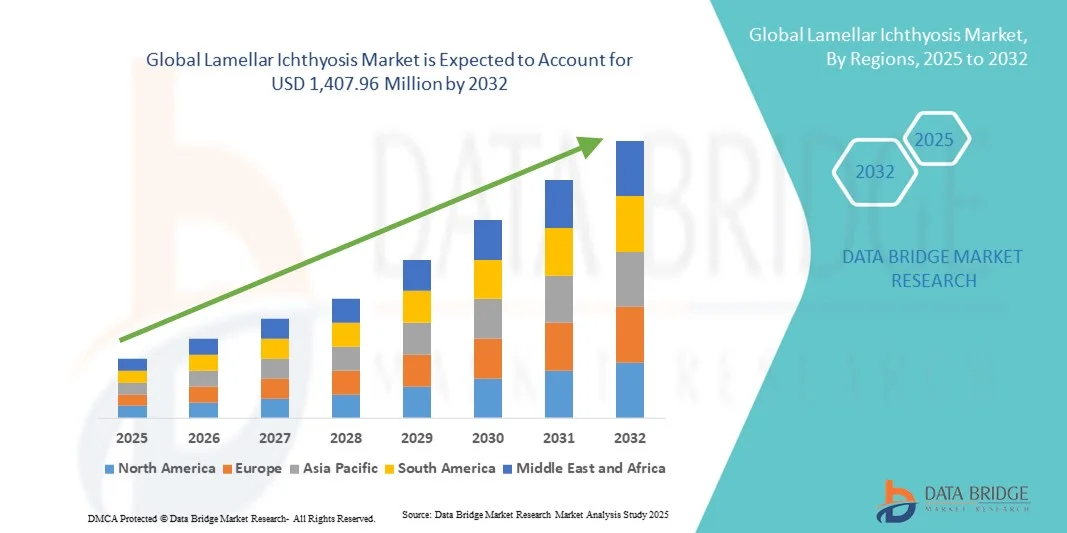
Lamellar Ichthyosis Market Size
- The global lamellar ichthyosis market size was valued at USD 910.50 million in 2024 and is expected to reach USD 1,407.96 million by 2032, at a CAGR of 5.60% during the forecast period
- The market growth is largely fueled by the increasing prevalence of rare genetic skin disorders, continuous advancements in dermatological research, and improved diagnostic accuracy enabling earlier and more effective treatment interventions
- Furthermore, rising investments in R&D for novel topical formulations, gene-based therapies, and retinoid derivatives are expanding treatment options, while growing patient awareness and improved healthcare accessibility are accelerating the adoption of lamellar ichthyosis therapies globally
Lamellar Ichthyosis Market Analysis
- Lamellar ichthyosis, a rare autosomal recessive skin disorder marked by persistent scaling and hyperkeratosis, has become a growing focus within the dermatology and rare disease therapeutics market, as healthcare systems worldwide emphasize early diagnosis, genetic counseling, and advanced treatment options to improve patient outcomes
- The increasing prevalence of congenital ichthyosis, advancements in prenatal and molecular diagnostic techniques, and rising patient awareness regarding specialized dermatological care are the primary drivers fueling market growth globally
- North America dominated the lamellar ichthyosis market with the largest revenue share of 38.6% in 2024, driven by robust healthcare infrastructure, high diagnostic accuracy, and strong R&D initiatives from pharmaceutical firms developing retinoid-based and moisturizing therapies
- Asia-Pacific is expected to be the fastest-growing region in the lamellar ichthyosis market during the forecast period, owing to expanding healthcare access, growing dermatology awareness programs, and increasing availability of treatment options through online and hospital pharmacies
- The topical route of administration segment dominated the lamellar ichthyosis market with a market share of 44.7% in 2024, attributed to the extensive use of petrolatum-based creams and ointments for skin hydration and barrier restoration, coupled with their ease of application and immediate symptomatic relief
Report Scope and Lamellar Ichthyosis Market Segmentation
|
Attributes |
Lamellar Ichthyosis Key Market Insights |
|
Segments Covered |
|
|
Countries Covered |
North America
Europe
Asia-Pacific
Middle East and Africa
South America
|
|
Key Market Players |
|
|
Market Opportunities |
|
|
Value Added Data Infosets |
In addition to the insights on market scenarios such as market value, growth rate, segmentation, geographical coverage, and major players, the market reports curated by the Data Bridge Market Research also include in-depth expert analysis, patient epidemiology, pipeline analysis, pricing analysis, and regulatory framework |
Lamellar Ichthyosis Market Trends
Advancements in Genetic Therapies and Personalized Dermatological Treatments
- A significant and accelerating trend in the global lamellar ichthyosis market is the growing focus on genetic and molecular-level treatments aimed at addressing the root cause of the disease rather than merely managing symptoms. This shift is transforming therapeutic strategies in rare dermatological disorders
- For instance, several biotechnology firms are exploring CRISPR-based gene editing and lipid-replacement therapies to correct transglutaminase 1 (TGM1) gene mutations responsible for lamellar ichthyosis. Early research in this area shows encouraging progress toward long-term therapeutic solutions
- Advances in personalized dermatology, including targeted retinoid formulations and biomarker-based treatment approaches, are improving patient outcomes and reducing adverse effects. For instance, topical retinoid therapies customized to individual genetic profiles have demonstrated better efficacy and skin tolerance in clinical studies
- The integration of teledermatology platforms and digital monitoring tools allows continuous tracking of disease progression and treatment response, enhancing care accessibility, particularly in underserved regions
- This trend toward precision and technology-driven care is reshaping patient management standards in rare skin diseases. Consequently, companies are investing heavily in gene therapy pipelines and AI-powered diagnostic support tools for early disease identification and monitoring
- The demand for targeted, safe, and patient-centered therapies is growing rapidly across both developed and emerging markets, as healthcare systems increasingly prioritize innovation and accessibility in rare disease management
Lamellar Ichthyosis Market Dynamics
Driver
Rising Awareness, Early Diagnosis, and Advanced Treatment Accessibility
- The increasing awareness of rare dermatological disorders, along with improved access to specialized healthcare services and diagnostic tools, is a major driver behind the growing demand for lamellar ichthyosis treatments
- For instance, advancements in genetic testing and prenatal diagnostic techniques have enhanced early detection rates, allowing timely initiation of treatment and better management of disease progression
- As patient advocacy groups and healthcare organizations expand educational initiatives, awareness about available treatments and genetic counseling continues to rise globally, improving diagnosis rates and patient outcomes
- Furthermore, the expansion of dermatology research centers and collaboration between biotech firms and hospitals are fueling innovation in novel topical and retinoid therapies for lamellar ichthyosis
- The growing number of clinical trials for next-generation treatments such as enzyme replacement and lipid barrier repair formulations is also driving market expansion and increasing investor interest in this niche segment
- Overall, advancements in healthcare infrastructure, early intervention strategies, and rising patient engagement are key factors propelling the global lamellar ichthyosis market forward
Restraint/Challenge
High Treatment Costs and Limited Availability of Specialized Therapies
- The high cost of advanced treatment formulations, including retinoids and emerging gene therapies, poses a significant restraint on the widespread adoption of lamellar ichthyosis treatments globally
- For instance, limited reimbursement coverage for rare disease therapies in certain countries discourages patients from pursuing long-term treatment, particularly in low- and middle-income regions
- The scarcity of experienced dermatologists specializing in congenital ichthyosis further restricts access to timely and effective care, leading to inconsistent treatment outcomes
- Furthermore, regulatory hurdles related to the approval of novel therapies for ultra-rare diseases delay product commercialization and restrict market expansion in multiple regions
- The dependence on imported pharmaceutical ingredients and variability in quality standards across regions also create supply chain challenges for manufacturers of dermatological formulations
- Overcoming these barriers through supportive government policies, expansion of patient assistance programs, and the development of cost-effective treatment alternatives will be vital for sustainable market growth
Lamellar Ichthyosis Market Scope
The market is segmented on the basis of diagnosis, treatment, route of administration, end-users, and distribution channel.
- By Diagnosis
On the basis of diagnosis, the lamellar ichthyosis market is segmented into prenatal diagnosis, immunohistochemistry, skin biopsy, and others. The skin biopsy segment dominated the market with the largest revenue share in 2024, as it remains the gold standard for confirming lamellar ichthyosis. Skin biopsies allow dermatologists to examine epidermal structural changes and determine the severity of scaling and hyperkeratosis. Their dominance is due to widespread availability in hospitals and specialized dermatology clinics. Biopsy results also guide treatment selection and help monitor disease progression over time. The reliability, established protocols, and cost-effectiveness further strengthen its market position. In addition, skin biopsy outcomes are critical for clinical research and formulation development in rare dermatological disorders.
The prenatal diagnosis segment is expected to witness the fastest growth during the forecast period, driven by advances in genetic testing and increasing awareness among prospective parents. Prenatal testing allows early detection of TGM1 gene mutations, enabling genetic counseling and preparation for postnatal care. Non-invasive prenatal testing (NIPT) and amniocentesis adoption are rising, particularly in developed countries with robust healthcare infrastructure. Early diagnosis also supports clinical trials for novel gene therapies. Increased prenatal screening campaigns and insurance coverage in several regions contribute to rapid growth. Patients and caregivers increasingly prefer early genetic insights for better disease management planning.
- By Treatment
On the basis of treatment, the lamellar ichthyosis market is segmented into petrolatum-based creams and ointments, artificial tears, retinoids, and others. The petrolatum-based creams and ointments segment dominated the market in 2024 due to its effectiveness in managing dryness and scaling. These formulations restore skin barrier function, retain moisture, and improve patient comfort, making them essential for daily management. Their affordability, widespread availability, and ease of application reinforce their dominance. Clinicians commonly recommend petrolatum-based products as first-line therapy, especially for mild to moderate cases. They also complement adjunct treatments such as retinoids, improving therapeutic outcomes. Long-term safety and proven efficacy maintain their role as a cornerstone treatment globally.
The retinoid segment is expected to witness the fastest growth, driven by rising adoption of oral and topical retinoids for moderate to severe cases. Retinoids normalize epidermal differentiation and reduce hyperkeratosis, offering significant clinical benefit. Research and development of safer, targeted retinoid formulations are expanding their market acceptance. Improved monitoring and patient education minimize side effects and enhance compliance. Combination therapies with moisturizers further improve adherence and treatment outcomes. Increasing awareness among dermatologists and patients fuels steady growth for this segment.
- By Route of Administration
On the basis of route of administration, the market is segmented into oral, topical, and others. The topical segment dominated the market in 2024 with a market share of 44.7% due to its direct action on affected skin, favorable safety profile, and ease of repeated use. Topical creams, ointments, and emollients are applied multiple times daily to control scaling, hydrate skin, and prevent secondary infections. Their non-invasive nature and compatibility with other treatments such as retinoids make them preferred by patients and clinicians asuch as. High patient adherence and continuous product availability contribute to sustained dominance. Topical therapies also facilitate self-management, improving quality of life. Their wide global availability supports consistent market demand.
The oral segment is expected to witness the fastest growth, driven by systemic retinoids for severe lamellar ichthyosis. Oral administration allows effective treatment over larger body areas and is critical for patients with extensive disease. Research into safer oral formulations enhances acceptance among clinicians. Hospitals and specialized clinics increasingly offer oral therapy with monitoring protocols. Oral treatments complement topical care for better efficacy. Expanding awareness of oral therapy benefits supports rapid adoption.
- By End-Users
On the basis of end-users, the market is segmented into clinics, hospitals, diagnostic centers, and others. The hospitals segment dominated the market in 2024 due to comprehensive dermatology departments, advanced diagnostic facilities, and availability of multidisciplinary care. Hospitals lead clinical trials and access to novel therapies, making them a hub for lamellar ichthyosis management. Referral networks and insurance coverage reinforce their market position. Experienced dermatologists, geneticists, and pediatricians provide coordinated care for complex cases. Hospitals also serve as centers for patient education and counseling. The concentration of resources ensures better treatment outcomes, supporting segment dominance.
The clinics segment is expected to witness the fastest growth, driven by the expansion of specialized dermatology and pediatric clinics. Clinics offer convenient access to care, particularly in urban areas. They adopt newer therapies faster and provide personalized follow-up care. Telemedicine integration in clinics enhances patient monitoring. Awareness campaigns and patient support programs improve clinic-based treatment adoption. The segment benefits from flexible scheduling and localized care, attracting more patients over time.
- By Distribution Channel
On the basis of distribution channel, the market is segmented into direct tender, hospital pharmacy, retail pharmacy, online pharmacy, and others. The hospital pharmacy segment dominated the market in 2024 due to the concentration of specialty dermatology care and direct prescriptions dispensed during hospital visits. Hospital pharmacies ensure proper storage and quality control of retinoids and other medications. Trained pharmacists provide counseling and adherence support, adding value to this channel. Hospitals also manage chronic prescriptions efficiently, ensuring continuous treatment. Established distribution networks in hospitals maintain consistent availability. Regulatory compliance and safety standards further reinforce their dominant position.
The online pharmacy segment is expected to witness the fastest growth, driven by increasing e-commerce adoption, convenience in accessing rare disease treatments, and home delivery services. Online pharmacies provide access in regions with limited hospital infrastructure. Digital platforms offer subscription models for chronic treatment adherence. Patients benefit from remote counseling and order tracking. Rising smartphone penetration supports online pharmacy adoption. Online channels also improve awareness of novel therapies, fueling growth.
Lamellar Ichthyosis Market Regional Analysis
- North America dominated the lamellar ichthyosis market with the largest revenue share of 38.6% in 2024, driven by robust healthcare infrastructure, high diagnostic accuracy, and strong R&D initiatives from pharmaceutical firms developing retinoid-based and moisturizing therapies
- Patients and clinicians in the region benefit from access to advanced diagnostic tools, including genetic testing, skin biopsy, and immunohistochemistry, enabling accurate and early diagnosis of lamellar ichthyosis
- The dominance is further supported by strong R&D investments, high healthcare spending, and the presence of key pharmaceutical and biotechnology companies developing novel therapies, making North America a leader in treatment availability and patient care
U.S. Lamellar Ichthyosis Market Insight
The U.S. lamellar ichthyosis market captured the largest revenue share of 82% in 2024 within North America, driven by advanced healthcare infrastructure and early adoption of innovative treatments. Patients have increasing access to genetic testing, prenatal diagnosis, and skin biopsy procedures, enabling timely diagnosis and management. Rising awareness of rare dermatological disorders and organized patient support programs are contributing to higher treatment adherence. Moreover, the availability of both topical and systemic therapies, including retinoids and petrolatum-based formulations, is expanding treatment options. Strong R&D presence and clinical trials in the country further propel market growth. In addition, insurance coverage and reimbursement policies for rare disease therapies facilitate patient access, strengthening market dominance.
Europe Lamellar Ichthyosis Market Insight
The Europe lamellar ichthyosis market is projected to expand at a substantial CAGR during the forecast period, driven by increasing awareness of rare skin disorders and government support for rare disease management. Rising urbanization and improved access to specialized dermatology care are encouraging early diagnosis and treatment adoption. European patients value advanced treatments that reduce disease symptoms and improve quality of life. The presence of clinical research centers and collaborations between biotech firms and hospitals support new therapy development. Furthermore, patient advocacy programs and rare disease networks enhance education and therapy awareness. Growth is observed across hospitals, clinics, and specialized dermatology centers, reflecting multi-channel adoption.
U.K. Lamellar Ichthyosis Market Insight
The U.K. lamellar ichthyosis market is anticipated to grow at a noteworthy CAGR during the forecast period, fueled by rising home-based awareness of rare genetic skin conditions and access to specialized dermatology care. Increasing demand for early diagnosis through genetic testing and skin biopsy procedures is contributing to market growth. Concerns regarding chronic skin complications and quality-of-life issues encourage patients to seek advanced treatment options. The country’s robust healthcare infrastructure, supportive insurance coverage, and easy access to dermatology clinics promote therapy adoption. Collaborative research programs and patient assistance initiatives are also stimulating market expansion. Growth is expected across both pediatric and adult patient segments in hospitals and clinics.
Germany Lamellar Ichthyosis Market Insight
The Germany lamellar ichthyosis market is expected to expand at a considerable CAGR during the forecast period, driven by strong healthcare infrastructure, increasing awareness of rare genetic skin disorders, and technological advancements in diagnostics. Hospitals and specialized dermatology clinics are adopting advanced treatments such as retinoids, emollients, and gene therapy trials. Germany’s focus on healthcare innovation and early diagnosis promotes improved treatment outcomes. Patients benefit from structured care programs and patient support networks. In addition, government policies supporting rare disease management enhance access to therapies. The integration of multidisciplinary care for lamellar ichthyosis further strengthens the market.
Asia-Pacific Lamellar Ichthyosis Market Insight
The Asia-Pacific lamellar ichthyosis market is poised to grow at the fastest CAGR of 23% during the forecast period of 2025 to 2032, driven by increasing healthcare access, rising awareness of rare skin disorders, and expanding dermatology infrastructure in countries such as China, Japan, and India. Growing interest in early diagnosis and genetic testing is improving patient outcomes. The adoption of topical and oral therapies is increasing in both urban and semi-urban areas. Government initiatives supporting rare disease research and healthcare digitalization facilitate better diagnosis and monitoring. Emerging domestic manufacturers and affordable therapy options enhance market penetration. In addition, teledermatology and online pharmacies are improving accessibility in remote regions.
Japan Lamellar Ichthyosis Market Insight
The Japan lamellar ichthyosis market is gaining momentum due to the country’s advanced healthcare system, high awareness of rare skin disorders, and demand for convenience in treatment management. Patients increasingly use genetic testing, skin biopsy, and advanced topical therapies for disease management. Integration of care with digital health platforms and telemedicine improves monitoring and adherence. Growing aging population requires easier-to-use treatment options. Hospitals and clinics are adopting comprehensive management programs for lamellar ichthyosis patients. Rising clinical research and government support for rare disease therapies further stimulate market growth.
India Lamellar Ichthyosis Market Insight
The India lamellar ichthyosis market accounted for the largest revenue share in Asia-Pacific in 2024, driven by increasing healthcare access, growing awareness of rare genetic skin disorders, and expanding dermatology services. The country has a rising number of specialized clinics and hospitals offering diagnostic and treatment services, including retinoids and moisturizers. Teledermatology and online pharmacy adoption are improving treatment accessibility. Government initiatives for rare disease management and smart healthcare programs support early diagnosis and patient care. Affordable therapy options and domestic pharmaceutical manufacturers enhance market growth. Rapid urbanization and increasing disposable income are further accelerating adoption.
Lamellar Ichthyosis Market Share
The Lamellar Ichthyosis industry is primarily led by well-established companies, including:
- CureMetrix, Inc (U.S.)
- Krystal Biotech, Inc. (U.S.)
- GALDERMA. (Switzerland)
- LEO Pharma A/S (Denmark)
- Mayne Pharma Group Limited (Australia)
- Patagonia Pharmaceuticals, LLC (U.S.)
- LGM Pharma (U.S.)
- AnaptysBio, Inc (U.S.)
- F. Hoffmann-La Roche Ltd (Switzerland)
- Charles River Laboratories (U.S.)
- Curi Bio (U.S.)
- Icahn School of Medicine at Mount Sinai (U.S.)
- The Hospital for Sick Children (SickKids). (Canada)
- QUOIN PHARMACEUTICALS INC. (U.S.)
- Amgen Inc. (U.S.)
- AbbVie Inc. (U.S.)
- Bristol-Myers Squibb Company (U.S.)
- AstraZeneca (U.K.)
- Johnson & Johnson Services, Inc (U.S.)
What are the Recent Developments in Global Lamellar Ichthyosis Market?
- In August 2025, a study published in PNAS found that for people with a rare form of ichthyosis, medications previously used to treat cancer could be repurposed for treatment of the skin disorder. The research identified potential therapeutic targets and suggested that certain cancer drugs might offer new hope for individuals with this rare skin condition. This approach highlights the potential of repurposing existing medications to treat rare diseases such as ichthyosis
- In July 2025, a study revealed momentum toward targeted topical gene therapies, protein replacement approaches, and barrier repair formulations. Notably, Krystal Biotech's KB105, a redosable, HSV-1-based topical gene therapy delivering functional TGM1, has shown encouraging safety and protein expression data in early trials. The company expects to initiate the Phase 2 portion of its KB105 Phase 1/2 JADE-1 trial evaluating KB105 for the treatment of TGM1-deficient lamellar ichthyosis in pediatric patients in 2026
- In October 2024, several case reports were published on the use of anti-IL-4Ra in the management of congenital ichthyosis, including the use of tralokinumab and acitretin for the treatment of lamellar ichthyosis. These reports suggest that combining tralokinumab, an anti-IL-4Ra monoclonal antibody, with acitretin, a systemic retinoid, may offer a promising therapeutic approach for patients with lamellar ichthyosis
- In June 2023, a Phase IIb randomized controlled study demonstrated that a novel topical isotretinoin formulation, TMB-001, is safe and effective in participants with either recessive X-linked or autosomal recessive lamellar congenital ichthyosis. The study found that TMB-001 significantly improved skin scaling and overall disease severity, with a favorable safety profile and no evidence of significant systemic exposure to isotretinoin. These results support the continued development of TMB-001 as a potential treatment for congenital ichthyosis
- In May 2022, Timber Pharmaceuticals received FDA Breakthrough Therapy Designation for TMB-001, a topical isotretinoin formulated using the company's patented IPEG delivery system, for the treatment of congenital ichthyosis. This designation is granted to expedite the development and review of drugs intended to treat serious conditions and demonstrate substantial improvement over existing therapies. The designation underscores the potential of TMB-001 in addressing the unmet medical needs of patients with congenital ichthyosis

- Interactive Data Analysis Dashboard
- Company Analysis Dashboard for high growth potential opportunities
- Research Analyst Access for customization & queries
- Competitor Analysis with Interactive dashboard
- Latest News, Updates & Trend analysis
- Harness the Power of Benchmark Analysis for Comprehensive Competitor Tracking
Data collection and base year analysis are done using data collection modules with large sample sizes. The stage includes obtaining market information or related data through various sources and strategies. It includes examining and planning all the data acquired from the past in advance. It likewise envelops the examination of information inconsistencies seen across different information sources. The market data is analysed and estimated using market statistical and coherent models. Also, market share analysis and key trend analysis are the major success factors in the market report. To know more, please request an analyst call or drop down your inquiry.
The key research methodology used by DBMR research team is data triangulation which involves data mining, analysis of the impact of data variables on the market and primary (industry expert) validation. Data models include Vendor Positioning Grid, Market Time Line Analysis, Market Overview and Guide, Company Positioning Grid, Patent Analysis, Pricing Analysis, Company Market Share Analysis, Standards of Measurement, Global versus Regional and Vendor Share Analysis. To know more about the research methodology, drop in an inquiry to speak to our industry experts.
Data Bridge Market Research is a leader in advanced formative research. We take pride in servicing our existing and new customers with data and analysis that match and suits their goal. The report can be customized to include price trend analysis of target brands understanding the market for additional countries (ask for the list of countries), clinical trial results data, literature review, refurbished market and product base analysis. Market analysis of target competitors can be analyzed from technology-based analysis to market portfolio strategies. We can add as many competitors that you require data about in the format and data style you are looking for. Our team of analysts can also provide you data in crude raw excel files pivot tables (Fact book) or can assist you in creating presentations from the data sets available in the report.












