


What is the Laminated Labels Market Size and Growth Rate?
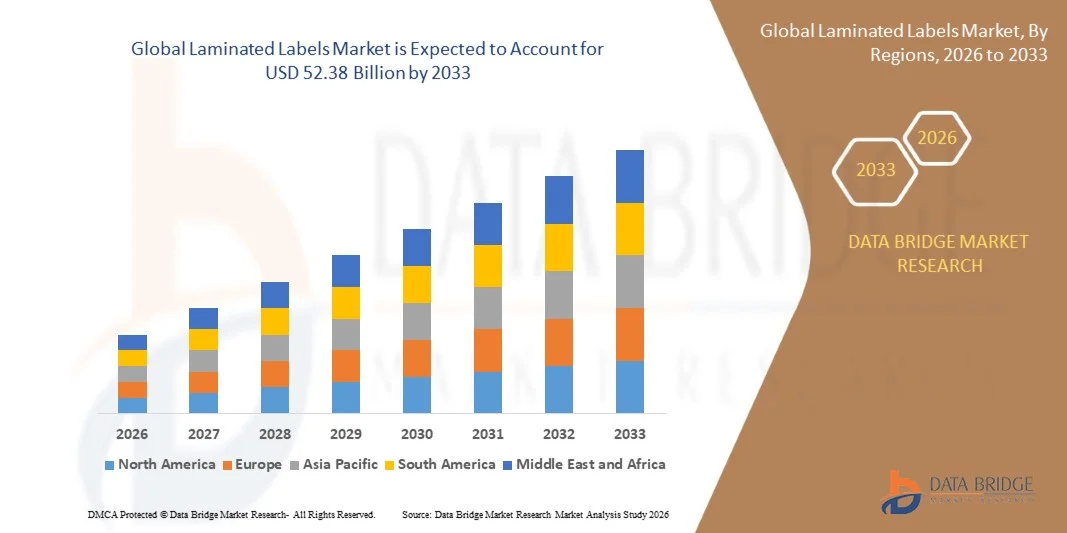
- As per Data Bridge Market Research Analysis the global laminated labels market size was valued at USD 37.32 billion in 2025 and is expected to reach USD 52.38 billion by 2033, at a CAGR of 4.33% during the forecast period
- The market growth is largely fueled by the rising demand for durable, high-quality, and tamper-resistant packaging solutions, leading to increased adoption of laminated labels across food & beverage, pharmaceuticals, and consumer goods industries
- Furthermore, increasing emphasis on product differentiation, brand visibility, and compliance with stringent labeling regulations is driving manufacturers to adopt advanced laminated labeling solutions, significantly supporting market expansion
Market Size & Forecast
- Global Market Value (2025): USD 37.32 Billion
- Expected Market Value (2033): USD 52.38 Billion
- Forecast CAGR (2026–2033): 4.33%
What are the Major Takeaways of Laminated Labels Market?
- Laminated labels are multi-layered labeling solutions designed to enhance durability, print protection, and resistance against moisture, chemicals, and abrasion, making them suitable for demanding packaging environments across multiple industries
- The escalating demand for laminated labels is primarily driven by the rapid growth of packaged goods consumption, expansion of organized retail and e-commerce, and increasing need for high-performance and visually appealing product labeling solutions
- Asia-Pacific dominated the laminated labels market with a share of 41.7% in 2025, due to rapid expansion of the packaging industry, increasing demand for durable and high-quality labeling solutions, and strong growth in food and beverage and pharmaceutical sectors
- North America is expected to be the fastest growing region in the laminated labels market during the forecast period due to increasing demand for advanced packaging solutions, rising adoption of smart labeling technologies, and strong presence of food, beverage, and pharmaceutical industries
- Facestock segment dominated the market with a market share of 45.47% in 2025, due to its critical role as the primary printable surface that directly influences label appearance, durability, and product branding. Manufacturers prioritize high-quality facestock materials to ensure resistance to moisture, chemicals, and abrasion, particularly in demanding end-use industries such as food and pharmaceuticals
Report Scope and Laminated Labels Market Segmentation
|
Attributes |
Laminated Labels Key Market Insights |
|
Segments Covered |
|
|
Countries Covered |
North America
Europe
Asia-Pacific
Middle East and Africa
South America
|
|
Key Market Players |
|
|
Market Opportunities |
|
|
Value Added Data Infosets |
In addition to the insights on market scenarios such as market value, growth rate, segmentation, geographical coverage, and major players, the market reports curated by the Data Bridge Market Research also include import export analysis, production capacity overview, production consumption analysis, price trend analysis, climate change scenario, supply chain analysis, value chain analysis, raw material/consumables overview, vendor selection criteria, PESTLE Analysis, Porter Analysis, and regulatory framework. |
What is the Key Trend in the Laminated Labels Market?
“Increasing Adoption of Sustainable and Recyclable Labeling Materials”
- A significant trend in the laminated labels market is the growing shift toward sustainable and recyclable label structures, driven by rising environmental regulations and brand commitments to reduce packaging waste. This transition is strengthening the use of eco-friendly facestock, water-based inks, and recyclable adhesives across multiple end-use industries such as food & beverage, pharmaceuticals, and personal care
- For instance, Avery Dennison has expanded its CleanFlake adhesive technology to support recyclability in PET bottle labeling applications, enabling labels to separate cleanly during the recycling process. Such innovations are improving circular economy outcomes and supporting brand owners in meeting sustainability targets
- The adoption of paper-based and biodegradable laminated label materials is increasing as companies aim to reduce reliance on multilayer plastic films. This shift is particularly visible in food packaging, where sustainability labeling is becoming a key purchasing factor for consumers
- Regulatory frameworks across regions are pushing manufacturers to redesign labeling solutions that comply with recycling and waste reduction standards. This is encouraging continuous material innovation and accelerating the development of mono-material label structures
- Leading packaging companies are investing in low-impact production processes that reduce energy consumption and carbon footprint in label manufacturing. This is reinforcing the broader industry movement toward environmentally responsible packaging solutions
- The market is witnessing stronger collaboration between brand owners and label manufacturers to develop fully recyclable laminated label systems. This trend is reshaping product design strategies and strengthening long-term sustainability integration across the packaging value chain
Laminated Labels Market Dynamics
Driver
“Rising Demand for Durable and High-Performance Packaging Labels”
- The growing need for durable, moisture-resistant, and tamper-proof labeling solutions is a key driver in the laminated labels market, particularly across fast-moving consumer goods, pharmaceuticals, and industrial packaging. These labels ensure product integrity, regulatory compliance, and long-lasting visual appeal under challenging storage and transportation conditions
- For instance, CCL Industries develops high-performance pressure-sensitive and laminated labels used extensively in pharmaceutical packaging to ensure traceability and resistance to moisture and chemical exposure. These solutions enhance product safety while maintaining label readability throughout the product lifecycle
- The expansion of packaged food and beverage consumption is increasing demand for labels that can withstand refrigeration, humidity, and handling stress without degradation. This is strengthening the adoption of laminated structures that provide enhanced barrier protection
- Growth in global pharmaceutical distribution networks is further driving demand for secure labeling systems that support authentication, serialization, and anti-counterfeit measures. Laminated labels play a crucial role in maintaining compliance with strict regulatory standards
- The continuous focus on brand visibility and premium packaging aesthetics is reinforcing demand for laminated labels with superior print quality and finish. This is making durability and visual performance critical factors in labeling material selection
Restraint/Challenge
“Volatility in Raw Material Prices Impacting Production Costs”
- The laminated labels market faces challenges due to fluctuations in the prices of raw materials such as polymers, paper, adhesives, and specialty coatings, which directly affect production costs and profit margins. This volatility creates pricing pressure for manufacturers and complicates long-term procurement planning
- For instance, UPM Raflatac has highlighted cost fluctuations in paper and polymer substrates as a key factor influencing label material pricing strategies across global supply chains. Such variations impact contract stability and force adjustments in product pricing models
- Dependence on petrochemical-derived materials makes the industry highly sensitive to crude oil price fluctuations, which affects adhesive and film production costs. This increases uncertainty in manufacturing budgets and reduces cost predictability
- Supply chain disruptions and logistics constraints further intensify raw material shortages, leading to inconsistent availability and increased procurement costs. This affects production continuity for label converters and material suppliers
- The ongoing volatility in global commodity markets continues to challenge pricing stability across the laminated labels industry. This is compelling manufacturers to adopt cost optimization strategies and explore alternative sustainable materials to maintain profitability
How is the Laminated Labels Market Segmented?
The market is segmented on the basis of composition, printing ink, printing technology, form, and application.
- By Composition
On the basis of composition, the laminated labels market is segmented into facestock, adhesive, release liner, and raw materials for laminated labels. The facestock segment dominated the largest market revenue share of 45.47% in 2025, driven by its critical role as the primary printable surface that directly influences label appearance, durability, and product branding. Manufacturers prioritize high-quality facestock materials to ensure resistance to moisture, chemicals, and abrasion, particularly in demanding end-use industries such as food and pharmaceuticals. The growing demand for visually appealing and long-lasting labels further strengthens the adoption of advanced facestock materials across industries.
The adhesive segment is anticipated to witness the fastest growth rate from 2026 to 2033, fueled by increasing demand for high-performance bonding solutions across diverse substrates and packaging formats. Adhesives play a vital role in ensuring label durability and application efficiency, especially in extreme environmental conditions. Continuous innovations in pressure-sensitive and eco-friendly adhesives are supporting their growing adoption in sustainable packaging solutions.
- By Printing Ink
On the basis of printing ink, the laminated labels market is segmented into water-based ink, UV-curable based ink, solvent-based ink, and hot-melt-based ink. The UV-curable based ink segment held the largest market revenue share in 2025 driven by its superior print quality, fast curing time, and enhanced resistance to scratches and chemicals. These inks are widely preferred in high-speed printing applications where durability and vibrant color output are essential. The increasing adoption of advanced printing technologies further boosts demand for UV-curable inks in premium labeling applications.
The water-based ink segment is expected to witness the fastest CAGR from 2026 to 2033, driven by rising environmental concerns and stringent regulations regarding volatile organic compound emissions. Water-based inks offer a sustainable alternative with lower environmental impact while maintaining acceptable print quality for various applications. Their growing use in food and beverage packaging significantly contributes to segment expansion.
- By Printing Technology
On the basis of printing technology, the laminated labels market is segmented into digital printing, flexographic printing, gravure printing, screen printing, lithography printing, offset printing, and letterpress printing. The flexographic printing segment dominated the largest market revenue share in 2025, driven by its cost efficiency, high-speed production capabilities, and suitability for large-volume label printing. It is widely adopted for packaging applications requiring consistent quality and scalability. The ability to print on a variety of substrates further strengthens its position in the laminated labels market.
The digital printing segment is anticipated to witness the fastest growth rate from 2026 to 2033, fueled by increasing demand for short-run, customized, and variable data printing. Digital printing enables faster turnaround times and reduces material waste, making it highly attractive for brand owners seeking flexibility and personalization. The rise of e-commerce and product differentiation strategies further accelerates its adoption.
- By Form
On the basis of form, the laminated labels market is segmented into reels and sheets. The reels segment held the largest market revenue share in 2025 driven by its compatibility with automated labeling systems and high-speed application processes in industrial settings. Reels enable efficient handling, reduced downtime, and improved productivity in mass production environments. Their widespread use across packaging lines supports their dominance in the market.
The sheets segment is expected to witness the fastest CAGR from 2026 to 2033, driven by increasing demand from small-scale manufacturers and customized printing applications. Sheets offer flexibility in design and are suitable for manual or semi-automatic labeling processes. Growing demand for short production runs and specialty labels contributes to the rising adoption of sheet formats.
- By Application
On the basis of application, the laminated labels market is segmented into food & beverage, consumer durables, home & personal care, pharmaceuticals, retail labels, and others. The food & beverage segment dominated the largest market revenue share in 2025, driven by the high demand for durable, moisture-resistant, and visually appealing labels for packaged food products. Strict labeling regulations and the need for clear product information further increase the adoption of laminated labels in this sector. The expansion of packaged and processed food consumption globally continues to support segment growth.
The pharmaceuticals segment is anticipated to witness the fastest growth rate from 2026 to 2033, fueled by stringent regulatory requirements for labeling accuracy, traceability, and product safety. Laminated labels provide enhanced durability and resistance to environmental factors, ensuring compliance with industry standards. The rising demand for healthcare products and increasing pharmaceutical production further contribute to segment expansion.
Which Region Holds the Largest Share of the Laminated Labels Market?
- Asia-Pacific dominated the laminated labels market with the largest revenue share of 41.7% in 2025, driven by rapid expansion of the packaging industry, increasing demand for durable and high-quality labeling solutions, and strong growth in food and beverage and pharmaceutical sectors
- The region’s cost-effective manufacturing environment, rising investments in packaging technologies, and growing exports of consumer goods are accelerating the adoption of laminated labels across industries
- The presence of large-scale manufacturing hubs, availability of raw materials, and supportive government initiatives promoting industrial growth are contributing to increased demand for advanced labeling solutions
China Laminated Labels Market Insight
China held the largest share in the Asia-Pacific laminated labels market in 2025, owing to its dominance in manufacturing and packaging industries along with extensive production of consumer goods. The country benefits from well-established supply chains, large-scale production capabilities, and strong export activities. Increasing demand for high-quality packaging and labeling in food, electronics, and retail sectors is further driving market growth.
India Laminated Labels Market Insight
India is witnessing the fastest growth in the Asia-Pacific region, fueled by expanding food processing, pharmaceutical, and retail sectors along with rising demand for packaged goods. Government initiatives supporting manufacturing and packaging industries are strengthening domestic production. Increasing investments in flexible packaging and labeling technologies are contributing to rapid market expansion.
Europe Laminated Labels Market Insight
The Europe laminated labels market is expanding steadily, supported by stringent regulations on product labeling, high demand for sustainable packaging solutions, and strong presence of premium consumer goods industries. The region emphasizes quality, compliance, and environmentally friendly materials in labeling applications. Increasing adoption of advanced printing technologies is further supporting market growth.
Germany Laminated Labels Market Insight
Germany’s laminated labels market is driven by its advanced manufacturing sector, strong packaging industry, and focus on innovation in printing technologies. The country has a well-established industrial base and high demand for precision labeling in automotive, pharmaceuticals, and consumer goods sectors. Continuous advancements in sustainable and high-performance materials are supporting market development.
U.K. Laminated Labels Market Insight
The U.K. market is supported by growing demand for premium packaging, increasing adoption of sustainable labeling solutions, and expansion of e-commerce and retail sectors. Strong focus on branding and product differentiation is encouraging the use of high-quality laminated labels. Investments in digital printing and labeling technologies are further enhancing market growth.
North America Laminated Labels Market Insight
North America is projected to grow at the fastest CAGR from 2026 to 2033, driven by increasing demand for advanced packaging solutions, rising adoption of smart labeling technologies, and strong presence of food, beverage, and pharmaceutical industries. Technological advancements in printing and labeling processes are supporting innovation. Growing emphasis on product traceability and branding is further boosting market expansion.
U.S. Laminated Labels Market Insight
The U.S. accounted for the largest share in the North America market in 2025, underpinned by its well-established packaging industry, high consumption of packaged goods, and strong demand for innovative labeling solutions. The country benefits from advanced printing infrastructure and continuous investment in sustainable materials. Presence of key industry players and focus on product differentiation are further strengthening market growth.
Which are the Top Companies in Laminated Labels Market?
The laminated labels industry is primarily led by well-established companies, including:
- Avery Dennison Corporation (U.S.)
- CCL Industries Inc. (Canada)
- 3M (U.S.)
- Constantia Flexibles Group GmbH (Austria)
- Coveris Holdings S.A. (Luxembourg)
- R.R. Donnelley & Sons Company (U.S.)
- Torraspapel Adestor (Spain)
- Flexcon Company, Inc. (U.S.)
- Stickythings Limited (U.K.)
- Lecta Adestor (Spain)
What are Latest Developments in Laminated Labels Market?
- In June 2025, SATO Group transitioned its printer packaging materials from foam-based solutions to cardboard-based alternatives, significantly strengthening its sustainability positioning within the packaging industry. This shift resulted in a 39% reduction in CO₂ emissions per unit and the elimination of approximately 8,596 kg of plastic annually. The development highlights the company’s commitment to circular economy principles and is expected to enhance demand for eco-friendly packaging materials across its supply chain while setting a benchmark for environmentally responsible packaging practices
- In April 2025, UPM Raflatac introduced product carbon footprint (PCF) reporting in its labeling solutions portfolio, improving transparency across the laminated labels and pressure-sensitive materials market. This initiative enables customers to assess environmental impact at the product level, supporting more informed procurement decisions and strengthening sustainability compliance across industries. The move is expected to accelerate adoption of low-carbon labeling solutions and reinforce the company’s position in the sustainable label materials segment
- In March 2025, ProMach’s ID Technology acquired Etiflex, enhancing its manufacturing capabilities in pressure-sensitive labels and expanding its RFID and labeling production footprint in North America. This acquisition strengthens ProMach’s competitive position in the packaging and labeling solutions market by increasing production capacity and broadening its product portfolio. The development is expected to support rising demand for high-performance labeling solutions in logistics, retail, and industrial applications
- In June 2024, Constantia Flexibles launched EcoTwistPaper, a wax-free twist wrap made from paper, marking a significant step toward sustainable packaging innovation in the flexible packaging and labeling market. The product is designed to improve recyclability and reduce reliance on plastic-based materials, aligning with growing regulatory and consumer demand for eco-friendly packaging solutions. This launch is expected to strengthen Constantia Flexibles’ sustainability portfolio and drive increased adoption of paper-based packaging alternatives
- In October 2023, Coveris introduced Formpeel P, a recyclable thermoforming film, expanding its sustainable medical packaging product portfolio. The innovation supports reduced environmental impact while maintaining high-performance packaging standards required in healthcare applications. This development is expected to enhance demand for recyclable medical packaging solutions and reinforce Coveris’ position in the sustainable healthcare packaging segment

- Interactive Data Analysis Dashboard
- Company Analysis Dashboard for high growth potential opportunities
- Research Analyst Access for customization & queries
- Competitor Analysis with Interactive dashboard
- Latest News, Updates & Trend analysis
- Harness the Power of Benchmark Analysis for Comprehensive Competitor Tracking
Global Laminated Labels Market, Supply Chain Analysis and Ecosystem Framework
To support market growth and help clients navigate the impact of geopolitical shifts, DBMR has integrated in-depth supply chain analysis into its Global Laminated Labels Market research reports. This addition empowers clients to respond effectively to global changes affecting their industries. The supply chain analysis section includes detailed insights such as Global Laminated Labels Market consumption and production by country, price trend analysis, the impact of tariffs and geopolitical developments, and import and export trends by country and HSN code. It also highlights major suppliers with data on production capacity and company profiles, as well as key importers and exporters. In addition to research, DBMR offers specialized supply chain consulting services backed by over a decade of experience, providing solutions like supplier discovery, supplier risk assessment, price trend analysis, impact evaluation of inflation and trade route changes, and comprehensive market trend analysis.
Data collection and base year analysis are done using data collection modules with large sample sizes. The stage includes obtaining market information or related data through various sources and strategies. It includes examining and planning all the data acquired from the past in advance. It likewise envelops the examination of information inconsistencies seen across different information sources. The market data is analysed and estimated using market statistical and coherent models. Also, market share analysis and key trend analysis are the major success factors in the market report. To know more, please request an analyst call or drop down your inquiry.
The key research methodology used by DBMR research team is data triangulation which involves data mining, analysis of the impact of data variables on the market and primary (industry expert) validation. Data models include Vendor Positioning Grid, Market Time Line Analysis, Market Overview and Guide, Company Positioning Grid, Patent Analysis, Pricing Analysis, Company Market Share Analysis, Standards of Measurement, Global versus Regional and Vendor Share Analysis. To know more about the research methodology, drop in an inquiry to speak to our industry experts.
Data Bridge Market Research is a leader in advanced formative research. We take pride in servicing our existing and new customers with data and analysis that match and suits their goal. The report can be customized to include price trend analysis of target brands understanding the market for additional countries (ask for the list of countries), clinical trial results data, literature review, refurbished market and product base analysis. Market analysis of target competitors can be analyzed from technology-based analysis to market portfolio strategies. We can add as many competitors that you require data about in the format and data style you are looking for. Our team of analysts can also provide you data in crude raw excel files pivot tables (Fact book) or can assist you in creating presentations from the data sets available in the report.













