


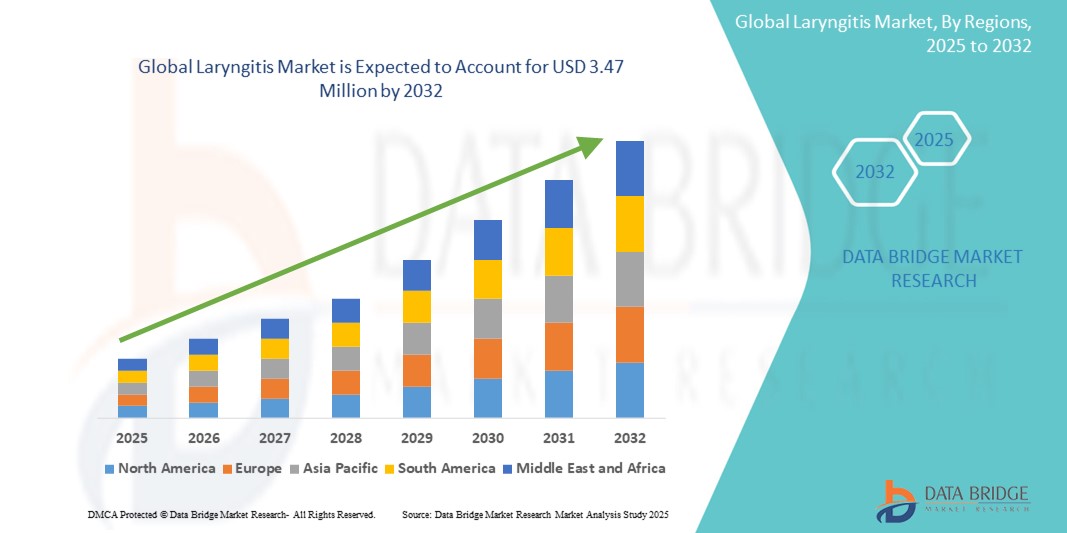
Laryngitis Market Size
- The global laryngitis market size was valued at USD 2.23 million in 2024 and is expected to reach USD 3.47 million by 2032, at a CAGR of 5.70% during the forecast period
- The market growth is largely fueled by the rising prevalence of upper respiratory tract infections, increasing exposure to environmental pollutants, and a growing number of patients affected by voice strain and allergic reactions, all contributing to the rising incidence of laryngitis across diverse age groups and geographies
- Furthermore, heightened awareness around vocal health, advancements in diagnostic tools such as laryngoscopy, and the increasing availability of targeted treatment options—including corticosteroids, antibiotics, and voice therapy—are accelerating the uptake of laryngitis solutions, thereby significantly boosting the industry's growth
Laryngitis Market Analysis
- Laryngitis, an inflammation of the voice box (larynx) caused by infection, irritation, or overuse, continues to gain clinical attention due to rising cases associated with viral infections, allergies, GERD, and vocal strain. The increasing prevalence of upper respiratory infections and growing awareness about early ENT interventions are contributing to market growth
- The growing demand for effective diagnostic and treatment solutions for both acute and chronic laryngitis is driven by rising patient visits to ENT clinics and advancements in otolaryngology tools such as laryngoscopes, corticosteroids, and voice therapy modalities
- North America dominated the laryngitis market with the largest revenue share of 38.6% in 2024, driven by a strong presence of ENT specialists, high awareness levels, and greater healthcare access. The U.S. in particular recorded increased cases of laryngitis, linked to post-COVID respiratory complications and lifestyle factors such as smoking and pollution
- Asia-Pacific is expected to be the fastest-growing region in the Laryngitis market, projected to grow at a CAGR of 7.9% from 2025 to 2032, driven by improving ENT infrastructure, rising healthcare expenditure, and a growing urban population exposed to air pollution and allergens
- The acute laryngitis segment dominated the market with the largest revenue share of 64.3% in 2024, owing to its high prevalence during respiratory infections and seasonal flu
Report Scope and Laryngitis Market Segmentation
|
Attributes |
Laryngitis Key Market Insights |
|
Segments Covered |
|
|
Countries Covered |
North America
Europe
Asia-Pacific
Middle East and Africa
South America
|
|
Key Market Players |
|
|
Market Opportunities |
|
|
Value Added Data Infosets |
In addition to the insights on market scenarios such as market value, growth rate, segmentation, geographical coverage, and major players, the market reports curated by the Data Bridge Market Research also include in-depth expert analysis, pricing analysis, brand share analysis, consumer survey, demography analysis, supply chain analysis, value chain analysis, raw material/consumables overview, vendor selection criteria, PESTLE Analysis, Porter Analysis, and regulatory framework. |
Laryngitis Market Trends
“Advancements in Diagnosis and Treatment Approaches”
- A significant and accelerating trend in the global laryngitis market is the improvement in diagnostic accuracy and treatment personalization, largely driven by the adoption of advanced laryngoscopy tools, real-time voice analysis software, and enhanced imaging techniques. These innovations are enabling ENT specialists to differentiate between acute and chronic laryngitis more effectively and provide faster, more targeted interventions
- For instance, the adoption of high-definition video laryngoscopy in outpatient settings has enabled earlier detection of vocal cord inflammation, vocal nodules, or polyps—common complications of chronic laryngitis. This trend is particularly prominent in developed healthcare systems across North America and Europe
- Integration of tele-ENT services is also transforming patient access to laryngitis care, especially in remote or underserved regions. Patients experiencing mild symptoms can now consult specialists via video consultations and receive e-prescriptions for anti-inflammatory drugs or voice rest protocols without in-person visits
- Pharmacological innovation is another critical aspect, with corticosteroids, mucolytics, antihistamines, and proton pump inhibitors (PPIs) being increasingly tailored based on the root cause of laryngitis—whether infectious, allergic, or reflux-related. Newer treatment regimens combine medication with speech therapy to promote vocal recovery and reduce relapse rates
- Hospitals and specialized ENT clinics are adopting multidisciplinary care models where speech-language pathologists, pulmonologists, and gastroenterologists collaborate in complex or recurrent laryngitis cases—especially where conditions like GERD, asthma, or vocal misuse are contributing factors
- The demand for non-invasive, outpatient-based treatments is growing rapidly across both developed and developing regions, as patients increasingly prioritize convenience, cost-effectiveness, and faster recovery. This is prompting pharmaceutical companies and medical device firms to invest in laryngitis-specific innovations such as portable diagnostic kits, home-use nebulizers, and voice hygiene education tools
Laryngitis Market Dynamics
Driver
“Growing Need Due to Rising Incidence of Respiratory Infections and Voice Disorders”
- The increasing prevalence of upper respiratory tract infections, rising exposure to air pollution, allergens, and irritants, along with growing cases of vocal strain and overuse, are significant drivers for the rising demand for effective laryngitis treatment options
- For instance, in April 2024, various clinical research initiatives were launched focusing on improved corticosteroid delivery systems and faster-acting anti-inflammatory drugs aimed at acute laryngitis treatment. Such advancements by key pharmaceutical players are expected to drive the laryngitis industry growth over the forecast period
- As public awareness grows regarding the early symptoms of laryngitis—such as hoarseness, throat pain, and voice loss—there is increased patient inclination toward early diagnosis and treatment. This rising awareness, combined with better access to ENT specialists and diagnostic tools like laryngoscopy, is fueling market expansion
- Furthermore, the growing demand for non-invasive, home-based therapies such as nebulization, throat lozenges, and herbal remedies is making laryngitis treatment more accessible and convenient. These options appeal particularly to patients with mild or recurring symptoms
- The development of telemedicine and digital health platforms is also playing a vital role, allowing patients to consult ENT specialists remotely and receive timely care. This is especially important in rural or underserved areas where access to specialized care may be limited
Restraint/Challenge
“Misdiagnosis, Underreporting, and Limited Treatment Access in Developing Regions”
- Misdiagnosis of laryngitis symptoms as common cold or pharyngitis, especially in primary care settings, remains a key challenge. This often leads to delayed treatment or inappropriate use of antibiotics, which can worsen outcomes and fuel antimicrobial resistance
- For instance, in many low- and middle-income countries, the underreporting of laryngitis cases due to lack of awareness and limited healthcare infrastructure restricts the market's full potential. Many patients do not seek medical care unless symptoms become severe or persistent
- Access to specialized ENT care and advanced diagnostic tools like fiberoptic laryngoscopy is limited in several developing regions, hindering timely diagnosis and proper disease classification (acute, chronic, or recurrent laryngitis)
- In addition, while many laryngitis treatments such as corticosteroids and nebulizers are effective, their cost can still be prohibitive for low-income populations, especially when not covered by public health insurance or reimbursement programs
- Overcoming these barriers through better clinician training, public awareness campaigns, and improved distribution of affordable diagnostic and therapeutic options will be critical to achieving sustainable growth in the global laryngitis market
Laryngitis Market Scope
The laryngitis market is segmented on the basis of type, treatment, diagnosis, symptoms, dosage, route of administration, end-users, and distribution channel.
- By Type
On the basis of type, the laryngitis market is segmented into acute laryngitis and chronic laryngitis. The acute laryngitis segment dominated the market with the largest revenue share of 64.3% in 2024, owing to its high prevalence during respiratory infections and seasonal flu.
The chronic laryngitis segment is projected to grow at the fastest CAGR of 6.8% from 2025 to 2032, driven by rising smoking rates, GERD cases, and occupational vocal strain.
- By Treatment
On the basis of treatment, the market is segmented into antibiotics, corticosteroids, pain medications, voice therapy, surgery, and others. The corticosteroid segment held the largest market share of 31.5% in 2024, due to its quick relief in inflammation-related cases.
The voice therapy segment is expected to grow at the highest CAGR of 7.4% during the forecast period, driven by the shift toward non-invasive and speech-preserving interventions.
- By Diagnosis
On the basis of diagnosis, the market is segmented into Laryngoscopy, Biopsy, and Others.
The Laryngoscopy segment accounted for the largest market share of 56.7% in 2024, as it remains the first-line diagnostic method used widely in ENT settings due to its speed, accessibility, and accuracy.
The Biopsy segment is projected to grow at the fastest CAGR of 6.2% from 2025 to 2032, particularly in chronic or malignancy-suspected cases where histopathological analysis is essential.
- By Symptoms
On the basis of symptoms, the market is segmented into Weak Voice, Hoarseness, Dry Throat, Tickling Sensation and Rawness in the Throat, Sore Throat, Dry Cough, and Others.
The Hoarseness segment held the largest revenue share of 38.9% in 2024, as it is the most commonly reported and clinically relevant symptom prompting ENT visits.
The Dry Throat segment is expected to witness the fastest CAGR from 2025 to 2032, due to increased awareness and proactive management of early-stage throat irritation.
- By Dosage
On the basis of dosage, the market is segmented into injection, tablets, and others. The tablets segment dominated the market with a share of 58.6% in 2024, as oral medications are the most commonly prescribed treatment for symptom relief and inflammation.
The injection segment is expected to witness the fastest CAGR from 2025 to 2032, since is primarily used in severe inflammation cases or hospital-based interventions requiring rapid therapeutic action.
- By Route of Administration
On the basis of route of administration, the market is segmented into oral, intravenous, and others. The oral route held the largest market share of 61.2% in 2024, due to its ease of administration, affordability, and strong patient compliance.
The Intravenous route is projected to grow at a CAGR of 5.9% from 2025 to 2032, especially in emergency care and inpatient settings where fast-acting therapies are required.
- By End-Users
On the basis of end-users, the market is segmented into clinics, hospitals, and others. The Hospital segment led the market with a revenue share of 54.1% in 2024, attributed to their comprehensive diagnostic capabilities and access to multidisciplinary care.
The Clinic segment is expected to grow at a fastest CAGR of 6.5% from 2025 to 2032, fueled by increased ENT outpatient services and specialty clinic expansion.
- By Distribution Channel
On the basis of distribution channel, the market is segmented into hospital pharmacy, retail pharmacy, and online pharmacy. The hospital pharmacy segment held the largest market share of 45.7% in 2024, driven by on-site prescription filling and availability of injectable drugs.
The online pharmacy segment is projected to expand at the fastest CAGR of 8.1%, attributed to growing digital health trends and convenience in medicine access.
Laryngitis Market Regional Analysis
- North America dominated the laryngitis market with the largest revenue share of 38.6% in 2024, driven by increasing prevalence of upper respiratory tract infections, seasonal allergies, and rising awareness of vocal health among the population
- Consumers in the region are highly engaged with early treatment-seeking behavior and have broad access to ENT specialists and advanced diagnostic technologies such as laryngoscopy, which supports timely diagnosis and effective management of laryngitis
- The widespread presence of leading pharmaceutical players, strong healthcare infrastructure, and high healthcare spending contribute significantly to the regional market growth. In addition, increasing awareness campaigns and patient education initiatives around throat infections are further accelerating the demand for laryngitis treatments
U.S. Laryngitis Market Insight
The U.S. laryngitis market captured the largest revenue share of 81% in 2024 within North America, fueled by rising cases of viral and bacterial infections, a high prevalence of allergic reactions and gastroesophageal reflux disease (GERD)—common contributors to laryngitis. Consumers increasingly seek medical attention for hoarseness, sore throat, and vocal fatigue, especially among professionals who rely heavily on their voice. The growing adoption of telemedicine, availability of OTC throat relief products, and insurance coverage for ENT consultations are all contributing to continued market expansion in the U.S.
Europe Laryngitis Market Insight
The Europe laryngitis market is projected to expand at a substantial CAGR throughout the forecast period, primarily driven by the increasing burden of respiratory infections, vocal strain in aging populations, and greater access to primary and specialist care. Regulatory emphasis on appropriate antibiotic use and rising awareness of non-infectious causes of laryngitis (e.g., reflux or overuse) are pushing demand for tailored treatment protocols. The region is witnessing growing investments in ENT infrastructure across both public and private healthcare systems, enhancing diagnosis and treatment capacity.
U.K. Laryngitis Market Insight
The U.K. laryngitis market is anticipated to grow at a noteworthy CAGR during the forecast period, driven by increasing demand for accurate voice disorder management, lifestyle changes, and environmental factors such as pollution and allergens. The NHS’s focus on early diagnosis and reducing unnecessary antibiotic prescriptions aligns with rising demand for corticosteroids, throat sprays, and voice therapy services. In addition, the country’s aging population and its growing voice-dependent workforce (teachers, performers, call center professionals) are expected to further support market growth.
Germany Laryngitis Market Insight
The Germany laryngitis market is expected to expand at a considerable CAGR during the forecast period, fueled by increased awareness of vocal health and demand for effective ENT services. The country’s strong emphasis on sustainability and natural remedies is boosting demand for herbal throat lozenges, homeopathic treatments, and voice rest therapies. Moreover, Germany’s robust outpatient care network and growing availability of specialized diagnostic tools are making laryngitis treatment more accessible, especially for chronic and recurrent cases.
Asia-Pacific Laryngitis Market Insight
The Asia-Pacific laryngitis market is poised to grow at the fastest CAGR of 7.9% during 2025 to 2032, driven by growing urbanization, environmental pollution, increasing smoking rates, and rising healthcare awareness in countries like China, India, and Japan. Public health initiatives targeting respiratory infections and better access to healthcare facilities are improving diagnosis rates. Moreover, the rising availability of cost-effective generic drugs and home remedies is supporting mass-market treatment accessibility in both urban and rural regions.
Japan Laryngitis Market Insight
The Japan laryngitis market is gaining momentum due to the country’s highly health-conscious aging population, increasing incidence of allergic rhinitis and air pollution, and growing voice-related occupational demands. There is a strong cultural emphasis on early and precise medical intervention, and laryngitis is no exception. Adoption of minimally invasive diagnostic tools, availability of advanced pharmacological and non-pharmacological treatments, and integration of digital health tools are key factors accelerating the market's growth in Japan.
China Laryngitis Market Insight
The China laryngitis market accounted for the largest revenue share in Asia-Pacific in 2024, attributed to the country’s expanding urban population, increasing exposure to pollution and industrial irritants, and rising demand for ENT consultations. Public health campaigns around infectious disease prevention and growing investment in primary healthcare are increasing access to laryngitis diagnosis and treatment. China also benefits from strong domestic pharmaceutical production, making laryngitis treatment options more affordable and widely available to the general population.
Laryngitis Market Share
The laryngitis industry is primarily led by well-established companies, including:
- F. Hoffmann-La Roche Ltd (Switzerland)
- Novartis AG (Switzerland)
- AstraZeneca (U.K.)
- Johnson & Johnson Services, Inc. (U.S.)
- AbbVie Inc. (U.S.)
- Pfizer Inc. (U.S.)
- Sanofi (France)
- Aurobindo Pharma (India)
- GSK plc (U.K.)
- Cipla (India)
- Sun Pharmaceutical Industries Ltd. (India)
- Abbott (U.S.)
- Teva Pharmaceutical Industries Ltd (Israel)
- Bausch Health Companies Inc. (Canada)
- Sumitomo Pharma Co., Ltd. (Japan)
- Merck & Co., Inc. (U.S.)
- Lilly (U.S.)
- Lupin (India)
- SHIONOGI & Co., Ltd. (Japan)
- Bayer AG (Germany)
- LEO Pharma A/S (Denmark)
Latest Developments in Global Laryngitis Market
- In June 2024, Akums Drugs & Pharmaceuticals (India) introduced a chewable antacid tablet containing sodium alginate and potassium bicarbonate targeting GERD-induced laryngeal irritation. This OTC formulation aims to help reduce reflux-triggered laryngitis by forming a protective barrier in the throat
- In May 2024, AI-Powered Voice Diagnostic Model Published Researchers published an AI-driven voice analysis model capable of distinguishing healthy voices from those affected by laryngeal diseases, including cancer and vocal paralysis. The model demonstrated 85–97% accuracy in distinguishing healthy vs. diseased voices and is a promising step toward non-invasive, real-time laryngitis diagnostics
- In April 2024, AAO-HNS Updates Clinical Guideline on Hoarseness (Dysphonia)
The American Academy of Otolaryngology–Head and Neck Surgery released updated practice guidelines for persistent hoarseness (dysphonia). The revisions include new recommendations for timely referral to laryngoscopy, standardized diagnostic procedures, and voice-rest protocols—enhancing early detection and management of laryngitis

- Interactive Data Analysis Dashboard
- Company Analysis Dashboard for high growth potential opportunities
- Research Analyst Access for customization & queries
- Competitor Analysis with Interactive dashboard
- Latest News, Updates & Trend analysis
- Harness the Power of Benchmark Analysis for Comprehensive Competitor Tracking
Data collection and base year analysis are done using data collection modules with large sample sizes. The stage includes obtaining market information or related data through various sources and strategies. It includes examining and planning all the data acquired from the past in advance. It likewise envelops the examination of information inconsistencies seen across different information sources. The market data is analysed and estimated using market statistical and coherent models. Also, market share analysis and key trend analysis are the major success factors in the market report. To know more, please request an analyst call or drop down your inquiry.
The key research methodology used by DBMR research team is data triangulation which involves data mining, analysis of the impact of data variables on the market and primary (industry expert) validation. Data models include Vendor Positioning Grid, Market Time Line Analysis, Market Overview and Guide, Company Positioning Grid, Patent Analysis, Pricing Analysis, Company Market Share Analysis, Standards of Measurement, Global versus Regional and Vendor Share Analysis. To know more about the research methodology, drop in an inquiry to speak to our industry experts.
Data Bridge Market Research is a leader in advanced formative research. We take pride in servicing our existing and new customers with data and analysis that match and suits their goal. The report can be customized to include price trend analysis of target brands understanding the market for additional countries (ask for the list of countries), clinical trial results data, literature review, refurbished market and product base analysis. Market analysis of target competitors can be analyzed from technology-based analysis to market portfolio strategies. We can add as many competitors that you require data about in the format and data style you are looking for. Our team of analysts can also provide you data in crude raw excel files pivot tables (Fact book) or can assist you in creating presentations from the data sets available in the report.












