


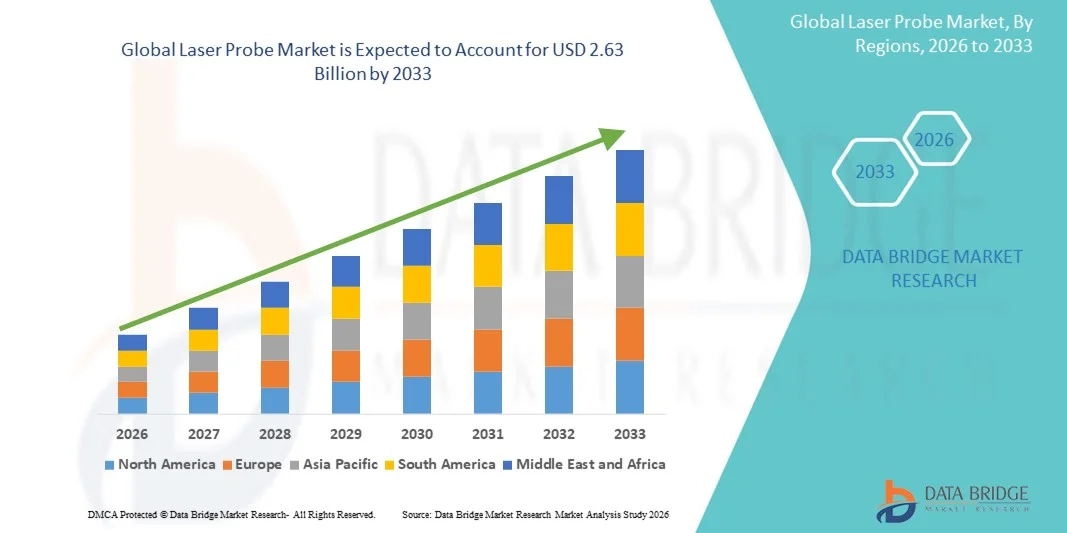
Laser Probe Market Size
- The global laser probe market size was valued at USD 1.30 billion in 2025 and is expected to reach USD 2.63 billion by 2033, at a CAGR of 9.11% during the forecast period
- The market growth is largely fueled by rising adoption of minimally invasive surgical procedures and diagnostic applications that leverage laser probes across ophthalmology, urology, oncology, dermatology, and other medical specialties
- Furthermore, technological progress, including advances in fiber-optics, laser wavelength control, and probe design, is improving precision, efficiency, and safety, thereby increasing the appeal of laser probes in both healthcare and industrial applications
Laser Probe Market Analysis
- Laser probes, providing precise laser-based measurement, diagnostic, and minimally invasive treatment capabilities, are increasingly vital tools in modern healthcare and industrial applications due to their enhanced accuracy, safety, and integration with advanced imaging and surgical systems
- The escalating demand for laser probes is primarily fueled by the growing adoption of minimally invasive surgical procedures, rising prevalence of chronic diseases requiring diagnostic interventions, and increasing industrial applications in quality control, material processing, and research laboratories
- North America dominated the laser probe market with the largest revenue share of 38.2% in 2025, characterized by advanced healthcare infrastructure, high adoption of cutting-edge medical devices, and a strong presence of key industry players, with the U.S. experiencing substantial growth in laser probe utilization across ophthalmology, oncology, urology, and dermatology, driven by innovations from both established medical device companies and startups focusing on fiber-optic and high-precision probe technologies
- Asia-Pacific is expected to be the fastest growing region in the laser probe market during the forecast period due to increasing healthcare expenditures, rising prevalence of chronic diseases, expanding industrial applications, and improving medical infrastructure in emerging economies
- Ophthalmology segment dominated the laser probe market with a market share of 31.9% in 2025, driven by its established use in laser-assisted eye surgeries, high precision, and growing adoption of minimally invasive ophthalmic procedures
Report Scope and Laser Probe Market Segmentation
|
Attributes |
Laser Probe Key Market Insights |
|
Segments Covered |
|
|
Countries Covered |
North America
Europe
Asia-Pacific
Middle East and Africa
South America
|
|
Key Market Players |
|
|
Market Opportunities |
|
|
Value Added Data Infosets |
In addition to the insights on market scenarios such as market value, growth rate, segmentation, geographical coverage, and major players, the market reports curated by the Data Bridge Market Research also include in-depth expert analysis, patient epidemiology, pipeline analysis, pricing analysis, and regulatory framework |
Laser Probe Market Trends
Integration with AI and Advanced Imaging Technologies
- A significant and accelerating trend in the global laser probe market is the integration with artificial intelligence (AI) and advanced imaging systems such as OCT (Optical Coherence Tomography) and high-resolution endoscopy. This combination is significantly enhancing diagnostic precision and procedural efficiency
- For instance, ophthalmic laser probes integrated with AI-assisted imaging can guide surgeons in real-time during retinal procedures, improving surgical outcomes and reducing procedural errors
- AI integration in laser probes enables features such as predictive analysis of tissue response, automated calibration, and real-time alerts for anomalies during surgical or diagnostic procedures. For instance, some ophthalmic and oncology laser probes utilize AI to optimize laser intensity based on tissue feedback and can provide intelligent warnings if unexpected tissue responses are detected
- The seamless integration of laser probes with imaging and robotic-assisted platforms facilitates centralized control over surgical or diagnostic procedures. Through a single interface, clinicians can manage laser probes alongside imaging, navigation, and robotic tools, creating a unified and precise procedural workflow
- This trend towards more intelligent, automated, and interconnected laser probe systems is fundamentally reshaping clinician expectations for surgical and diagnostic accuracy. Consequently, companies such as IRIDEX are developing AI-enabled laser probes with features such as automated tissue targeting and real-time feedback for enhanced procedural safety
- The demand for laser probes that offer seamless AI and imaging integration is growing rapidly across both healthcare and industrial sectors, as users increasingly prioritize precision, efficiency, and comprehensive procedural support
Laser Probe Market Dynamics
Driver
Rising Demand for Minimally Invasive Procedures and High-Precision Diagnostics
- The increasing adoption of minimally invasive surgeries and high-precision diagnostic procedures is a significant driver for the heightened demand for laser probes
- For instance, in March 2025, Ellex Medical Lasers announced an advancement in AI-assisted ophthalmic laser probes, focusing on improved precision for retinal procedures. Such strategies by key companies are expected to drive the laser probe industry growth in the forecast period
- As healthcare providers seek safer, faster, and less invasive procedures, laser probes offer advanced features such as precise tissue targeting, reduced collateral damage, and real-time feedback, providing a compelling advantage over conventional instruments
- Furthermore, the growing use of laser probes in industrial inspection, material processing, and laboratory research is expanding the market beyond healthcare, offering diversified growth avenues and application-specific innovations
- The precision, reproducibility, and minimally invasive nature of laser probes, along with increasing awareness among clinicians and industries, are key factors propelling adoption across healthcare and industrial sectors. The trend towards integrated, user-friendly laser probe solutions further contributes to market growth
- The expanding use of laser probes in emerging markets, driven by improving healthcare infrastructure and industrial automation, is creating new growth opportunities. For instance, adoption is increasing in countries such as India and Brazil for ophthalmic and dermatology applications
Restraint/Challenge
High Cost and Regulatory Compliance Hurdles
- The relatively high cost of advanced laser probe systems poses a significant challenge to broader market penetration, particularly in price-sensitive regions and smaller healthcare facilities
- For instance, high-end ophthalmic and surgical laser probes with integrated AI and imaging capabilities often have purchase and maintenance costs that limit adoption in emerging markets
- Addressing these cost barriers through modular designs, lower-cost variants, and financing options is crucial for expanding market access. Companies such as Lumenis emphasize cost-effective solutions while maintaining performance to attract a wider user base
- In addition, laser probes are subject to stringent regulatory approvals and compliance standards across different regions, which can delay product launches and add complexity to market entry
- While technological advancements are driving demand, overcoming the dual challenges of high initial investment and regulatory compliance will be vital for sustained growth and broader adoption of laser probe systems
- Limited availability of trained personnel to operate advanced laser probe systems in certain regions is restraining adoption. For instance, some emerging markets face a shortage of clinicians and technicians skilled in minimally invasive laser procedures
- Potential safety concerns related to improper use or calibration of laser probes pose additional challenges, requiring comprehensive training and adherence to strict operational protocols. For instance, misuse in surgical or industrial settings can lead to tissue damage or measurement errors
Laser Probe Market Scope
The market is segmented on the basis of product type, probe type, application, and end users.
- By Product Type
On the basis of product type, the laser probe market is segmented into Continuous Wave (CW) laser probes and Pulsed laser probes. The CW laser probe segment dominated the market with the largest market revenue share in 2025, driven by its continuous and stable laser output suitable for precision procedures in ophthalmology and dermatology. CW probes are widely preferred for procedures requiring constant energy delivery, such as retinal photocoagulation and skin resurfacing, providing consistent results with minimal tissue damage. Their reliability, ease of integration with existing surgical systems, and compatibility with AI-enabled imaging platforms contribute to their sustained demand. Furthermore, CW probes are often favored in research and industrial applications for high-precision material processing. Established medical institutions and research centers often prioritize CW probes due to their proven performance and long operational lifespan.
The Pulsed laser probe segment is anticipated to witness the fastest growth rate from 2026 to 2033, fueled by increasing adoption in advanced surgical and industrial applications requiring controlled, high-intensity bursts of energy. Pulsed probes are particularly suited for procedures such as lithotripsy, dermatological tattoo removal, and precise tissue ablation, where localized, high-peak energy is essential. The technological advancements in pulsed laser systems, including shorter pulse durations and adjustable energy parameters, enhance their precision and safety. Growing demand in minimally invasive procedures and oncology interventions is further accelerating the uptake of pulsed laser probes. Emerging markets are increasingly adopting pulsed systems due to their versatility across medical and industrial sectors.
- By Probe Type
On the basis of probe type, the market is segmented into single laser probes and cluster laser probes. The single laser probe segment dominated the market in 2025 due to its simplicity, ease of operation, and widespread use in ophthalmology, dermatology, and dentistry. Single probes are preferred for targeted procedures requiring focused laser delivery and minimal setup complexity. They provide cost-effective solutions for hospitals and clinics, allowing precise energy control and high repeatability. Their compatibility with AI-assisted guidance systems further enhances their adoption among clinicians seeking reliable performance. In addition, single probes are easier to sterilize and maintain, making them suitable for high-frequency clinical use. Training and operational requirements are minimal compared to more complex probe systems, contributing to market preference.
The cluster laser probe segment is expected to witness the fastest growth from 2026 to 2033 due to its ability to deliver multiple laser beams simultaneously, improving procedural efficiency in dermatology, ophthalmology, and cosmetic applications. Cluster probes reduce treatment times and enhance uniformity in tissue ablation or skin resurfacing procedures. Their integration with robotic or AI-assisted platforms allows precise multi-point energy delivery, boosting clinical outcomes. The rising demand for non-invasive cosmetic treatments and multi-functional therapeutic applications is driving the adoption of cluster probes. Advances in probe design, portability, and adjustable beam configurations are making cluster probes increasingly attractive to clinics and specialized surgical centers.
- By Application
On the basis of application, the laser probe market is segmented into ophthalmology, dermatology, rheumatology, orthopaedics, dentistry, and others. The ophthalmology segment dominated the market in 2025 with a market share of 31.9%, owing to the widespread use of laser probes in retinal surgeries, glaucoma treatments, and cataract procedures. Ophthalmic laser probes offer high precision, minimal invasiveness, and integration with imaging systems, making them essential in modern eye care. Their compatibility with AI-assisted diagnostics further enhances procedural accuracy and patient outcomes. Hospitals and specialized eye clinics often prioritize ophthalmic laser probes due to their established clinical utility. The prevalence of eye disorders and the growing number of ophthalmic procedures globally sustain strong demand. In addition, continuous advancements in ophthalmic laser technologies are expanding their applications and adoption.
The dermatology segment is expected to witness the fastest growth from 2026 to 2033, driven by the rising demand for cosmetic procedures such as tattoo removal, skin resurfacing, and scar treatment. Dermatological laser probes enable minimally invasive treatments with faster recovery and improved patient satisfaction. Increasing consumer awareness of non-invasive cosmetic treatments and the proliferation of dermatology clinics in emerging markets are fueling growth. Technological innovations, including AI-guided targeting and pulsed laser delivery, enhance precision and safety. Market growth is further supported by the trend of medical spas and aesthetic centers adopting advanced laser systems for diverse skin therapies.
- By End Users
On the basis of end users, the laser probe market is segmented into hospitals, clinics, and others. The hospital segment dominated the market in 2025 due to large-scale adoption of laser probes across multiple specialties, availability of advanced surgical infrastructure, and higher patient throughput. Hospitals benefit from the versatility of laser probes in ophthalmology, dermatology, dentistry, and minimally invasive surgeries, supporting both routine and complex procedures. The integration of AI and imaging platforms in hospital settings enhances precision and operational efficiency. In addition, hospitals often have the budget and skilled personnel to adopt high-end laser probe systems. Long-term service agreements, maintenance support, and training programs offered by suppliers further strengthen hospital adoption.
The clinic segment is expected to witness the fastest growth from 2026 to 2033, driven by increasing demand for outpatient procedures, dermatological treatments, and aesthetic therapies. Clinics prefer portable and cost-effective laser probe systems that offer multifunctional applications and ease of use. Rising disposable incomes, awareness of cosmetic treatments, and expansion of private healthcare services in emerging economies support market growth. Small-to-medium clinics are increasingly investing in AI-integrated and user-friendly laser probes to enhance patient experience and procedural efficiency. In addition, the growing trend of specialized dermatology and ophthalmology centers adopting advanced laser technologies contributes to the rapid growth of the clinic segment.
Laser Probe Market Regional Analysis
- North America dominated the laser probe market with the largest revenue share of 38.2% in 2025, characterized by advanced healthcare infrastructure, high adoption of cutting-edge medical devices, and a strong presence of key industry players
- Clinicians and industrial users in the region highly value the accuracy, safety, and seamless integration offered by laser probes with advanced imaging, AI-assisted systems, and robotic platforms
- This widespread adoption is further supported by advanced healthcare infrastructure, high R&D investments, a technologically skilled workforce, and the presence of leading laser probe manufacturers, establishing laser probes as a preferred solution for both hospitals and research/industrial facilities
U.S. Laser Probe Market Insight
The U.S. laser probe market captured the largest revenue share of 82% in 2025 within North America, fueled by the rapid adoption of minimally invasive procedures and precision diagnostic technologies. Healthcare providers are increasingly prioritizing the use of laser probes for ophthalmology, dermatology, oncology, and other specialties due to their high accuracy and safety. The growing trend of integrating laser probes with AI-assisted imaging and robotic platforms further propels market growth. Moreover, strong R&D investments and the presence of leading laser probe manufacturers support continuous technological advancements. Increasing patient awareness and demand for faster, less invasive treatments are also significantly contributing to the market’s expansion.
Europe Laser Probe Market Insight
The Europe laser probe market is projected to expand at a substantial CAGR throughout the forecast period, primarily driven by the rising adoption of minimally invasive procedures and high-precision diagnostics in hospitals and clinics. The presence of stringent healthcare standards and regulatory frameworks is fostering demand for advanced laser probe systems. European healthcare facilities are increasingly implementing laser probes for ophthalmology, dermatology, and cosmetic applications. Furthermore, technological advancements and integration with AI and imaging systems enhance procedural accuracy and efficiency. The market is experiencing significant growth across private clinics and public hospitals, with laser probes being incorporated into both new facilities and upgrades of existing equipment.
U.K. Laser Probe Market Insight
The U.K. laser probe market is anticipated to grow at a noteworthy CAGR during the forecast period, driven by the rising adoption of minimally invasive surgeries and diagnostic procedures. In addition, the increasing prevalence of chronic conditions and demand for high-precision treatment tools are encouraging healthcare providers to invest in laser probe systems. The U.K.’s advanced healthcare infrastructure, coupled with the integration of AI-assisted imaging platforms, is expected to continue to stimulate market growth. Hospitals and specialized clinics are increasingly adopting laser probes for ophthalmology, dermatology, and oncology applications. Awareness among patients regarding the benefits of non-invasive procedures further supports market expansion.
Germany Laser Probe Market Insight
The Germany laser probe market is expected to expand at a considerable CAGR during the forecast period, fueled by growing demand for technologically advanced, precision-based medical devices. Germany’s well-developed healthcare infrastructure and strong emphasis on innovation and research promote the adoption of laser probe systems. Hospitals and clinics increasingly integrate laser probes with imaging and robotic-assisted platforms to enhance surgical outcomes. The market also benefits from government initiatives supporting medical device adoption and modernization. Demand for environmentally sustainable and energy-efficient medical technologies is In addition driving the adoption of advanced laser probes. Consumer focus on patient safety and minimally invasive procedures aligns with the growth of this market.
Asia-Pacific Laser Probe Market Insight
The Asia-Pacific laser probe market is poised to grow at the fastest CAGR of 25% during the forecast period of 2026 to 2033, driven by increasing healthcare infrastructure, rising disposable incomes, and technological advancements in countries such as China, Japan, and India. The region's growing inclination toward minimally invasive and precision-based treatments, supported by government healthcare initiatives, is driving adoption. Furthermore, APAC is emerging as a hub for manufacturing advanced laser probe systems, improving affordability and accessibility. Hospitals and specialized clinics are increasingly adopting laser probes for ophthalmology, dermatology, and cosmetic procedures. Expanding medical tourism in the region also contributes to rising demand for high-precision diagnostic and therapeutic tools.
Japan Laser Probe Market Insight
The Japan laser probe market is gaining momentum due to the country’s high-tech medical environment, increasing demand for minimally invasive procedures, and the emphasis on patient-centric care. The Japanese market places significant focus on precision, safety, and efficiency, driving adoption of laser probes in ophthalmology, dermatology, and oncology. Integration with AI-assisted imaging and robotic platforms enhances procedural accuracy and workflow efficiency. The aging population in Japan is also such asly to spur demand for easy-to-use, reliable laser probe solutions in both hospitals and outpatient clinics. Moreover, ongoing R&D and technology partnerships further accelerate market expansion.
India Laser Probe Market Insight
The India laser probe market accounted for the largest market revenue share in Asia Pacific in 2025, attributed to the country’s expanding healthcare infrastructure, rapid urbanization, and increasing adoption of advanced medical technologies. India represents one of the fastest-growing markets for minimally invasive procedures, with laser probes becoming increasingly popular in hospitals, clinics, and diagnostic centers. Government initiatives promoting smart healthcare solutions and medical tourism are propelling the market. Affordable laser probe options and strong domestic manufacturing capabilities further support adoption. The rising awareness of precision treatment options among patients is driving growth across ophthalmology, dermatology, and cosmetic applications.
Laser Probe Market Share
The Laser Probe industry is primarily led by well-established companies, including:
- Iridex Corporation (U.S.)
- Lumenis Ltd. (Israel)
- Carl Zeiss Meditec AG (Germany)
- Topcon Corporation (Japan)
- Ellex Medical Lasers Ltd. (Australia)
- NIDEK Co., Ltd. (Japan)
- Bausch + Lomb (U.S.)
- Quantel Medical SAS (France)
- Ziemer Ophthalmic Systems AG (Switzerland)
- LightMed Corporation (U.S.)
- A.R.C. Laser GmbH (Germany)
- Abbott (U.S.)
- SCHWIND eye‑tech‑solutions GmbH & Co. KG (Germany)
- Optos Plc (U.K.)
- Meridian AG (Switzerland)
- Ocular Instruments, Inc. (U.S.)
- LENSAR, Inc. (U.S.)
- Avedro, Inc. (U.S.)
- NoIR Laser Company, LLC (U.S.)
- Fotona d.o.o. (Slovenia)
What are the Recent Developments in Global Laser Probe Market?
- In April 2025, Lumenis Be. Ltd. announced the launch of the newest edition of its dual-wavelength hair‑removal and dermatology laser system SPLENDOR X™ powered by its proprietary dual‑laser “BLEND X®” technology (simultaneous Alexandrite and Nd:YAG emission). The updated SPLENDOR X offers improved skin‑tone coverage, large‑spot square‑fiber delivery, and enhanced patient comfort expanding the market of laser‑probe applications beyond ophthalmology into aesthetics and dermatology
- In February 2024, Iridex was granted a European patent (EP 3009093) covering its MicroPulse and short‑pulse laser‑system technology strengthening its intellectual property and reinforcing its global leadership in safe, low‑thermal‑impact ophthalmic laser solutions. This patent protection enables the company to maintain a competitive edge and supports wider international adoption of MicroPulse‑enabled probes
- In January 2024, Iridex initiated its first patient enrollment in a multicenter clinical study in collaboration with Imperial College Healthcare NHS Trust (UK) to evaluate the long‑term outcomes of MicroPulse Transscleral Laser Therapy (TLT) using its Cyclo G6 laser and MicroPulse P3 delivery device for glaucoma treatment. This marks an important step toward wider clinical validation and potential expansion of laser‑probe therapies in glaucoma management globally
- In April 2023, Iridex Corporation launched the next‑generation Iridex PASCAL Laser with its proprietary MicroPulse Technology in the U.S. market combining fast pattern‑scanning, endpoint‑management subthreshold therapy, and MicroPulse modes in a more compact, ergonomic platform. This upgrade broadens treatment capabilities for retinal diseases and glaucoma while improving workflow efficiency for clinicians
- In March 2023, Iridex disclosed that it sold 59,800 units of its Cyclo G6 laser probes up from 58,200 in the prior year reflecting increasing global demand for laser‑probe based glaucoma and retinal treatment devices and indicating sustained growth in adoption among clinics and hospitals worldwide

- Interactive Data Analysis Dashboard
- Company Analysis Dashboard for high growth potential opportunities
- Research Analyst Access for customization & queries
- Competitor Analysis with Interactive dashboard
- Latest News, Updates & Trend analysis
- Harness the Power of Benchmark Analysis for Comprehensive Competitor Tracking
Data collection and base year analysis are done using data collection modules with large sample sizes. The stage includes obtaining market information or related data through various sources and strategies. It includes examining and planning all the data acquired from the past in advance. It likewise envelops the examination of information inconsistencies seen across different information sources. The market data is analysed and estimated using market statistical and coherent models. Also, market share analysis and key trend analysis are the major success factors in the market report. To know more, please request an analyst call or drop down your inquiry.
The key research methodology used by DBMR research team is data triangulation which involves data mining, analysis of the impact of data variables on the market and primary (industry expert) validation. Data models include Vendor Positioning Grid, Market Time Line Analysis, Market Overview and Guide, Company Positioning Grid, Patent Analysis, Pricing Analysis, Company Market Share Analysis, Standards of Measurement, Global versus Regional and Vendor Share Analysis. To know more about the research methodology, drop in an inquiry to speak to our industry experts.
Data Bridge Market Research is a leader in advanced formative research. We take pride in servicing our existing and new customers with data and analysis that match and suits their goal. The report can be customized to include price trend analysis of target brands understanding the market for additional countries (ask for the list of countries), clinical trial results data, literature review, refurbished market and product base analysis. Market analysis of target competitors can be analyzed from technology-based analysis to market portfolio strategies. We can add as many competitors that you require data about in the format and data style you are looking for. Our team of analysts can also provide you data in crude raw excel files pivot tables (Fact book) or can assist you in creating presentations from the data sets available in the report.













