


What is the Law Enforcement and Military Clothing Market Size and Growth Rate?
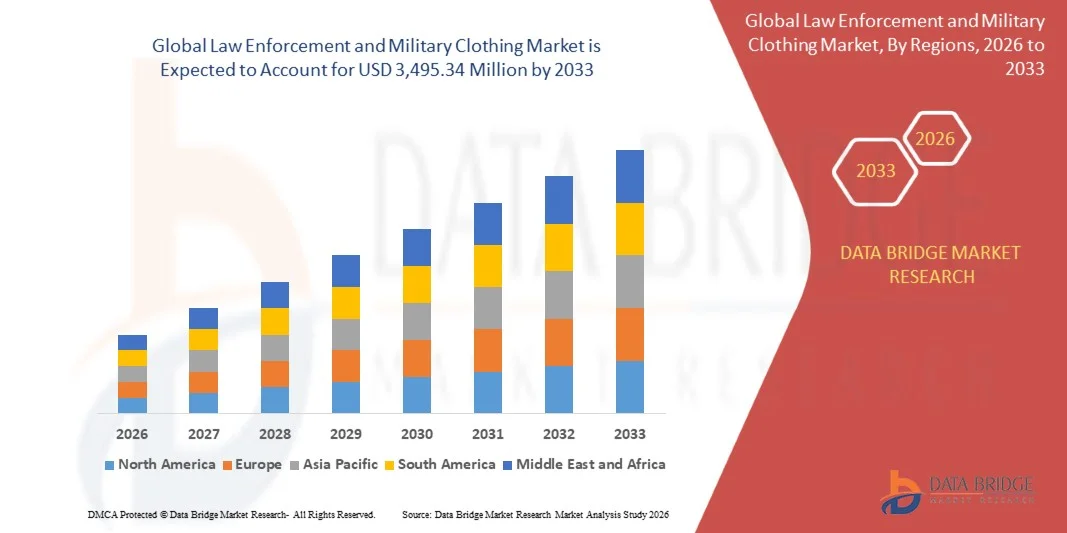
- As per Data Bridge Market Research analysis, the law enforcement and military clothing market was valued at USD 1,932.34 million in 2025 and is projected to reach USD 3,495.34 million by 2033, growing at a CAGR of 7.69% from 2026 to 2033.
- The market is experiencing steady growth driven by the rising global defense expenditure, increasing modernization of law enforcement uniforms and protective apparel, and growing adoption of advanced technical fabrics offering flame resistance, ballistic protection, and moisture management for field personnel.
- The growing emphasis on soldier and officer survivability, combined with increasing government investment in next-generation combat and duty apparel, is compelling defense and law enforcement procurement agencies to transition toward advanced aramid-fiber and high-performance synthetic fabrics that offer improved durability, comfort, and multi-threat protection. Rising demand for modular, MOLLE-compatible tactical clothing systems is further reshaping procurement specifications across military and law enforcement agencies worldwide.
- Continued innovation in lightweight, breathable ballistic and flame-resistant textiles is enabling manufacturers to reduce garment weight while maintaining or improving protection levels, addressing longstanding concerns around personnel fatigue and heat stress during extended field deployments.
Market Size & Forecast
- Global Market Value (2025): USD 1,932.34 Million
- Expected Market Value (2033): USD 3,495.34 Million
- Forecast CAGR (2026–2033): 7.69%
- Leading Region in 2025: North America
- Fastest Growing Region: Asia-Pacific
What are the Major Takeaways of the Law Enforcement and Military Clothing Market?
- North America dominated the global law enforcement and military clothing market with the largest revenue share of 35.62% in 2025, supported by high defense spending and extensive law enforcement uniform modernization programs.
- Asia-Pacific is expected to be the fastest-growing region at a CAGR of 9.4% from 2026 to 2033, fueled by rising defense budgets, expanding paramilitary and border security forces, and growing domestic textile manufacturing capacity in China and India.
- The combat uniforms segment led the market with a 34.87% share in 2025, driven by continuous replacement cycles, ongoing uniform modernization programs, and consistent government procurement across military branches.
- The aramid fibers material type segment is the fastest-growing material category, projected to register a CAGR of 10.2%, reflecting rising demand for flame-resistant and ballistic-grade fabrics across combat and tactical apparel applications.
- The military end user segment dominated the end user category with a 62.74% revenue share in 2025, led by sustained global defense modernization programs and recurring uniform and protective-apparel procurement cycles.
- The government procurement/direct contracts distribution channel accounted for 68.43% of the market share in 2025, preferred for its long-term supply agreements and standardized specification compliance requirements.
- The digital/pixelated camouflage pattern segment is the fastest-growing pattern category, with a CAGR of 9.8%, driven by rising adoption of advanced multi-terrain camouflage systems designed for improved concealment across diverse operational environments.
Report Scope and Law Enforcement and Military Clothing Market Segmentation
|
Attributes |
Law Enforcement and Military Clothing Key Market Insights |
|
Segments Covered |
|
|
Countries Covered |
North America
Europe
Asia-Pacific
Middle East and Africa
South America
|
|
Key Market Players |
|
|
Market Opportunities |
|
|
Value Added Data Infosets |
In addition to the insights on market scenarios such as market value, growth rate, segmentation, geographical coverage, and major players, the market reports curated by the Data Bridge Market Research also include in-depth expert analysis, geographically represented company-wise production and capacity, network layouts of distributors and partners, detailed and updated price trend analysis and deficit analysis of supply chain and demand. |
What is the Key Trend in the Law Enforcement and Military Clothing Market?
- Defense and law enforcement procurement agencies are increasingly transitioning toward advanced aramid-fiber and high-performance synthetic fabrics that offer improved flame resistance, ballistic protection, and durability compared to legacy cotton-blend uniforms.
- For instance, in April 2025, Teijin Limited expanded its Twaron aramid-fiber production capacity in Europe to meet rising demand from military and law enforcement apparel manufacturers seeking improved flame-resistant and ballistic-grade fabrics.
- Rising adoption of modular, MOLLE-compatible tactical clothing systems is enabling military and law enforcement personnel to customize load-bearing configurations for mission-specific equipment attachment.
- Manufacturers are increasingly investing in advanced multi-terrain digital and pixelated camouflage patterns designed to improve concealment effectiveness across diverse operational environments and lighting conditions.
- For instance, in January 2025, Crye Precision introduced an updated multi-environment camouflage pattern and lightweight combat uniform system, targeting military customers seeking improved concealment and reduced garment weight.
- As defense and law enforcement agencies continue to prioritize personnel survivability, comfort, and operational versatility, the adoption of advanced technical clothing and fabric systems is expected to accelerate, reinforcing their role as a critical procurement category across global defense and security budgets.
What are the Key Drivers of the Law Enforcement and Military Clothing Market?
- Rising global defense expenditure, combined with increasing modernization of military and law enforcement uniform programs, has significantly increased demand for advanced technical clothing systems offering improved protection and durability.
- For instance, in March 2025, Point Blank Enterprises expanded its tactical apparel production capacity in North America to meet rising demand from law enforcement agencies upgrading standard-issue duty uniforms.
- Military and law enforcement procurement agencies are increasingly incorporating flame-resistant and ballistic-grade fabrics into standard uniform specifications to improve personnel survivability during combat and high-risk operations.
- For instance, in October 2024, Koninklijke Ten Cate announced an investment in additional flame-resistant fabric production capacity to support rising orders from military and law enforcement apparel manufacturers across North America and Europe.
- With defense and homeland security budgets increasingly prioritizing personnel protection and operational readiness, law enforcement and military clothing will remain an indispensable procurement category across armed forces, police agencies, and border security organizations worldwide.
- For instance, in June 2024, DuPont de Nemours expanded its Kevlar and Nomex fiber production capacity to support growing demand from tactical apparel manufacturers serving military and law enforcement customers globally.
Which Factors are Challenging the Growth of the Law Enforcement and Military Clothing Market?
- Advanced technical fabrics such as aramid fibers and multi-layer ballistic textiles carry significantly higher production costs than conventional cotton-blend uniforms, increasing the overall budgetary burden on defense and law enforcement procurement programs.
- These elevated material and manufacturing costs limit adoption among smaller law enforcement agencies and constrain procurement budgets in developing regions with limited defense spending capacity.
- For instance, in September 2024, the National Police of Colombia initiated a procurement process for 2024 police-unit supplies, demonstrating continued institutional demand for specialized uniforms and equipment across law enforcement agencies in South America.
- The high cost and lengthy procurement cycles associated with advanced technical clothing systems continue to restrict adoption, particularly among smaller law enforcement agencies and defense forces in emerging markets. This cost and procurement-cycle barrier slows market penetration in price-sensitive regions, limiting the widespread deployment of advanced protective clothing technologies despite growing demand.
How is the Law Enforcement and Military Clothing Market Segmented?
The law enforcement and military clothing market is segmented on the basis of product type, material type, fabric technology, protection level, end user, application, camouflage pattern, gender, distribution channel and design feature.
- By Product Type
On the basis of product type, the global law enforcement and military clothing market is segmented into combat uniforms, tactical vests & body armor apparel, camouflage clothing, outerwear & jackets, headgear, and footwear. The combat uniforms segment dominated the market with a 34.87% share in 2025, owing to continuous replacement cycles, ongoing uniform modernization programs, and consistent government procurement across military branches. These garments deliver essential field durability and protection, making them the foundational procurement category for defense and law enforcement apparel budgets.
The tactical vests & body armor apparel segment is projected to register the fastest growth at a CAGR of 9.6% from 2026 to 2033, driven by rising demand for lightweight, modular ballistic protection systems among both military and law enforcement personnel. Advances in ballistic textile technology, combined with growing emphasis on personnel survivability, are accelerating segment expansion.
- By Material Type
On the basis of material type, the global law enforcement and military clothing market is segmented into nylon, polyester, cotton blends, aramid fibers, ripstop fabrics, and others. The cotton blends segment led the market with a 31.24% share in 2025, supported by its widespread use in standard-issue duty uniforms requiring breathability, comfort, and cost-effective large-scale procurement.
The aramid fibers segment is expected to experience the fastest growth at a CAGR of 10.2% from 2026 to 2033, driven by increasing demand for flame-resistant and ballistic-grade fabrics across combat and tactical apparel applications.
- By Fabric Technology
On the basis of fabric technology, the global law enforcement and military clothing market is segmented into flame-resistant, water-resistant/waterproof, anti-microbial, moisture-wicking, and camouflage-printed. The flame-resistant segment dominated the market with a share of 33.68% in 2025 due to its widespread adoption across combat uniforms and tactical apparel requiring protection from fire and thermal hazards, increasing demand for compliance with military safety standards, and growing integration with advanced fiber-blend technologies. Additionally, rising focus on personnel safety in combat and industrial-hazard environments further supports the strong adoption of flame-resistant fabric technology.
The moisture-wicking segment is anticipated to witness the fastest CAGR of 9.9% from 2026 to 2033, driven by the increasing need for comfort-enhancing fabric technologies that improve personnel performance during extended field deployments and physically demanding operations. Manufacturers are adopting advanced moisture-management textile platforms to conduct cost-effective, scalable, and repeatable garment production. Additionally, the integration of moisture-wicking technology with lightweight combat and duty uniforms is enhancing personnel comfort and operational endurance, further driving segment growth.
- By Protection Level
On the basis of protection level, the global law enforcement and military clothing market is segmented into ballistic protection, flame & fire protection, chemical & biological protection, and standard duty wear. The standard duty wear segment dominated the market with a share of 41.53% in 2025 due to its critical role in outfitting the largest base of military and law enforcement personnel engaged in routine duty, training, and administrative functions. The widespread procurement of standard-issue uniforms across all branches and ranks is driving strong demand for this protection-level category.
The ballistic protection segment is expected to witness the fastest CAGR of 10.4% from 2026 to 2033, driven by the rising need for lightweight, wearable ballistic protection systems among frontline military and law enforcement personnel. Procurement agencies are increasingly integrating soft-armor and hard-plate-compatible apparel into standard tactical loadouts. Additionally, the growing emphasis on personnel survivability in high-threat operational environments is further accelerating adoption of this protection-level category.
- By End User
On the basis of end user, the global law enforcement and military clothing market is segmented into military, law enforcement/police, paramilitary & border security, and private security. The military segment dominated the market with a share of 62.74% in 2025 due to its critical role in equipping the largest global personnel base across army, navy, and air force branches requiring recurring uniform and protective-apparel procurement. High adoption is driven by the increasing need for standardized combat and duty apparel, integration with national defense modernization programs, and enhanced procurement-cycle consistency. Additionally, growing investment by defense ministries and armed forces procurement agencies to improve personnel protection and operational readiness is reinforcing the leading position of this segment in the market.
The law enforcement/police segment is expected to witness the fastest CAGR of 9.1% from 2026 to 2033. This growth is driven by increasing municipal and national law enforcement uniform modernization programs seeking improved officer safety, comfort, and durability. Growing adoption of advanced ballistic-resistant and flame-resistant duty uniforms among police departments is further accelerating market expansion in this segment.
- By Application
On the basis of application, the global law enforcement and military clothing market is segmented into combat & field operations, training, ceremonial, riot control, and everyday duty wear. The everyday duty wear segment dominated the market with a share of 38.29% in 2025 due to its widespread use as the primary daily apparel category for both military and law enforcement personnel across administrative, patrol, and routine operational duties. Rising adoption of durable, comfortable, and cost-effective standard uniforms is enabling procurement agencies to enhance personnel readiness, reduce replacement frequency, and optimize apparel budgets. Additionally, increasing investment by defense and law enforcement procurement agencies is accelerating adoption and reinforcing this segment's leading position in the market.
The riot control segment is expected to witness the fastest CAGR of 9.7% from 2026 to 2033, driven by the increasing integration of advanced protective clothing systems designed to withstand impact, chemical exposure, and close-quarters confrontation during civil disturbance response operations. These systems enhance officer protection, reduce injury risk, and allow more effective crowd-management operations, making advanced riot-control apparel more accessible, desirable, and valuable for law enforcement agencies.
- By Camouflage Pattern
On the basis of camouflage pattern, the global law enforcement and military clothing market is segmented into woodland, desert, digital/pixelated, urban, and solid color. The solid color segment dominated the market with a share of 36.42% in 2025 due to its widespread adoption in law enforcement duty uniforms and ceremonial apparel that prioritize visibility and standardized department branding over concealment. High adoption is supported by police departments, private security firms, and administrative military personnel that rely on solid-color uniforms to ensure consistency, professional appearance, and measurable operational outcomes. Additionally, increasing integration with department-specific branding and rank-insignia systems enhances uniform standardization and reinforces the dominance of the solid color segment.
The digital/pixelated segment is expected to witness the fastest CAGR of 9.8% from 2026 to 2033. This growth is primarily driven by the increasing demand for advanced multi-terrain concealment patterns that improve operational effectiveness across diverse combat environments. By offering improved visual disruption and adaptability across terrain types, this pattern category enhances tactical concealment, personnel safety, and mission effectiveness, making digital camouflage highly attractive for modern military procurement programs.
- By Gender
On the basis of gender, the global law enforcement and military clothing market is segmented into men, women, and unisex. The men segment dominated the market with a share of 68.37% in 2025 due to its preference among the largest base of military and law enforcement personnel globally, reflecting current force composition across most national defense and police organizations. Additionally, established manufacturing infrastructure, broad supplier familiarity, and extensive sizing and fit standards are facilitating continued adoption of men's-fit uniforms, while strong procurement relationships are improving accessibility, reliability, and trust, further reinforcing this segment's leading market position.
The women segment is expected to witness the fastest CAGR of 10.6% from 2026 to 2033, driven by the increasing representation of women across military and law enforcement forces globally, prompting procurement agencies to expand dedicated women's-fit uniform and protective-apparel lines. Manufacturers are leveraging updated sizing standards and ergonomic design to enhance fit, comfort, and protective-equipment compatibility, thereby accelerating adoption across defense and law enforcement procurement programs.
- By Distribution Channel
On the basis of distribution channel, the global law enforcement and military clothing market is segmented into government procurement/direct contracts, institutional suppliers, and retail & specialty stores. The government procurement/direct contracts segment dominated the market with a share of 68.43% in 2025 due to its widespread adoption in large-scale defense and law enforcement uniform sourcing, which requires standardized specification compliance, long-term supply agreements, and quality-assurance certification. High adoption is supported by defense ministries, police departments, and border security agencies that rely on direct government contracts to ensure consistency, cost control, and measurable procurement outcomes. Additionally, increasing integration with digital procurement and contract-management systems enhances sourcing efficiency and reinforces the dominance of the government procurement/direct contracts segment.
The retail & specialty stores segment is expected to witness the fastest CAGR of 8.9% from 2026 to 2033. This growth is primarily driven by the increasing demand from individual military and law enforcement personnel, private security contractors, and outdoor enthusiasts for direct-purchase tactical apparel and gear. By offering accessible, cost-effective retail sourcing, this channel enhances product availability, personalization options, and purchasing convenience, making it highly attractive for individual buyers and smaller private security firms.
- By Design Feature
On the basis of design feature, the global law enforcement and military clothing market is segmented into modular/MOLLE-compatible and standard design. The standard design segment dominated the market with a share of 57.86% in 2025 due to its critical role in outfitting the largest base of personnel engaged in routine duty and administrative functions that do not require modular equipment-attachment capabilities. Additionally, established manufacturing infrastructure, cost-effective production processes, and extensive procurement history are facilitating continued adoption of standard-design uniforms across global defense and law enforcement budgets.
The modular/MOLLE-compatible segment is expected to witness the fastest CAGR of 10.1% from 2026 to 2033, driven by the increasing demand for customizable, mission-adaptable load-bearing equipment systems among frontline military and tactical law enforcement units. Manufacturers and procurement agencies are leveraging modular attachment platforms to enhance operational flexibility, enable rapid equipment reconfiguration, and support diverse mission profiles, thereby accelerating adoption across special operations and tactical response units.
Which Region Holds the Largest Share of the Law Enforcement and Military Clothing Market?
- North America dominated the law enforcement and military clothing market and accounted for the largest revenue share of 35.62% in 2025, supported by high defense spending, extensive law enforcement uniform modernization programs, and the presence of established technical textile and apparel manufacturers.
- The region also benefits from strong government procurement infrastructure, high adoption of advanced ballistic and flame-resistant fabric technologies, and growing use of modular tactical clothing systems across military and law enforcement applications. Increasing focus on personnel survivability and domestic defense-manufacturing self-reliance continues to strengthen North America's leadership position in the global market.
U.S. Law Enforcement and Military Clothing Market Insight
The U.S. law enforcement and military clothing market is growing steadily, driven by sustained defense modernization spending, extensive municipal and federal law enforcement uniform upgrade programs, and rising adoption of advanced technical fabrics across combat and duty apparel. Growing adoption of lightweight ballistic protection systems and modular tactical clothing across military branches and police departments is significantly boosting market demand. In addition, rising investments in domestic technical textile manufacturing capacity, increasing defense-procurement self-reliance initiatives, and rapid material innovation are positioning the United States as the leading market for law enforcement and military clothing globally.
Canada Law Enforcement and Military Clothing Market Insight
The Canadian law enforcement and military clothing market is expanding steadily, driven by increased federal defense spending and modernizing equipment standards for tactical personnel. A primary catalyst for growth is the strict requirement for advanced cold-weather gear, forcing manufacturers to innovate with high-performance thermal insulation, water resistance, and arctic-grade durability. Additionally, there is a strong shift toward domestic procurement policies within Canada to secure local supply chains. Government contracts increasingly prioritize Canadian-based textile manufacturers, fueling regional market competition and technological development in protective combat apparel.
Asia-Pacific Law Enforcement and Military Clothing Market Insight
The Asia-Pacific law enforcement and military clothing market fueled by rising defense budgets and territorial tensions. Major economies like China, India, and Japan are aggressively modernizing combat uniforms, driving high demand for flame-resistant and aramid-based technical textiles. Regional growth centers on indigenous manufacturing, with domestic contractors scaling production to secure local supply chains. Procurement focuses heavily on environment-specific gear, ranging from high-altitude arctic outerwear to lightweight, moisture-wicking apparel optimized for tropical jungle operations.
China Law Enforcement and Military Clothing Market Insight
The China law enforcement and military clothing market is expanding rapidly, supported by sustained defense budget growth, large-scale paramilitary and border security force expansion, and increasing domestic technical textile manufacturing capacity. Military and law enforcement procurement agencies are increasingly utilizing advanced aramid-fiber and flame-resistant fabrics for combat and duty apparel applications. Continuous expansion of domestic fiber-production infrastructure, government defense-modernization mandates, and rising export-oriented technical textile production are further driving market growth in China.
India Law Enforcement and Military Clothing Market Insight
The India law enforcement and military clothing market is expanding steadily, supported by rising defense modernization spending, expanding paramilitary and border security forces, and increasing investments in domestic technical textile manufacturing infrastructure. Military and police procurement agencies are increasingly integrating advanced ballistic-resistant and flame-resistant apparel into standard-issue uniform programs. Continuous advancements in cost-optimized fabric technologies, along with strong government focus on domestic defense manufacturing under self-reliance initiatives, are further driving market growth in India.
Which are the Top Companies in Law Enforcement and Military Clothing Market?
The law enforcement and military clothing industry is primarily led by well-established companies, including:
- Honeywell International Inc. (U.S.)
- DuPont de Nemours, Inc. (U.S.)
- Teijin Limited (Japan)
- Koninklijke Ten Cate B.V. (TenCate Protective Fabrics) (Netherlands)
- W. L. Gore & Associates, Inc. (U.S.)
- Milliken & Company (U.S.)
- Propper International (U.S.)
- Tru-Spec (Atlanco, Inc.) (U.S.)
- Crye Precision LLC (U.S.)
- Point Blank Enterprises, Inc. (U.S.)
- Safariland Group (U.S.)
- BAE Systems plc (U.K.)
- Elbit Systems Ltd. (Israel)
- Rheinmetall AG (Germany)
- Survitec Group Limited (U.K.)
- Ansell Limited (Australia)
- 3M Company (U.S.)
- Drägerwerk AG & Co. KGaA (Germany)
- Kappler, Inc. (U.S.)
- Peerless Garments LP (Canada)
- MSA Safety Incorporated (U.S.)
- Gentex Corporation (U.S.)
- Blauer Manufacturing Company, Inc. (U.S.)
- Spiewak & Sons, Inc. (U.S.)
- Marom Dolav Ltd. (Israel)
- Kolon Industries, Inc. (South Korea)
- Berry Global Group, Inc. (U.S.)
- LHD Group (Spain)
- Carrington Textiles Ltd. (U.K.)
What are Latest Developments in Law Enforcement and Military Clothing Market?
- In September 2025, Honeywell International launched an upgraded Spectra Shield fiber platform for lightweight ballistic protection apparel, strengthening its position in the military and law enforcement body-armor apparel market.
- In February 2025, Point Blank Enterprises expanded its tactical vest and body armor apparel manufacturing capacity in North America to support growing demand from law enforcement agencies upgrading protective equipment.
- In November 2025, Crye Precision introduced a next-generation multi-environment camouflage combat uniform system incorporating lightweight, moisture-wicking fabric technology, improving personnel comfort and concealment effectiveness across diverse operational terrains. This development strengthens Crye Precision's position in the combat apparel market by offering militaries an updated alternative to legacy uniform systems.
- In October 2024, Koninklijke Ten Cate expanded its flame-resistant fabric production capacity in Europe to include additional aramid-blend product lines, improving supply continuity for military and law enforcement apparel manufacturers.
- In June 2023, Teijin Limited partnered with a defense apparel manufacturer to co-develop next-generation aramid-fiber combat uniform fabrics, combining its fiber technology expertise with the partner's garment manufacturing capabilities to support improved flame resistance and durability for military end users.

- Interactive Data Analysis Dashboard
- Company Analysis Dashboard for high growth potential opportunities
- Research Analyst Access for customization & queries
- Competitor Analysis with Interactive dashboard
- Latest News, Updates & Trend analysis
- Harness the Power of Benchmark Analysis for Comprehensive Competitor Tracking
Global Law Enforcement And Military Clothing Market, Supply Chain Analysis and Ecosystem Framework
To support market growth and help clients navigate the impact of geopolitical shifts, DBMR has integrated in-depth supply chain analysis into its Global Law Enforcement And Military Clothing Market research reports. This addition empowers clients to respond effectively to global changes affecting their industries. The supply chain analysis section includes detailed insights such as Global Law Enforcement And Military Clothing Market consumption and production by country, price trend analysis, the impact of tariffs and geopolitical developments, and import and export trends by country and HSN code. It also highlights major suppliers with data on production capacity and company profiles, as well as key importers and exporters. In addition to research, DBMR offers specialized supply chain consulting services backed by over a decade of experience, providing solutions like supplier discovery, supplier risk assessment, price trend analysis, impact evaluation of inflation and trade route changes, and comprehensive market trend analysis.
Data collection and base year analysis are done using data collection modules with large sample sizes. The stage includes obtaining market information or related data through various sources and strategies. It includes examining and planning all the data acquired from the past in advance. It likewise envelops the examination of information inconsistencies seen across different information sources. The market data is analysed and estimated using market statistical and coherent models. Also, market share analysis and key trend analysis are the major success factors in the market report. To know more, please request an analyst call or drop down your inquiry.
The key research methodology used by DBMR research team is data triangulation which involves data mining, analysis of the impact of data variables on the market and primary (industry expert) validation. Data models include Vendor Positioning Grid, Market Time Line Analysis, Market Overview and Guide, Company Positioning Grid, Patent Analysis, Pricing Analysis, Company Market Share Analysis, Standards of Measurement, Global versus Regional and Vendor Share Analysis. To know more about the research methodology, drop in an inquiry to speak to our industry experts.
Data Bridge Market Research is a leader in advanced formative research. We take pride in servicing our existing and new customers with data and analysis that match and suits their goal. The report can be customized to include price trend analysis of target brands understanding the market for additional countries (ask for the list of countries), clinical trial results data, literature review, refurbished market and product base analysis. Market analysis of target competitors can be analyzed from technology-based analysis to market portfolio strategies. We can add as many competitors that you require data about in the format and data style you are looking for. Our team of analysts can also provide you data in crude raw excel files pivot tables (Fact book) or can assist you in creating presentations from the data sets available in the report.













