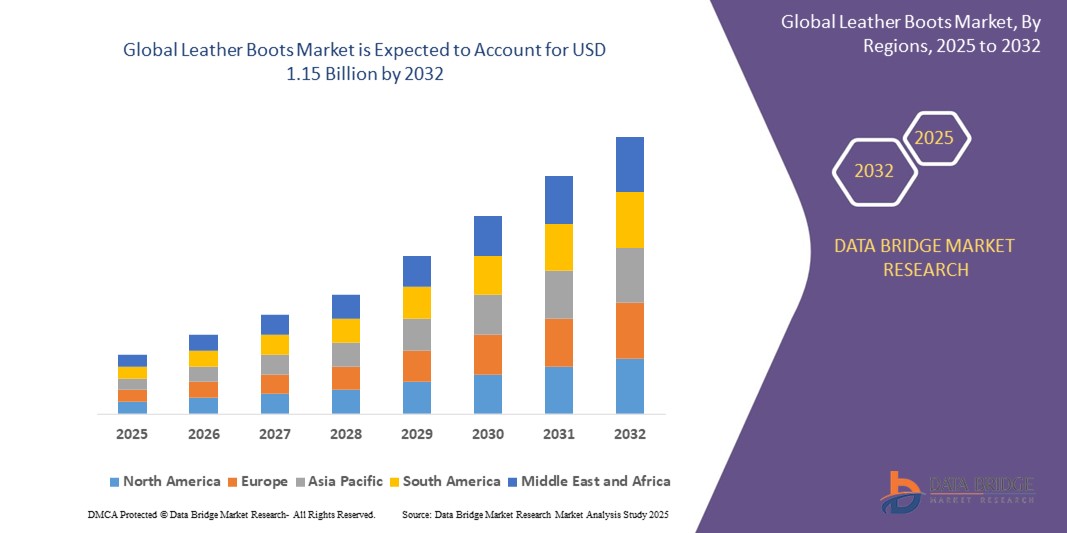
Leather Boots Market Size
- The global leather boots market was valued at USD 1.06 billion in 2024 and is expected to reach USD 1.15 billion by 2032
- During the forecast period of 2025 to 2032 the market is likely to grow at a CAGR of 1.05%, primarily driven by the rising demand for durable and stylish footwear
- This growth is driven by factors such as increasing consumer interest in premium and sustainable fashion, expanding retail networks, and rising disposable incomes
Leather Boots Market Analysis
- Leather boots are a key category in the global footwear market, providing durable and stylish options for consumers across various demographics. They are widely used for fashion, work, and outdoor activities, offering long-lasting protection and comfort
- The demand for leather boots is significantly driven by the increasing preference for high-quality, durable footwear and the growing trend toward sustainable fashion. A large portion of global demand is driven by fashion-conscious consumers seeking premium footwear, with the highest demand seen in regions with colder climates and a strong outdoor culture
- The North America region stands out as one of the dominant regions for leather boots, driven by its established retail networks, high disposable incomes, and preference for quality footwear
- Globally, leather boots rank as one of the most sought-after footwear choices, following casual and sports shoes, and play a key role in the fashion and workwear sectors, offering versatility, comfort, and durability to a wide range of consumers
Report Scope and Leather Boots Market Segmentation
|
Attributes |
Leather Boots Key Market Insights |
|
Segments Covered |
|
|
Countries Covered |
North America
Europe
Asia-Pacific
Middle East and Africa
South America
|
|
Key Market Players |
|
|
Market Opportunities |
|
|
Value Added Data Infosets |
In addition to the insights on market scenarios such as market value, growth rate, segmentation, geographical coverage, and major players, the market reports curated by the Data Bridge Market Research also include in-depth expert analysis, pricing analysis, brand share analysis, consumer survey, demography analysis, supply chain analysis, value chain analysis, raw material/consumables overview, vendor selection criteria, PESTLE Analysis, Porter Analysis, and regulatory framework. |
Leather Boots Market Trends
“Rising Demand for Sustainable and Eco-friendly Leather Boots”
- One prominent trend in the global leather boots market is the growing demand for sustainable and eco-friendly materials
- Consumers are increasingly prioritizing environmentally responsible products, prompting brands to incorporate sustainable practices and materials such as vegetable-tanned leather and recycled components
- For instance, brands are adopting plant-based leather alternatives and reducing waste in the production process to appeal to environmentally conscious consumers
- This trend is reshaping the leather boots market by encouraging innovation in material sourcing and production methods, fostering the growth of eco-friendly product lines
Leather Boots Market Dynamics
Driver
“Rising Consumer Demand for Durable and Stylish Footwear”
- The growing consumer preference for high-quality, durable, and fashionable footwear is significantly contributing to the increased demand for leather boots
- As consumers prioritize long-lasting products, leather boots are becoming a popular choice due to their durability, comfort, and timeless style, making them suitable for both everyday wear and specialized use
- The increasing interest in outdoor activities and workwear further boosts demand for leather boots, which are valued for their protective qualities and ruggedness
- Additionally, the rising disposable incomes and expanding middle-class populations in emerging markets are driving the demand for premium leather boots
- As a result of the rising demand for durable and stylish footwear, the leather boots market is witnessing significant growth across various regions, driving innovation and expansion in the sector
Opportunity
“Integration of Sustainable and Innovative Materials in Leather Boots”
- The increasing demand for eco-friendly and sustainable products presents a significant opportunity for the leather boots market
- Brands are exploring the use of alternative materials such as plant-based leathers, recycled materials, and environmentally conscious tanning processes to appeal to eco-conscious consumers
- This shift towards sustainability offers manufacturers a chance to innovate in design, reduce environmental impact, and attract a growing segment of consumers who prioritize ethical and sustainable production
For instance,
- In January 2024, according to a report by The Business of Fashion, several leading footwear brands began incorporating plant-based leather alternatives like mushroom leather and apple skin into their collections, responding to the rising consumer demand for sustainable footwear options
- The integration of sustainable materials and innovative production methods into leather boots is set to enhance brand image, capture eco-conscious consumers, and drive growth in the market
Restraint/Challenge
“High Production and Material Costs Hindering Market Growth”
- The high cost of producing leather boots is a significant challenge for the market, particularly affecting smaller manufacturers and brands, especially in regions with lower labor and material availability
- Leather, being a premium material, combined with manufacturing processes such as tanning and stitching, can make the final product costly, which in turn impacts the pricing and accessibility for consumers
- This financial barrier can prevent smaller brands or emerging markets from competing effectively, leading to price constraints and limited market penetration
For instance,
- In August 2023, according to a report by Footwear News, the rising costs of raw materials like leather and labor in countries like Italy and Brazil have caused some footwear brands to increase their retail prices, making them less accessible to price-sensitive consumers
- Consequently, these challenges could result in limited growth opportunities for small-scale producers and a slower adoption of premium leather boot products in price-sensitive markets
Leather Boots Market Scope
The market is segmented on the basis of product, end user, distribution channel, and grade type.
|
Segmentation |
Sub-Segmentation |
|
By Product |
|
|
By End User |
|
|
By Distribution Channel |
|
|
By Grade Type |
|
Leather Boots Market Regional Analysis
“North America is the Dominant Region in the Leather Boots Market”
- North America dominates the leather boots market, driven by strong consumer demand, premium product offerings, and a high level of fashion-consciousness among consumers
- The U.S. holds a significant share due to the increasing demand for durable, stylish leather boots across various sectors, including fashion, outdoor activities, and workwear
- The presence of well-established retail chains, along with a preference for high-quality leather products, continues to fuel market expansion in the region
- Furthermore, the growing interest in sustainable and ethically sourced leather products is encouraging the development of eco-friendly options within the market
“Asia-Pacific is Projected to Register the Highest Growth Rate”
- The Asia-Pacific region is expected to witness the highest growth rate in the leather boots market, driven by rapid urbanization, rising disposable incomes, and an expanding middle class
- Countries such as China, India, and Japan are emerging as key markets due to an increasing preference for fashionable and durable leather boots, particularly among young and working-age populations
- Japan, with its advanced fashion culture and high spending power, remains a crucial market for premium leather boots, while China and India are witnessing a surge in demand for both high-end and affordable leather products
- The growth is also supported by the increasing availability of leather boots in both brick-and-mortar stores and online platforms, making them more accessible to a wide range of consumers
Leather Boots Market Share
The market competitive landscape provides details by competitor. Details included are company overview, company financials, revenue generated, market potential, investment in research and development, new market initiatives, global presence, production sites and facilities, production capacities, company strengths and weaknesses, product launch, product width and breadth, application dominance. The above data points provided are only related to the companies' focus related to market.
The Major Market Leaders Operating in the Market Are:
- Nike (U.S.)
- Adidas (Germany)
- Dr. Martens (U.K.)
- Timberland (U.S.)
- Red Wing Shoes (U.S.)
- Clarks (U.K.)
- UGG Australia (U.S.)
- Steve Madden (U.S.)
- Hunter Boot (U.K.)
- Frye (U.S.)
- Danner (U.S.)
- Vans (U.S.)
- Geox (Italy)
- Keen (U.S.)
- Columbia Sportswear (U.S.)
- Sorel (Canada)
- Bata (Switzerland)
- Palladium (France)
- Timberland PRO (U.S.)
- L.L. Bean (U.S.)
Latest Developments in Global Leather Boots Market
- In August 2022, Amar Shoes & Leather Wears, a prominent manufacturer of leather footwear, launched its exclusive collection of high-quality leather men's shoes in India under the brand name EZOK
- In March 2022, MoonRay, a womenswear brand, introduced a collection of plant-based vegan leather footwear, designed to complement its garments and accessories, available for purchase on its e-commerce platform
- In January 2021, Adidas AG unveiled a new line of trainers crafted from mushroom leather as part of its sustainability initiative. The company partnered with biotech startup Bolt Threads, along with Stella McCartney and lululemon, to develop plant-based vegan leather trainers
- In January 2021, Nike, Inc. introduced its inaugural SB Dunk sneakers constructed from vegan leather. These cruelty-free sneakers are part of Nike's Zero Waste Initiative, launched in 2019
- In August 2020, PUMA SE unveiled its inaugural collection of three Xetic sneakers in collaboration with Porsche Design. The collection featured both casual and performance footwear crafted from 100% recycled mesh material, 100% chrome-free leather, and liners containing 30% algae

- Interactive Data Analysis Dashboard
- Company Analysis Dashboard for high growth potential opportunities
- Research Analyst Access for customization & queries
- Competitor Analysis with Interactive dashboard
- Latest News, Updates & Trend analysis
- Harness the Power of Benchmark Analysis for Comprehensive Competitor Tracking
Data collection and base year analysis are done using data collection modules with large sample sizes. The stage includes obtaining market information or related data through various sources and strategies. It includes examining and planning all the data acquired from the past in advance. It likewise envelops the examination of information inconsistencies seen across different information sources. The market data is analysed and estimated using market statistical and coherent models. Also, market share analysis and key trend analysis are the major success factors in the market report. To know more, please request an analyst call or drop down your inquiry.
The key research methodology used by DBMR research team is data triangulation which involves data mining, analysis of the impact of data variables on the market and primary (industry expert) validation. Data models include Vendor Positioning Grid, Market Time Line Analysis, Market Overview and Guide, Company Positioning Grid, Patent Analysis, Pricing Analysis, Company Market Share Analysis, Standards of Measurement, Global versus Regional and Vendor Share Analysis. To know more about the research methodology, drop in an inquiry to speak to our industry experts.
Data Bridge Market Research is a leader in advanced formative research. We take pride in servicing our existing and new customers with data and analysis that match and suits their goal. The report can be customized to include price trend analysis of target brands understanding the market for additional countries (ask for the list of countries), clinical trial results data, literature review, refurbished market and product base analysis. Market analysis of target competitors can be analyzed from technology-based analysis to market portfolio strategies. We can add as many competitors that you require data about in the format and data style you are looking for. Our team of analysts can also provide you data in crude raw excel files pivot tables (Fact book) or can assist you in creating presentations from the data sets available in the report.