


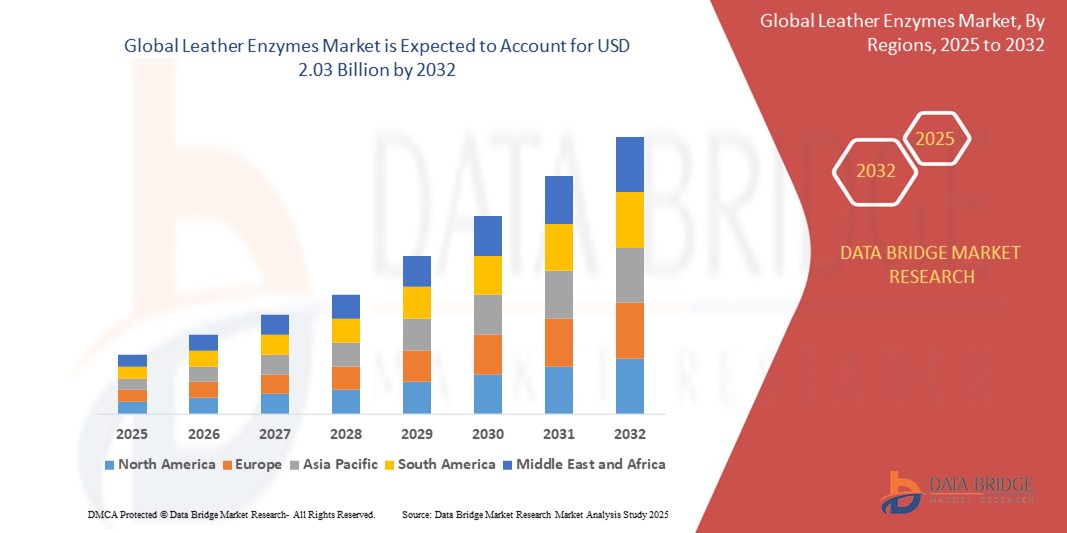
Leather Enzymes Market Size
- The global leather enzymes market size was valued at USD 1.31 billion in 2024 and is expected to reach USD 2.03 billion by 2032, at a CAGR of 5.6% during the forecast period
- This growth is driven by factors such as the rising demand for eco-friendly leather processing solutions and increasing adoption of enzymatic alternatives to traditional chemical treatments across the leather industry
Leather Enzymes Market Analysis
- The leather enzymes market is witnessing steady growth as manufacturers shift towards sustainable and cost-effective processing methods that improve leather quality and reduce environmental impact
- Increasing demand for high-performance enzymes that enhance tanning efficiency and minimize waste generation is influencing product innovation and commercial uptake in the market
- North America is expected to dominate the leather enzymes market due to the presence of advanced leather processing facilities, growing adoption of eco-friendly technologies, and strong regulatory support for sustainable practices
- Asia-Pacific is expected to be the fastest growing region in the leather enzymes market during the forecast period due to rapid industrialization, expansion of the leather manufacturing sector, and rising awareness about environmentally friendly processing methods
- The industrial segment is expected to dominate the leather enzymes market with the largest share of 56.5% in 2025 due to its widespread use in large-scale leather processing operations. Industrial enzymes offer enhanced efficiency, reduced processing time, and improved environmental sustainability compared to traditional chemicals. They are preferred in applications such as soaking, dehairing, and bating, where high-volume throughput and consistent results are essential. This segment benefits from rising demand for cost-effective, eco-friendly processing solutions in the global leather industry.
Report Scope and Leather Enzymes Market Segmentation
|
Attributes |
Leather Enzymes Key Market Insights |
|
Segments Covered |
|
|
Countries Covered |
North America
Europe
Asia-Pacific
Middle East and Africa
South America
|
|
Key Market Players |
|
|
Market Opportunities |
|
|
Value Added Data Infosets |
In addition to the insights on market scenarios such as market value, growth rate, segmentation, geographical coverage, and major players, the market reports curated by the Data Bridge Market Research also include import export analysis, production capacity overview, production consumption analysis, price trend analysis, climate change scenario, supply chain analysis, value chain analysis, raw material/consumables overview, vendor selection criteria, PESTLE Analysis, Porter Analysis, and regulatory framework. |
Leather Enzymes Market Trends
“Integration of Smart Technologies in Leather Enzyme Processing”
- Automation is being widely adopted in enzyme-based leather processing to improve efficiency, reduce labor dependency, and minimize processing time
- Real-time monitoring tools are enabling precise control of enzymatic reactions, which helps maintain consistent leather quality and reduces material waste
- Data-driven technologies are helping manufacturers optimize enzyme concentration and application techniques for various leather types
- The use of customized enzyme formulations guided by intelligent systems is enhancing product innovation and meeting specific customer requirements
- For instance, companies such as Stahl have partnered with tech innovators to implement digital process control systems that monitor enzyme performance and reduce chemical load during leather production
Leather Enzymes Market Dynamics
Driver
“Rising Demand for Eco-Friendly Leather Processing”
- Growing environmental awareness among manufacturers and consumers is accelerating the shift toward sustainable leather processing methods using enzymes
- For instance, European tanneries are adopting enzyme-based solutions to meet EU environmental standards and reduce pollution levels
- Traditional leather processing uses chemicals such as sulfides and lime that contribute to water pollution and hazardous waste, creating pressure for cleaner alternatives
- Enzymes such as proteases, lipases, and amylases offer an eco-friendly solution by effectively replacing harmful chemicals while operating at lower temperatures and pH levels
- Enzymatic processing generates less solid waste and simplifies wastewater treatment, making it a viable choice for tanneries focused on sustainable operations
- Sustainability initiatives in the fashion and automotive industries are increasing demand for green leather treatments, further pushing the market toward enzyme adoption
Opportunity
“Innovation in Enzyme Formulations for Specialized Leather Finishing”
- A key opportunity in the leather enzymes market lies in creating customized enzyme blends tailored to different leather types and finishes
- For instance, enzymes engineered for high-end upholstery leather help enhance softness without compromising strength
- Each leather application, such as footwear, automotive interiors, or luxury accessories, demands unique qualities such as texture, durability, or grain consistency
- Biotechnological innovations are enabling enzyme formulations that can target specific processing needs, such as fat removal or controlled grain tightening
- These precision-driven enzyme systems reduce reprocessing, improve material yield, and support consistent quality, meeting both performance and sustainability expectations
- With increasing demand for premium and differentiated leather products, brands using application-specific enzymes can stand out in niche markets
Restraint/Challenge
“High Cost and Limited Awareness in Emerging Markets”
- Despite their benefits, leather enzymes face slow adoption due to high costs and limited awareness, especially in developing markets
- For instance, many small tanneries in South Asia continue to rely on sulfide-based methods due to lower upfront costs
- Producing enzymes requires advanced biotech infrastructure and quality control, which raises product prices compared to traditional chemicals
- Many small and medium-sized tanneries lack the capital and training to implement enzyme-based processes into their existing operations
- Limited understanding of enzyme functions, dosages, and application conditions hinders proper usage and discourages transition from chemical methods
- Regulatory inconsistencies and absence of universal quality standards across regions make it difficult for global enzyme adoption
Leather Enzymes Market Scope
The market is segmented on the basis of product, type, and source.
|
Segmentation |
Sub-Segmentation |
|
By Product |
|
|
By Type |
|
|
By Source |
|
In 2025, the industrial is projected to dominate the market with a largest share in type segment
The industrial segment is expected to dominate the leather enzymes market with the largest share of 56.5% in 2025 due to its widespread use in large-scale leather processing operations. Industrial enzymes offer enhanced efficiency, reduced processing time, and improved environmental sustainability compared to traditional chemicals. They are preferred in applications such as soaking, dehairing, and bating, where high-volume throughput and consistent results are essential. This segment benefits from rising demand for cost-effective, eco-friendly processing solutions in the global leather industry.
The carbohydrase is expected to account for the largest share during the forecast period in product segment
In 2025, the carbohydrase segment is expected to dominate the market with the largest market share of 47.5% due to its versatile role in breaking down complex carbohydrates during leather processing. Carbohydrases enhance the soaking and fiber-opening stages, improving water absorption and chemical penetration. Their efficiency in preparing hides for tanning contributes to better leather quality and texture. In addition, their mild reaction conditions align with sustainable manufacturing practices, driving their growing adoption.
Leather Enzymes Market Regional Analysis
“North America Holds the Largest Share in the Leather Enzymes Market”
- North America is expected to dominate the global leather enzymes market by holding a market share of 37.5%
- The region benefits from advanced leather processing technologies and established infrastructure, enabling widespread use of enzyme-based solutions
- Strict environmental regulations promote sustainable alternatives, accelerating the shift from traditional chemicals to bio-based enzymes
- Major players in enzyme manufacturing are headquartered in the region, contributing to technological advancements and consistent supply
- High consumer awareness and demand for eco-friendly leather in the fashion and automotive industries support strong market uptake
“Asia-Pacific is Projected to Register the Highest CAGR in the Leather Enzymes Market”
- Asia-Pacific is projected to be the fastest growing region in the leather enzymes market during the forecast period
- Rapid industrialization in countries such as China, India, and Bangladesh is driving growth in the leather sector, increasing the need for efficient processing methods
- Rising awareness about environmental sustainability is pushing tanneries to adopt enzyme-based technologies
- Cost-effective labour and government initiatives to improve wastewater management are supporting enzyme integration
- Growing exports of leather goods from Asia-Pacific markets create demand for high-quality, processed leather using enzyme treatments
Leather Enzymes Market Share
The market competitive landscape provides details by competitor. Details included are company overview, company financials, revenue generated, market potential, investment in research and development, new market initiatives, global presence, production sites and facilities, production capacities, company strengths and weaknesses, product launch, product width and breadth, application dominance. The above data points provided are only related to the companies' focus related to market.
The Major Market Leaders Operating in the Market Are:
- BASF (Germany)
- Novozymes (Denmark)
- DuPont Danisco (U.S.)
- DSM (Netherlands)
- NOVUS International (U.S.)
- Associated British Foods Plc (U.K.)
- Chr. Hansen Holding A/S (Denmark)
- Advanced Enzyme Technologies (India)
- Lesaffre (France)
- Adisseo (France)
Latest Developments in Global Leather Enzymes Market
- In January 2024, Novozymes and Chr. Hansen completed their merger to form Novonesis, a global biosolutions leader. This strategic combination aims to accelerate innovation in enzymes and microbial solutions by leveraging the strengths of both companies. The new entity is expected to provide more sustainable and efficient products across industries, including food, agriculture, and leather processing. By uniting advanced research capabilities and commercial reach, Novonesis enhances its ability to address global challenges such as climate change and resource efficiency. This merger is anticipated to strengthen market competitiveness and drive long-term growth in the biosolutions sector

- Interactive Data Analysis Dashboard
- Company Analysis Dashboard for high growth potential opportunities
- Research Analyst Access for customization & queries
- Competitor Analysis with Interactive dashboard
- Latest News, Updates & Trend analysis
- Harness the Power of Benchmark Analysis for Comprehensive Competitor Tracking
Global Leather Enzymes Market, Supply Chain Analysis and Ecosystem Framework
To support market growth and help clients navigate the impact of geopolitical shifts, DBMR has integrated in-depth supply chain analysis into its Global Leather Enzymes Market research reports. This addition empowers clients to respond effectively to global changes affecting their industries. The supply chain analysis section includes detailed insights such as Global Leather Enzymes Market consumption and production by country, price trend analysis, the impact of tariffs and geopolitical developments, and import and export trends by country and HSN code. It also highlights major suppliers with data on production capacity and company profiles, as well as key importers and exporters. In addition to research, DBMR offers specialized supply chain consulting services backed by over a decade of experience, providing solutions like supplier discovery, supplier risk assessment, price trend analysis, impact evaluation of inflation and trade route changes, and comprehensive market trend analysis.
Data collection and base year analysis are done using data collection modules with large sample sizes. The stage includes obtaining market information or related data through various sources and strategies. It includes examining and planning all the data acquired from the past in advance. It likewise envelops the examination of information inconsistencies seen across different information sources. The market data is analysed and estimated using market statistical and coherent models. Also, market share analysis and key trend analysis are the major success factors in the market report. To know more, please request an analyst call or drop down your inquiry.
The key research methodology used by DBMR research team is data triangulation which involves data mining, analysis of the impact of data variables on the market and primary (industry expert) validation. Data models include Vendor Positioning Grid, Market Time Line Analysis, Market Overview and Guide, Company Positioning Grid, Patent Analysis, Pricing Analysis, Company Market Share Analysis, Standards of Measurement, Global versus Regional and Vendor Share Analysis. To know more about the research methodology, drop in an inquiry to speak to our industry experts.
Data Bridge Market Research is a leader in advanced formative research. We take pride in servicing our existing and new customers with data and analysis that match and suits their goal. The report can be customized to include price trend analysis of target brands understanding the market for additional countries (ask for the list of countries), clinical trial results data, literature review, refurbished market and product base analysis. Market analysis of target competitors can be analyzed from technology-based analysis to market portfolio strategies. We can add as many competitors that you require data about in the format and data style you are looking for. Our team of analysts can also provide you data in crude raw excel files pivot tables (Fact book) or can assist you in creating presentations from the data sets available in the report.













