


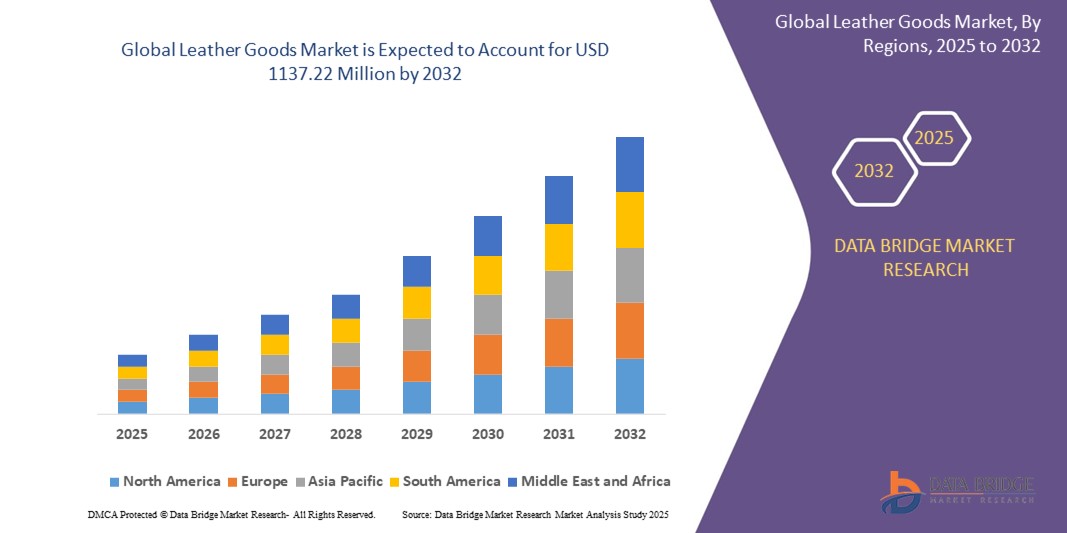
Leather Goods Market Size
- The global leather goods market was valued at USD 746.65 million in 2024 and is expected to reach USD 1,137.22 million by 2032
- During the forecast period of 2025 to 2032 the market is likely to grow at a CAGR of 5.40%, primarily driven by the increasing demand for luxury leather goods and growing consumer preferences for sustainable and eco-friendly products
- This growth is driven by factors such as rising disposable incomes, evolving fashion trends, and the expansion of e-commerce platforms, making leather goods more accessible globally
Leather Goods Market Analysis
- Leather goods are widely recognized for their durability, luxury appeal, and versatility, used in products ranging from footwear, bags, and wallets to apparel and accessories. Leather goods are crafted from both natural and synthetic materials and are essential in fashion, lifestyle, and functional products
- The demand for leather goods is primarily driven by the growing consumer preference for high-quality, long-lasting products, and an increasing inclination toward luxury and premium brands. Additionally, advancements in leather processing techniques and growing awareness about sustainable leather alternatives are contributing to market growth
- The Asia-Pacific region is anticipated to witness substantial growth in the leather goods market, driven by the expanding middle-class population, rising disposable income, and an increasing demand for both traditional and fashion-forward leather products
- For instance, countries like China and India are becoming key players in the production and consumption of leather goods, with the rise of domestic manufacturers and an expanding retail sector providing ample market opportunities
- Leather goods are increasingly becoming an integral part of global fashion trends, with continuous innovations in design, functionality, and sustainability. As a result, they remain a preferred choice for consumers worldwide, ensuring the steady growth of the market
Report Scope and Leather Goods Market Segmentation
|
Attributes |
Leather Goods Key Market Insights |
|
Segments Covered |
|
|
Countries Covered |
North America
Europe
Asia-Pacific
Middle East and Africa
South America
|
|
Key Market Players |
|
|
Market Opportunities |
|
|
Value Added Data Infosets |
In addition to the insights on market scenarios such as market value, growth rate, segmentation, geographical coverage, and major players, the market reports curated by the Data Bridge Market Research also include in-depth expert analysis, pricing analysis, brand share analysis, consumer survey, demography analysis, supply chain analysis, value chain analysis, raw material/consumables overview, vendor selection criteria, PESTLE Analysis, Porter Analysis, and regulatory framework. |
Leather Goods Market Trends
“Growing Demand for Sustainable and Eco-friendly Leather Goods”
- A significant trend in the global leather goods market is the increasing demand for sustainable and eco-friendly products
- Consumers are becoming more conscious of the environmental impact of leather production, driving the adoption of eco-friendly materials such as plant-based leather, recycled leather, and alternative synthetic options
- For instance, brands are focusing on using vegetable-tanned leather and reducing their carbon footprint by implementing sustainable manufacturing processes
- Many luxury and mainstream brands are also incorporating environmentally conscious practices, such as adopting cruelty-free leather alternatives and reducing waste, to meet consumer demand for ethical products
- This trend is transforming the leather goods market, as companies focus on sustainability to attract environmentally aware consumers and align with global sustainability goals
Leather Goods Market Dynamics
Driver
“Rising Consumer Demand for Premium and Customized Leather Goods”
- The increasing demand for premium and customized leather goods is significantly driving the growth of the global leather goods market
- Consumers are becoming more interested in high-quality, unique leather products, such as personalized handbags, wallets, shoes, and belts, that reflect individual style and preferences
- The growing middle-class population in emerging markets is contributing to higher disposable incomes, which fuels the demand for luxury and high-end leather goods
- Additionally, the rise of online platforms has made it easier for consumers to access bespoke leather products, further enhancing the demand for tailored, exclusive leather items
- As consumers seek personalized, high-quality leather products, manufacturers are responding by offering customizable options, making this a key driver for market growth
For instance,
- In 2023, renowned luxury brands began offering tailored leather products, allowing customers to personalize items such as handbags and shoes with initials, colors, and patterns, catering to the growing demand for individual expression in luxury goods
- The global leather goods market is expected to grow due to increasing demand for premium items and custom-made designs, particularly in North America and Europe
Opportunity
“Expansion of Eco-Friendly and Sustainable Leather Goods”
- The growing consumer preference for sustainable and eco-friendly products is significantly boosting the global leather goods market
- As awareness of environmental impact increases, consumers are seeking leather products made from sustainably sourced materials, such as vegetable-tanned leather, or those produced using eco-friendly processes
- Manufacturers are adopting innovative techniques, such as plant-based leather alternatives (such as mushroom leather, pineapple leather) to cater to this emerging demand, further promoting environmental responsibility
- With governments and organizations increasingly focusing on sustainable practices, the leather goods industry is witnessing a shift toward reducing the carbon footprint and ensuring ethical production processes
- This trend is being further amplified by the rise of ethical consumerism, where consumers are more conscious of the environmental and social impacts of their purchasing decisions
For instance,
- In 2023, several leading leather goods brands launched collections made from sustainable and cruelty-free materials, including vegan leather and bio-based alternatives, gaining popularity in markets like Europe and North America
- According to a study by the Ellen MacArthur Foundation, the global demand for sustainable leather goods is expected to grow significantly, with more consumers prioritizing brands that offer eco-friendly and ethically sourced products
Restraint/Challenge
“High Production Costs and Raw Material Prices”
- The high production costs and fluctuating raw material prices, particularly for high-quality leather, are significant challenges in the global leather goods market
- Leather, especially premium types like full-grain and top-grain leather, requires substantial resources and processing, leading to increased production expenses
- Additionally, the rising costs of labor and environmental compliance in leather tanning and manufacturing processes further contribute to the overall price increase of leather goods
- As a result, the high cost of production can lead to higher retail prices for leather products, which may deter price-sensitive consumers and limit market expansion, especially in emerging economies
For instance,
- In June 2024, according to a report published by the International Leather Goods Manufacturers Association, the cost of leather production increased by 10% due to rising raw material prices, affecting the profitability of leather goods manufacturers worldwide
- In July 2023, the price hike in hides and skins led several global leather goods brands to reconsider their production strategies, with some opting for synthetic or alternative leather materials to maintain competitive pricing in the market
- The high production costs and fluctuating raw material prices, especially for premium leathers, pose significant challenges to the global leather goods market. The rising costs of labor and environmental compliance further increase expenses, leading to higher retail prices that may deter price-sensitive consumers
Leather Goods Market Scope
The market is segmented on the basis leather type, product, grade, and distribution channel.
|
Segmentation |
Sub-Segmentation |
|
By Leather Type |
|
|
By Product |
|
|
By Grade |
|
|
By Distribution Channel
|
|
Leather Goods Market Regional Analysis
“North America is the Dominant Region in the Global Leather Goods Market”
- North America dominates the global leather goods market due to a high demand for premium leather products, a strong retail infrastructure, and the presence of several luxury brands and manufacturers
- The U.S. holds a significant share, driven by the high consumer preference for premium leather goods, including bags, footwear, and accessories, along with a strong presence of global luxury brands
- The region's high disposable income, coupled with a well-established retail network, allows for continuous market expansion and innovation in product offerings
- In addition, the growing trend of sustainable and ethically sourced leather products is pushing manufacturers to adopt innovative production processes and materials
“Asia-Pacific is Projected to Register the Highest Growth Rate”
- The Asia-Pacific region is expected to witness the highest growth rate in the global leather goods market, fueled by increasing disposable incomes, rapid urbanization, and a rising demand for both premium and affordable leather products
- Countries such as China, India, and Japan are emerging as key markets for leather goods due to their expanding middle class, increased demand for fashion accessories, and a shift toward higher-quality products
- China, with its vast manufacturing base and growing domestic consumption, is becoming a major player in the production and consumption of leather goods, especially in footwear, bags, and wallets
- India, with its booming retail industry and increasing preference for leather fashion items, is contributing significantly to the market's growth. Japan, known for its sophisticated fashion trends, is also expected to see strong demand for luxury and high-quality leather goods
Leather Goods Market Share
The market competitive landscape provides details by competitor. Details included are company overview, company financials, revenue generated, market potential, investment in research and development, new market initiatives, global presence, production sites and facilities, production capacities, company strengths and weaknesses, product launch, product width and breadth, application dominance. The above data points provided are only related to the companies' focus related to market.
The Major Market Leaders Operating in the Market Are:
- Louis Vuitton (France)
- Gucci (Italy)
- Prada (Italy)
- Hermès (France)
- Coach (U.S.)
- Michael Kors (U.S.)
- Fossil Group, Inc. (U.S.)
- Tapestry, Inc. (U.S.)
- Samsonite International S.A. (Hong Kong)
- Montblanc (Germany)
- LVMH (France)
- Bally (Switzerland)
- Burberry (U.K.)
- Kate Spade (U.S.)
- Radley London (U.K.)
- The Leather Satchel Co. (U.K.)
- S.T. Dupont (France)
- Longchamp (France)
- Tod’s (Italy)
- Shinola (U.S.)
Latest Developments in Global Leather Goods Market
- In October 2022, LVMH further strengthened its footprint in Italy by inaugurating new production facilities for Fendi and Bulgari. Despite escalating costs, the company remains steadfast in its substantial investments in Italian manufacturing, underscoring its dedication to maintaining the highest standards of quality and craftsmanship in one of the world’s foremost fashion hubs. This strategic expansion highlights LVMH's continued commitment to premium leather goods production, particularly in Italy, renowned for its leather craftsmanship
- In October 2022, Prada, a leading name in luxury fashion, officially opened a state-of-the-art facility near Sibiu, Romania, focused on producing components for its leather goods. Managed by Hipic Prod Impex, now integrated into the Prada group, the 31,000-square-foot factory, located in the West Industrial Zone of Sibiu, highlights Prada's strategic move to enhance its production capabilities and streamline its manufacturing processes. This expansion reflects Prada's commitment to maintaining the highest standards in leather craftsmanship while optimizing its production processes
- In April 2022, Tapestry, Inc., the New York-based luxury accessories and lifestyle conglomerate encompassing Coach, Kate Spade, and Stuart Weitzman, entered into a strategic partnership with the World Wildlife Fund (WWF). This collaboration, supported by a philanthropic grant of USD 3 million from the Tapestry Foundation, is focused on driving sustainability within Brazil's leather industry. The initiative aims to develop an innovative traceability system that fosters social and environmental justice, thereby supporting responsible practices within the sector. This partnership highlights Tapestry’s commitment to promoting sustainability and ethical sourcing practices within the leather goods industry
- In January 2022, Thrasio-style Mensa Brands announced the acquisition of Estalon, aiming to meet the increasing demand for leather products. The acquisition is designed to expand Mensa Brands' footprint, leveraging Estalon's expertise in data-driven insights, digital marketing, and operational efficiencies. This acquisition underscores Mensa Brands' strategic move to enhance its presence in the competitive leather goods market. By integrating Estalon’s capabilities in digital marketing and operational optimization, Mensa Brands is well-positioned to address the growing consumer demand for high-quality leather products
- In October 2021, Roots unveiled a collection of limited-edition leather jackets and handbags in collaboration with Révolutionnaire. This exclusive collection emphasizes inclusivity and social justice, aiming to appeal to a broader consumer base. This collaboration highlights Roots' commitment to both social responsibility and expanding its market reach within the global leather industry

- Interactive Data Analysis Dashboard
- Company Analysis Dashboard for high growth potential opportunities
- Research Analyst Access for customization & queries
- Competitor Analysis with Interactive dashboard
- Latest News, Updates & Trend analysis
- Harness the Power of Benchmark Analysis for Comprehensive Competitor Tracking
Data collection and base year analysis are done using data collection modules with large sample sizes. The stage includes obtaining market information or related data through various sources and strategies. It includes examining and planning all the data acquired from the past in advance. It likewise envelops the examination of information inconsistencies seen across different information sources. The market data is analysed and estimated using market statistical and coherent models. Also, market share analysis and key trend analysis are the major success factors in the market report. To know more, please request an analyst call or drop down your inquiry.
The key research methodology used by DBMR research team is data triangulation which involves data mining, analysis of the impact of data variables on the market and primary (industry expert) validation. Data models include Vendor Positioning Grid, Market Time Line Analysis, Market Overview and Guide, Company Positioning Grid, Patent Analysis, Pricing Analysis, Company Market Share Analysis, Standards of Measurement, Global versus Regional and Vendor Share Analysis. To know more about the research methodology, drop in an inquiry to speak to our industry experts.
Data Bridge Market Research is a leader in advanced formative research. We take pride in servicing our existing and new customers with data and analysis that match and suits their goal. The report can be customized to include price trend analysis of target brands understanding the market for additional countries (ask for the list of countries), clinical trial results data, literature review, refurbished market and product base analysis. Market analysis of target competitors can be analyzed from technology-based analysis to market portfolio strategies. We can add as many competitors that you require data about in the format and data style you are looking for. Our team of analysts can also provide you data in crude raw excel files pivot tables (Fact book) or can assist you in creating presentations from the data sets available in the report.













