


Legal Operations Software Market Overview
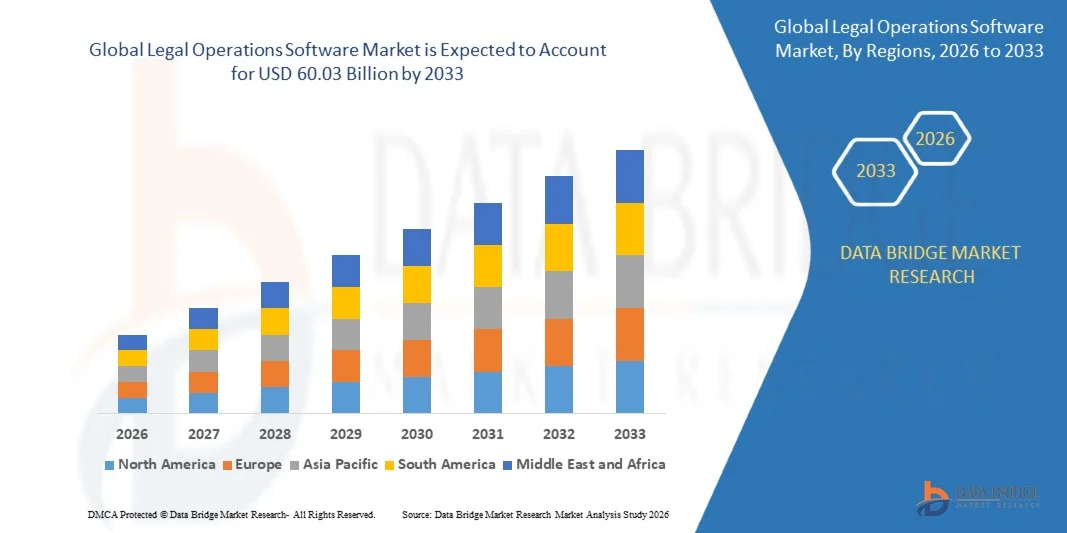
The Legal Operations Software Market was valued at USD 20.18 billion in 2025 and is projected to reach USD 60.03 billion by 2033, growing at a CAGR of 14.60% from 2026 to 2033. The market is experiencing rapid growth driven by increasing digital transformation across corporate legal departments, rising demand for workflow automation, and growing pressure on organizations to improve legal efficiency while controlling operational costs. Expanding adoption of cloud-based legal platforms, contract lifecycle management solutions, e-billing systems, and matter management software is further accelerating market expansion across enterprises of all sizes.
The increasing complexity of regulatory requirements, growing volumes of legal data, and rising demand for transparency in legal spending are encouraging organizations to modernize traditional legal operations through advanced software solutions. Legal operations software enables corporate legal teams to streamline contract management, automate compliance tracking, improve collaboration, and gain real-time visibility into legal workflows and expenditures. In addition, the growing integration of artificial intelligence, machine learning, predictive analytics, and document automation capabilities is enhancing decision-making and operational productivity. As enterprises continue to prioritize risk management, governance, and legal process optimization, legal operations software is becoming an essential tool for improving efficiency, reducing manual workloads, and supporting strategic business objectives.
Key Market Trends & Insights
- North America dominated the legal operations software market with the largest revenue share of 41.26% in 2025, supported by early adoption of legal technology solutions, strong digital transformation initiatives, the presence of major legal software providers, and increasing demand for operational efficiency across corporate legal departments and law firms.
- Asia-Pacific is expected to be the fastest-growing region, recording a CAGR of 16.20% from 2026 to 2033. Growth is driven by rapid enterprise digitalization, expanding corporate sectors, increasing adoption of cloud computing technologies, rising regulatory compliance requirements, and growing investments in legal technology infrastructure.
- The Cloud segment held the largest market revenue share of approximately 68.7% in 2025 driven by increasing enterprise adoption of Software-as-a-Service (SaaS) platforms, lower infrastructure costs, and greater operational flexibility. Cloud-based legal operations solutions enable legal teams to access contracts, compliance data, and case information remotely while supporting seamless collaboration across geographically distributed teams. The growing preference for scalable and subscription-based software models continues to strengthen segment dominance.
- The Cloud segment is also projected to register the fastest growth at a CAGR of 16.2% from 2026 to 2033, driven by rising digital transformation initiatives, increasing adoption among small and medium-sized enterprises, and continuous advancements in AI-powered legal software platforms. Growing demand for real-time analytics, automated updates, and enhanced cybersecurity capabilities is further accelerating segment expansion.
- The Large Enterprises segment held the largest market revenue share of approximately 71.4% in 2025 driven by higher legal workloads, complex regulatory obligations, and substantial investments in enterprise legal technology infrastructure. Large organizations increasingly deploy legal operations software to streamline contract management, monitor compliance requirements, control legal spending, and improve operational transparency across multiple business units and jurisdictions.
- The Small Enterprises segment is projected to register the fastest growth at a CAGR of 15.8% from 2026 to 2033, driven by increasing affordability of cloud-based legal software solutions and growing awareness of workflow automation benefits. Rising adoption of subscription-based legal technology platforms is enabling smaller organizations to improve efficiency without significant upfront investments, supporting rapid segment growth.
- The Contract Management segment held the largest market revenue share of approximately 24.9% in 2025 driven by increasing contract volumes, growing compliance requirements, and rising demand for automated contract lifecycle management solutions. Organizations utilize contract management software to improve visibility, reduce legal risks, and accelerate approval workflows across procurement, sales, and vendor management functions.
- The Governance, Risk Management, and Compliance segment is projected to register the fastest growth at a CAGR of 17.1% from 2026 to 2033, driven by evolving regulatory requirements, increasing cybersecurity concerns, and growing enterprise focus on risk mitigation. Organizations are investing heavily in compliance monitoring and governance solutions to strengthen regulatory adherence and operational resilience.
- The Corporate segment held the largest market revenue share of approximately 63.5% in 2025 driven by rising demand for centralized legal management, contract automation, legal spend tracking, and regulatory compliance solutions. Corporate legal departments increasingly utilize integrated software platforms to manage growing legal workloads while improving productivity and reducing administrative costs. The expansion of multinational business operations continues to support strong demand within this segment.
- The Law Firms segment is projected to register the fastest growth at a CAGR of 15.4% from 2026 to 2033, driven by increasing adoption of cloud-based practice management solutions, AI-assisted legal research tools, and automated document management platforms. Growing competition among legal service providers and rising client expectations for efficiency and transparency are accelerating technology investments across law firms globally.
Market Size & Forecast
- Global Market Value (2025): USD 20.18 Billion
- Expected Market Value (2033): USD 60.03 Billion
- Forecast CAGR (2026–2033): 14.60%
- Leading Region in 2025: North America
- Fastest Growing Region: Asia-Pacific
Report Scope and Legal Operations Software Market Segmentation
|
Attributes |
Legal Operations Software Key Market Insights |
|
Segments Covered |
|
|
Countries Covered |
North America
Europe
Asia-Pacific
Middle East and Africa
South America
|
|
Key Market Players |
• Elevate Services, Inc. (U.S.) |
|
Market Opportunities |
• Increasing Adoption Of AI-Powered Legal Analytics And Contract Intelligence Solutions • Growing Demand For Cloud-Based Legal Operations Platforms Across Small And Medium Enterprises |
|
Value Added Data Infosets |
In addition to the market insights such as market value, growth rate, market segments, geographical coverage, market players, and market scenario, the market report curated by the Data Bridge Market Research team includes in-depth expert analysis, import/export analysis, pricing analysis, production consumption analysis, and pestle analysis. |
Legal Operations Software Market Trends
Trend: Rapid Integration Of Artificial Intelligence And Automation In Legal Workflows
Increasing demand for operational efficiency, cost control, and faster legal service delivery is driving the adoption of artificial intelligence and automation technologies across corporate legal departments and law firms. Traditional legal processes often involve extensive manual document review, contract analysis, compliance monitoring, and matter management activities that consume significant time and resources. As organizations face growing regulatory complexity and rising legal workloads, businesses are increasingly deploying legal operations software to automate repetitive tasks and improve decision-making capabilities.
In modern enterprises, legal teams are integrating AI-powered contract lifecycle management systems, For instance for automated clause extraction, risk identification, and contract review, to accelerate legal processes and reduce administrative burdens. Corporate legal departments are also utilizing workflow automation platforms to streamline matter intake, e-billing, and compliance reporting functions. The rapid growth of cloud computing and generative AI technologies is further increasing demand for intelligent legal solutions capable of improving productivity and accuracy. In addition, legal technology providers are continuously expanding AI functionality to support predictive analytics and legal spend management. Industry surveys conducted during 2025 indicated that organizations deploying AI-enabled legal software reduced contract review times by approximately 30–50% while improving document processing efficiency across legal operations.
Legal Operations Software Market Dynamics
Key Market Driver: Growing Need For Legal Process Efficiency And Cost Optimization
Organizations worldwide are facing increasing pressure to improve legal department performance while controlling operational expenditures. Rising contract volumes, growing compliance obligations, and expanding regulatory requirements are creating significant administrative burdens for corporate legal teams. This is generating strong demand for software solutions capable of automating legal workflows, improving resource allocation, and providing greater visibility into legal operations.
Enterprises across financial services, healthcare, technology, manufacturing, and retail sectors are increasingly deploying legal operations software to manage contracts, legal matters, compliance activities, and outside counsel spending more efficiently. Legal departments are implementing centralized legal management platforms, For instance enterprise legal management and e-billing systems, to improve budgeting accuracy and operational transparency. Similarly, multinational organizations are adopting integrated legal technology solutions to support governance and risk management initiatives. Real-world implementations across North America and Europe during 2024 reported reductions of approximately 15–25% in external legal spending following deployment of advanced legal operations management platforms.
Key Restraint/Challenge: Data Security Concerns And Complex System Integration
Legal operations software platforms handle highly sensitive corporate, financial, regulatory, and client-related information, making data security and privacy protection critical concerns for organizations. Legal departments must ensure compliance with various data protection regulations while safeguarding confidential information against cyber threats and unauthorized access. These requirements often complicate software deployment and increase implementation costs.
In addition, integrating legal operations platforms with existing enterprise resource planning, document management, customer relationship management, and compliance systems can be technically complex. Organizations frequently face challenges associated with data migration, interoperability, user adoption, and customization requirements. Small and medium-sized enterprises may encounter additional barriers related to implementation costs and limited technical expertise. Industry assessments indicate that enterprise legal software implementation projects can require integration timelines of six to twelve months depending on organizational complexity, creating operational and budgetary challenges for some users.
Key Market Opportunity: Expansion Of AI-Powered Legal Analytics And Contract Intelligence Solutions
Modern enterprises increasingly require data-driven insights to improve legal decision-making, manage risks, and enhance contract performance. Traditional legal review processes often provide limited visibility into contractual obligations, compliance exposure, and legal spending patterns. This is creating significant opportunities for advanced legal operations software solutions incorporating artificial intelligence, predictive analytics, and contract intelligence capabilities.
Software providers are increasingly integrating machine learning and generative AI technologies, For instance automated contract analysis, legal research assistance, and risk prediction tools, to improve operational efficiency and support strategic decision-making. In addition, growing adoption of cloud-based legal platforms is enabling organizations to access scalable analytics capabilities without substantial infrastructure investments. Advancements in natural language processing are further enhancing the ability of legal teams to extract actionable insights from large volumes of unstructured legal data. Pilot deployments conducted during 2025 reported contract processing productivity improvements of approximately 40–60% and compliance review time reductions of nearly 25–35% after implementation of AI-driven legal operations software platforms.
Legal Operations Software Market Scope
The market is segmented on the basis of deployment, organization, application, and end user.
• By Deployment
On the basis of deployment, the legal operations software market is segmented into Cloud and On-Premise. The Cloud segment held the largest market revenue share of approximately 68.7% in 2025 driven by increasing enterprise adoption of Software-as-a-Service (SaaS) platforms, lower infrastructure costs, and greater operational flexibility. Cloud-based legal operations solutions enable legal teams to access contracts, compliance data, and case information remotely while supporting seamless collaboration across geographically distributed teams. The growing preference for scalable and subscription-based software models continues to strengthen segment dominance.
The Cloud segment is also projected to register the fastest growth at a CAGR of 16.2% from 2026 to 2033, driven by rising digital transformation initiatives, increasing adoption among small and medium-sized enterprises, and continuous advancements in AI-powered legal software platforms. Growing demand for real-time analytics, automated updates, and enhanced cybersecurity capabilities is further accelerating segment expansion.
• By Organization
On the basis of organization, the legal operations software market is segmented into Large Enterprises and Small Enterprises. The Large Enterprises segment held the largest market revenue share of approximately 71.4% in 2025 driven by higher legal workloads, complex regulatory obligations, and substantial investments in enterprise legal technology infrastructure. Large organizations increasingly deploy legal operations software to streamline contract management, monitor compliance requirements, control legal spending, and improve operational transparency across multiple business units and jurisdictions.
The Small Enterprises segment is projected to register the fastest growth at a CAGR of 15.8% from 2026 to 2033, driven by increasing affordability of cloud-based legal software solutions and growing awareness of workflow automation benefits. Rising adoption of subscription-based legal technology platforms is enabling smaller organizations to improve efficiency without significant upfront investments, supporting rapid segment growth.
• By Application
On the basis of application, the legal operations software market is segmented into Legal Hold/e-Discovery, e-Billing, Intellectual Property Management, Matter/Case Management, Contract Management, Legal Project and Analytics Management, Governance, Risk Management, and Compliance, Knowledge Management, Document Management, and Others. The Contract Management segment held the largest market revenue share of approximately 24.9% in 2025 driven by increasing contract volumes, growing compliance requirements, and rising demand for automated contract lifecycle management solutions. Organizations utilize contract management software to improve visibility, reduce legal risks, and accelerate approval workflows across procurement, sales, and vendor management functions.
The Governance, Risk Management, and Compliance segment is projected to register the fastest growth at a CAGR of 17.1% from 2026 to 2033, driven by evolving regulatory requirements, increasing cybersecurity concerns, and growing enterprise focus on risk mitigation. Organizations are investing heavily in compliance monitoring and governance solutions to strengthen regulatory adherence and operational resilience.
• By End User
On the basis of end user, the legal operations software market is segmented into Law Firms, Corporate, and Others. The Corporate segment held the largest market revenue share of approximately 63.5% in 2025 driven by rising demand for centralized legal management, contract automation, legal spend tracking, and regulatory compliance solutions. Corporate legal departments increasingly utilize integrated software platforms to manage growing legal workloads while improving productivity and reducing administrative costs. The expansion of multinational business operations continues to support strong demand within this segment.
The Law Firms segment is projected to register the fastest growth at a CAGR of 15.4% from 2026 to 2033, driven by increasing adoption of cloud-based practice management solutions, AI-assisted legal research tools, and automated document management platforms. Growing competition among legal service providers and rising client expectations for efficiency and transparency are accelerating technology investments across law firms globally.
Legal Operations Software Market Regional Analysis
North America Legal Operations Software Market Insight
North America dominated the legal operations software market with the largest revenue share of 41.26% in 2025, supported by early adoption of legal technology solutions, a highly developed corporate sector, and increasing investments in digital transformation initiatives. Organizations across the region are increasingly deploying legal operations platforms to streamline contract management, automate legal workflows, and improve compliance monitoring. The presence of leading legal technology vendors, coupled with growing demand for operational efficiency and cost control, continues to strengthen market growth. In addition, rising adoption of artificial intelligence and cloud-based legal solutions is accelerating software implementation across enterprises and law firms.
U.S. Legal Operations Software Market Insight
The U.S. legal operations software market captured the largest revenue share in 2025 within North America, fueled by increasing digitalization of legal departments and strong demand for workflow automation solutions. Corporate legal teams are increasingly prioritizing contract lifecycle management, legal spend management, and compliance automation to improve productivity and reduce administrative burdens. The growing adoption of AI-powered legal analytics and document review platforms is further supporting market expansion. Moreover, the presence of major technology providers and a strong focus on regulatory compliance continue to drive investment in legal operations software across industries.
Europe Legal Operations Software Market Insight
The Europe legal operations software market is expected to witness significant growth from 2026 to 2033, primarily driven by evolving regulatory requirements, increasing adoption of cloud technologies, and growing demand for operational transparency. Organizations across the region are implementing legal software platforms to strengthen governance, risk management, and compliance processes. The increasing complexity of data protection regulations and contractual obligations is encouraging enterprises to modernize legal operations. In addition, growing investments in digital transformation and enterprise automation are creating favorable conditions for market expansion across both private and public sectors.
U.K. Legal Operations Software Market Insight
The U.K. legal operations software market is expected to witness strong growth from 2026 to 2033, driven by increasing adoption of cloud-based legal technologies and growing demand for efficient legal service delivery. Businesses are increasingly investing in contract management, e-billing, and compliance software to improve operational efficiency and reduce legal costs. The country's mature legal services industry and strong technology ecosystem are supporting software adoption across law firms and corporate legal departments. Furthermore, rising focus on regulatory compliance and data governance is expected to contribute significantly to market growth.
Germany Legal Operations Software Market Insight
The Germany legal operations software market is expected to witness strong growth from 2026 to 2033, fueled by increasing enterprise digitization and growing demand for compliance management solutions. Germany's strong industrial base and highly regulated business environment are encouraging organizations to adopt legal operations platforms that improve transparency and risk management. Businesses are increasingly integrating legal software with enterprise systems to streamline workflows and enhance operational control. The growing focus on cybersecurity, data privacy, and regulatory compliance further supports the adoption of advanced legal technology solutions throughout the country.
Asia-Pacific Legal Operations Software Market Insight
The Asia-Pacific legal operations software market is expected to witness the fastest growth rate from 2026 to 2033, supported by rapid digital transformation, expanding corporate sectors, and increasing awareness of legal technology solutions. Organizations across the region are investing in software platforms to automate legal processes, improve compliance monitoring, and enhance contract management capabilities. The growing adoption of cloud computing, artificial intelligence, and enterprise automation technologies is accelerating market growth. Furthermore, increasing regulatory complexity and rising demand for operational efficiency are encouraging businesses to modernize legal functions across emerging economies.
Japan Legal Operations Software Market Insight
The Japan legal operations software market is expected to witness strong growth from 2026 to 2033 due to increasing enterprise digitalization, growing adoption of cloud technologies, and rising demand for compliance management solutions. Japanese organizations are increasingly implementing legal software platforms to improve document management, contract administration, and regulatory reporting processes. The integration of artificial intelligence and automation technologies is helping legal departments improve productivity and operational accuracy. Moreover, Japan's emphasis on corporate governance and risk management is supporting long-term market expansion.
China Legal Operations Software Market Insight
The China legal operations software market accounted for the largest market revenue share in Asia-Pacific in 2025, attributed to the country's rapidly expanding corporate sector, growing digital economy, and increasing adoption of enterprise software solutions. Chinese organizations are increasingly deploying legal operations platforms to manage contracts, compliance requirements, and legal workflows more efficiently. The growing implementation of cloud-based technologies and AI-powered business applications is accelerating software adoption across industries. In addition, government-led digitalization initiatives and increasing regulatory oversight are creating strong demand for advanced legal operations software solutions throughout the country.
Legal Operations Software Market Share
The Legal Operations Software industry is primarily led by well-established companies, including:
• Elevate Services, Inc. (U.S.)
• LexisNexis (U.S.)
• Wolters Kluwer ELM Solutions, Inc. (Netherlands)
• Thomson Reuters (Canada)
• Mitratech Holdings, Inc. (U.S.)
• ThinkSmart LLC (U.S.)
• SimpleLegal, Inc. (U.S.)
• doeLEGAL, Inc. (U.S.)
• BUSYLAMP GmbH (Germany)
• Acuity Management Solutions (U.S.)
• Onit, Inc. (U.S.)

- Interactive Data Analysis Dashboard
- Company Analysis Dashboard for high growth potential opportunities
- Research Analyst Access for customization & queries
- Competitor Analysis with Interactive dashboard
- Latest News, Updates & Trend analysis
- Harness the Power of Benchmark Analysis for Comprehensive Competitor Tracking
Data collection and base year analysis are done using data collection modules with large sample sizes. The stage includes obtaining market information or related data through various sources and strategies. It includes examining and planning all the data acquired from the past in advance. It likewise envelops the examination of information inconsistencies seen across different information sources. The market data is analysed and estimated using market statistical and coherent models. Also, market share analysis and key trend analysis are the major success factors in the market report. To know more, please request an analyst call or drop down your inquiry.
The key research methodology used by DBMR research team is data triangulation which involves data mining, analysis of the impact of data variables on the market and primary (industry expert) validation. Data models include Vendor Positioning Grid, Market Time Line Analysis, Market Overview and Guide, Company Positioning Grid, Patent Analysis, Pricing Analysis, Company Market Share Analysis, Standards of Measurement, Global versus Regional and Vendor Share Analysis. To know more about the research methodology, drop in an inquiry to speak to our industry experts.
Data Bridge Market Research is a leader in advanced formative research. We take pride in servicing our existing and new customers with data and analysis that match and suits their goal. The report can be customized to include price trend analysis of target brands understanding the market for additional countries (ask for the list of countries), clinical trial results data, literature review, refurbished market and product base analysis. Market analysis of target competitors can be analyzed from technology-based analysis to market portfolio strategies. We can add as many competitors that you require data about in the format and data style you are looking for. Our team of analysts can also provide you data in crude raw excel files pivot tables (Fact book) or can assist you in creating presentations from the data sets available in the report.













