


What is the Life Science Instrumentation Market Size and Growth Rate?
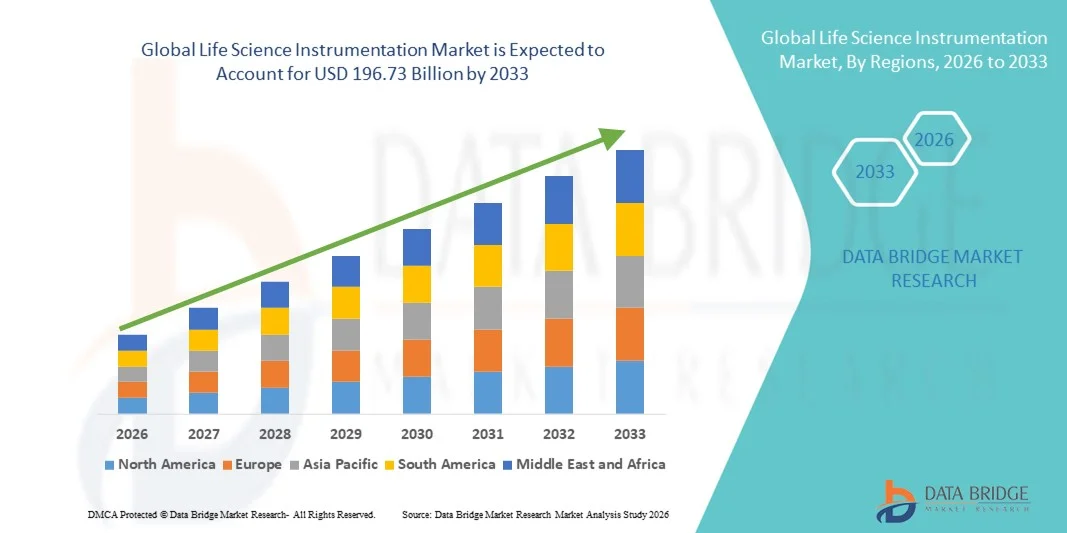
- As per Data Bridge Market Research Analysis the global life science instrumentation market size was valued at USD 111.55 billion in 2025 and is expected to reach USD 196.73 billion by 2033, at a CAGR of 7.35% during the forecast period
- The market growth is largely fueled by the growing adoption and technological advancements within analytical and laboratory instruments, leading to increased digitalization, automation, and precision in both research and clinical applications across pharmaceutical, biotechnology, and healthcare sectors
- Furthermore, rising demand for accurate, efficient, and integrated analytical systems for drug discovery, genomics, proteomics, and diagnostics is establishing Life Science Instrumentation as a cornerstone of modern laboratory infrastructure. These converging factors—coupled with expanding investments in R&D, the growing emphasis on personalized medicine, and technological innovation in mass spectrometry, chromatography, and molecular analysis—are accelerating the uptake of Life Science Instrumentation solutions, thereby significantly boosting the industry's growth
Market Size & Forecast
- Global Market Value (2025): USD 111.55 billion
- Expected Market Value (2033): USD 196.73 billion
- Forecast CAGR (2026–2033): 7.35%
What are the Major Takeaways of Life Science Instrumentation Market ?
- Life Science Instrumentation, encompassing analytical, diagnostic, and research instruments, is increasingly vital in modern biotechnology, pharmaceutical, and healthcare sectors due to its precision, automation, and integration with digital laboratory systems. The adoption of advanced instruments enables high-throughput analysis, real-time data monitoring, and enhanced accuracy across genomics, proteomics, and clinical diagnostics applications
- The escalating demand for Life Science Instrumentation is primarily fueled by the growing prevalence of chronic diseases, expansion of pharmaceutical R&D, and increasing focus on personalized medicine and molecular diagnostics. In addition, the integration of artificial intelligence, robotics, and automation in laboratories is revolutionizing research efficiency and analytical accuracy, significantly enhancing market adoption globally
- North America dominated the life science instrumentation market with the largest revenue share of 41.8% in 2025, driven by strong healthcare infrastructure, significant investments in life sciences research, and the presence of key industry leaders such as Thermo Fisher Scientific, Agilent Technologies, and Danaher Corporation. The region’s advanced biotechnology ecosystem, high R&D expenditure, and early adoption of digital laboratory automation tools are further propelling market expansion, particularly in genomics, drug discovery, and clinical diagnostics sectors
- Asia-Pacific is expected to be the fastest-growing region in the life science instrumentation market during the forecast period, projected to register a CAGR of 13.9% from 2026 to 2033, driven by rapid advancements in healthcare infrastructure, government initiatives to promote biomedical research, and rising investments by pharmaceutical and biotechnology firms in China, India, and Japan. The growing patient population, expansion of academic research institutions, and increased focus on preventive healthcare are accelerating demand for analytical and clinical instruments in the region
- The clinical and diagnostic applications segment accounted for the largest market revenue share of 48.2% in 2025, driven by increasing utilization of analytical and molecular instruments in disease diagnosis, biomarker discovery, and drug monitoring
Report Scope and Life Science Instrumentation Market Segmentation
|
Attributes |
Life Science Instrumentation Key Market Insights |
|
Segments Covered |
|
|
Countries Covered |
North America
Europe
Asia-Pacific
Middle East and Africa
South America
|
|
|
|
Market Opportunities |
|
|
Value Added Data Infosets |
In addition to the insights on market scenarios such as market value, growth rate, segmentation, geographical coverage, and major players, the market reports curated by the Data Bridge Market Research also include in-depth expert analysis, patient epidemiology, pipeline analysis, pricing analysis, and regulatory framework. |
What is the Key Trend in the Life Science Instrumentation Market ?
Advancement in Automation and Digitalization of Laboratory Systems
- A major and accelerating trend in the global life science instrumentation market is the growing automation and digital transformation of laboratory workflows, enabling faster, more accurate, and reproducible research outcomes
- The integration of robotic systems and automated analyzers has significantly improved sample handling efficiency, reduced human error, and enhanced data throughput in both clinical and research laboratories
- For instance, in February 2025, Agilent Technologies introduced a new fully automated liquid handling platform designed to optimize sample preparation for genomic and proteomic applications
- Digitalization through cloud-based data management and real-time analytics is also transforming how laboratories store, share, and interpret large datasets, promoting seamless collaboration across global research networks
- Moreover, miniaturization of analytical devices and lab-on-a-chip technologies is enabling faster diagnostics and field-based testing, expanding accessibility to advanced analytical capabilities beyond traditional laboratory settings
- Automation and connectivity are collectively redefining laboratory efficiency, leading to significant time savings, improved consistency, and reduced operational costs, while ensuring compliance with regulatory standards
- This ongoing trend toward smart, interconnected laboratories is expected to continue shaping the next phase of innovation in life sciences, fostering data-driven discoveries and high-throughput research solutions
Life Science Instrumentation Market Dynamics
Driver
Rising Demand for Advanced Analytical Tools in Drug Discovery and Clinical Diagnostics
- The Life Science Instrumentation market is experiencing robust growth due to increasing investments in biotechnology, pharmaceutical R&D, and clinical diagnostics aimed at improving disease detection and treatment precision
- The growing focus on precision medicine, genomics, and proteomics has intensified demand for advanced analytical tools such as mass spectrometers, chromatography systems, and sequencing instruments
- For instance, in March 2025, Thermo Fisher Scientific launched its Orbitrap Ascend Tribrid mass spectrometer, providing enhanced sensitivity and faster analysis for complex biological samples
- The surge in chronic diseases such as cancer, diabetes, and cardiovascular disorders has further propelled the need for reliable diagnostic tools that can deliver accurate, real-time results
- Automation, miniaturization, and digital integration in instruments are improving operational efficiency and accuracy in research and diagnostic workflows
- In addition, increasing collaborations between pharmaceutical firms, academic institutions, and CROs are accelerating the adoption of next-generation life science instrumentation technologies
- Overall, the demand for innovative and high-throughput analytical solutions continues to drive substantial market growth worldwide
Restraint/Challenge
High Equipment Costs and Maintenance Requirements Limiting Accessibility
- Despite the strong market momentum, the high cost of advanced life science instruments remains a major barrier, particularly for small laboratories and research facilities in emerging markets
- Instruments such as NMR spectrometers, electron microscopes, and high-resolution mass spectrometers require heavy capital investment, specialized infrastructure, and highly trained personnel
- For instance, comprehensive proteomic or metabolomic setups can cost several hundred thousand dollars, restricting access for smaller institutions and academic labs
- The ongoing cost of maintenance, software upgrades, and calibration also adds to the financial burden, impacting overall operational budgets
- Moreover, limited technical expertise in developing economies further slows the adoption of high-end analytical systems
- Manufacturers are responding by introducing modular systems, cloud-based analytics, and flexible leasing models to lower entry barriers
- Nevertheless, achieving widespread affordability and accessibility remains a key challenge for sustaining long-term market expansion
How is the Life Science Instrumentation Market Segmented ?
The market is segmented on the basis of technology, application, and end user.
- By Technology
On the basis of technology, the Life Science Instrumentation market is segmented into spectroscopy, chromatography, PCR, immunoassays, lyophilization, liquid handling, clinical chemistry analyzers, microscopy, flow cytometry, next-generation sequencing (NGS), centrifuges, electrophoresis, cell counting, and others. The spectroscopy segment dominated the largest market revenue share of 24.6% in 2025, primarily due to its broad application in pharmaceutical analysis, biotechnology research, and environmental testing. Spectroscopy technologies, including mass spectrometry, atomic absorption, and molecular spectroscopy, are essential for accurate detection, quantification, and structural analysis of biological and chemical compounds. Their integration with automation and AI-based data processing enhances accuracy and throughput, supporting rapid quality control and drug discovery efforts. The demand is also driven by the need for precise molecular characterization in proteomics and metabolomics studies, making spectroscopy indispensable across both research and diagnostic laboratories.
The next-generation sequencing (NGS) segment is expected to witness the fastest CAGR of 11.8% from 2026 to 2033, fueled by growing demand for personalized medicine, genomics-driven drug development, and declining sequencing costs. The increasing application of NGS in oncology, infectious disease surveillance, and reproductive health testing is driving rapid adoption across clinical and research settings. Continuous technological advancements in sequencing platforms, coupled with improved data analytics and bioinformatics tools, are further expanding its accessibility. Moreover, public–private investments in genomic research are propelling market expansion, positioning NGS as a transformative technology for precision medicine and large-scale genomic studies.
- By Application
On the basis of application, the Life Science Instrumentation market is segmented into research applications, clinical and diagnostic applications, and others. The clinical and diagnostic applications segment accounted for the largest market revenue share of 48.2% in 2025, driven by increasing utilization of analytical and molecular instruments in disease diagnosis, biomarker discovery, and drug monitoring. The rising burden of chronic diseases, coupled with the need for early detection and accurate clinical testing, is enhancing instrument deployment in diagnostic laboratories and hospitals. High-throughput automation and miniaturized instruments have improved diagnostic accuracy and turnaround time, supporting growth. Furthermore, the COVID-19 pandemic accelerated the adoption of PCR and immunoassay-based diagnostic systems, establishing a lasting infrastructure for molecular diagnostics globally.
The research applications segment is projected to register the fastest CAGR of 10.4% from 2026 to 2033, owing to the surge in R&D investments by pharmaceutical, biotechnology, and academic institutes. Growing focus on genomics, proteomics, and cell biology research is driving demand for advanced analytical and imaging systems. In addition, government funding initiatives supporting biomedical innovation and translational research are further boosting adoption. Life science instruments are increasingly used to support breakthroughs in regenerative medicine, immunotherapy, and synthetic biology, enabling researchers to achieve greater precision and reproducibility in experiments, thereby fueling segmental growth.
- By End User
On the basis of end user, the Life Science Instrumentation market is segmented into hospitals and diagnostic laboratories, pharmaceutical and biotechnology companies, academic and research institutes, agriculture and food industries, environmental testing labs, clinical research organizations (CROs), and others. The pharmaceutical and biotechnology companies segment held the dominant market share of 35.7% in 2025, attributed to continuous investments in drug discovery, biologics manufacturing, and quality assurance processes. The rising focus on developing complex biologics, biosimilars, and cell and gene therapies has created substantial demand for advanced analytical, molecular, and imaging instruments. These companies utilize a wide range of tools, including chromatography, spectroscopy, and flow cytometry, for formulation, validation, and product characterization. Moreover, the trend toward automation and integrated lab systems supports higher efficiency and compliance with regulatory standards, strengthening the leadership of this segment.
The hospitals and diagnostic laboratories segment is expected to exhibit the fastest CAGR of 9.8% from 2026 to 2033, driven by increasing adoption of molecular diagnostic technologies and point-of-care instruments for rapid disease detection. The shift toward personalized medicine and growing patient awareness of early diagnostic testing are spurring investments in modern laboratory infrastructure. In addition, the expansion of private diagnostic chains and the integration of automated instruments for clinical chemistry, hematology, and microbiology applications are improving operational efficiency. Rising demand for real-time, data-driven diagnostics is expected to further accelerate instrument deployment across healthcare settings, ensuring sustained growth.
Which Region Holds the Largest Share of the Life Science Instrumentation Market ?
- North America dominated the life science instrumentation market with the largest revenue share of 41.8% in 2025
- Driven by strong healthcare infrastructure, significant investments in life sciences research, and the presence of key industry leaders such as Thermo Fisher Scientific, Agilent Technologies, and Danaher Corporation
- The region’s advanced biotechnology ecosystem, high R&D expenditure, and early adoption of digital laboratory automation tools are further propelling market expansion, particularly in genomics, drug discovery, and clinical diagnostics sectors
U.S. Life Science Instrumentation Market Insight
The U.S. life science instrumentation market captured the largest revenue share of 82% within North America in 2025, supported by robust federal funding for biomedical research and continuous innovation from major domestic players. The country’s extensive network of pharmaceutical and biotechnology companies, along with advanced academic research institutions, drives steady demand for chromatography, spectroscopy, sequencing, and mass spectrometry systems. In addition, the adoption of automation, robotics, and cloud-based data management solutions in laboratories is enhancing operational efficiency and fostering further market growth.
Europe Life Science Instrumentation Market Insight
The Europe life science instrumentation market is projected to expand at a substantial CAGR throughout the forecast period, primarily driven by a strong focus on precision medicine, stringent regulatory frameworks, and the growing prevalence of chronic diseases. The region benefits from well-established healthcare systems, significant R&D investments, and collaborative efforts between industry and academia. Increasing adoption of high-performance analytical instruments in drug development and clinical diagnostics is further accelerating growth across major economies such as Germany, the U.K., and France.
U.K. Life Science Instrumentation Market Insight
The U.K. life science instrumentation market dominated the European region in 2025, supported by the country’s thriving biopharmaceutical research environment, world-class academic institutions, and initiatives such as the “Life Sciences Vision” promoting innovation and industry collaboration. The U.K.’s leadership in genomics and proteomics research, along with rapid adoption of digital laboratory technologies, continues to strengthen its position as a key hub for life science advancements.
Germany Life Science Instrumentation Market Insight
Germany life science instrumentation market is expected to be the fastest-growing market in Europe during the forecast period, with a projected CAGR of 12.7% from 2026 to 2033. This growth is fueled by the nation’s strong manufacturing base, heavy investment in biotechnology and analytical chemistry, and growing demand for sustainable, high-precision instrumentation. The emphasis on quality control in pharmaceuticals and the expansion of clinical testing facilities further contribute to the country’s accelerating market growth.
Asia-Pacific Life Science Instrumentation Market Insight
The Asia-Pacific life science instrumentation market is poised to grow at the fastest CAGR of 13.9% during 2025–2032, driven by rapid advancements in healthcare infrastructure, government initiatives to promote biomedical research, and rising investments by pharmaceutical and biotechnology firms across China, India, and Japan. The region’s expanding patient population, increasing focus on preventive healthcare, and the establishment of local manufacturing hubs are fostering significant growth opportunities.
China Life Science Instrumentation Market Insight
China life science instrumentation market accounted for the largest market revenue share in the Asia-Pacific region in 2025, owing to substantial government funding in biopharmaceutical innovation, a thriving domestic life sciences sector, and the growing number of CROs and CDMOs. The country’s strong manufacturing capabilities and the adoption of high-end analytical and diagnostic equipment are key contributors to its leadership position.
Japan Life Science Instrumentation Market Insight
The Japan life science instrumentation market is experiencing steady growth due to its advanced healthcare infrastructure, early adoption of precision diagnostics, and emphasis on automation in laboratories. Continuous innovation in molecular diagnostics, coupled with a focus on aging-related research and regenerative medicine, positions Japan as a pivotal market within the Asia-Pacific region.
Which are the Top Companies in Life Science Instrumentation Market ?
The Life Science Instrumentation industry is primarily led by well-established companies, including:
- Agilent Technologies (U.S.)
- Thermo Fisher Scientific (U.S.)
- PerkinElmer (U.S.)
- Shimadzu Corporation (Japan)
- Waters Corporation (U.S.)
- Bruker Corporation (U.S.)
- Bio-Rad Laboratories (U.S.)
- Danaher Corporation (U.S.)
- Mettler-Toledo International Inc. (Switzerland)
- Sartorius AG (Germany)
- Hitachi High-Tech Corporation (Japan)
- Merck KGaA (Germany)
- Eppendorf SE (Germany)
- Horiba Ltd. (Japan)
- Oxford Instruments plc (U.K.)
- JEOL Ltd. (Japan)
- Beckman Coulter, Inc. (U.S.)
What are Latest Developments in Life Science Instrumentation Market ?
- In June 2022, Agilent Technologies launched new liquid chromatography-mass spectrometry (LC-MS) and gas chromatography-mass spectrometry (GC-MS) quadrupole systems featuring built-in instrument intelligence and enhanced diagnostic capabilities. This innovation marked a significant advancement in automation and uptime for analytical laboratories, enabling faster and more precise analysis across pharmaceutical and biotechnological research
- In June 2023, Thermo Fisher Scientific unveiled the Orbitrap Astral Mass Spectrometer, considered one of the most groundbreaking advancements in mass spectrometry in over a decade. The system provides faster throughput, higher sensitivity, and deeper proteome coverage, empowering life science researchers to accelerate discoveries in proteomics and biomarker identification
- In May 2024, Agilent Technologies introduced the NovoCyte Opteon Spectral Flow Cytometer, designed with configurations supporting three to five lasers and up to 73 detectors. This instrument set a new benchmark in flow cytometry performance, offering advanced analytical precision for applications in cell biology, immunology, and clinical research
- In June 2025, Thermo Fisher Scientific announced the launch of the Orbitrap Astral Zoom MS and Orbitrap Excedion Pro MS. These systems deliver approximately 35% faster scan speeds and 40% higher throughput compared to previous models, with advanced fragmentation technology that enhances deep biomolecule analysis and supports next-generation precision medicine research

- Interactive Data Analysis Dashboard
- Company Analysis Dashboard for high growth potential opportunities
- Research Analyst Access for customization & queries
- Competitor Analysis with Interactive dashboard
- Latest News, Updates & Trend analysis
- Harness the Power of Benchmark Analysis for Comprehensive Competitor Tracking
Data collection and base year analysis are done using data collection modules with large sample sizes. The stage includes obtaining market information or related data through various sources and strategies. It includes examining and planning all the data acquired from the past in advance. It likewise envelops the examination of information inconsistencies seen across different information sources. The market data is analysed and estimated using market statistical and coherent models. Also, market share analysis and key trend analysis are the major success factors in the market report. To know more, please request an analyst call or drop down your inquiry.
The key research methodology used by DBMR research team is data triangulation which involves data mining, analysis of the impact of data variables on the market and primary (industry expert) validation. Data models include Vendor Positioning Grid, Market Time Line Analysis, Market Overview and Guide, Company Positioning Grid, Patent Analysis, Pricing Analysis, Company Market Share Analysis, Standards of Measurement, Global versus Regional and Vendor Share Analysis. To know more about the research methodology, drop in an inquiry to speak to our industry experts.
Data Bridge Market Research is a leader in advanced formative research. We take pride in servicing our existing and new customers with data and analysis that match and suits their goal. The report can be customized to include price trend analysis of target brands understanding the market for additional countries (ask for the list of countries), clinical trial results data, literature review, refurbished market and product base analysis. Market analysis of target competitors can be analyzed from technology-based analysis to market portfolio strategies. We can add as many competitors that you require data about in the format and data style you are looking for. Our team of analysts can also provide you data in crude raw excel files pivot tables (Fact book) or can assist you in creating presentations from the data sets available in the report.













