


What is the Light Sensor Market Size and Growth Rate?
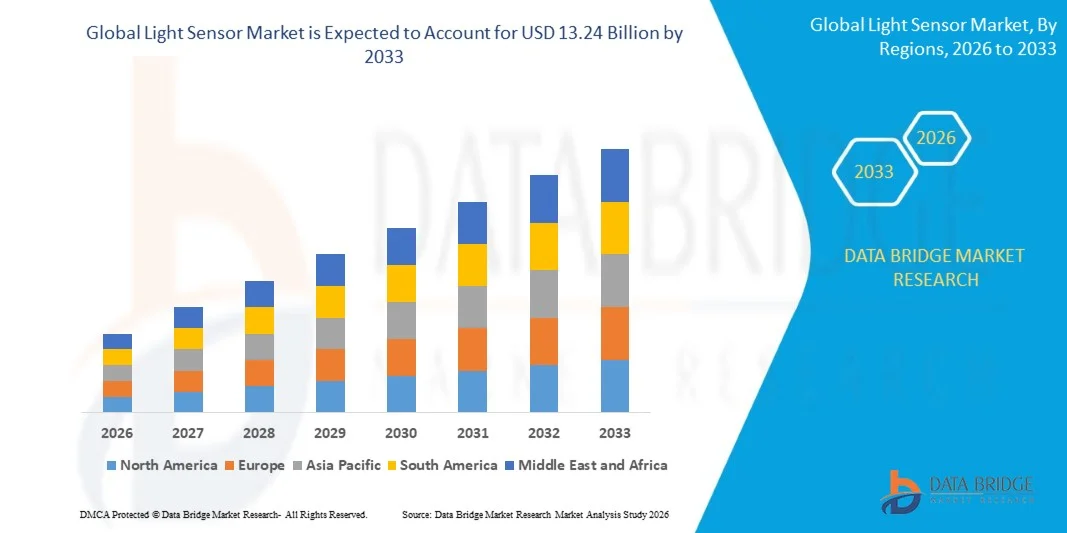
- As per Data Bridge Market Research analysis, the light sensor market was valued at USD 5.50 billion in 2025 and is projected to reach USD 13.24 billion by 2033, growing at a CAGR of 11.60% from 2026 to 2033.
- The market is experiencing robust growth driven by the increasing penetration of smart devices, rising demand for energy-efficient lighting solutions, and the rapid adoption of IoT-enabled systems across various industries.
- The proliferation of smartphones, wearables, and smart home devices has significantly boosted the demand for ambient light sensors for automatic brightness control and power optimization. In addition, the automotive sector's shift toward Advanced Driver Assistance Systems (ADAS), autonomous vehicles, and adaptive lighting solutions is creating sustained demand for sophisticated light sensors.
Market Size & Forecast
- Market Value (2025): USD 5.50 Billion
- Expected Market Value (2033): USD 13.24 Billion
- Forecast CAGR (2026–2033): 11.60%
- Leading Region in 2025: Asia Pacific
- Fastest Growing Region: North America
What are the Major Takeaways of the Light Sensor Market?
- Asia-Pacific dominated the light sensor market with the largest revenue share of 35.5% in 2025, supported by rapid urbanization, expanding consumer electronics manufacturing, and increasing investments in smart city infrastructure across China, Japan, South Korea, and India.
- North America light sensor market is expected to witness the fastest growth rate from 2026 to 2033, supported by the widespread adoption of consumer electronics, industrial automation, automotive electronics, and smart building technologies.
- The combination segment dominated the market in 2025, owing to its widespread adoption in smartphones, wearable devices, automotive electronics, and industrial automation systems. Combination light sensors integrate ambient light sensing, proximity detection, and color sensing into a single compact module, reducing component count, power consumption, and manufacturing costs while improving overall device performance.
- The discrete segment is projected to register the fastest growth from 2026 to 2033, driven by increasing demand for application-specific sensing solutions in industrial equipment, smart agriculture, healthcare devices, and advanced automotive systems. Growing deployment of customized sensor architectures for precision monitoring and IoT-enabled applications is expected to support segment expansion.
- The consumer electronics segment led the market in 2025, supported by the extensive integration of ambient light and proximity sensors in smartphones, tablets, laptops, wearable devices, and smart home products. Rising demand for enhanced user experience, automatic brightness adjustment, and energy-efficient displays continues to drive strong adoption across consumer devices.
- The healthcare segment is anticipated to witness the fastest growth from 2026 to 2033, driven by increasing adoption of wearable health monitoring devices, portable diagnostic equipment, and optical sensing technologies in medical applications. Advancements in digital healthcare and remote patient monitoring are further accelerating segment growth.
Report Scope and Light Sensor Market Segmentation
|
Attributes |
Light Sensor Key Market Insights |
|
Segments Covered |
|
|
Countries Covered |
North America
Europe
Asia-Pacific
Middle East and Africa
South America
|
|
Key Market Players |
|
|
Market Opportunities |
|
|
Value Added Data Infosets |
In addition to the insights on market scenarios such as market value, growth rate, segmentation, geographical coverage, and major players, the market reports curated by the Data Bridge Market Research also include in-depth expert analysis, geographically represented company-wise production and capacity, network layouts of distributors and partners, detailed and updated price trend analysis and deficit analysis of supply chain and demand. |
What is the Key Trend in the Light Sensor Market?
- Light sensor manufacturers are increasingly integrating ambient light sensing, true color sensing, proximity detection, and AI-enabled edge processing into compact, low-power sensor modules to support intelligent displays, wearable devices, automotive systems, industrial automation, robotics, and smart buildings. These advanced sensors enable automatic brightness adjustment, improved color accuracy, energy optimization, and context-aware sensing while supporting next-generation AI-powered devices.
- For instance, in June 2025, ams OSRAM showcased its latest light sensing portfolio at Sensors Converge 2025, introducing AI-ready ambient light and true color sensors, including the TCS3530 True Color Sensor, designed for robotics, drones, wearables, smart buildings, and display management applications. The company highlighted how compact, high-sensitivity light sensors are enabling AI-driven automation and intelligent sensing across multiple industries.
- Advanced ambient light and spectral sensors are enabling devices to automatically optimize display brightness, enhance camera imaging, improve battery efficiency, and deliver accurate color reproduction under varying lighting conditions, significantly enhancing user experience across smartphones, laptops, AR/VR devices, and automotive displays.
- Manufacturers are also developing highly integrated optical sensing solutions that combine ambient light, color, gesture, and proximity sensing into a single low-power package, supporting the growing adoption of AI-enabled consumer electronics, industrial IoT systems, and autonomous platforms.
- As demand for intelligent edge devices, AI-powered automation, smart displays, and energy-efficient electronics continues to increase, the adoption of multifunction light sensors is expected to accelerate, positioning AI-enabled optical sensing as a fundamental technology across consumer electronics, automotive, healthcare, industrial automation, and smart infrastructure.
What are the Key Drivers of the Light Sensor Market?
- The increasing adoption of smartphones, smartwatches, fitness trackers, AR/VR devices, and other connected consumer electronics is significantly driving demand for ambient light, color, and proximity sensors. These sensors enable automatic brightness adjustment, accurate color reproduction, lower power consumption, and improved user experience, making them indispensable in next-generation consumer devices.
- For instance, in May 2025, ROHM Semiconductor introduced a new series of compact surface-mount near-infrared (NIR) LEDs designed for wearable devices, VR/AR headsets, industrial optical sensors, and human detection applications. The new ultra-compact optical components enable manufacturers to develop smaller, more power-efficient wearable electronics and optical sensing systems, supporting the growing adoption of advanced light sensing technologies in consumer devices.
- Consumer electronics manufacturers are increasingly integrating optical sensing technologies to enable adaptive displays, gesture recognition, environmental sensing, and AI-enabled user interactions. The demand for compact, low-power optical components continue to grow as devices become thinner, smarter, and more energy efficient.
- As AI-powered smartphones, wearable devices, AR/VR headsets, and connected consumer electronics continue to expand globally, manufacturers are expected to increase the integration of compact ambient light and optical sensors, supporting sustained growth in the global light sensor market.
Which Factors are Challenging the Growth of the Light Sensor Market?
- Advanced light sensors require significant investment in semiconductor fabrication, CMOS process technologies, wafer-level optics, MEMS integration, precision optical filters, and advanced packaging to deliver the high sensitivity, low power consumption, and miniaturization demanded by consumer electronics, automotive, industrial, and healthcare applications.
- These high research, development, and manufacturing costs increase production expenses and create barriers for smaller sensor manufacturers and OEMs, particularly in price-sensitive markets where cost competitiveness is critical.
- For instance, in May 2024, Infineon Technologies received the final building permit for the construction of its Smart Power Fab in Dresden, Germany. The company is investing approximately EUR 5 billion in the state-of-the-art semiconductor manufacturing facility, highlighting the substantial capital expenditure required to expand advanced semiconductor production, including sensing technologies used in automotive, industrial, and consumer electronics applications.
- The high capital expenditure required for semiconductor fabrication, continuous technology upgrades, and precision manufacturing continues to restrict market expansion, particularly for small and mid-sized sensor manufacturers. These cost pressures can delay commercialization, limit production scalability, and slow the adoption of advanced light sensing technologies in cost-sensitive consumer and industrial markets despite growing long-term demand.
How is the Light Sensor Market Segmented?
The light sensor market is segmented on the basis of integration, end user, application, type, function, and output.
- By Integration
On the basis of integration, the light sensor market is segmented into discrete and combination sensors. The combination segment dominated the market in 2025, owing to its widespread adoption in smartphones, wearable devices, automotive electronics, and industrial automation systems. Combination light sensors integrate ambient light sensing, proximity detection, and color sensing into a single compact module, reducing component count, power consumption, and manufacturing costs while improving overall device performance.
The discrete segment is projected to register the fastest growth from 2026 to 2033, driven by increasing demand for application-specific sensing solutions in industrial equipment, smart agriculture, healthcare devices, and advanced automotive systems. Growing deployment of customized sensor architectures for precision monitoring and IoT-enabled applications is expected to support segment expansion.
- By End User
On the basis of end user, the light sensor market is segmented into automotive, consumer electronics, industrial, healthcare, and entertainment. The consumer electronics segment led the market in 2025, supported by the extensive integration of ambient light and proximity sensors in smartphones, tablets, laptops, wearable devices, and smart home products. Rising demand for enhanced user experience, automatic brightness adjustment, and energy-efficient displays continues to drive strong adoption across consumer devices.
The healthcare segment is anticipated to witness the fastest growth from 2026 to 2033, driven by increasing adoption of wearable health monitoring devices, portable diagnostic equipment, and optical sensing technologies in medical applications. Advancements in digital healthcare and remote patient monitoring are further accelerating segment growth.
- By Application
On the basis of application, the light sensor market is segmented into placement detection, brightness control, security, planning, and agriculture. The brightness control segment dominated the market in 2025 due to its extensive use in smartphones, consumer electronics, automotive displays, and commercial lighting systems. Ambient light sensors improve display visibility while reducing energy consumption, making brightness control one of the most widely adopted applications globally.
The agriculture segment is expected to register the fastest CAGR from 2026 to 2033, driven by the increasing adoption of precision farming, greenhouse automation, and smart crop monitoring systems. Rising investments in IoT-enabled agricultural technologies and environmental monitoring solutions continue to fuel demand for advanced light sensing technologies.
- By Type
On the basis of type, the light sensor market is segmented into photo conductive cells, photo voltaic cells, and photo junction diodes. The photo junction diodes segment accounted for the largest market share in 2025, owing to their high sensitivity, rapid response time, compact size, and low power consumption. These sensors are extensively used in consumer electronics, automotive systems, industrial automation, and healthcare devices for reliable optical detection.
The photo voltaic cells segment is projected to witness the fastest growth from 2026 to 2033, driven by increasing adoption in energy harvesting applications, smart lighting systems, renewable energy technologies, and self-powered IoT devices requiring sustainable sensing solutions.
- By Function
On the basis of function, the light sensor market is segmented into ambient light sensing, proximity detection, RGB color sensing, gesture recognition, and IR detection. The ambient light Sensing segment dominated the market in 2025 due to its widespread deployment across smartphones, tablets, laptops, automotive infotainment systems, and intelligent lighting solutions. The technology enhances display readability while optimizing battery efficiency and user comfort.
The gesture recognition segment is expected to experience the fastest growth from 2026 to 2033, driven by increasing integration of touchless interfaces in consumer electronics, automotive infotainment systems, healthcare devices, and smart home applications. Advancements in AI-powered human-machine interaction are further accelerating segment adoption.
- By Output
On the basis of output, the light sensor market is segmented into analog and digital. The digital segment dominated the market in 2025, supported by its superior accuracy, faster signal processing, improved noise immunity, and seamless integration with microcontrollers and IoT platforms. Digital light sensors are increasingly preferred across consumer electronics, industrial automation, and automotive applications due to their reliability and ease of system integration.
The analog segment is expected to witness the fastest growth from 2026 to 2033, driven by rising demand in cost-sensitive industrial equipment, legacy electronic systems, and customized sensing applications where continuous signal output and simple circuit integration remain advantageous
Which Region Holds the Largest Share of the Light Sensor Market?
- Asia-Pacific dominated the light sensor market with the largest revenue share of 35.5% in 2025, supported by rapid urbanization, expanding consumer electronics manufacturing, and increasing investments in smart city infrastructure across China, Japan, South Korea, and India.
- Rising demand for smartphones, wearable devices, automotive electronics, and intelligent lighting systems is driving the adoption of light sensors throughout the region. Furthermore, the presence of leading semiconductor manufacturers and expanding electronics production capabilities continues to strengthen the regional market.
Japan Light Sensor Market Insight
The Japan light sensor market is expected to witness the fastest growth rate from 2026 to 2033 due to the country's leadership in semiconductor innovation, precision electronics, and automotive technologies. Japanese manufacturers are increasingly integrating advanced ambient light sensors into consumer electronics, industrial automation equipment, robotics, and automotive safety systems. Moreover, growing investments in smart factories, intelligent infrastructure, and next-generation sensing technologies are expected to support long-term market growth across diverse end-use industries.
China Light Sensor Market Insight
The China light sensor market accounted for the largest market revenue share in Asia-Pacific in 2025, attributed to the country's extensive electronics manufacturing ecosystem, rapid industrialization, and growing production of smartphones, consumer electronics, and automotive components. China continues to be one of the world's largest markets for semiconductor-based sensing technologies, with increasing adoption of light sensors across smart devices, intelligent lighting systems, industrial automation, and smart city projects. Strong government support for digital transformation and domestic semiconductor manufacturing further strengthens the country's leadership in the regional market.
North America Light Sensor Market Insight
North America light sensor market is expected to witness the fastest growth rate from 2026 to 2033, supported by the widespread adoption of consumer electronics, industrial automation, automotive electronics, and smart building technologies. The region benefits from strong investments in semiconductor innovation, IoT-enabled devices, and advanced sensing technologies. Growing demand for energy-efficient lighting systems, intelligent displays, and automated environmental monitoring solutions, coupled with stringent energy conservation standards, continues to accelerate the deployment of light sensors across residential, commercial, industrial, and healthcare applications.
U.S. Light Sensor Market Insight
The U.S. light sensor market is expected to witness the fastest growth rate from 2026 to 2033, fueled by the rapid adoption of connected consumer electronics, smart home devices, and advanced driver assistance systems (ADAS). Manufacturers are increasingly integrating ambient light sensors into smartphones, laptops, wearable devices, automotive infotainment systems, and intelligent lighting controls to enhance user experience and optimize power consumption. Furthermore, the growing deployment of IoT-enabled automation systems and smart infrastructure projects continues to strengthen market expansion.
Europe Light Sensor Market Insight
The Europe light sensor market is expected to witness the fastest growth rate from 2026 to 2033, primarily driven by stringent energy efficiency regulations, increasing industrial automation, and the growing adoption of smart lighting technologies across residential, commercial, and industrial sectors. Rising investments in Industry 4.0, intelligent building management systems, and automotive safety technologies are further supporting demand for advanced light sensing solutions. The region is also experiencing increased deployment of optical sensors in healthcare equipment, consumer electronics, and environmental monitoring applications.
U.K. Light Sensor Market Insight
The U.K. light sensor market is expected to witness the fastest growth rate from 2026 to 2033, driven by increasing investments in smart infrastructure, connected buildings, and energy-efficient lighting systems. The growing adoption of IoT-enabled automation technologies, intelligent street lighting, and advanced security systems is accelerating the demand for ambient light sensors across commercial and residential applications. In addition, expanding deployment of optical sensing technologies in healthcare devices and consumer electronics is expected to support sustained market growth.
Germany Light Sensor Market Insight
The Germany light sensor market is expected to witness the fastest growth rate from 2026 to 2033, fueled by the country's strong automotive manufacturing industry, advanced industrial automation capabilities, and leadership in semiconductor and sensor technologies. Growing integration of light sensors into ADAS, factory automation systems, and smart manufacturing environments is supporting market expansion. Furthermore, Germany's continued emphasis on energy-efficient buildings, digitalization, and Industry 4.0 is encouraging the adoption of intelligent optical sensing solutions across multiple industries.
Which are the Top Companies in Light Sensor Market?
The light sensor market industry is primarily led by well-established companies, including:
- ams OSRAM AG (Germany)
- STMicroelectronics N.V. (Switzerland)
- Broadcom Inc. (U.S.)
- Texas Instruments Inc. (U.S.)
- ON Semiconductor (onsemi) (U.S.)
- Vishay Intertechnology Inc. (U.S.)
- Sharp Corporation (Japan)
- Analog Devices, Inc. (U.S.)
- ROHM Co., Ltd. (Japan)
- Panasonic Holdings Corporation (Japan)
- Renesas Electronics Corporation (Japan)
- Sony Semiconductor Solutions Corporation (Japan)
- Everlight Electronics Co., Ltd. (Taiwan)
- Lite-On Technology Corporation (Taiwan)
- Melexis NV (Belgium)
- Alps Alpine Co., Ltd. (Japan)
- Omron Corporation (Japan)
- Murata Manufacturing Co., Ltd. (Japan)
- Himax Technologies, Inc. (Taiwan)
- TE Connectivity Ltd. (Switzerland)
- Sitronix Technology Corporation (Taiwan)
- ELAN Microelectronics Corp. (Taiwan)
- Excelitas Technologies Corp. (U.S.)
- New Japan Radio Co., Ltd. (Japan)
- Sensortek (Taiwan)
- Silicon Laboratories (U.S.)
- Microchip Technology Inc. (U.S.)
What are Latest Developments in Light Sensor Market?
- In June 2025, Sony Semiconductor Solutions introduced the IMX479, a stacked SPAD depth sensor designed for automotive LiDAR applications. The sensor features 520 dToF pixels and offers a detection range of up to 300 meters. Targeted at advanced driver-assistance systems (ADAS) and autonomous driving platforms, sample shipments are scheduled to begin in Autumn 2025 at a unit price of JPY 35,000 (approximately USD 230).
- In January 2025, ams OSRAM secured a USD 240.6 million investment grant from the EU Commission under the European Chips Act to expand semiconductor manufacturing operations in Austria. The total investment is expected to reach USD 601 million by 2030, with a focus on next-generation optoelectronic sensors for medical and automotive applications.

- Interactive Data Analysis Dashboard
- Company Analysis Dashboard for high growth potential opportunities
- Research Analyst Access for customization & queries
- Competitor Analysis with Interactive dashboard
- Latest News, Updates & Trend analysis
- Harness the Power of Benchmark Analysis for Comprehensive Competitor Tracking
Global Light Sensor Market, Supply Chain Analysis and Ecosystem Framework
To support market growth and help clients navigate the impact of geopolitical shifts, DBMR has integrated in-depth supply chain analysis into its Global Light Sensor Market research reports. This addition empowers clients to respond effectively to global changes affecting their industries. The supply chain analysis section includes detailed insights such as Global Light Sensor Market consumption and production by country, price trend analysis, the impact of tariffs and geopolitical developments, and import and export trends by country and HSN code. It also highlights major suppliers with data on production capacity and company profiles, as well as key importers and exporters. In addition to research, DBMR offers specialized supply chain consulting services backed by over a decade of experience, providing solutions like supplier discovery, supplier risk assessment, price trend analysis, impact evaluation of inflation and trade route changes, and comprehensive market trend analysis.
Data collection and base year analysis are done using data collection modules with large sample sizes. The stage includes obtaining market information or related data through various sources and strategies. It includes examining and planning all the data acquired from the past in advance. It likewise envelops the examination of information inconsistencies seen across different information sources. The market data is analysed and estimated using market statistical and coherent models. Also, market share analysis and key trend analysis are the major success factors in the market report. To know more, please request an analyst call or drop down your inquiry.
The key research methodology used by DBMR research team is data triangulation which involves data mining, analysis of the impact of data variables on the market and primary (industry expert) validation. Data models include Vendor Positioning Grid, Market Time Line Analysis, Market Overview and Guide, Company Positioning Grid, Patent Analysis, Pricing Analysis, Company Market Share Analysis, Standards of Measurement, Global versus Regional and Vendor Share Analysis. To know more about the research methodology, drop in an inquiry to speak to our industry experts.
Data Bridge Market Research is a leader in advanced formative research. We take pride in servicing our existing and new customers with data and analysis that match and suits their goal. The report can be customized to include price trend analysis of target brands understanding the market for additional countries (ask for the list of countries), clinical trial results data, literature review, refurbished market and product base analysis. Market analysis of target competitors can be analyzed from technology-based analysis to market portfolio strategies. We can add as many competitors that you require data about in the format and data style you are looking for. Our team of analysts can also provide you data in crude raw excel files pivot tables (Fact book) or can assist you in creating presentations from the data sets available in the report.













