


What is the Global Light Weight Silk Market Size and Growth Rate?
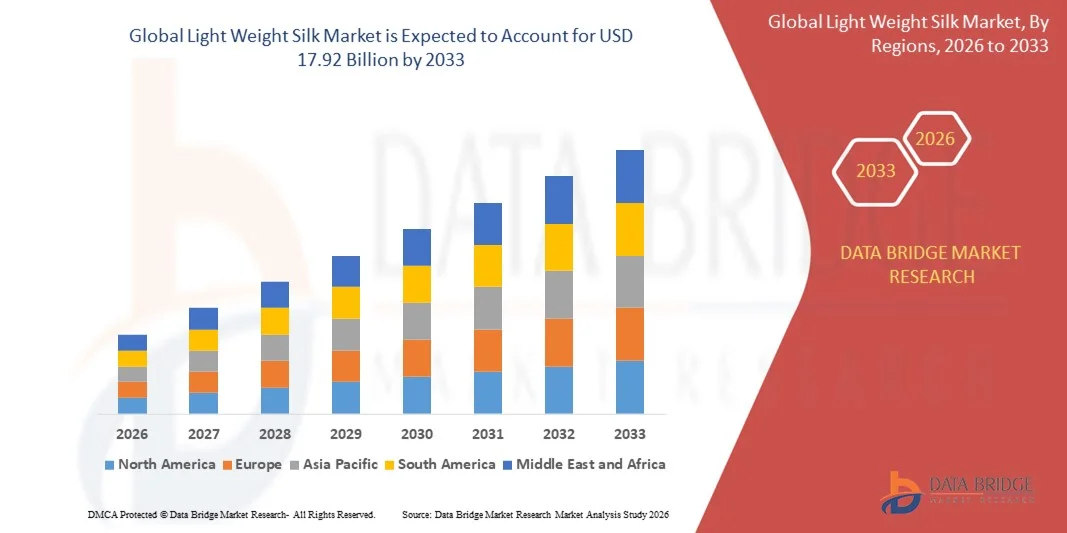
- The global light weight silk market size was valued at USD 8.72 billion in 2025 and is expected to reach USD 17.92 billion by 2033, at a CAGR of 9.42% during the forecast period
- During the forecast period of 2025 to 2032 the market is such asly to grow at a CAGR of 9.1%, primarily driven by the rising consumer preference for sustainable and ethically sourced silk, including peace silk and organic silk
- This growth is driven by factors such as strong government support for domestic silk production, especially in leading producers such as China and India. Subsidies, R&D programs, and infrastructure investments are enhancing silk quality and output, which in turn are supporting rising demand from apparel, cosmetics, and medical sectors globally
What are the Major Takeaways of Light Weight Silk Market?
- The global silk market is experiencing steady growth, driven by rising demand for natural, luxurious, and biodegradable textiles amid growing sustainability concerns. Consumers are increasingly opting for silk due to its premium texture, hypoallergenic properties, and biodegradability, especially in apparel, home furnishings, and personal care products
- Key markets such as China, India, Italy, and Japan continue to influence global supply and innovation, while developing countries are expanding production capacity with government support and rural employment programs
- Asia-Pacific dominated the light weight silk market with a 34.8% revenue share in 2025, driven by strong sericulture production, extensive textile manufacturing infrastructure, and rising demand for premium silk fabrics across fashion and luxury apparel industries in countries such as China, India, Japan, and Thailand
- North America is projected to register the fastest CAGR of 8.21% from 2026 to 2033, driven by growing demand for luxury fashion products, premium textiles, and sustainable natural fabrics across the U.S. and Canada
- The Mulberry Silk segment dominated the market with a 48.2% share in 2025, as it is the most widely produced and commercially used silk variety due to its superior softness, smooth texture, and high tensile strength
Report Scope and Light Weight Silk Market Segmentation
|
Attributes |
Light Weight Silk Key Market Insights |
|
Segments Covered |
|
|
Countries Covered |
North America
Europe
Asia-Pacific
Middle East and Africa
South America
|
|
Key Market Players |
|
|
Market Opportunities |
|
|
Value Added Data Infosets |
In addition to the insights on market scenarios such as market value, growth rate, segmentation, geographical coverage, and major players, the market reports curated by the Data Bridge Market Research also include in-depth expert analysis, pricing analysis, brand share analysis, consumer survey, demography analysis, supply chain analysis, value chain analysis, raw material/consumables overview, vendor selection criteria, PESTLE Analysis, Porter Analysis, and regulatory framework. |
What is the Key Trend in the Light Weight Silk Market?
Increasing Demand for Sustainable, Breathable, and High-Quality Light Weight Silk Fabrics
- The light weight silk market is witnessing growing adoption of soft, breathable, and premium-quality silk fabrics designed to support the expanding fashion, luxury apparel, and home textile industries
- Manufacturers are increasingly focusing on advanced weaving techniques, eco-friendly dyeing processes, and innovative silk blends to enhance fabric durability, comfort, and aesthetic appeal
- Growing demand for lightweight, skin-friendly, and temperature-regulating fabrics is driving the use of lightweight silk in premium clothing, scarves, evening wear, and luxury bedding products
- For instance, companies such as Loro Piana, Jiangsu Soho International, Sichuan Nanchong Liuhe Group, and Wujiang First Textile are introducing refined lightweight silk fabrics with improved texture, color retention, and sustainability certifications
- Increasing consumer preference for sustainable luxury textiles and natural fibers is accelerating the shift toward high-quality lightweight silk fabrics in global fashion markets
- As fashion trends continue to emphasize comfort, elegance, and eco-friendly materials, lightweight silk fabrics will remain essential for premium apparel, designer collections, and luxury home textiles
What are the Key Drivers of Light Weight Silk Market?
- Rising demand for luxury fashion products, premium apparel, and high-quality natural fabrics is significantly driving the growth of the Light Weight Silk market
- For instance, in 2025, leading silk producers and textile manufacturers expanded production of lightweight silk fabrics to meet increasing demand from global fashion brands and luxury garment manufacturers.
- Growing popularity of sustainable and biodegradable textiles among environmentally conscious consumers is further boosting the adoption of natural silk fabrics across North America, Europe, and Asia-Pacific.
- Advancements in silk processing technologies, fabric finishing techniques, and eco-friendly dyeing methods have improved fabric softness, durability, and color quality.
- Increasing use of lightweight silk in bridal wear, designer clothing, scarves, luxury lingerie, and high-end home textiles is creating strong demand in fashion and lifestyle industries.
- Supported by rising investments in textile innovation, sustainable production practices, and premium fashion markets, the Light Weight Silk market is expected to witness steady long-term growth
Which Factor is Challenging the Growth of the Light Weight Silk Market?
- A notable restraint in the global Silk (TSP) market is the allergenic nature of soy, which continues to limit consumer acceptance despite TSP's nutritional and functional benefits. Soy ranks among the top eight food allergens globally, and even minimal exposure can lead to allergic reactions, ranging from mild symptoms to severe anaphylaxis, particularly in infants and young children. This risk discourages many consumers and complicates product development for manufacturers aiming for mass-market appeal
- To mitigate these challenges, food producers are increasingly exploring alternative plant-based proteins such as pea, rice, and chickpea, which are generally considered less allergenic. These alternatives are often positioned as “allergen-free” or “clean-label,” appealing to health-conscious and sensitive consumers while allowing brands to tap into a broader, more inclusive market segment
- Strict regulatory frameworks requiring clear allergen labeling, particularly concerning soy, further influence consumer decisions. Although such transparency enhances food safety, it can also dissuade potential buyers from choosing soy-based products such as TSP due to heightened awareness of allergen risks. This regulatory landscape places soy-derived ingredients at a relative disadvantage compared to more allergen-neutral options
- Despite its affordability, protein content, and sustainability profile, TSP faces a significant hurdle in gaining widespread market penetration due to concerns surrounding soy allergies. Until scientific advancements succeed in reducing the allergenic properties of soy, this limitation is expected to persist and influence product strategy across the industry
- For instance, in November 2024, an article published by Elsevier Inc. highlighted a case of food-dependent exercise-induced anaphylaxis caused by hidden soy ingredients in processed foods, illustrating the difficulties consumers face in detecting allergens. Similarly, in December 2022, the Asthma and Allergy Foundation of America, via Kids with Food Allergies, emphasized the need for complete avoidance of soy in children with allergies, reinforcing the need for alternative ingredients in pediatric nutrition
- Overall, allergen concerns surrounding soy present a considerable restraint to the Silk market, prompting a shift among manufacturers toward hypoallergenic alternatives and driving innovation in allergen-free product development
How is the Light Weight Silk Market Segmented?
The market is segmented on the basis of type, product type, weight, ply, country of origin, material, production process, end-user, and distribution channel.
- By Type
On the basis of type, the light weight silk market is segmented into Mulberry Silk, Tasar Silk/Wild Silk, Eri Silk, Spider Silk, Muga Silk, Anaphe Silk, Fagara Silk, Coan Silk, Mussel Silk, Sea Silk, Silk Charmeuse (Silk Satin), Chiffon Silk (Crepe Chiffon), Silk Dupioni, Silk Gauze, Fuji Silk, Silk Noil, Silk Shantung, Silk Organza, Silk Broadcloth, Silk Crepe, Habutai Silk, Silk Pongee, and Others. The Mulberry Silk segment dominated the market with a 48.2% share in 2025, as it is the most widely produced and commercially used silk variety due to its superior softness, smooth texture, and high tensile strength. Mulberry silk is extensively used in premium apparel, luxury garments, scarves, and bedding products. Its consistent fiber quality and ability to absorb dyes effectively make it highly preferred by textile manufacturers and fashion designers.
The Chiffon Silk segment is expected to grow at the fastest CAGR from 2026 to 2033, driven by rising demand for lightweight, breathable fabrics in fashion garments, bridal wear, and designer clothing collections.
- By Product Type
On the basis of product type, the Light Weight Silk market is segmented into Raw Silk, Silk Yarns, and Others. The Raw Silk segment dominated the market with a 45.7% share in 2025, supported by its widespread use as a primary raw material for producing premium silk fabrics and textiles. Raw silk fibers obtained from silkworm cocoons are processed into yarns and woven into lightweight fabrics used across fashion apparel, scarves, and home textiles. Textile manufacturers rely heavily on high-quality raw silk to maintain fabric durability, softness, and sheen. Rising global demand for natural fibers and luxury fabrics continues to strengthen the demand for raw silk.
The Silk Yarns segment is expected to grow at the fastest CAGR from 2026 to 2033, driven by increasing adoption in advanced textile weaving, embroidery applications, and premium garment manufacturing processes.
- By Ply
On the basis of ply, the Light Weight Silk market is segmented into 2 Ply, 3 Ply, 4 Ply, and Others. The 2 Ply segment dominated the market with a 46.1% share in 2025, as two-ply silk yarn provides an ideal balance between strength, flexibility, and softness. This configuration is widely used in lightweight fabrics such as chiffon, satin, and habutai silk, which are commonly utilized in fashion garments, scarves, and luxury home textiles. The smooth texture and durability of two-ply silk yarn make it highly suitable for delicate and premium fabrics. In addition, two-ply yarn requires less raw material and processing compared to higher ply variants, making it more cost efficient for textile manufacturers.
The 3 Ply segment is expected to grow at the fastest CAGR from 2026 to 2033, driven by increasing demand for stronger silk yarns used in embroidery, decorative fabrics, and premium textile applications.
- By Country Origin
On the basis of country origin, the Light Weight Silk market is segmented into Japan Silk, Indian Silk, Thailand Silk, and Others. The Indian Silk segment dominated the market with a 43.5% share in 2025, owing to India’s strong sericulture industry and large-scale production of diverse silk varieties including mulberry, tasar, eri, and muga silk. Indian silk is widely used in traditional garments, designer apparel, and luxury textiles. Government initiatives supporting sericulture farming, skilled artisanship, and strong domestic demand further strengthen India’s position in the global silk market.
The Thailand Silk segment is expected to grow at the fastest CAGR from 2026 to 2033, driven by increasing global demand for handcrafted silk fabrics, unique weaving patterns, and premium-quality traditional Thai silk textiles.
- By Material
On the basis of material, the Light Weight Silk market is segmented into Pure Silk, Standard Silk, and Blended Silk. The Pure Silk segment dominated the market with a 51.4% share in 2025, driven by rising consumer preference for natural, breathable, and luxury fabrics. Pure silk is valued for its softness, sheen, durability, and hypoallergenic properties, making it ideal for premium clothing, scarves, luxury bedding, and fashion accessories. Increasing consumer awareness regarding sustainable and natural fibers further boosts demand for pure silk fabrics.
The Blended Silk segment is projected to grow at the fastest CAGR from 2026 to 2033, supported by its cost efficiency and improved durability achieved by blending silk with fibers such as cotton, polyester, or viscose for broader textile applications.
- By Production Process
On the basis of production process, the Light Weight Silk market is segmented into Cocoon Production, Reeling, Throwing, Weaving, Dyeing, and Others. The Reeling segment dominated the market with a 40.8% share in 2025, as it is a critical stage where silk filaments are extracted from cocoons to form raw silk yarns. High-quality reeling ensures uniform fiber thickness, smoothness, and strength, which are essential for producing lightweight silk fabrics. Advances in automated reeling technologies and improved cocoon processing methods have enhanced production efficiency.
The Dyeing segment is expected to grow at the fastest CAGR from 2026 to 2033, driven by rising demand for vibrant, eco-friendly, and color-fast silk fabrics in fashion and luxury textile applications.
- By End-User
On the basis of end-user, the Light Weight Silk market is segmented into Textile, Cosmetics, Medical, and Others. The Textile segment dominated the market with a 55.6% share in 2025, as lightweight silk fabrics are widely used in fashion apparel, scarves, luxury garments, and home textiles. Designers and fashion brands increasingly incorporate lightweight silk in premium clothing collections due to its softness, elegance, and breathability. Growing demand for luxury fabrics in global fashion markets further strengthens this segment.
The Medical segment is expected to grow at the fastest CAGR from 2026 to 2033, driven by increasing use of silk proteins and fibroin materials in biomedical applications such as surgical sutures, wound dressings, and regenerative medicine.
- By Distribution Channel
On the basis of distribution channel, the Light Weight Silk market is segmented into Offline and Online. The Offline segment dominated the market with a 62.3% share in 2025, supported by the presence of textile wholesalers, fashion boutiques, specialty fabric stores, and traditional silk markets. Many buyers prefer physical inspection of silk fabrics to assess texture, quality, and authenticity before purchasing. Strong presence of textile markets in Asia and Europe further supports offline sales channels.
The Online segment is projected to grow at the fastest CAGR from 2026 to 2033, driven by rapid expansion of e-commerce platforms, digital textile marketplaces, and direct-to-consumer fashion brands offering premium silk fabrics globally.
Which Region Holds the Largest Share of the Light Weight Silk Market?
- Asia-Pacific dominated the light weight silk market with a 34.8% revenue share in 2025, driven by strong sericulture production, extensive textile manufacturing infrastructure, and rising demand for premium silk fabrics across fashion and luxury apparel industries in countries such as China, India, Japan, and Thailand. The region benefits from favorable climatic conditions for silkworm cultivation, a large skilled workforce, and long-standing traditions in silk weaving and processing. Increasing global demand for lightweight, breathable, and natural fabrics continues to strengthen the production and export of lightweight silk textiles from Asia-Pacific markets
- Leading silk-producing countries in the region are investing in modern reeling technologies, sustainable dyeing methods, and advanced textile processing techniques, improving fabric quality, production efficiency, and global competitiveness. Expanding fashion industries and rising demand for eco-friendly luxury textiles further accelerate regional growth
- Strong government support for sericulture development, rising export opportunities, and expanding textile manufacturing ecosystems continue to reinforce Asia-Pacific’s leadership in the global lightweight silk market
China Light Weight Silk Market Insight
China is the largest contributor in Asia-Pacific due to its world-leading silk production capacity, well-established textile manufacturing industry, and strong export network. The country produces a significant portion of global mulberry silk and supplies lightweight silk fabrics to international fashion and luxury apparel brands. Continuous investments in automated silk reeling, weaving, and dyeing technologies enhance production efficiency and fabric consistency. Increasing demand for premium silk garments, scarves, and home textiles further strengthens domestic consumption. China’s strong supply chain infrastructure and large-scale textile manufacturing facilities enable cost-effective production and global distribution of lightweight silk fabrics.
India Light Weight Silk Market Insight
India plays a major role in the regional market due to its diverse silk varieties including mulberry, tasar, ERI, and muga silk. The country has a long-standing tradition of silk weaving and a large network of sericulture farmers and textile artisans. Lightweight silk fabrics are widely used in traditional garments, designer clothing, and luxury apparel. Government initiatives promoting sericulture development, rural employment, and textile exports further strengthen industry growth. Increasing demand for sustainable natural fibers and handcrafted silk textiles supports expanding production and global market penetration.
Japan Light Weight Silk Market Insight
Japan demonstrates steady market growth supported by high-quality textile manufacturing, advanced weaving techniques, and strong demand for premium silk fabrics. Japanese silk is known for its superior craftsmanship and refined texture, making it highly valued in luxury fashion and high-end garments. Innovation in textile processing and strict quality standards continue to enhance product value. Increasing demand for premium lightweight fabrics in fashion and home décor applications further supports market expansion.
Thailand Light Weight Silk Market Insight
Thailand contributes significantly through its handcrafted silk textiles and traditional weaving techniques, which are widely recognized in international markets. Thai silk fabrics are popular for their vibrant colors, unique patterns, and premium quality. Rising tourism, cultural heritage promotion, and increasing demand for luxury handmade textiles continue to drive production and exports of lightweight silk fabrics.
North America Light Weight Silk Market
North America is projected to register the fastest CAGR of 8.21% from 2026 to 2033, driven by growing demand for luxury fashion products, premium textiles, and sustainable natural fabrics across the U.S. and Canada. Increasing consumer preference for eco-friendly clothing materials, breathable fabrics, and high-end designer garments is fueling demand for lightweight silk products. Expanding fashion brands, rising online retail platforms, and growing imports of high-quality silk fabrics from Asia-Pacific are strengthening regional market growth. Luxury fashion houses and apparel manufacturers are increasingly incorporating lightweight silk fabrics into designer clothing, scarves, lingerie, and luxury bedding products. Rising awareness regarding sustainable textiles and natural fiber materials further accelerates market adoption across North America.
U.S. Light Weight Silk Market Insight
The U.S. represents the largest market in North America due to strong demand for luxury apparel, premium fashion brands, and high-end home textiles. Increasing consumer spending on designer clothing, silk accessories, and sustainable fashion products continues to drive market expansion. Growth of e-commerce fashion platforms and rising collaboration between global textile suppliers and American fashion houses further support market growth.
Canada Light Weight Silk Market Insight
Canada contributes steadily to regional demand due to growing interest in sustainable fashion, premium fabrics, and eco-friendly clothing materials. Rising adoption of natural fiber textiles among environmentally conscious consumers is driving demand for silk fabrics. Increasing presence of luxury fashion retailers, expanding online textile platforms, and growing imports of premium silk textiles from Asia-Pacific support continued market development.
Which are the Top Companies in Light Weight Silk Market?
The light weight silk industry is primarily led by well-established companies, including:
- Anhui Bring Import & Export Trading Co., Ltd (China)
- Zhejiang Jiaxin Silk Corp., Ltd (China)
- SICHUAN NANCHONG LIUHE (GROUP) CO., LTD (China)
- Shengkun Silk Manufacturing Co., Ltd (China)
- Jinchengjiang Xinxing Silk Co., Ltd (China)
- Bolt Threads (U.S.)
- Spiber Technologies (Japan)
- AMSilk GmbH (Germany)
- Kraig Biocraft Laboratories, Inc. (U.S.)
- Arun Yarns (India)
- WENSLI (China)
- Pratham Silks (India)
- LILYSILK (China)
- China National Silk Imp. & Exp. Wuxi Corp., Ltd. (China)
- ERIS GLOBAL LLP (India)
- NISHA SILK EXPORTS (India)
- Garima Silks (India)
- M. Jiju Silk Mills (India)
- STARLING SILK MILLS PVT. LTD. (India)
- Fishers Finery (U.S.)
- UNNATI SILK PRINTS PVT LTD (India)
- Alashan Cashmere (China)
- WUJIANG FIRST TEXTILE CO. LTD. (China)
- Orient Group (China)
What are the Recent Developments in Global Light Weight Silk Market?
- In January 2025, LILYSILK opened its first concept store in New York City, marking a key retail expansion. This move enhances brand visibility and customer engagement through a luxury, sustainable shopping experience. The store also supports eco-friendly initiatives, reinforcing the company’s commitment to sustainability
- In Feburary 2025, Bolt Threads and Goddess Maintenance Co. have announced a USD 4 million annual partnership to integrate Bolt’s b-silk technology into a new biotech-powered beauty line. Launching Spring 2025 across 1,300+ U.S. retail locations via Sally Beauty, this collaboration marks a major milestone for sustainable, science-driven skincare, reinforcing Bolt’s position in the clean beauty market and expanding its reach
- In January 2024, Wensli Group was recognized as a national demonstration base for cultural and technological integration by China's Ministry of Industry and Information Technology and other governmental bodies. This acknowledgment highlighted Wensli's innovative use of Artificial Intelligence (AI) in silk design and production. The company's AI-driven design system, developed in collaboration with Wujie AI, boasts a database of over 500,000 patterns and more than 300 AI imaging algorithms. This system enables the creation of up to 100,000 unique silk scarf designs, facilitating rapid customization and efficient production. In addition, Wensli has implemented eco-friendly digital machines that eliminate water usage in printing and dyeing processes, addressing environmental concerns in textile manufacturing
- In August 2024, Wensli Group held the "Trendy Olympics: A Century of Silk Scarves" exhibition at Hangzhou Tower Shopping Center. This cultural event celebrated the Olympic spirit through silk artistry, blending modern design with traditional Chinese craftsmanship. It strengthened Wensli’s brand visibility, supported international cultural exchange, and showcased the company's innovation in themed product design, helping expand its global and domestic reach
- In October 2024, Bolt Projects Holdings expands its Vegan Silk Technology Platform with new product launches featuring b-silk, including Freaks of Nature sunscreens and upcoming color cosmetics. The company also teases the debut of xl-silk, its second proprietary ingredient. With more brand partnerships ahead, Bolt positions 2025 as a breakout year for sustainable, high-performance beauty innovation across haircare, skincare, and cosmetics

- Interactive Data Analysis Dashboard
- Company Analysis Dashboard for high growth potential opportunities
- Research Analyst Access for customization & queries
- Competitor Analysis with Interactive dashboard
- Latest News, Updates & Trend analysis
- Harness the Power of Benchmark Analysis for Comprehensive Competitor Tracking
Global Light Weight Silk Market, Supply Chain Analysis and Ecosystem Framework
To support market growth and help clients navigate the impact of geopolitical shifts, DBMR has integrated in-depth supply chain analysis into its Global Light Weight Silk Market research reports. This addition empowers clients to respond effectively to global changes affecting their industries. The supply chain analysis section includes detailed insights such as Global Light Weight Silk Market consumption and production by country, price trend analysis, the impact of tariffs and geopolitical developments, and import and export trends by country and HSN code. It also highlights major suppliers with data on production capacity and company profiles, as well as key importers and exporters. In addition to research, DBMR offers specialized supply chain consulting services backed by over a decade of experience, providing solutions like supplier discovery, supplier risk assessment, price trend analysis, impact evaluation of inflation and trade route changes, and comprehensive market trend analysis.
Data collection and base year analysis are done using data collection modules with large sample sizes. The stage includes obtaining market information or related data through various sources and strategies. It includes examining and planning all the data acquired from the past in advance. It likewise envelops the examination of information inconsistencies seen across different information sources. The market data is analysed and estimated using market statistical and coherent models. Also, market share analysis and key trend analysis are the major success factors in the market report. To know more, please request an analyst call or drop down your inquiry.
The key research methodology used by DBMR research team is data triangulation which involves data mining, analysis of the impact of data variables on the market and primary (industry expert) validation. Data models include Vendor Positioning Grid, Market Time Line Analysis, Market Overview and Guide, Company Positioning Grid, Patent Analysis, Pricing Analysis, Company Market Share Analysis, Standards of Measurement, Global versus Regional and Vendor Share Analysis. To know more about the research methodology, drop in an inquiry to speak to our industry experts.
Data Bridge Market Research is a leader in advanced formative research. We take pride in servicing our existing and new customers with data and analysis that match and suits their goal. The report can be customized to include price trend analysis of target brands understanding the market for additional countries (ask for the list of countries), clinical trial results data, literature review, refurbished market and product base analysis. Market analysis of target competitors can be analyzed from technology-based analysis to market portfolio strategies. We can add as many competitors that you require data about in the format and data style you are looking for. Our team of analysts can also provide you data in crude raw excel files pivot tables (Fact book) or can assist you in creating presentations from the data sets available in the report.













