


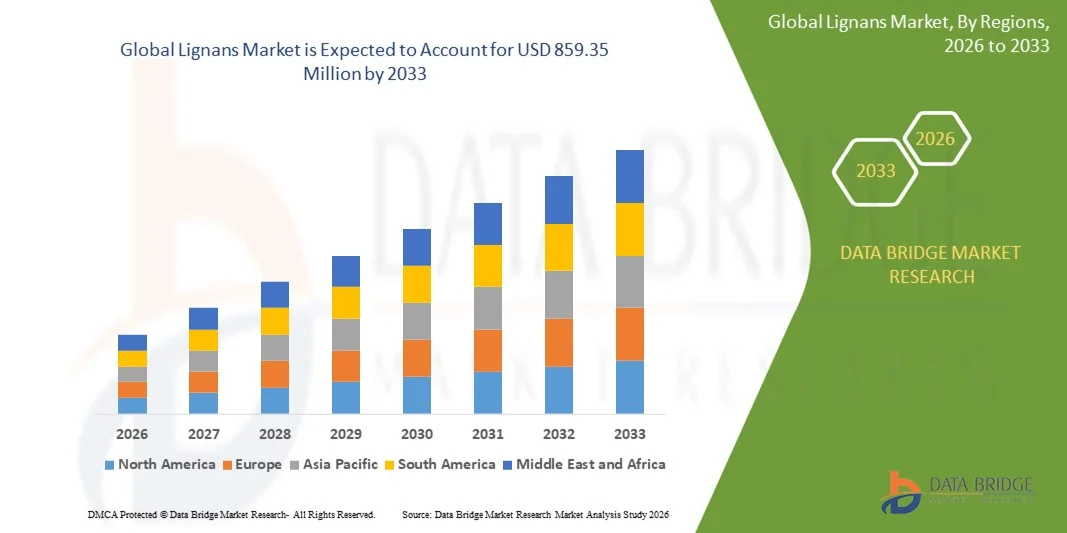
What is the Global Lignans Market Size and Growth Rate?
- The global lignans market size was valued at USD 496.42 million in 2025 and is expected to reach USD 859.35 million by 2033, at a CAGR of 7.10% during the forecast period
- The major growing factor towards lignans market is the rising consumption of cereal based foods such as muesli, oatmeal, raisin bran and compressed puffed rice
- The prime factor driving the demand for lignans is the rising usage of lignans to incorporate estrogen and antioxidant attributes to food products such as energy bars, cereals, whole-grain bread, crackers, semolina pasta, meatless meals and other snack food
- Furthermore, the increasing health concerns, increasing animal feed industry and strong pharmaceutical sector which is also heightening the overall demand for lignans market
What are the Major Takeaways of Lignans Market?
- The increasing preference for herbal products over synthetic drugs and a rapid upward trend in the overall functional food and beverage industry also serves as a foremost driver for increasing the demand for lignans market at a global level. In addition, the high disposable income, technological developments, changing demographics and lifestyles and various favorable research studies are also lifting the growth of the lignans market
- However, the regulations and taxations on lignans production by various governments in the different regions are projected to act as a restraint towards the growth of lignans market, whereas the lack of product awareness amongst the consumers has the potential to challenge the growth of the lignans market
- Asia-Pacific dominated the Lignans market with the largest revenue share of 42.8% in 2025, driven by the abundant availability of lignan-rich raw materials such as flaxseed and sesame, strong agricultural production, and rising demand for functional foods, dietary supplements, and nutraceuticals across China, India, Japan, and South Korea
- North America is projected to witness the fastest growth rate of 9.5% during 2026–2033, fueled by rising consumer preference for plant-based, natural bioactive compounds in functional foods and dietary supplements
- The Oilseeds segment dominated the market with a revenue share of 45.2% in 2025, owing to its rich lignan content, ease of extraction, and widespread availability in flaxseed, sesame, and sunflower seeds
Report Scope and Lignans Market Segmentation
|
Attributes |
Lignans Key Market Insights |
|
Segments Covered |
|
|
Countries Covered |
North America
Europe
Asia-Pacific
Middle East and Africa
South America
|
|
Key Market Players |
|
|
Market Opportunities |
|
|
Value Added Data Infosets |
In addition to the insights on market scenarios such as market value, growth rate, segmentation, geographical coverage, and major players, the market reports curated by the Data Bridge Market Research also include in-depth expert analysis, pricing analysis, brand share analysis, consumer survey, demography analysis, supply chain analysis, value chain analysis, raw material/consumables overview, vendor selection criteria, PESTLE Analysis, Porter Analysis, and regulatory framework. |
What is the Key Trend in the Lignans Market?
Growing Focus on Functional Foods and Nutraceutical Applications
- The Lignans market is witnessing a key trend of increasing incorporation of lignans into functional foods, dietary supplements, and nutraceuticals due to their antioxidant, anticancer, and cardiovascular benefits. This trend is driven by rising health awareness and the growing interest in plant-based bioactive compounds among consumers globally
- For instance, ADM and Naturalin Bio-Resources have launched lignan-enriched ingredients and extracts for use in fortified beverages, bakery products, and nutritional supplements, targeting heart health and hormone balance
- The increasing prevalence of lifestyle-related diseases such as cardiovascular disorders, diabetes, and hormonal imbalances is boosting demand for lignan-based dietary interventions
- Food and beverage manufacturers are formulating lignan-enriched products, including functional drinks, protein powders, and snack bars, to meet consumer demand for natural health solutions
- Rising research on lignan bioavailability, gut microbiota interactions, and synergistic health benefits is encouraging product innovation in supplements and functional foods
- As health-conscious consumers prioritize plant-based, natural compounds, lignans are expected to remain a central trend in functional foods, nutraceuticals, and dietary supplement markets
What are the Key Drivers of Lignans Market?
- Rising consumer awareness of the health benefits of lignans, including antioxidant, anti-inflammatory, and hormone-regulating properties, is a major driver of the market
- For instance, in 2025, Arjuna Natural Pvt Ltd and Prairie Tide Diversified Inc. expanded production of lignan-rich flaxseed and sesame extracts for inclusion in dietary supplements and functional foods
- Growing demand for natural, plant-based, and clean-label ingredients in food, beverage, and nutraceutical products is fueling market growth
- Advances in extraction, purification, and standardization technologies are enabling higher-quality lignan formulations with consistent bioactivity
- Increased adoption in preventive healthcare, nutraceuticals, and functional foods across Europe, North America, and Asia-Pacific is driving demand
- As research, product innovation, and health-driven consumer trends continue to expand, the global lignans market is projected to witness steady growth over the coming years
Which Factor is Challenging the Growth of the Lignans Market?
- High production costs, complex extraction processes, and variability in raw material quality limit large-scale adoption of lignans
- For instance, during 2024–2025, fluctuations in flaxseed and sesame seed supply affected production volumes for lignan-enriched extracts
- Regulatory compliance for nutraceutical and functional food ingredients across different regions increases the cost and complexity of market entry
- Limited consumer awareness in emerging markets about the health benefits of lignans slows market penetration
- Competition from other plant-based bioactives such as polyphenols, isoflavones, and carotenoids creates price pressure and affects adoption
- To overcome these challenges, market players are investing in advanced extraction techniques, strategic partnerships, and marketing initiatives to educate consumers and ensure consistent, high-quality lignan supply
How is the Lignans Market Segmented?
The market is segmented on the basis of source type and end user.
- By Source Type
On the basis of source type, the lignans market is segmented into Oilseeds, Cereals, and Plant Resins. The Oilseeds segment dominated the market with a revenue share of 45.2% in 2025, owing to its rich lignan content, ease of extraction, and widespread availability in flaxseed, sesame, and sunflower seeds. Oilseed-derived lignans are extensively used in nutraceutical, pharmaceutical, and functional food applications due to their antioxidant and health-promoting properties.
The Cereals segment is projected to grow at the fastest CAGR from 2026 to 2033, driven by the rising adoption of cereal-based lignans in dietary supplements, bakery products, and fortified foods. Increasing consumer preference for plant-based, natural ingredients and clean-label products is fueling the growth of cereal-sourced lignans globally. Continuous research on high-yield cereal varieties and advanced extraction techniques further supports the expansion of this segment across food and health industries.
- By End User
Based on end user, the lignans market is segmented into Food and Beverages, Cosmetics and Toiletries, Pharmaceuticals, Animal Nutrition, and Others. The Food and Beverages segment dominated the market with a revenue share of 42.8% in 2025, driven by the growing incorporation of lignans into functional foods, bakery items, dietary supplements, and beverages for antioxidant and health benefits.
The Pharmaceuticals segment is anticipated to witness the fastest CAGR during 2026–2033, propelled by increasing research on lignans’ therapeutic potential, including cardiovascular, anti-cancer, and hormonal health applications. Rising awareness about natural, plant-based bioactive compounds and regulatory support for functional ingredients are further accelerating adoption in pharmaceutical formulations and nutraceutical development worldwide. Continuous innovations in extraction, purification, and formulation techniques are expected to sustain market expansion across this high-growth end-user segment.
Which Region Holds the Largest Share of the Lignans Market?
- Asia-Pacific dominated the Lignans market with the largest revenue share of 42.8% in 2025, driven by the abundant availability of lignan-rich raw materials such as flaxseed and sesame, strong agricultural production, and rising demand for functional foods, dietary supplements, and nutraceuticals across China, India, Japan, and South Korea. Increasing consumer focus on heart health, hormone balance, and antioxidant-rich diets has accelerated market penetration
- Enterprises in the region are investing heavily in advanced extraction, purification, and standardization technologies to produce high-quality lignan ingredients. The growth of functional food manufacturing hubs, combined with rising health awareness and export demand, strengthens regional dominance
- Supportive government initiatives promoting nutraceutical development, plant-based nutrition, and functional food innovation continue to position Asia-Pacific as the global leader in the Lignans market
China Lignans Market Insight
China represents the largest contributor to the Asia-Pacific Lignans market, supported by robust flaxseed and sesame cultivation, growing functional food and supplement production, and increasing consumer awareness of plant-based bioactives. Companies are investing in scalable extraction technologies to supply high-quality lignan extracts to domestic and international nutraceutical manufacturers. Government incentives for agricultural innovation and dietary supplement development, coupled with partnerships between local and global suppliers, reinforce China’s leadership in both dietary supplement and functional food applications.
India Lignans Market Insight
India is emerging as a key contributor to the Asia-Pacific Lignans market, driven by rising demand for plant-based nutraceuticals, growing functional food consumption, and the expansion of health-conscious urban populations. Government initiatives such as “Make in India” and support for nutraceutical startups are fostering domestic production of lignan-enriched ingredients. Continuous investments in extraction technology, standardized lignan formulations, and dietary supplement R&D are further strengthening India’s market presence within the region.
North America Lignans Market Insight
North America is projected to witness the fastest growth rate of 9.5% during 2026–2033, fueled by rising consumer preference for plant-based, natural bioactive compounds in functional foods and dietary supplements. Strong nutraceutical manufacturing capabilities in the U.S. and Canada, coupled with increasing awareness of antioxidant and cardiovascular benefits of lignans, support market expansion. Ongoing research, product innovation, and marketing of lignan-enriched functional foods are accelerating regional adoption.
U.S. Lignans Market Insight
The U.S. represents the largest contributor to the North American Lignans market, supported by advanced nutraceutical R&D, widespread functional food adoption, and high consumer health awareness. Manufacturers are leveraging standardized lignan extracts in dietary supplements, fortified beverages, and health bars to support cardiovascular, hormonal, and antioxidant benefits. Regulatory support, clean-label trends, and growing e-commerce channels further drive market growth across the country.
Canada Lignans Market Insight
Canada contributes steadily to the North American Lignans market, supported by increasing functional food consumption, dietary supplement adoption, and plant-based nutrition trends. Government programs promoting health, wellness, and nutraceutical innovation encourage local production of lignan-rich ingredients. Collaboration between research institutions and functional food manufacturers is enhancing innovation in extraction techniques and product formulations.
Europe Lignans Market Insight
Europe holds a significant share in the global Lignans market, driven by rising functional food and nutraceutical consumption in Germany, U.K., France, and the Netherlands. The focus on preventive healthcare, antioxidant-rich diets, and hormone-regulating plant compounds continues to propel market adoption. Manufacturers are integrating lignan extracts into fortified foods, dietary supplements, and beverages to meet consumer demand for natural and bioactive ingredients.
Germany Lignans Market Insight
Germany leads the European Lignans market, supported by strong nutraceutical infrastructure, research on lignan bioactivity, and high consumer demand for natural health supplements. Companies are investing in advanced extraction, quality standardization, and functional food applications. Government policies encouraging dietary supplement innovation and preventive healthcare further strengthen Germany’s position in the regional market.
U.K. Lignans Market Insight
The U.K. market is expanding steadily, driven by increasing awareness of lignan health benefits, adoption of plant-based supplements, and growing functional food consumption. Domestic manufacturers and retailers are promoting lignan-enriched products for cardiovascular health, hormone balance, and antioxidant benefits. Regulatory compliance, clean-label trends, and e-commerce growth are supporting long-term market expansion within the region.
Which are the Top Companies in Lignans Market?
The lignans industry is primarily led by well-established companies, including:
- Naturalin Bio Resources Co., Ltd. (China)
- BioGin Biochemicals Co., Ltd. (China)
- KINGHERBS Limited (China)
- Prairie Tide Diversified Inc. (Canada)
- ADM (Archer Daniels Midland Company) (U.S.)
- Skuny Bioscience Co., Ltd. (China)
- Chengdu Biopurify Phytochemicals Ltd. (China)
- Arjuna Natural Pvt Ltd (India)

- Interactive Data Analysis Dashboard
- Company Analysis Dashboard for high growth potential opportunities
- Research Analyst Access for customization & queries
- Competitor Analysis with Interactive dashboard
- Latest News, Updates & Trend analysis
- Harness the Power of Benchmark Analysis for Comprehensive Competitor Tracking
Global Lignans Market, Supply Chain Analysis and Ecosystem Framework
To support market growth and help clients navigate the impact of geopolitical shifts, DBMR has integrated in-depth supply chain analysis into its Global Lignans Market research reports. This addition empowers clients to respond effectively to global changes affecting their industries. The supply chain analysis section includes detailed insights such as Global Lignans Market consumption and production by country, price trend analysis, the impact of tariffs and geopolitical developments, and import and export trends by country and HSN code. It also highlights major suppliers with data on production capacity and company profiles, as well as key importers and exporters. In addition to research, DBMR offers specialized supply chain consulting services backed by over a decade of experience, providing solutions like supplier discovery, supplier risk assessment, price trend analysis, impact evaluation of inflation and trade route changes, and comprehensive market trend analysis.
Data collection and base year analysis are done using data collection modules with large sample sizes. The stage includes obtaining market information or related data through various sources and strategies. It includes examining and planning all the data acquired from the past in advance. It likewise envelops the examination of information inconsistencies seen across different information sources. The market data is analysed and estimated using market statistical and coherent models. Also, market share analysis and key trend analysis are the major success factors in the market report. To know more, please request an analyst call or drop down your inquiry.
The key research methodology used by DBMR research team is data triangulation which involves data mining, analysis of the impact of data variables on the market and primary (industry expert) validation. Data models include Vendor Positioning Grid, Market Time Line Analysis, Market Overview and Guide, Company Positioning Grid, Patent Analysis, Pricing Analysis, Company Market Share Analysis, Standards of Measurement, Global versus Regional and Vendor Share Analysis. To know more about the research methodology, drop in an inquiry to speak to our industry experts.
Data Bridge Market Research is a leader in advanced formative research. We take pride in servicing our existing and new customers with data and analysis that match and suits their goal. The report can be customized to include price trend analysis of target brands understanding the market for additional countries (ask for the list of countries), clinical trial results data, literature review, refurbished market and product base analysis. Market analysis of target competitors can be analyzed from technology-based analysis to market portfolio strategies. We can add as many competitors that you require data about in the format and data style you are looking for. Our team of analysts can also provide you data in crude raw excel files pivot tables (Fact book) or can assist you in creating presentations from the data sets available in the report.













