


Limb Gridle Muscular Dystrophy Market Size
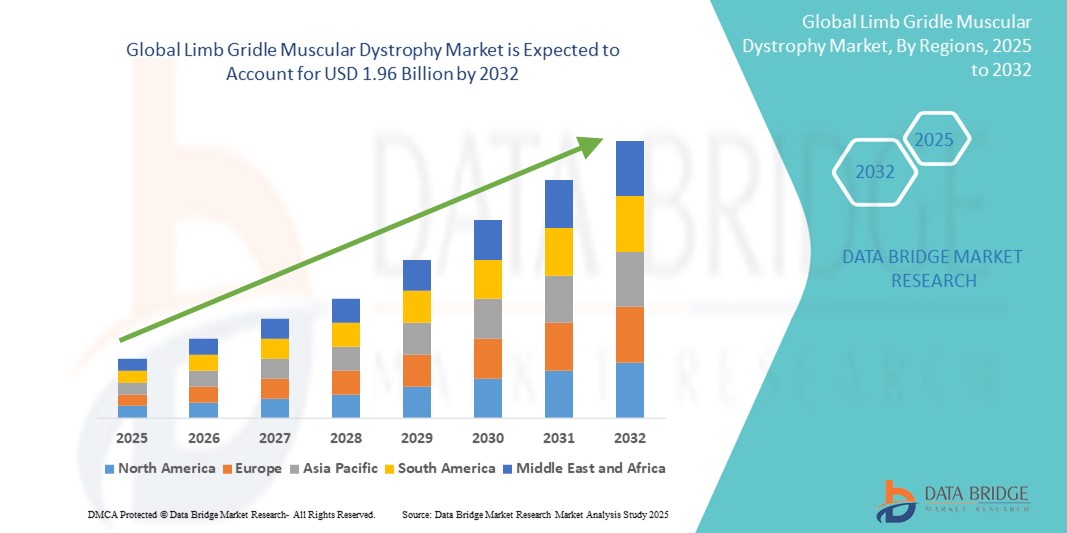
- The global limb gridle muscular dystrophy market size was valued at USD 1.36 billion in 2024 and is expected to reach USD 1.96 billion by 2032, at a CAGR of4.70% during the forecast period
- The market growth is largely fueled by the growing advancements in gene therapy, molecular diagnostics, and personalized medicine, which are enhancing early diagnosis and the development of targeted therapies for limb-girdle muscular dystrophy (LGMD). Innovations in gene editing technologies such as CRISPR/Cas9 and the increasing pipeline of RNA-based and enzyme replacement therapies are transforming the treatment landscape for LGMD patients, thereby driving market expansion
- Furthermore, rising patient awareness, improved healthcare infrastructure, and increased government and private funding for rare disease research are accelerating the adoption of innovative LGMD solutions. As more pharmaceutical companies invest in orphan drug development and clinical trials for various LGMD subtypes, the market is witnessing a growing number of novel therapeutics entering different phases of development. These converging factors are significantly boosting the growth of the global Limb-Girdle Muscular Dystrophy market across diagnostics, therapy, and disease management segments
Limb Gridle Muscular Dystrophy Market Analysis
- Limb-Girdle Muscular Dystrophy (LGMD), a group of genetically inherited neuromuscular disorders primarily affecting the shoulder and pelvic girdles, is increasingly drawing attention in the medical field due to advances in genetic testing, gene therapy, and rare disease research. The market is witnessing rapid growth as early diagnosis and targeted treatment options become more accessible through emerging biotechnological innovations and molecular diagnostics
- The escalating demand for effective LGMD therapies is primarily fueled by rising awareness among patients and caregivers, supportive regulatory incentives for orphan drugs, and an expanding pipeline of novel treatments including gene therapies, exon-skipping therapies, and enzyme replacement therapies. Increased advocacy and patient registries are also helping streamline clinical research and data collection for rare subtypes
- North America dominated the limb-girdle muscular dystrophy market with the largest revenue share of 41.3% in 2024, attributed to advanced healthcare infrastructure, strong presence of leading pharmaceutical and biotechnology companies, and early adoption of gene therapies. The U.S. continues to lead in clinical trials and FDA designations for LGMD-related therapies, with substantial funding support from public and private sectors
- Asia-Pacific is projected to be the fastest-growing region in the limb-girdle muscular dystrophy market, registering a CAGR of 19.6% from 2025 to 2032, driven by improving healthcare access, growing genetic testing capabilities, and increasing investments in rare disease diagnostics and treatments across countries such as China, Japan, and India
- The weakness of the proximal muscles of the hip and shoulder segment dominated the market with the largest revenue share of 46.5% in 2024, primarily due to its prevalence across various subtypes of LGMD. This symptom is often the earliest clinical manifestation, leading to diagnostic evaluation and therapeutic intervention
Report Scope and Limb Gridle Muscular Dystrophy Market Segmentation
|
Attributes |
Limb Gridle Muscular Dystrophy Key Market Insights |
|
Segments Covered |
|
|
Countries Covered |
North America
Europe
Asia-Pacific
Middle East and Africa
South America
|
|
Key Market Players |
|
|
Market Opportunities |
|
|
Value Added Data Infosets |
In addition to the insights on market scenarios such as market value, growth rate, segmentation, geographical coverage, and major players, the market reports curated by the Data Bridge Market Research also include in-depth expert analysis, pricing analysis, brand share analysis, consumer survey, demography analysis, supply chain analysis, value chain analysis, raw material/consumables overview, vendor selection criteria, PESTLE Analysis, Porter Analysis, and regulatory framework. |
Limb Gridle Muscular Dystrophy Market Trends
“Increasing Focus on Personalized and Genetic-Based Therapies”
- A significant and accelerating trend in the global limb girdle muscular dystrophy (LGMD) market is the growing emphasis on the development of personalized medicine and gene-based treatment options tailored to specific LGMD subtypes. This approach is redefining the therapeutic landscape by targeting the root genetic causes rather than just managing symptoms
- For instance, Sarepta Therapeutics and other biotech firms are developing gene therapy programs specifically for certain LGMD subtypes, such as LGMD2E (Beta-sarcoglycan deficiency), with clinical trials showing promising early-stage results. These advancements aim to restore the missing or malfunctioning proteins in muscle cells, improving both mobility and quality of life
- Pharmaceutical innovations are increasingly focusing on exon skipping, CRISPR editing, and viral vector delivery systems to provide targeted therapeutic benefits. The goal is to delay disease progression and potentially reverse certain muscular dystrophy symptoms, especially when diagnosed early
- In parallel, increased funding from global health agencies, orphan drug designations, and patient advocacy efforts are accelerating clinical research timelines. Patient registries and genetic screening programs are also being expanded to identify eligible patients for clinical trials and novel treatments
- This trend towards precision medicine in LGMD is not only improving clinical outcomes but also reshaping how patients and healthcare providers approach diagnosis, prognosis, and long-term care strategies. As awareness and diagnostic capabilities improve, personalized treatment protocols are expected to become the standard of care
- The demand for innovative therapies that can address the underlying genetic mutations of LGMD is growing rapidly across both developed and emerging markets, as patients and healthcare systems increasingly seek durable and disease-modifying treatment options
Limb Gridle Muscular Dystrophy Market Dynamics
Driver
“Growing Need Due to Rising Disease Awareness and Advancements in Genetic Therapies”
- The increasing global awareness of rare neuromuscular disorders like limb girdle muscular dystrophy (LGMD), combined with a surge in early genetic screening and diagnosis, is significantly driving the demand for more targeted and effective treatments
- For instance, in March 2024, Sarepta Therapeutics expanded its gene therapy development program to include additional LGMD subtypes, focusing on delivering mutation-specific therapies using AAV-based vectors. Such strategic investments are expected to fuel growth in the LGMD industry during the forecast period
- As patients and healthcare providers become more informed about the genetic basis and progressive nature of LGMD, the demand for disease-modifying therapies is rising. This includes gene therapies, exon-skipping treatments, and regenerative medicines aimed at preserving or restoring muscle function
- Furthermore, increased global funding and regulatory incentives for orphan diseases have accelerated the research pipeline. LGMD is now frequently included in early-phase clinical trials and natural history studies, increasing the pool of therapeutic candidates in development
- The availability of novel delivery mechanisms (e.g., AAV vectors), patient registries, and real-world evidence platforms is also streamlining drug development. As treatment pipelines grow and awareness campaigns expand, patient recruitment for clinical trials is improving—further supporting industry growth
Restraint/Challenge
“High Treatment Costs and Limited Access to Specialized Care”
- The high cost associated with gene and precision therapies for LGMD presents a significant barrier to broader adoption, particularly in middle- and low-income regions. Many of the innovative treatments are still in trial phases and, once approved, may command premium pricing
- For instance, one-time gene therapies for muscular dystrophies have been priced in the range of several hundred thousand dollars in recent launches, raising concerns about affordability, especially for uninsured or underinsured patients
- Another major challenge is the limited access to specialized neuromuscular care centers capable of diagnosing and managing LGMD cases. Many regions lack trained specialists and necessary diagnostic infrastructure, which delays treatment initiation and compromises disease monitoring
- Reimbursement issues and lack of insurance coverage for newer, high-cost therapies further complicate patient access, despite growing clinical need. This may result in treatment delays or complete absence of therapeutic options for many diagnosed patients
- Overcoming these challenges will require coordinated efforts across healthcare systems, including value-based pricing models, public-private partnerships to subsidize care, and educational initiatives aimed at building diagnostic and clinical expertise in underserved regions
Limb Gridle Muscular Dystrophy Market Scope
The market is segmented on the basis of symptoms, treatment, mode of administration, and end user.
- By Symptoms
On the basis of symptoms, the limb girdle muscular dystrophy market is segmented into weakness of the proximal muscles of the hip and shoulder, additional abnormalities, weakening of the heart muscle, and others. The weakness of the proximal muscles of the hip and shoulder segment dominated the market with the largest revenue share of 46.5% in 2024, primarily due to its prevalence across various subtypes of LGMD. This symptom is often the earliest clinical manifestation, leading to diagnostic evaluation and therapeutic intervention.
The weakening of the heart muscle segment is expected to witness the fastest CAGR of 8.9% from 2025 to 2032, driven by increasing awareness of cardiac complications in muscular dystrophies and the need for early cardiological assessment and management in affected patients.
- By Treatment
On the basis of treatment, the limb girdle muscular dystrophy market is segmented into surgery, therapy, and others. The therapy segment held the largest market revenue share of 58.2% in 2024, attributed to the widespread use of physical, occupational, and gene therapy interventions in slowing disease progression and improving patient mobility and quality of life.
The surgery segment is anticipated to grow at the fastest CAGR of 7.6% from 2025 to 2032, driven by rising surgical interventions for orthopedic complications and corrective procedures aimed at enhancing function and mobility in advanced cases.
- By Mode of Administration
On the basis of mode of administration, the limb girdle muscular dystrophy market is segmented into injectable, oral, and others. The injectable segment dominated the market with the largest revenue share of 61.4% in 2024, driven by the use of corticosteroids, gene therapies, and enzyme replacement therapies that are typically administered via injection.
The oral segment is expected to witness the fastest CAGR of 8.2% from 2025 to 2032, supported by increased preference for patient-compliant oral formulations such as anti-inflammatory and supportive therapies that ease disease burden.
- By End User
On the basis of end user, the limb girdle muscular dystrophy market is segmented into hospitals, homecare, specialty clinics, and others. The hospitals segment accounted for the largest market revenue share of 54.7% in 2024, driven by the availability of multidisciplinary care, diagnostic facilities, and specialized neuromuscular services.
The homecare segment is projected to grow at the highest CAGR of 9.4% from 2025 to 2032, owing to the shift towards patient-centered care, increased use of at-home physiotherapy and monitoring devices, and growing demand for supportive services in a home environment.
Limb Gridle Muscular Dystrophy Market Regional Analysis
- North America dominated the limb girdle muscular dystrophy market with the largest revenue share of 41.3% in 2024, driven by a strong research infrastructure
- High prevalence of genetic disorders, and the early adoption of advanced gene therapies
- The region benefits from favorable regulatory frameworks for orphan drugs, presence of key biotech firms, and substantial funding for rare disease research, contributing to the robust development pipeline and early clinical adoption of novel LGMD treatments
U.S. Limb Girdle Muscular Dystrophy Market Insight
The U.S. limb girdle muscular dystrophy market accounted for 82.4% of the North America revenue share in 2024. This is attributed to significant clinical trial activity, rising diagnostic rates through genetic testing, and expanding patient advocacy efforts. Organizations such as the Muscular Dystrophy Association (MDA) are instrumental in promoting awareness, funding, and support services. Moreover, U.S.-based biotech firms are leading the development of gene therapies targeting specific LGMD subtypes (e.g., LGMD2I, LGMD2E).
Europe Limb Girdle Muscular Dystrophy Market Insight
The Europe limb girdle muscular dystrophy market is expected to grow at a CAGR of 13.2% from 2025 to 2032, driven by supportive government initiatives for rare disease research and increasing clinical collaborations across universities and pharmaceutical firms. Key countries such as Germany, the U.K., and France are seeing increasing trial enrollments, growing patient registries, and rising availability of genetic counseling, which are collectively expanding early diagnosis and treatment reach.
U.K. Limb Girdle Muscular Dystrophy Market Insight
The U.K. limb girdle muscular dystrophy market is anticipated to grow at a CAGR of 12.6% during the forecast period, supported by NHS-backed rare disease programs and advancements in precision diagnostics. Increasing awareness of neuromuscular conditions, along with the country’s involvement in international clinical trials and registries, has helped improve patient identification and access to emerging therapies.
Germany Limb Girdle Muscular Dystrophy Market Insight
The Germany limb girdle muscular dystrophy market is forecasted to expand at a CAGR of 13.9% through 2032, owing to its strong focus on biopharma innovation, robust healthcare infrastructure, and government-sponsored rare disease initiatives. Academic research hubs like Tübingen and Munich are actively involved in neuromuscular gene therapy trials, making Germany a key location for LGMD clinical development and treatment access.
Asia-Pacific Limb Girdle Muscular Dystrophy Market Insight
The Asia-Pacific limb girdle muscular dystrophy market is projected to grow at the fastest CAGR of 19.6% during the forecast period (2025–2032), propelled by increasing awareness, improving healthcare access, and growing investments in genomics and rare disease management. Countries such as Japan, China, and India are seeing growth in newborn screening programs and early diagnosis of muscular dystrophies, facilitating early-stage intervention and research collaboration.
Japan Limb Girdle Muscular Dystrophy Market Insight
The Japan limb girdle muscular dystrophy market is expanding steadily, with a projected CAGR of 14.8%, supported by the country’s strong emphasis on genetic research, aging population, and investments in regenerative medicine.Institutions such as the National Center of Neurology and Psychiatry are at the forefront of clinical studies in limb girdle muscular dystrophies, making Japan a strategic hub for innovation and therapeutic development.
China Limb Girdle Muscular Dystrophy Market Insight
The China limb girdle muscular dystrophy market held the largest market revenue share in the Asia-Pacific region, contributing 39.6% of the regional LGMD market in 2024. Rapid improvements in healthcare infrastructure, local biotech innovations, and government-backed rare disease policies are supporting this growth. With a growing number of genetic testing centers and the emergence of Chinese firms in the cell and gene therapy space, the market outlook remains highly positive, especially in tier-1 and tier-2 cities.
Limb Gridle Muscular Dystrophy Market Share
The Limb Gridle Muscular Dystrophy industry is primarily led by well-established companies, including:
- Amgen Inc. (U.S.)
- Alkem (India)
- LUPIN (India)
- Hope Pharmaceuticals (U.S.)
- Sanifit (Spain)
- Essity Health & Medical (Germany)
- Sun Pharmaceutical Industries Ltd (India)
- Cipla (India)
- Viatris Inc. (U.S.)
- Teva Pharmaceutical Industries Ltd (Israel)
- Zydus Cadila (India)
Latest Developments in Global Limb Gridle Muscular Dystrophy Market
- In February 2022, Asklepios BioPharmaceutical, Inc., a subsidiary of Bayer AG, announced that the European Commission (EC) granted orphan drug designation to AB-1003, also referred to as LION-101, for treating limb girdle muscular dystrophy. This designation highlights the drug's potential in addressing the needs of patients with this rare condition. Securing orphan drug status can facilitate expedited development and regulatory processes, paving the way for earlier access to much-needed therapies
- In September 2024, Atamyo Therapeutics has collaborated with the Dion Foundation for Children with Rare Diseases to initiate a clinical trial in the U.S. for ATA-200, a promising gene therapy aimed at treating limb girdle muscular dystrophy type 2C/R5 (LGMD2C/R5). This partnership highlights a commitment to advancing innovative therapies for patients affected by this rare condition. The trial's expansion into the U.S. signifies a crucial step in exploring the potential of ATA-200 as a treatment option for individuals suffering from LGMD2C/R5

- Interactive Data Analysis Dashboard
- Company Analysis Dashboard for high growth potential opportunities
- Research Analyst Access for customization & queries
- Competitor Analysis with Interactive dashboard
- Latest News, Updates & Trend analysis
- Harness the Power of Benchmark Analysis for Comprehensive Competitor Tracking
Data collection and base year analysis are done using data collection modules with large sample sizes. The stage includes obtaining market information or related data through various sources and strategies. It includes examining and planning all the data acquired from the past in advance. It likewise envelops the examination of information inconsistencies seen across different information sources. The market data is analysed and estimated using market statistical and coherent models. Also, market share analysis and key trend analysis are the major success factors in the market report. To know more, please request an analyst call or drop down your inquiry.
The key research methodology used by DBMR research team is data triangulation which involves data mining, analysis of the impact of data variables on the market and primary (industry expert) validation. Data models include Vendor Positioning Grid, Market Time Line Analysis, Market Overview and Guide, Company Positioning Grid, Patent Analysis, Pricing Analysis, Company Market Share Analysis, Standards of Measurement, Global versus Regional and Vendor Share Analysis. To know more about the research methodology, drop in an inquiry to speak to our industry experts.
Data Bridge Market Research is a leader in advanced formative research. We take pride in servicing our existing and new customers with data and analysis that match and suits their goal. The report can be customized to include price trend analysis of target brands understanding the market for additional countries (ask for the list of countries), clinical trial results data, literature review, refurbished market and product base analysis. Market analysis of target competitors can be analyzed from technology-based analysis to market portfolio strategies. We can add as many competitors that you require data about in the format and data style you are looking for. Our team of analysts can also provide you data in crude raw excel files pivot tables (Fact book) or can assist you in creating presentations from the data sets available in the report.












