What is the Limestone for Agriculture Market Size and Growth Rate?
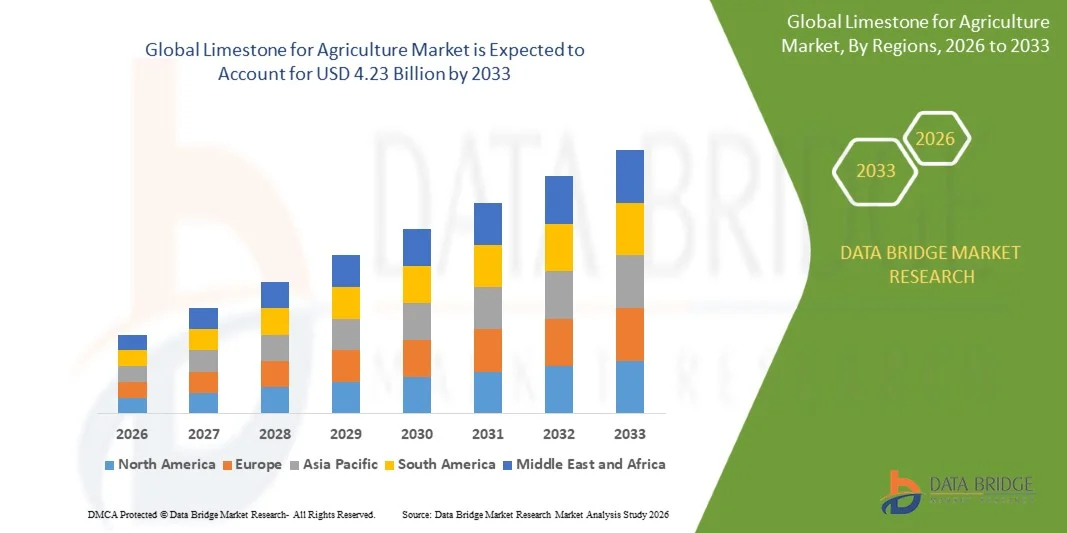
- As per Data Bridge Market Research analysis, the limestone for agriculture market was valued at USD 2.70 billion in 2025 and is projected to reach USD 4.23 billion by 2033, growing at a CAGR of 5.80% from 2026 to 2033.
- The market is experiencing consistent growth driven by increasing demand for soil pH correction, growing emphasis on soil fertility and crop productivity, and rising adoption of sustainable agricultural practices. Agricultural limestone helps neutralize acidic soils, improve nutrient availability, and support healthier crop growth.
- The increasing need to enhance agricultural yields and maintain soil health, combined with expanding farming activities and growing awareness of limestone’s benefits, is encouraging farmers to adopt agricultural limestone products. Calcitic and dolomitic limestone, available in normal and granular/palletized forms, are increasingly used across agriculture and gardening applications to improve soil conditions and support productive farming.
Market Size & Forecast
- Global Market Value (2025): USD 2.70 Billion
- Expected Market Value (2033): USD 4.23 Billion
- Forecast CAGR (2026–2033): 5.80%
- Leading Region in 2025: North America
- Fastest Growing Region: Asia Pacific
What are the Major Takeaways of the Limestone for Agriculture Market?
- North America dominated the limestone for agriculture market with the largest revenue share of 40% in 2025, supported by its mature agricultural sector, widespread soil-management practices, and established distribution infrastructure.
- Asia-Pacific is expected to be the fastest-growing region at a CAGR of 7.5% from 2026 to 2033, fueled by expanding agricultural activities, increasing soil-acidity concerns, rising food-production requirements, and growing adoption of sustainable soil amendments in India and China.
- The calcitic segment led the market with a 61.2% share in 2025, driven by its widespread use for correcting soil acidity and supplying calcium to agricultural soils.
- Dolomitic are the fastest-growing type, projected to register a CAGR of 4.8%, reflecting the surge in demand for products that provide both calcium and magnesium while correcting acidic soils.
- The soil conditioning segment dominated the application category with a 48.5% revenue share in 2025, led by extensive use of limestone to neutralize acidic soils and improve soil fertility.
- Normal accounted for 45% of the market share in 2025, preferred by its widespread availability and established use in conventional agricultural liming applications.
- The pelletized segment is the fastest-growing product category, with a CAGR of 6.0%, driven by the increasing demand for convenient handling and more precise agricultural application.
Report Scope and Limestone for Agriculture Market Segmentation
|
Attributes |
Limestone for Agriculture Key Market Insights |
|
Segments Covered |
|
|
Countries Covered |
North America
Europe
Asia-Pacific
Middle East and Africa
South America
|
|
Key Market Players |
|
|
Market Opportunities |
|
|
Value Added Data Infosets |
In addition to the insights on market scenarios such as market value, growth rate, segmentation, geographical coverage, and major players, the market reports curated by the Data Bridge Market Research also include import export analysis, production capacity overview, production consumption analysis, price trend analysis, climate change scenario, supply chain analysis, value chain analysis, raw material/consumables overview, vendor selection criteria, PESTLE Analysis, Porter Analysis, and regulatory framework. |
What is the Key Trend in the Limestone for Agriculture Market?
- Farmers are increasingly adopting precision liming and variable-rate limestone application to address field-level variations in soil acidity, improve input efficiency, and apply lime according to specific soil pH requirements.
- For instance, in November 2024, the University of Delaware demonstrated variable-rate limestone application using grid-based soil sampling and GPS-guided application, with soil pH and buffer-pH maps used to create a targeted lime prescription that brought most of the field toward the 6.0–6.5 pH range.
- High-resolution soil mapping using proximal sensors is enabling farmers to identify variations in pH, soil texture, and organic matter and generate more accurate limestone application recommendations.
- The integration of soil sensors, digital soil maps, GPS-guided equipment, and variable-rate spreaders is creating more precise and data-driven approaches to agricultural limestone management.
- For instance, in February 2023, the University of Georgia demonstrated that variable-rate lime application could reduce lime costs from USD 60 per acre under uniform application to USD 32 per acre, while precision soil sampling added approximately USD 10 per acre, highlighting the economic potential of site-specific limestone management.
- As precision agriculture technologies continue to improve soil diagnostics and application accuracy, the adoption of site-specific limestone management is expected to accelerate, reinforcing precision liming as an important trend in sustainable soil fertility management.
What are the Key Drivers of the Limestone for Agriculture Market?
- The growing prevalence of soil acidity and nutrient-availability problems is significantly increasing demand for agricultural limestone, as liming raises soil pH, reduces aluminum and manganese toxicity, and improves nutrient availability for crops.
- For instance, in March 2025, a study in northwestern Ethiopia found that lime application substantially improved acidic-soil conditions and increased wheat grain yield to 2,198.4 kg per hectare under the most effective lime-recommendation treatment, highlighting the importance of limestone for improving crop productivity in acid soils.
- Farmers, agricultural cooperatives, and governments are increasingly using limestone as a cost-effective soil amendment to restore soil fertility, improve crop productivity, and maintain long-term agricultural land quality.
- For instance, in August 2024, Kansas State University recommended variable-rate limestone application for acidic fields after long-term nitrogen fertilization, highlighting how lime is used to correct fertilizer-induced soil acidity and maintain productive crop-growing conditions
- With increasing pressure to enhance agricultural productivity while maintaining soil quality, the need to correct acidic soils and improve nutrient-use efficiency will continue supporting demand for agricultural limestone across major farming regions.
Which Factors are Challenging the Growth of the Limestone for Agriculture Market?
- Agricultural limestone is a relatively heavy, bulk commodity, making transportation, handling, storage, and spreading costs significant, particularly when farms are located far from limestone production facilities.
- For instance, in June 2023, a Soil Security study of Ethiopia’s agricultural lime value chain found that lime processing and transportation accounted for major portions of the value-chain costs, with transport representing 31.9% of the total gross margin, highlighting the logistics burden associated with delivering agricultural limestone to farmers.
- These logistics costs can reduce farmer affordability and limit limestone adoption in remote agricultural areas and emerging markets where transportation infrastructure remains underdeveloped.
- Agricultural limestone also requires application based on soil-test results and appropriate application rates, while over-application can cause nutrient-availability problems and unnecessary expenditure, increasing the importance of accurate soil assessment.
- For instance, in July 2026, a study of lime adoption in Ethiopia found that only 36.6% of surveyed households had adopted lime technology, while 63.4% remained non-adopters; the study identified rising lime costs, limited access, transportation expenses, and financial constraints as major barriers to adoption.
- The combination of high transportation requirements, application costs, and the need for accurate soil testing continues to challenge market expansion, particularly for smallholder farmers and geographically dispersed agricultural markets.
How is the Limestone for Agriculture Market Segmented?
The limestone for agriculture market is segmented on the basis of type, application, product, end user, and distribution channel.
- By Type
On the basis of type, the limestone for agriculture market is segmented into calcitic, dolomitic, and other. The calcitic segment dominated the market with 61.2% share in 2025, owing to its widespread use for correcting soil acidity and supplying calcium to agricultural soils. Calcitic limestone is particularly suitable for soils that require pH adjustment without additional magnesium. It is widely applied across field crops, horticulture, and pasture systems to improve nutrient availability and root development. Its broad geological availability and established supply chains further support its adoption. Increasing awareness of soil-health management and the need to maintain suitable soil pH levels are also supporting demand. Its established use across conventional farming systems is expected to maintain its leading position.
The dolomitic segment is projected to register the fastest growth at 4.8% CAGR during forecast period, driven by increasing demand for products that provide both calcium and magnesium while correcting acidic soils. Dolomitic limestone is particularly valuable in soils where magnesium deficiencies occur alongside low pH. Its dual nutrient function can reduce the need for separate magnesium amendments in suitable agricultural applications. Growing soil testing and site-specific nutrient management are helping farmers identify fields where dolomitic limestone is more appropriate. Expanding crop production in regions with acidic and magnesium-deficient soils is further creating demand. Increasing adoption of balanced soil-fertility practices is expected to support continued segment growth.
- By Application
On the basis of application, the limestone for agriculture market is segmented into agriculture, gardening, soil conditioning, animal feed, and others. The soil conditioning segment dominated the market with 48.5% share in 2025, supported by extensive use of limestone to neutralize acidic soils and improve soil fertility. Limestone helps raise soil pH and can improve the availability of nutrients required for crop development. It is widely incorporated into soil-management programs for acidic agricultural land. Increasing concerns regarding soil degradation and declining fertility are encouraging farmers to adopt soil amendments. Growing awareness of the relationship between soil pH and crop productivity is further supporting demand. The importance of maintaining productive agricultural soils is expected to sustain the segment's leading position.
The agriculture segment is projected to register the fastest growth at 5.6% CAGR during forecast period, driven by expanding crop production and increasing adoption of soil-pH management practices. Agricultural limestone is increasingly used to improve growing conditions in acidified soils and support more efficient nutrient utilization. Rising global food requirements are encouraging farmers to improve productivity from existing agricultural land. The shift toward sustainable and regenerative farming is also increasing interest in soil amendments that improve long-term soil quality. Major crop-producing countries are expanding the use of limestone as part of integrated soil-fertility programs. Increasing recognition of soil pH as an important determinant of crop performance is expected to accelerate demand.
- By Product
On the basis of product, the limestone for agriculture market is segmented into normal, granular, pelletized, crushed, and powdered. The normal segment is expected to dominate the market with 45% share in 2025, supported by its widespread availability and established use in conventional agricultural liming applications. Normal limestone is commonly used for large-scale soil-acidity correction where substantial quantities of material are required. Its established production and distribution infrastructure supports accessibility across major agricultural markets. Farmers and agricultural distributors are familiar with its application requirements and handling characteristics. Its suitability for broad-acre farming provides a substantial demand base. The relatively established nature of conventional limestone application is expected to preserve the segment's leading position.
The pelletized segment is projected to register the fastest growth at 6.0% CAGR during forecast period, supported by increasing demand for convenient handling and more precise agricultural application. Pelletized limestone provides relatively uniform particle sizing, which can improve spreading consistency. Its handling characteristics make it attractive for farmers using modern application equipment. Growing adoption of precision agriculture is creating additional opportunities for products that can be applied at field-specific rates. Pelletized formats can also reduce dust during handling compared with very fine powdered materials. Increasing interest in efficient input management and controlled application is supporting adoption. These characteristics are expected to make pelletized limestone one of the faster-growing product formats.
- By End User
On the basis of end user, the limestone for agriculture market is segmented into crop farming, horticulture, livestock farming, turf & lawn care, and organic farming. The crop farming segment is expected to dominate the market with 60% share in 2025, owing to the extensive use of limestone across large agricultural areas. Major field crops such as cereals, corn, wheat, soybeans, and oilseeds require appropriate soil-pH conditions for efficient nutrient utilization. Commercial farmers increasingly use soil testing to determine whether agricultural limestone is required. Limestone application can improve nutrient availability and create more favorable conditions for root development. The large global area devoted to crop cultivation provides a substantial recurring market for agricultural limestone. Increasing efforts to maximize yields while maintaining soil quality are expected to sustain the segment's dominance.
The organic farming segment is projected to register the fastest growth at 6.0% CAGR during forecast period, supported by increasing adoption of sustainable agricultural practices and expansion of organic cultivation. Agricultural limestone can be used in organic production systems where permitted under applicable organic standards to manage soil acidity. Organic farmers increasingly emphasize soil fertility, nutrient cycling, and long-term soil health. Rising organic farmland and consumer demand for organically produced food are expanding the potential user base. Growing interest in regenerative agriculture is also encouraging farmers to adopt soil-management practices that support long-term productivity. Soil testing and integrated nutrient-management programs are helping organic growers determine appropriate liming requirements. These trends are expected to support increasing limestone demand from organic farming.
- By Distribution Channel
On the basis of distribution channel, the limestone for agriculture market is segmented into direct sales, distributors, agricultural cooperatives, retail stores, and online sales. The distributors segment is expected to dominate the market with 35% share in 2025, because agricultural limestone is a bulk product requiring transportation, storage, and regional distribution. Distributors connect limestone producers with farmers and agricultural businesses across geographically dispersed farming regions. Their logistics networks enable movement of large quantities from production facilities to agricultural areas. Distributors can also supply different limestone grades and formats according to local farming requirements. Their established relationships with agricultural retailers and farming communities further expand market reach.
The online sales segment is projected to register the fastest growth at 7.0% CAGR during forecast period, supported by increasing digitalization of agricultural procurement and expanding agricultural e-commerce platforms. Online channels provide farmers with convenient access to product information, specifications, pricing, and purchasing options. Digital agricultural marketplaces are increasingly connecting input suppliers with farmers beyond traditional local distribution networks. Rising internet and smartphone penetration in emerging agricultural markets is creating additional opportunities for digital purchasing. Packaged and specialty limestone products are particularly suitable for online retail compared with large bulk shipments. Integration of online purchasing with digital farm-management and advisory platforms could further improve product discovery.
Which Region Holds the Largest Share of the Limestone for Agriculture Market?
- North America dominated the limestone for agriculture market with the largest revenue share of 40% in 2025, supported by its mature agricultural sector, widespread soil-management practices, and established distribution infrastructure.
- The region also benefits from extensive use of agricultural limestone for soil pH correction, crop-yield optimization, and soil-health management, particularly across the U.S. and Canada. Strong adoption of precision agriculture, established agricultural input supply chains, and increasing emphasis on sustainable farming practices continue to strengthen North America's leadership position in the global market.
U.S. Limestone for Agriculture Market Insight
The U.S. limestone for agriculture market is witnessing steady growth due to widespread use of agricultural lime for soil acidity correction, crop productivity improvement, and soil fertility management. The country’s extensive agricultural land base, particularly across major crop-producing regions, creates sustained demand for limestone-based soil amendments. Farmers are increasingly using soil testing and precision agriculture practices to determine appropriate liming requirements. In addition, growing emphasis on maintaining soil health, improving nutrient availability, and optimizing crop yields is accelerating limestone adoption across commercial farming operations.
Asia-Pacific Limestone for Agriculture Market Insight
The Asia-Pacific limestone for agriculture market is expected to witness rapid growth, driven by expanding agricultural activities, increasing food-production requirements, and rising concerns regarding soil acidity across countries such as China and India. Growing adoption of soil-management practices, increasing awareness of agricultural lime benefits, and rising demand for higher crop productivity are supporting regional market expansion. In addition, increasing use of precision agriculture and sustainable farming practices is encouraging more targeted application of limestone across crop-producing regions.
Japan Limestone for Agriculture Market Insight
The Japan limestone for agriculture market is witnessing consistent growth due to increasing emphasis on soil fertility management, crop productivity, and sustainable agricultural practices. Farmers are increasingly adopting soil amendments to maintain appropriate soil pH and improve nutrient availability for agricultural production. Moreover, Japan’s advanced agricultural technologies and growing adoption of precision farming practices are supporting more efficient limestone application. Increasing focus on maintaining productive farmland and improving resource-use efficiency is further contributing to market growth.
China Limestone for Agriculture Market Insight
The China limestone for agriculture market is growing rapidly, driven by extensive agricultural production, increasing soil-acidity management requirements, and rising demand for improved crop yields. Growing adoption of agricultural limestone for soil pH correction and nutrient management across major farming regions is significantly boosting market demand. In addition, government emphasis on improving farmland quality, increasing agricultural productivity, and promoting sustainable soil-management practices is encouraging the adoption of soil amendments, positioning China as one of the important growth markets for agricultural limestone.
U.K. Limestone for Agriculture Market Insight
The U.K. limestone for agriculture market is experiencing steady growth, supported by increasing adoption of soil pH management practices across arable farming and grassland applications. Farmers are increasingly using agricultural limestone to correct acidic soils, improve nutrient availability, and maintain productive farmland. Increasing emphasis on sustainable agricultural practices and efficient nutrient management is contributing to market development. Furthermore, growing adoption of soil testing and precision farming technologies is enabling more targeted lime applications, supporting the efficient use of limestone across agricultural operations.
Germany Limestone for Agriculture Market Insight
The Germany limestone for agriculture market is expanding steadily due to the country’s established agricultural sector, increasing focus on soil health, and growing adoption of sustainable farming practices. Agricultural producers are increasingly utilizing limestone to manage soil acidity and support nutrient availability across crop-growing areas. Continuous advancements in soil testing, precision agriculture, and site-specific nutrient management are further improving limestone application efficiency. In addition, increasing emphasis on maintaining agricultural soil quality and optimizing crop productivity is supporting continued demand for agricultural limestone in Germany.
Which are the Top Companies in Limestone for Agriculture Market?
The limestone for agriculture industry is primarily led by well-established companies, including:
- Omya International AG, (Switzerland)
- Carmeuse (Belgium)
- Graymont Limited (Canada)
- Lhoist (Belgium)
- Nordkalk Corporation (Finland)
- Sibelco (Belgium)
- Tarmac Trading Limited (U.K.)
- Holcim UK Limited (U.K.)
- Roadstone Ltd. (Ireland)
- Western Agriculture Lime Company (Australia)
- G&W INDUSTRIAL MINERALS (Zimbabwe)
- SA Lime & Gypsum (South Africa)
- Alternative Materials, LLC (U.S.)
- Tuscola Stone Company (U.S.)
- Kimble Company (U.S.)
- Schildberg Construction Company (U.S.)
- Bullimores Sand & Gravel Ltd (U.K.)
- Matrix Fertilisers (Zimbabwe)
- White Earth Pvt Ltd (India)
What are Latest Developments in Limestone for Agriculture Market?
- In February 2025, the Department of Agriculture, Environment and Rural Affairs (DAERA) in Northern Ireland highlighted liming as a key soil-fertility practice for grassland, emphasizing that lime neutralizes acidity generated by nitrogen fertilizer and slurry while improving nutrient availability and supporting grass growth. The guidance reinforced the increasing importance of agricultural limestone in maintaining soil fertility and improving nutrient-use efficiency in dairy farming.
- In September 2024, DAERA advised farmers to apply agricultural lime to productive grassland and arable fields after wet weather and nutrient leaching increased soil-acidity concerns. The department reported that CAFRE farms use regular soil testing to determine pH and target lime applications, with bulk ground limestone applied according to soil-analysis recommendations. This development highlights the growing integration of soil testing with targeted agricultural limestone application.
- In March 2023, Ireland’s Department of Agriculture, Food and the Marine launched the €8 million National Liming Programme to encourage farmers to purchase and spread calcium ground limestone and dolomitic ground limestone. The program provided financial support for lime application based on soil-analysis requirements and was introduced to improve soil fertility, nutrient-use efficiency, and reduce dependence on chemical fertilizers.
- In February 2022, Teagasc published updated technical guidance on agricultural liming, reporting that lime application can release up to 80 kg of soil nitrogen per hectare annually and increase grass production by approximately 1.5 tonnes of dry matter per hectare, reinforcing the role of limestone in improving soil fertility and nutrient-use efficiency.
- In January 2021, researchers from Teagasc and collaborating institutions published a long-term field study showing that increasing soil pH through liming reduced fertilizer-derived nitrous oxide emissions by up to 39% compared with unlimed plots. The eight-year grassland trial also linked appropriate soil pH management with improved nutrient availability and agricultural productivity, strengthening the environmental and agronomic case for agricultural limestone.

- Interactive Data Analysis Dashboard
- Company Analysis Dashboard for high growth potential opportunities
- Research Analyst Access for customization & queries
- Competitor Analysis with Interactive dashboard
- Latest News, Updates & Trend analysis
- Harness the Power of Benchmark Analysis for Comprehensive Competitor Tracking
Data collection and base year analysis are done using data collection modules with large sample sizes. The stage includes obtaining market information or related data through various sources and strategies. It includes examining and planning all the data acquired from the past in advance. It likewise envelops the examination of information inconsistencies seen across different information sources. The market data is analysed and estimated using market statistical and coherent models. Also, market share analysis and key trend analysis are the major success factors in the market report. To know more, please request an analyst call or drop down your inquiry.
The key research methodology used by DBMR research team is data triangulation which involves data mining, analysis of the impact of data variables on the market and primary (industry expert) validation. Data models include Vendor Positioning Grid, Market Time Line Analysis, Market Overview and Guide, Company Positioning Grid, Patent Analysis, Pricing Analysis, Company Market Share Analysis, Standards of Measurement, Global versus Regional and Vendor Share Analysis. To know more about the research methodology, drop in an inquiry to speak to our industry experts.
Data Bridge Market Research is a leader in advanced formative research. We take pride in servicing our existing and new customers with data and analysis that match and suits their goal. The report can be customized to include price trend analysis of target brands understanding the market for additional countries (ask for the list of countries), clinical trial results data, literature review, refurbished market and product base analysis. Market analysis of target competitors can be analyzed from technology-based analysis to market portfolio strategies. We can add as many competitors that you require data about in the format and data style you are looking for. Our team of analysts can also provide you data in crude raw excel files pivot tables (Fact book) or can assist you in creating presentations from the data sets available in the report.