


Lip Enhancement Injectable Fillers Market Size
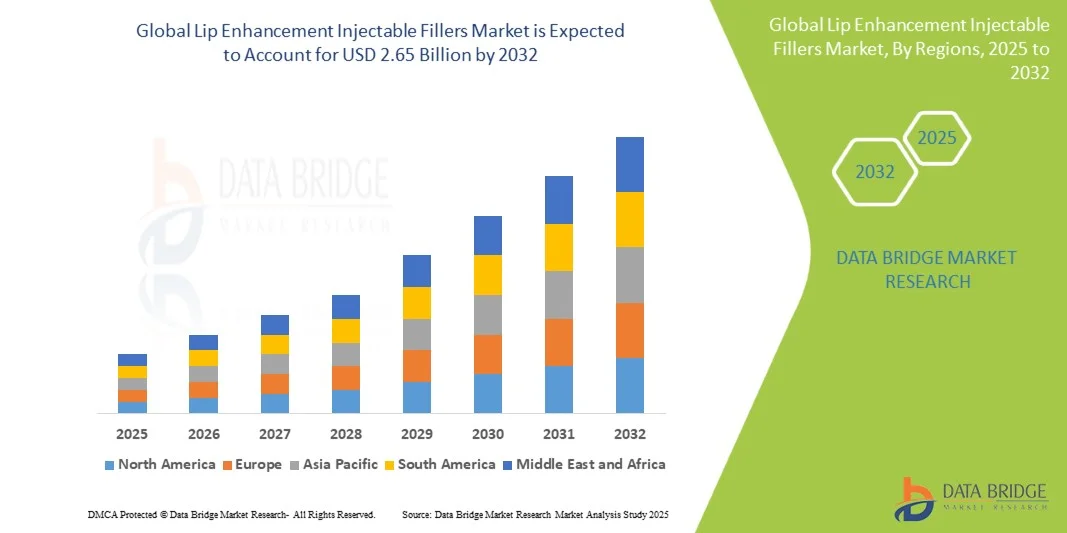
- The global lip enhancement injectable fillers market size was valued at USD 1.22 billion in 2024 and is expected to reach USD 2.65 billion by 2032, at a CAGR of 10.15% during the forecast period
- The market growth is largely fueled by the growing adoption of minimally‑invasive aesthetic procedures, rising consumer preference for fuller lips and youthful facial aesthetics, and technological advances in injectable filler formulations
- Furthermore, rising consumer demand for safe, user‑friendly, and customizable lip enhancement solutions is establishing injectable lip fillers as a key access point in aesthetic medicine. These converging factors are accelerating uptake of lip enhancement injectable fillers, thereby significantly boosting the industry’s growth
Lip Enhancement Injectable Fillers Market Analysis
- Lip enhancement injectable fillers minimally invasive cosmetic treatments for lips are increasingly integral to modern aesthetic medicine in both cosmetic and reconstructive applications due to offering natural lip volume, enhanced contour, quicker procedures, and reduced downtime
- The escalating demand for lip enhancement injectable fillers is primarily fueled by rising social media and celebrity influence on lip aesthetics, growing consumer preference for non-surgical procedures, and technological advances in filler materials, particularly hyaluronic-acid based formulations, which improve safety, effectiveness, and customization
- North America dominated the lip enhancement injectable fillers market with the largest revenue share of 40.2% in 2024, characterized by high consumer spending, advanced aesthetic clinic infrastructure, and early adoption of aesthetic procedures, with the U.S. experiencing substantial growth in lip filler procedures, driven by innovations from established aesthetic companies and emerging clinics offering personalized solutions
- Asia-Pacific is expected to be the fastest-growing region in the lip enhancement injectable fillers market during the forecast period due to increasing urbanization, rising disposable incomes, a growing beauty-conscious population, and expanding access to aesthetic services in emerging markets
- Hyaluronic acid fillers dominated the lip enhancement injectable fillers market with a market share of 45% in 2024, driven by their strong safety profile, reversibility, and widespread adoption in non-surgical lip augmentation procedures
Report Scope and Lip Enhancement Injectable Fillers Market Segmentation
|
Attributes |
Lip Enhancement Injectable Fillers Key Market Insights |
|
Segments Covered |
|
|
Countries Covered |
North America
Europe
Asia-Pacific
Middle East and Africa
South America
|
|
Key Market Players |
|
|
Market Opportunities |
|
|
Value Added Data Infosets |
In addition to the insights on market scenarios such as market value, growth rate, segmentation, geographical coverage, and major players, the market reports curated by the Data Bridge Market Research also include in-depth expert analysis, patient epidemiology, pipeline analysis, pricing analysis, and regulatory framework |
Lip Enhancement Injectable Fillers Market Trends
“Rising Popularity of Minimally Invasive Procedures and Personalized Treatments”
- A significant and accelerating trend in the global lip enhancement injectable fillers market is the growing preference for minimally invasive procedures that provide natural-looking results with reduced downtime and fewer complications
- For instance, the use of advanced hyaluronic acid (HA) fillers allows clinicians to customize lip volume and contour for individual patients, achieving a more personalized aesthetic outcome
- Technological advancements in filler formulations enable longer-lasting effects, reduced swelling, and lower risk of adverse reactions, making procedures more appealing to consumers
- Clinics are increasingly offering AI-assisted imaging and simulation tools that allow patients to visualize potential outcomes prior to injection, enhancing patient confidence and satisfaction
- Mobile and on-demand aesthetic services are emerging, allowing patients to access filler treatments at home or convenient locations, increasing accessibility and adoption
- Social media platforms are driving consumer awareness and shaping beauty standards, further increasing the desire for cosmetic lip enhancements
- This trend toward personalized, safer, and more predictable results is reshaping consumer expectations in aesthetic medicine. Consequently, companies are developing innovative HA-based fillers with variable viscosity and specialized applicators for precise lip sculpting
- The demand for advanced, patient-tailored lip enhancement solutions is growing rapidly across both cosmetic and reconstructive applications as consumers increasingly prioritize safety, convenience, and natural aesthetics
Lip Enhancement Injectable Fillers Market Dynamics
Driver
“Increasing Demand Due to Social Media Influence and Growing Cosmetic Awareness”
- The rising popularity of fuller lips driven by social media, influencers, and celebrity trends is a significant driver for the growing adoption of lip enhancement injectable fillers
- For instance, in 2024, several aesthetic clinics reported a surge in consultations after viral cosmetic trends on platforms such as Instagram and TikTok, highlighting the social influence on patient preferences
- Consumers increasingly prefer non-surgical procedures that provide quick results and minimal recovery time, fueling the adoption of injectable fillers over surgical alternatives
- Rising awareness about aesthetic procedures and the availability of FDA-approved, safe filler products are encouraging more first-time users to opt for lip enhancements
- Expansion of clinics and aesthetic centers into tier-2 and tier-3 cities is increasing accessibility, fueling adoption in emerging markets
- Advancements in filler techniques, such as microcannula injections and layered application methods, are improving outcomes and patient satisfaction
- Clinics offering bundled cosmetic services, loyalty programs, and financing options are further increasing accessibility and uptake of lip enhancement treatments
- The convenience of quick, minimally invasive procedures combined with predictable, customizable results continues to drive market growth across both established and emerging markets
Restraint/Challenge
“Adverse Reactions and Regulatory Compliance Hurdles”
- Safety concerns related to swelling, bruising, or allergic reactions pose a significant challenge to the broader adoption of lip enhancement injectable fillers
- For instance, reports of rare but severe complications such as vascular occlusion or infection make some consumers hesitant to undergo cosmetic injections
- Regulatory requirements and approval processes for new filler formulations can slow market entry and limit availability of innovative products in certain regions
- The relatively high cost of premium filler procedures may deter price-sensitive consumers, particularly in emerging markets where disposable incomes are lower. Counterfeit or substandard filler products entering the market can damage consumer confidence and restrict overall growth
- Limited availability of trained and certified practitioners in some regions may restrict adoption and negatively impact procedure safety
- While clinics offer lower-cost alternatives, patients may perceive them as less safe or effective, influencing adoption rates
- Overcoming these challenges through rigorous clinical testing, enhanced patient education, and the introduction of cost-effective, safe formulations is vital for sustained market growth
Lip Enhancement Injectable Fillers Market Scope
The market is segmented on the basis of product type, type, application, and end user.
- By Product Type
On the basis of product type, the market is segmented into Hyaluronic Acid (HA) fillers, Collagen fillers, Poly‑L‑Lactic Acid (PLLA) fillers, Calcium Hydroxyapatite (CaHA) fillers, and Others. The Hyaluronic Acid fillers segment dominated the market with the largest market revenue share of 45% in 2024, driven by their strong safety profile, reversibility, and versatility in achieving natural-looking lip volume. HA fillers are widely preferred by dermatologists and cosmetic practitioners for their predictable results and minimal downtime. Consumers increasingly choose HA fillers for their biocompatibility and lower risk of adverse reactions. The segment benefits from continuous product innovations such as varying viscosity formulations and specialized cannulas for precise lip sculpting. HA fillers are also supported by strong clinical data, enhancing patient confidence and adoption rates. Their compatibility with non-surgical procedures has solidified their leadership in the market.
The Poly‑L‑Lactic Acid fillers segment is anticipated to witness the fastest growth rate from 2025 to 2032, fueled by their collagen-stimulating properties and longer-lasting results. PLLA fillers are gaining popularity among consumers seeking gradual, natural enhancement over multiple sessions. Clinics are increasingly adopting PLLA fillers for patients looking for subtle and sustainable lip augmentation. The rising awareness about long-term results and minimally invasive procedures is driving the growth of this segment. Emerging markets are witnessing growing acceptance of PLLA due to improved availability and training among practitioners. Innovations in PLLA formulations and injection techniques are also contributing to faster adoption rates.
- By Type
On the basis of type, the market is segmented into Temporary and Permanent fillers. The Temporary segment dominated the market in 2024, led by hyaluronic acid-based fillers, which typically last between 6 to 12 months. Temporary fillers are preferred for first-time users due to their reversibility and safety profile. The predictability of results and minimal recovery time make temporary fillers attractive for cosmetic enhancement procedures. Clinics often recommend temporary fillers to allow patients to adjust to their new appearance before committing to permanent solutions. Temporary fillers also enable easier customization of lip shape and volume, contributing to higher adoption rates. Growing consumer preference for non-invasive and low-risk procedures continues to reinforce this segment’s dominance.
The Permanent fillers segment is expected to witness the fastest growth from 2025 to 2032, driven by increasing demand for long-lasting aesthetic results. Permanent fillers, such as autologous fat transfer or advanced synthetic implants, appeal to consumers looking to reduce the frequency of maintenance procedures. Technological improvements and safer formulations are enhancing the marketability of permanent fillers. Surgeons are increasingly adopting permanent solutions for reconstructive and cosmetic purposes due to durable outcomes. Rising awareness about permanent solutions in developed markets is accelerating adoption. The combination of convenience and long-term results positions this segment for robust growth during the forecast period.
- By Application
On the basis of application, the market is segmented into Cosmetic enhancement and Reconstructive procedures. The Cosmetic enhancement segment dominated the market with the highest revenue share in 2024, driven by the growing trend of facial aesthetics and social-media influence. Consumers increasingly seek fuller lips and enhanced facial features for personal and professional reasons. Cosmetic procedures are often non-invasive, quick, and customizable, aligning with modern lifestyle preferences. Clinics offer innovative filler solutions tailored to patient-specific needs, boosting adoption. Media exposure and influencer trends have further popularized cosmetic lip enhancement globally. The wide availability of certified aesthetic practitioners supports the continued growth of this segment.
The Reconstructive procedures segment is expected to witness the fastest growth from 2025 to 2032, fueled by rising awareness and accessibility of lip reconstruction after trauma, congenital defects, or surgical removal of lesions. Reconstructive fillers are increasingly utilized in hospitals and specialized clinics. Advanced filler materials provide natural texture and volume for functional and aesthetic restoration. The segment benefits from increasing collaboration between cosmetic and reconstructive specialists. Growing healthcare infrastructure and investment in surgical and aesthetic clinics in emerging regions also contribute to faster adoption. Patient-centric innovations are enhancing outcomes and satisfaction, driving market expansion.
- By End User
On the basis of end user, the market is segmented into Dermatology & cosmetic clinics, Hospitals & surgical centres, and Medical spas. The Dermatology & cosmetic clinics segment dominated the market with the largest market revenue share in 2024, owing to their widespread accessibility, specialized expertise, and personalized treatment offerings. Clinics provide advanced consultation, customized procedures, and follow-up services that attract repeat and first-time patients. Dermatologists leverage clinical training and experience to deliver precise and safe lip enhancement outcomes. Urbanization and rising consumer preference for non-surgical procedures drive high patient footfall in these clinics. The availability of advanced equipment and innovative filler materials strengthens the segment’s position. Strategic marketing and patient education programs by clinics further increase adoption rates.
The Medical spas segment is anticipated to witness the fastest growth rate from 2025 to 2032, driven by the increasing popularity of wellness and cosmetic services in a single location. Medical spas offer convenience, affordability, and a more relaxed setting for cosmetic procedures. Rising disposable incomes and the aspirational lifestyle trend are fueling demand for lip enhancements at spas. Integration of aesthetic procedures with wellness services attracts a wider demographic, including younger consumers. The adoption of minimally invasive fillers in medical spas is increasing due to trained personnel and growing consumer trust. Innovative marketing strategies and package offerings contribute to accelerated growth in this segment.
Lip Enhancement Injectable Fillers Market Regional Analysis
- North America dominated the lip enhancement injectable fillers market with the largest revenue share of 40.2% in 2024, characterized by high consumer spending, advanced aesthetic clinic infrastructure, and early adoption of aesthetic procedures
- Consumers in the region show a strong preference for non-surgical cosmetic treatments that offer immediate and natural-looking results with minimal downtime, boosting demand for dermal fillers used in lip enhancement
- The U.S. leads the region due to the widespread availability of FDA-approved filler products, the presence of established players such as Allergan Aesthetics and Revance Therapeutics, and increasing acceptance of aesthetic treatments among both younger and older populations
U.S. Lip Enhancement Injectable Fillers Market Insight
The U.S. lip enhancement injectable fillers market captured the largest revenue share of 78.4% in 2024 within North America, driven by the strong demand for minimally invasive aesthetic treatments and the presence of leading cosmetic filler manufacturers. Consumers are increasingly prioritizing non-surgical solutions for enhancing lip volume and contour with minimal recovery time. The rising popularity of social media–influenced beauty ideals, coupled with advanced product availability such as FDA-approved hyaluronic acid fillers, continues to stimulate market growth. Furthermore, the growing preference for customized and natural-looking enhancements has encouraged practitioners to adopt advanced injection techniques. Robust regulatory frameworks and the presence of skilled dermatologists further contribute to the dominance of the U.S. market.
Europe Lip Enhancement Injectable Fillers Market Insight
The Europe lip enhancement injectable fillers market is projected to expand at a substantial CAGR throughout the forecast period, primarily driven by the growing acceptance of aesthetic procedures and a mature cosmetic industry. European consumers are increasingly embracing lip fillers as part of routine beauty maintenance, particularly in urban centers such as Paris, Milan, and Madrid. The region benefits from the presence of globally recognized aesthetic brands and high awareness of product safety and quality standards. Furthermore, favorable regulatory approvals and the integration of advanced filler technologies are contributing to market expansion. The rising demand among both younger and older age groups seeking rejuvenation and lip volume restoration further fuels regional growth.
U.K. Lip Enhancement Injectable Fillers Market Insight
The U.K. lip enhancement injectable fillers market is anticipated to grow at a noteworthy CAGR during the forecast period, driven by heightened demand for aesthetic enhancements and a rising trend toward self-care beauty treatments. Consumers are increasingly opting for non-invasive cosmetic procedures, with lip fillers being among the most requested treatments in clinics. The growing influence of social media trends and celebrity aesthetics continues to shape consumer preferences. In addition, the proliferation of licensed aesthetic practitioners and medical spas offering personalized filler options supports market expansion. The regulatory emphasis on practitioner accreditation and product safety further enhances consumer confidence and sustains long-term growth.
Germany Lip Enhancement Injectable Fillers Market Insight
The Germany lip enhancement injectable fillers market is expected to expand at a considerable CAGR during the forecast period, fueled by rising awareness of facial aesthetics and increasing adoption of advanced dermal filler formulations. German consumers place strong emphasis on safety, quality, and natural-looking results, which aligns with the growing use of scientifically backed products from established European manufacturers. The country’s well-structured healthcare and aesthetic infrastructure supports the availability of high-quality aesthetic services. In addition, the growing trend of preventive aesthetics, where consumers seek subtle enhancements at younger ages, is gaining traction. Increasing practitioner expertise and technological innovation in filler composition further strengthen the market outlook.
Asia-Pacific Lip Enhancement Injectable Fillers Market Insight
The Asia-Pacific lip enhancement injectable fillers market is poised to grow at the fastest CAGR of 25.6% during 2025–2032, driven by rising disposable incomes, evolving beauty perceptions, and a surge in medical tourism. Countries such as South Korea, Japan, and China are leading regional adoption due to a strong aesthetic culture and growing interest in minimally invasive procedures. The expanding network of cosmetic clinics, availability of cost-effective treatments, and localized filler products contribute to increasing accessibility. Moreover, social media influence and celebrity beauty standards are fueling demand among younger consumers. The region’s growing base of skilled practitioners and the entry of international filler brands through partnerships further boost market penetration and consumer trust.
Japan Lip Enhancement Injectable Fillers Market Insight
The Japan lip enhancement injectable fillers market is gaining traction due to the nation’s advanced cosmetic sector, cultural emphasis on subtle aesthetic enhancement, and growing acceptance of minimally invasive beauty solutions. Japanese consumers favor natural, balanced facial features, driving demand for precision-based filler applications. For instance, major clinics are increasingly adopting innovative filler technologies that ensure smooth texture and long-lasting results. The country’s aging population and preference for non-surgical rejuvenation procedures are also supporting market growth. In addition, strong domestic brands and collaborations with international companies are expanding product diversity and availability across key urban centers.
India Lip Enhancement Injectable Fillers Market Insight
The India lip enhancement injectable fillers market accounted for the largest revenue share within Asia-Pacific in 2024, attributed to rapid urbanization, an expanding middle class, and rising consumer spending on beauty procedures. Increasing awareness of aesthetic treatments and the growing presence of certified dermatology clinics are driving widespread adoption. For instance, social media platforms and beauty influencers are significantly shaping consumer preferences toward lip enhancement treatments. Affordable treatment options and the availability of high-quality international filler brands further boost demand. The government’s Smart Cities and healthcare modernization initiatives are improving access to aesthetic care facilities, positioning India as a fast-emerging hub for non-surgical cosmetic procedures.
Lip Enhancement Injectable Fillers Market Share
The Lip Enhancement Injectable Fillers industry is primarily led by well-established companies, including:
- AbbVie. (U.S.)
- GALDERMA (Switzerland)
- REVANCE (U.S.)
- Merz North America, Inc. (Germany)
- Sinclair (U.K.)
- TEOXANE (Switzerland)
- Prollenium Medical Technologies (Canada)
- Anika Therapeutics, Inc. (U.S.)
- Bioxis Pharmaceuticals (France)
- Sculpt Luxury Dermal Fillers (U.K.)
- Laboratoires VIVACY (France)
- Suneva Medical, Inc. (U.S.)
- Laboratoires FILLMED (France)
- Medytox Inc. (South Korea)
- BioPlus Co., Ltd. (South Korea)
- LG Chem (South Korea)
- Caregen Co., Ltd. (South Korea)
- Huons Global (South Korea)
- JETEMA Co., Ltd. (South Korea)
What are the Recent Developments in Global Lip Enhancement Injectable Fillers Market?
- In February 2025, Evolus, Inc. announced FDA approval of its new HA gel products: Evolysse™ Form and Evolysse™ Smooth, described as the first major technological breakthrough in HA dermal fillers in a decade, setting the stage for rapid U.S. launch in Q2 2025. This development reflects how companies are expanding product portfolios and leveraging technological differentiation to capture incremental market share in aesthetic injections
- In July 2024, The “lip flip” trend (using botulinum toxin instead of fillers) and continuing search-data on lip fillers were reported by dermatology media: a poll showed lip-filler searches still outpacing lip-flip, highlighting consumer interest in injectable lip enhancement
- In June 2023, Restylane® Eyelight™ (by Galderma) received FDA approval, although for under-eye hollows rather than lips, signalling advanced HA filler technologies that may influence lip-enhancement formulations and adoption
- In February 2022, JUVÉDERM® VOLBELLA® XC injectable gel was approved by the FDA for use in lips for lip-augmentation and correction of perioral lines in adults over 21, expanding approved HA filler options specifically for lip enhancement
- In October 2021, The U.S. Food & Drug Administration (FDA) issued a formal warning against the use of needle-free “hyaluron pen” devices for lip plumping, citing serious safety risks such as vascular occlusion, scarring and infection from uncontrolled filler injection

- Interactive Data Analysis Dashboard
- Company Analysis Dashboard for high growth potential opportunities
- Research Analyst Access for customization & queries
- Competitor Analysis with Interactive dashboard
- Latest News, Updates & Trend analysis
- Harness the Power of Benchmark Analysis for Comprehensive Competitor Tracking
Data collection and base year analysis are done using data collection modules with large sample sizes. The stage includes obtaining market information or related data through various sources and strategies. It includes examining and planning all the data acquired from the past in advance. It likewise envelops the examination of information inconsistencies seen across different information sources. The market data is analysed and estimated using market statistical and coherent models. Also, market share analysis and key trend analysis are the major success factors in the market report. To know more, please request an analyst call or drop down your inquiry.
The key research methodology used by DBMR research team is data triangulation which involves data mining, analysis of the impact of data variables on the market and primary (industry expert) validation. Data models include Vendor Positioning Grid, Market Time Line Analysis, Market Overview and Guide, Company Positioning Grid, Patent Analysis, Pricing Analysis, Company Market Share Analysis, Standards of Measurement, Global versus Regional and Vendor Share Analysis. To know more about the research methodology, drop in an inquiry to speak to our industry experts.
Data Bridge Market Research is a leader in advanced formative research. We take pride in servicing our existing and new customers with data and analysis that match and suits their goal. The report can be customized to include price trend analysis of target brands understanding the market for additional countries (ask for the list of countries), clinical trial results data, literature review, refurbished market and product base analysis. Market analysis of target competitors can be analyzed from technology-based analysis to market portfolio strategies. We can add as many competitors that you require data about in the format and data style you are looking for. Our team of analysts can also provide you data in crude raw excel files pivot tables (Fact book) or can assist you in creating presentations from the data sets available in the report.












