


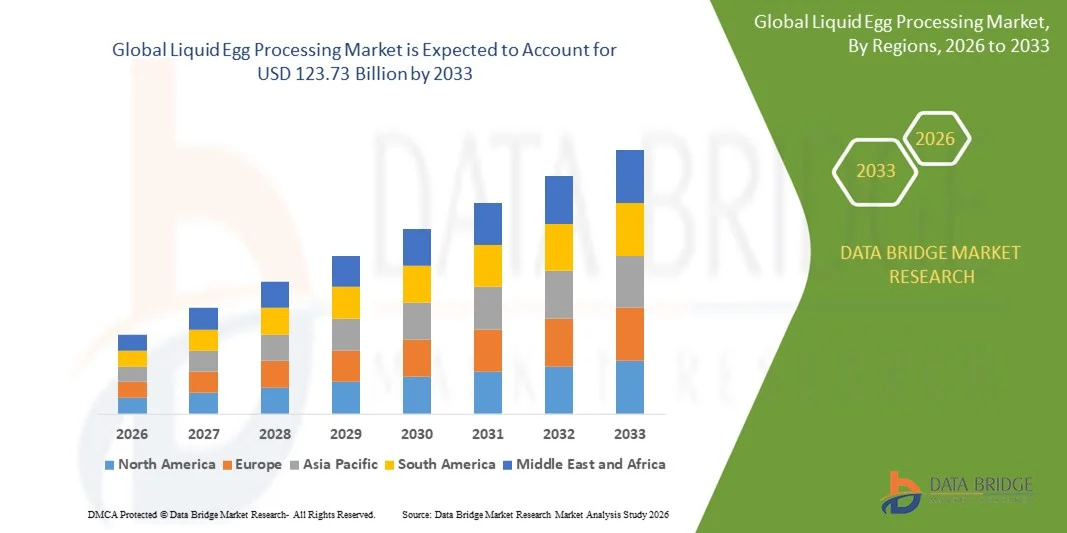
What is the Global Liquid Egg Processing Market Size and Growth Rate?
- The global liquid egg processing market size was valued at USD 70.02 billion in 2025 and is expected to reach USD 123.73 billion by 2033, at a CAGR of 6.50% during the forecast period
- The major growing factor towards the liquid egg processing market is the high demand for processed egg products. The prime factor driving the need for liquid egg processing is the wide and rising consumption of eggs
- Furthermore, due to technological advancements, processed eggs are more resourcefully treated and pasteurized, therefore assuring protection, less risk of contamination, and extended shelf life, heightening the overall demand for liquid egg processing market
What are the Major Takeaways of Liquid Egg Processing Market?
- The growing demand for nutritional diet and high protein food items also positively impacts the liquid egg processing market growth rate. The shifting consumer inclination towards processed food has led to an increase in demand for high-quality egg products, thereby accelerating the liquid egg processing market's growth in the above-mentioned forecast period
- However, the various food safety regulations is projected to act as a restraint towards the growth of liquid egg processing market, whereas the strict and time-consuming regulatory policies and animal welfare regulatory policies have the potential to challenge the growth of the market
- North America dominated the liquid egg processing market with the largest revenue share of 42.91% in 2025, driven by high adoption of automated processing equipment, rising demand from commercial bakeries and food manufacturers, and strict food safety regulations
- The Asia-Pacific liquid egg processing market is poised to grow at the fastest CAGR of 10.97% during 2026–2033, driven by rapid urbanization, rising disposable incomes, and increasing demand for processed food products in countries such as China, Japan, and India
- The egg breakers segment dominated the market with a revenue share of 38.5% in 2025, driven by its essential role in automating the initial stage of liquid egg production and ensuring efficiency in high-volume facilities
Report Scope and Liquid Egg Processing Market Segmentation
|
Attributes |
Liquid Egg Processing Key Market Insights |
|
Segments Covered |
|
|
Countries Covered |
North America
Europe
Asia-Pacific
Middle East and Africa
South America
|
|
Key Market Players |
|
|
Market Opportunities |
|
|
Value Added Data Infosets |
In addition to the insights on market scenarios such as market value, growth rate, segmentation, geographical coverage, and major players, the market reports curated by the Data Bridge Market Research also include in-depth expert analysis, pricing analysis, brand share analysis, consumer survey, demography analysis, supply chain analysis, value chain analysis, raw material/consumables overview, vendor selection criteria, PESTLE Analysis, Porter Analysis, and regulatory framework. |
What is the Key Trend in the Liquid Egg Processing Market?
Automation and AI-Driven Efficiency
- A major and accelerating trend in the global liquid egg processing market is the increasing integration of automation and artificial intelligence (AI) into processing and packaging operations. These technologies optimize production efficiency, reduce labor costs, and ensure higher consistency in product quality
- For instance, AI-powered sorting and grading systems enable real-time quality assessment of eggs, separating damaged or substandard eggs before further processing. Similarly, automated filling and pasteurization lines are being enhanced with smart sensors to maintain precise temperature and viscosity control
- AI integration also allows predictive maintenance of machinery, reducing downtime and improving operational efficiency. Advanced monitoring systems track production patterns, detect anomalies, and suggest process optimizations, enabling more intelligent resource management
- The adoption of robotics and automation in liquid egg processing facilities facilitates higher throughput, better hygiene, and reduced human error. Companies such as MOBA and SANOVO are implementing AI-driven solutions that improve packaging efficiency and traceability across the supply chain
- The shift toward automated and AI-enabled liquid egg processing is reshaping industry standards, with companies increasingly investing in smart systems that improve productivity, reduce waste, and enhance overall process reliability
What are the Key Drivers of Liquid Egg Processing Market?
- The rising demand for liquid egg products in bakeries, food service, and industrial applications is driving growth, along with the need for processed eggs that meet safety and hygiene standards
- For instance, in 2023, Ovobel Foods implemented automated pasteurization and blending systems to meet growing demand for high-quality liquid egg products across Europe. This demonstrates how efficiency and scalability drive market expansion
- Consumers’ preference for ready-to-use egg products that save preparation time is fueling adoption in commercial kitchens, bakeries, and food processing plants. Liquid eggs offer convenience, extended shelf life, and reduced handling risks compared to shell eggs
- The increasing emphasis on food safety regulations and quality compliance requires advanced processing technologies, supporting the adoption of pasteurization, filtration, and automated packaging systems in production lines
- The growing trend of industrial-scale food manufacturing and ready-to-eat meal production creates additional demand for standardized, high-volume liquid egg products, encouraging investments in advanced processing infrastructure
Which Factor is Challenging the Growth of the Liquid Egg Processing Market?
- High initial capital investment in automated and AI-enabled processing facilities presents a barrier for small- and medium-scale producers. Advanced pasteurization, blending, and packaging equipment require significant funding, limiting market entry
- Fluctuating egg prices and raw material availability can impact operational costs, creating uncertainty for producers dependent on consistent supply chains
- Strict regulatory standards for food safety, pasteurization, and labeling require continuous monitoring and compliance, which may increase operational costs for manufacturers
- In addition, maintenance and technical expertise for automated systems are critical, and a lack of skilled workforce can limit the full potential of AI and automation deployment
- Addressing these challenges through financing solutions, workforce training, and scalable processing technologies will be crucial for sustained growth in the Liquid Egg Processing market, ensuring both cost efficiency and high product quality
How is the Liquid Egg Processing Market Segmented?
The market is segmented on the basis of product type, application, and end users.
- By Product Type
On the basis of product type, the liquid egg processing market is segmented into egg breakers, egg pasteurizers, egg filters, egg separators, and others. The egg breakers segment dominated the market with a revenue share of 38.5% in 2025, driven by its essential role in automating the initial stage of liquid egg production and ensuring efficiency in high-volume facilities. Egg breakers minimize manual labor, reduce contamination risks, and allow consistent egg output, making them indispensable for commercial operations.
The egg pasteurizers segment is expected to witness the fastest CAGR of 19.8% from 2026 to 2033, propelled by increasing food safety regulations and rising demand for pasteurized liquid eggs in food service, bakeries, and ready-to-eat products. Advanced pasteurizers ensure microbial safety without compromising quality, supporting manufacturers in meeting stringent hygiene and shelf-life requirements.
- By Application
On the basis of application, the liquid egg processing market is segmented into small and medium liquid egg factories and big liquid egg factories. The big liquid egg factory segment dominated the market in 2025 with a revenue share of 55%, driven by large-scale operations focusing on industrial and commercial production of liquid eggs. These factories leverage automation, high-capacity pasteurization, and integrated packaging systems to meet the growing demand from food service and industrial customers.
The small and medium factory segment is projected to register the fastest growth rate of 16.5% during 2026–2033, fueled by the increasing number of small-scale bakeries, artisanal food producers, and regional liquid egg suppliers. Smaller facilities benefit from compact, cost-effective equipment, enabling them to meet local demand efficiently while ensuring quality and compliance with food safety standards.
- By End Users
On the basis of end users, the liquid egg processing market is segmented into bakery, confectionery, dairy products, ready-to-eat, soups and sauces, and others. The bakery segment held the largest revenue share of 42% in 2025, driven by the high consumption of liquid eggs in cake batters, pastries, and bread products. Liquid eggs provide uniform consistency, improved texture, and ease of handling, making them a preferred ingredient for large-scale bakery operations.
The ready-to-eat segment is expected to witness the fastest CAGR of 18.7% from 2026 to 2033, supported by the global rise in convenience foods and pre-prepared meal consumption. Liquid eggs are increasingly used in ready-to-eat products such as omelets, quiches, and frozen breakfast items, meeting consumer demand for quality, safety, and time-saving solutions in the food industry.
Which Region Holds the Largest Share of the Liquid Egg Processing Market?
- North America dominated the liquid egg processing market with the largest revenue share of 42.91% in 2025, driven by high adoption of automated processing equipment, rising demand from commercial bakeries and food manufacturers, and strict food safety regulations
- Manufacturers and food service providers in the region highly value efficiency, quality, and compliance, which has propelled the demand for advanced liquid egg processing systems
- Strong infrastructure, technological advancements, and a well-established supply chain further support widespread adoption, establishing North America as a dominant market for both industrial and commercial liquid egg applications
U.S. Liquid Egg Processing Market Insight
The U.S. liquid egg processing market captured the largest revenue share of 81% in 2025 within North America, fueled by the presence of major food manufacturers and the rising demand for liquid egg products in bakery, confectionery, and ready-to-eat sectors. The growing preference for automated egg breakers, pasteurizers, and separators, along with strict compliance to food safety standards, significantly contributes to the market’s expansion. Technologically advanced processing systems and increasing focus on operational efficiency are further driving market growth.
Europe Liquid Egg Processing Market Insight
The Europe liquid egg processing market is projected to expand at a substantial CAGR during the forecast period, driven by rising demand for processed egg products, growing industrial bakeries, and stringent hygiene regulations. Countries such as Germany, the U.K., and France are adopting advanced liquid egg processing technologies to enhance productivity, ensure quality, and meet growing demand from foodservice and commercial applications. In addition, the emphasis on sustainable and energy-efficient processing equipment is fostering further adoption across the region.
U.K. Liquid Egg Processing Market Insight
The U.K. market is anticipated to grow at a noteworthy CAGR, owing to the increasing presence of small-to-medium bakeries and food processing units, alongside the demand for automation in liquid egg processing. Consumers’ growing preference for pasteurized and ready-to-use liquid egg products in bakery, confectionery, and ready-to-eat meals encourages adoption. Investments in high-efficiency processing machinery and adherence to strict food safety standards continue to drive market growth.
Germany Liquid Egg Processing Market Insight
The Germany liquid egg processing market is expected to expand at a considerable CAGR, supported by the presence of large-scale industrial bakeries, confectioneries, and ready-to-eat meal manufacturers. Germany’s emphasis on innovation, automation, and energy-efficient technologies promotes the adoption of liquid egg processing systems. The integration of automated egg breakers, pasteurizers, and separators ensures compliance with hygiene regulations while enhancing operational efficiency and reducing labor costs.
Which Region is the Fastest Growing Region in the Liquid Egg Processing Market?
The Asia-Pacific liquid egg processing market is poised to grow at the fastest CAGR of 10.97% during 2026–2033, driven by rapid urbanization, rising disposable incomes, and increasing demand for processed food products in countries such as China, Japan, and India. Government initiatives supporting food processing and automation further encourage market expansion. In addition, the growth of foodservice chains, bakeries, and ready-to-eat product manufacturers is boosting adoption of liquid egg processing systems across the region.
Japan Liquid Egg Processing Market Insight
The Japan market is gaining momentum due to the country’s advanced food processing culture, high demand for quality and safety, and growing use of automated liquid egg processing equipment. Integration of egg breakers, pasteurizers, and separators with food safety and hygiene standards supports operational efficiency. In addition, Japan’s aging population and rising demand for convenience foods are driving the need for ready-to-use liquid egg solutions in commercial and industrial applications.
China Liquid Egg Processing Market Insight
The China market accounted for the largest revenue share in Asia-Pacific in 2025, owing to the rapid growth of industrial bakeries, processed food manufacturing, and ready-to-eat meals. The availability of cost-effective liquid egg processing equipment, strong local manufacturing capabilities, and increasing adoption of automation in food production are key growth drivers. Rising urbanization, expanding middle-class population, and growing consumption of bakery and confectionery products continue to propel the market forward.
Which are the Top Companies in Liquid Egg Processing Market?
The liquid egg processing industry is primarily led by well-established companies, including:
- Cargill, Incorporated (U.S.)
- Cal Maine Foods, Inc. (U.S.)
- SANOVO Technology Group (Denmark)
- International Plastics Inc. (U.S.)
- Kyowa Machinery Co., Ltd. (Japan)
- ACTINI GROUP (Netherlands)
- Ovobel Foods Limited (Belgium)
- Interovo Egg Group BV (Netherlands)
- Pelbo SPA (Italy)
- SSP Pvt Limited (India)
- Pulviver (Brazil)
- Rose Acre Farms (U.S.)
- OVO TECH (Belgium)
- Innovo Solutions (U.S.)
- AGRIEQUIP PTY LTD (Australia)
- Bouwhuis Enthoven (Netherlands)
- OVOSTAR UNION (Ukraine)
- Global Food Group BV (Netherlands)
- Prinzen (Germany)
- OVOCONCEPT (Denmark)
What are the Recent Developments in Global Liquid Egg Processing Market?
- In June 2026, Cal-Maine Foods completed an agreement with Echo Lake Foods, one of the largest manufacturers of ready-to-eat egg products, for $258 million, positioning the company for growth in the value-added egg market and strengthening its relationships with retail and foodservice partners, which is expected to positively impact results in 2026
- In May 2026, Sanguan Farm, a leading egg producer based in Thailand's Saraburi province, launched the country's first pasteurized cage-free liquid egg, marking a significant milestone in Thailand’s egg processing industry and setting a new standard for food safety and quality
- In March 2026, Rose Acre Farms purchased a 3.64-acre site in Bullhead City, Arizona, to develop its first western U.S. liquid egg processing facility, which will include proprietary egg breaking, automatic packaging, and space for future expansion, with an estimated processing capacity of 2 million eggs daily, strengthening its operational capabilities and market presence
- In January 2026, Cal-Maine Foods, Inc. announced a USD 15 million investment to expand its egg products processing facility in Blackshear, Georgia, focusing on extended shelf-life liquid egg products to meet growing demand from foodservice and ready-to-eat segments, which is expected to drive future revenue growth

- Interactive Data Analysis Dashboard
- Company Analysis Dashboard for high growth potential opportunities
- Research Analyst Access for customization & queries
- Competitor Analysis with Interactive dashboard
- Latest News, Updates & Trend analysis
- Harness the Power of Benchmark Analysis for Comprehensive Competitor Tracking
Global Liquid Egg Processing Market, Supply Chain Analysis and Ecosystem Framework
To support market growth and help clients navigate the impact of geopolitical shifts, DBMR has integrated in-depth supply chain analysis into its Global Liquid Egg Processing Market research reports. This addition empowers clients to respond effectively to global changes affecting their industries. The supply chain analysis section includes detailed insights such as Global Liquid Egg Processing Market consumption and production by country, price trend analysis, the impact of tariffs and geopolitical developments, and import and export trends by country and HSN code. It also highlights major suppliers with data on production capacity and company profiles, as well as key importers and exporters. In addition to research, DBMR offers specialized supply chain consulting services backed by over a decade of experience, providing solutions like supplier discovery, supplier risk assessment, price trend analysis, impact evaluation of inflation and trade route changes, and comprehensive market trend analysis.
Data collection and base year analysis are done using data collection modules with large sample sizes. The stage includes obtaining market information or related data through various sources and strategies. It includes examining and planning all the data acquired from the past in advance. It likewise envelops the examination of information inconsistencies seen across different information sources. The market data is analysed and estimated using market statistical and coherent models. Also, market share analysis and key trend analysis are the major success factors in the market report. To know more, please request an analyst call or drop down your inquiry.
The key research methodology used by DBMR research team is data triangulation which involves data mining, analysis of the impact of data variables on the market and primary (industry expert) validation. Data models include Vendor Positioning Grid, Market Time Line Analysis, Market Overview and Guide, Company Positioning Grid, Patent Analysis, Pricing Analysis, Company Market Share Analysis, Standards of Measurement, Global versus Regional and Vendor Share Analysis. To know more about the research methodology, drop in an inquiry to speak to our industry experts.
Data Bridge Market Research is a leader in advanced formative research. We take pride in servicing our existing and new customers with data and analysis that match and suits their goal. The report can be customized to include price trend analysis of target brands understanding the market for additional countries (ask for the list of countries), clinical trial results data, literature review, refurbished market and product base analysis. Market analysis of target competitors can be analyzed from technology-based analysis to market portfolio strategies. We can add as many competitors that you require data about in the format and data style you are looking for. Our team of analysts can also provide you data in crude raw excel files pivot tables (Fact book) or can assist you in creating presentations from the data sets available in the report.













