What is The Liquid Fertilizers Market Size and Growth Rate?
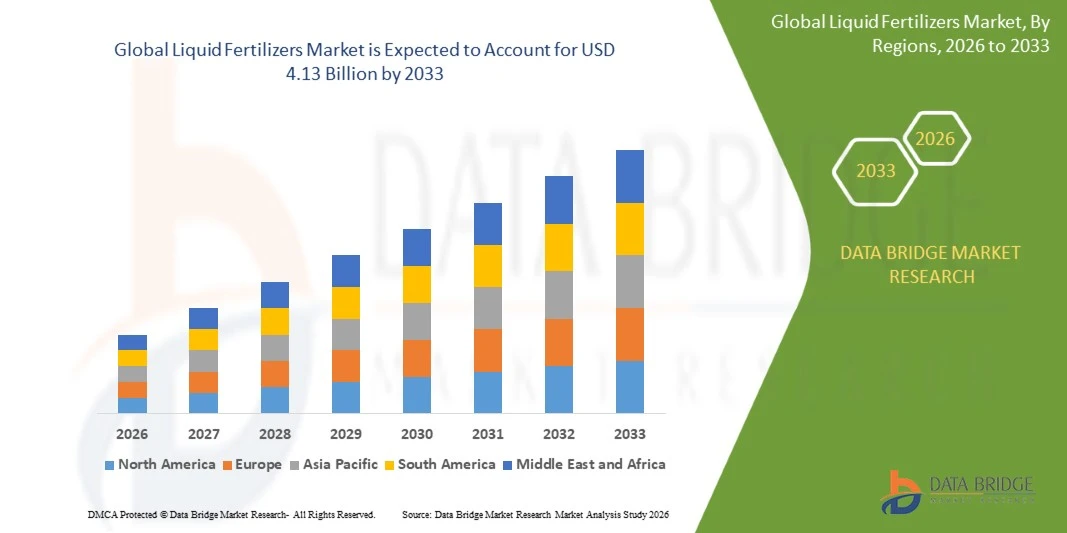
- As per Data Bridge Market Research analysis, the liquid fertilizers market was valued at USD 3.05 billion in 2025 and is projected to reach USD 4.13 billion by 2033, growing at a CAGR of 3.85% from 2026 to 2033.
- The market is expanding due to increasing demand for improved agricultural productivity, growing adoption of high-efficiency fertilizers, rising demand for liquid nutrient solutions, and the increasing use of precision farming and modern agricultural practices. Liquid fertilizers enable efficient nutrient application and support improved nutrient availability across different crop production systems.
- Liquid fertilizers comprise nutrient formulations supplied in liquid form, including nitrogen, phosphorus, potash, micronutrients, and biofertilizers, which are applied through soil application, foliar spraying, fertigation, and other methods. The market covers applications across cereals and grains, fruits and vegetables, oilseeds and pulses, and other crops, while increasing adoption of precision agriculture and efficient nutrient-management practices is supporting market development.
Market Size & Forecast
- Global Market Value (2025): USD 3.05 billion
- Expected Market Value (2033): USD 4.13 billion
- Forecast CAGR (2026–2033): 3.85%
- Leading Region in 2025: Europe
- Fastest Growing Region: Asia-Pacific
What are the Major Takeaways of the Liquid Fertilizers Market?
- Europe dominated the liquid fertilizers market with a 35.0% revenue share in 2025, supported by high agricultural production, increasing demand for crop productivity, expanding adoption of modern farming practices, and growing use of efficient nutrient-management solutions.
- Asia-Pacific is projected to register the fastest regional growth at a CAGR of 4.60% from 2026 to 2033, driven by increasing adoption of precision farming, growing demand for efficient nutrient delivery, and technological advancements in agricultural input management.
- Synthetic fertilizers dominated the category segment with a 65.4% revenue share in 2025, supported by their high nutrient concentration, consistent composition, cost-effectiveness, and compatibility with modern agricultural practices.
- Cereals & Grains dominated the crop type segment with a 42.7% revenue share in 2025, supported by extensive cultivation of wheat, rice, maize, and other staple crops and their substantial nutrient requirements.
- The Fruits & Vegetables segment is projected to grow at a CAGR of 21.8% from 2026 to 2033, driven by expanding horticultural production and increasing adoption of precision nutrient-management practices.
- Soil application dominated the mode of application segment with a 48.5% revenue share in 2025, supported by its established use in conventional farming and effective nutrient delivery to crop root zones.
- Urea Ammonium Nitrate segment with a 21.5% revenue share in 2025, remain important within the component segment, supported by their high nutrient efficiency and widespread agricultural application.
Report Scope and Liquid Fertilizers Market Segmentation
Attributes |
Liquid Fertilizers Key Market Insights |
|
Segments Covered |
|
|
Countries Covered |
North America
Europe
Asia-Pacific
Middle East and Africa
South America
|
|
Key Market Players |
|
|
Market Opportunities |
|
|
Value Added Data Infosets |
In addition to the insights on market scenarios such as market value, growth rate, segmentation, geographical coverage, and major players, the market reports curated by the Data Bridge Market Research also include import export analysis, production capacity overview, production consumption analysis, price trend analysis, climate change scenario, supply chain analysis, value chain analysis, raw material/consumables overview, vendor selection criteria, PESTLE Analysis, Porter Analysis, and regulatory framework. |
What is the Key Trend in the Liquid Fertilizers Market?
- The liquid fertilizers market is increasingly shifting toward precision nutrient management and efficient application technologies, as farmers seek to improve nutrient-use efficiency, reduce wastage, and enhance crop productivity. The growing adoption of fertigation, drip irrigation, foliar application, and precision agriculture is supporting demand for liquid formulations because nutrients can be delivered more uniformly and closer to crop requirements.
- For instance, in December 2025, Coromandel International launched Fertinex, a next-generation water-soluble fertilizer developed for fertigation applications. The product incorporates Smart Signalling Technology designed to improve nutrient uptake, plant physiology, and soil health, highlighting the industry's movement toward technology-enabled and application-specific liquid fertilizer solutions.
- The market is also moving toward specialized micronutrient blends, water-soluble formulations, and enhanced-efficiency fertilizers. Increasing concerns regarding nutrient losses, water scarcity, soil nutrient deficiencies, and sustainable crop production are encouraging the development of formulations containing micronutrients such as zinc and boron, along with technologies designed to improve nutrient availability and reduce application losses.
- Overall, the liquid fertilizers market is increasingly shaped by precision farming, fertigation, water-soluble micronutrients, enhanced-efficiency formulations, digital crop monitoring, and sustainable nutrient management. Manufacturers are focusing on specialized formulations and application technologies that improve nutrient-use efficiency, reduce environmental losses, and support higher crop yield.
What are the Key Drivers Of The Liquid Fertilizers Market?
- The liquid fertilizers Market is increasingly shifting toward efficient and precision-based nutrient application as farmers seek to improve nutrient-use efficiency, crop productivity, and fertilizer utilization. Liquid formulations can be applied through fertigation and foliar spraying, enabling more uniform nutrient distribution and supporting modern precision-agriculture practices. The growing need to improve crop yields while optimizing fertilizer and water use is therefore supporting demand for liquid fertilizer solutions.
- For instance, in September 2025, Adufértil Fertilizantes, part of Indorama Corporation, signed definitive agreements to acquire Fass Agro, a company specializing in liquid fertilizers. The transaction was intended to expand Adufértil's liquid fertilizer portfolio, strengthen its technical capabilities and customer reach, and create a broader platform for liquid fertilizer solutions focused on agricultural productivity and sustainability.
- The market is also moving toward specialized liquid nutrient formulations and water-soluble fertilizer solutions, particularly those compatible with fertigation, foliar application, drip irrigation, and precision nutrient-management systems. These formulations enable controlled nutrient delivery and can improve nutrient availability while reducing fertilizer losses, supporting their adoption across cereals and grains, fruits and vegetables, oilseeds and pulses, and other crops.
- Overall, the liquid fertilizers Market is increasingly shaped by precision agriculture, fertigation, foliar feeding, water-soluble formulations, efficient nutrient management, sustainable farming practices, and demand for higher crop productivity. Manufacturers are focusing on improving formulation efficiency, nutrient availability, compatibility with modern irrigation systems, and application flexibility to address the growing need for optimized crop nutrition. The expansion of liquid fertilizer portfolios through acquisitions, such as the Adufértil–Fass Agro transaction, further reflects increasing industry focus on specialized liquid crop-nutrition solutions.
What Factors Are Challenging the Growth of the Accelerometer-Based Digital Pen Market?
- The liquid fertilizers market faces raw material price volatility and supply-chain disruptions, particularly for nitrogen, phosphate, potash, ammonia, and natural gas-based inputs. The World Bank reported that fertilizer prices remained elevated in 2025 due to higher input costs, strong demand, and trade restrictions, while the EU also continues to face exposure to imported fertilizer and raw materials.
- Trade restrictions, geopolitical tensions, and dependence on international fertilizer supply chains remain significant challenges for market participants. China’s restrictions on nitrogen fertilizer exports and sanctions affecting Belarusian potash supplies have tightened global availability, while more recent trade measures have contributed to changes in fertilizer trade flows and pricing.
- For instance, in September 2025, Adufértil Fertilizantes, part of Indorama Corporation, announced the acquisition of Fass Agro, a company specializing in liquid fertilizers. The transaction was intended to expand Adufértil's liquid fertilizer portfolio, technical capabilities, operational efficiencies, and customer reach. This development illustrates the increasing industry focus on expanding specialized liquid fertilizer portfolios and strengthening market access.
- Product innovation and adoption of enhanced-efficiency liquid fertilizers are increasingly important, as farmers seek improved nutrient utilization and more precise application.
- Overall, the liquid fertilizers market is increasingly shaped by raw material and energy-price volatility, international trade restrictions, environmental regulations, carbon-emission concerns, supply-chain dependence, affordability for farmers, and the need for efficient nutrient delivery. Manufacturers are therefore focusing on enhanced-efficiency fertilizers, precision application, water-soluble formulations, biological technologies, and specialized liquid products to improve nutrient-use efficiency while addressing sustainability and cost pressures.
How is the Liquid Fertilizers Market Segmented?
The liquid fertilizers market is segmented on the basis of category, type, crop type, mode of application, and component.
- By Category
On the basis of category, the global liquid fertilizers market is segmented into organic and synthetic. The synthetic segment dominated the market with a 64.70% revenue share in 2025, supported by its wide availability, consistent nutrient composition, cost-effectiveness, and extensive use in large-scale agricultural production.
The organic segment is projected to grow at a CAGR of 9.20% from 2026 to 2033, driven by increasing adoption of sustainable agricultural practices, growing emphasis on soil health, and demand for environmentally friendly nutrient-management solutions.
- By Type
On the basis of type, the global liquid fertilizers market is segmented into nitrogen, potassium, phosphate, and others. The nitrogen segment dominated the market with a 43.10% revenue share in 2025, supported by the essential role of nitrogen in plant growth, crop productivity, and nutrient management across cereals, grains, fruits, vegetables, and oilseeds.
The nitrogen segment is hypothetically projected to grow at a CAGR of 6.40% from 2026 to 2033, supported by increasing demand for nitrogen-based nutrient solutions, precision agriculture, fertigation, and improved crop productivity.
- By Crop Type
On the basis of crop type, the global liquid fertilizers market is segmented into cereals & grains, fruits & vegetables, oilseeds & pulses, and others. The cereals & grains segment dominated the market with a 43.00% revenue share in 2025, owing to the extensive cultivation of cereal crops and the high nutrient requirements associated with wheat, corn, rice, and other grain crops.
The fruits & vegetables segment is hypothetically projected to grow at a CAGR of 7.20% from 2026 to 2033, driven by increasing cultivation of high-value crops, growing adoption of fertigation and foliar application, and rising demand for efficient nutrient management.=.
- By Mode of Application
On the basis of mode of application, the global liquid fertilizers market is segmented into soil, foliar, fertigation, and others. fertigation accounted for a 62.60% revenue share in 2025, supported by the increasing adoption of precision irrigation, drip irrigation, and efficient nutrient delivery directly to the crop root zone.
The fertigation segment is also projected to register a CAGR of 7.30% from 2026 to 2033, reflecting increasing demand for improved nutrient-use efficiency and reduced fertilizer losses.
- By Component
On the basis of component, the global liquid fertilizers market is segmented into calcium ammonium nitrate, urea ammonium nitrate, potassium nitrate, phosphorous pentoxide, and others. The urea ammonium nitrate segment accounted for a 32.69% revenue share in 2025, supported by its balanced nitrogen profile, ease of application, and suitability for fertigation systems.
The urea ammonium nitrate segment is hypothetically projected to grow at a CAGR of 6.70% from 2026 to 2033, supported by increasing demand for efficient nitrogen delivery, compatibility with modern irrigation systems, and growing adoption of liquid nutrient formulations.
Which Region Holds the Largest Share of The Liquid Fertilizers Market?
- Europe dominated the liquid fertilizers market with a 35.0% revenue share in 2025, supported by high agricultural production, increasing demand for crop productivity, expanding adoption of modern farming practices, and growing use of efficient nutrient-management solutions.
- The region also benefits from increasing adoption of fertigation, modern irrigation infrastructure, and sustainable agricultural practices. Growing investments in agricultural technology and increasing demand for efficient nutrient delivery are strengthening the use of liquid fertilizers across major farming markets in China, India, Japan, and other Asia-Pacific countries.
U.S. Liquid Fertilizers Market Insight
The U.S. liquid fertilizers market is supported by the country’s large-scale agricultural sector, widespread adoption of precision farming, and increasing demand for efficient nutrient management. Growing use of fertigation, foliar application, and advanced irrigation systems is supporting the adoption of liquid fertilizer formulations across cereals and grains, fruits and vegetables, oilseeds, and specialty crops. Rising emphasis on improving nutrient-use efficiency and reducing fertilizer losses is further contributing to market growth. In addition, technological advancements in enhanced-efficiency fertilizers and increasing focus on sustainable agricultural practices are creating opportunities for liquid fertilizer manufacturers.
Canada Liquid Fertilizers Market Insight
The Canada liquid fertilizers market is driven by the country’s large-scale cultivation of cereals, grains, oilseeds, and pulses, particularly wheat, corn, canola, and barley. Increasing adoption of precision agriculture, fertigation, and efficient nutrient-management practices is supporting demand for liquid fertilizer formulations. Nitrogen-based fertilizers remain important due to their role in improving crop productivity and nutrient availability. Growing awareness of fertilizer-use efficiency and sustainable farming is also encouraging the adoption of specialized liquid formulations. In addition, technological advancements in application equipment and increasing focus on reducing nutrient losses are expected to support market expansion across Canada.
Germany Liquid Fertilizers Market Insight
Germany’s liquid fertilizers market is supported by the country’s advanced agricultural sector, increasing adoption of precision farming, and growing emphasis on efficient nutrient management. Demand for liquid formulations is rising as farmers seek improved nutrient-use efficiency, accurate application, and compatibility with fertigation and modern farm machinery. Cereals and grains represent an important application area, while nitrogen-based liquid fertilizers remain widely used for crop productivity. Increasing regulatory focus on reducing nutrient losses and environmental impacts is also encouraging the adoption of more efficient fertilizer application technologies and sustainable nutrient-management practices.
U.K. Liquid Fertilizers Market Insight
The U.K. liquid fertilizers market is supported by increasing adoption of precision agriculture, controlled nutrient application, and sustainable farming practices. Demand for liquid nitrogen, phosphate, and potassium fertilizers is rising as farmers seek improved nutrient-use efficiency and higher crop productivity. Fertigation and foliar application are gaining attention due to their ability to deliver nutrients efficiently and reduce application losses. Growing emphasis on reducing environmental impact and improving soil health is also encouraging the adoption of enhanced-efficiency and organic liquid fertilizer formulations. The market is further supported by technological advancements in nutrient management and modern agricultural equipment.
Asia-Pacific Liquid Fertilizers Market Insight
The Asia-Pacific liquid fertilizers market is witnessing steady growth, supported by expanding agricultural production, rising food demand, and increasing adoption of modern farming practices. Countries such as China, India, Japan, and Australia are increasingly adopting fertigation, foliar application, and precision nutrient-management technologies to improve crop productivity and fertilizer-use efficiency. Growing cultivation of cereals and grains, fruits and vegetables, oilseeds, and pulses is further supporting demand for liquid nutrient solutions. In addition, government initiatives promoting sustainable agriculture, efficient irrigation, and balanced nutrient application are expected to create growth opportunities for liquid fertilizer manufacturers across the region.
China Liquid Fertilizers Market Insight
The China liquid fertilizers market is experiencing steady growth, supported by increasing agricultural productivity requirements, modernization of farming practices, and growing adoption of precision nutrient management. Rising cultivation of cereals, grains, fruits, vegetables, and cash crops is driving demand for efficient liquid nutrient solutions. Fertigation and foliar application are gaining importance as farmers seek improved nutrient-use efficiency and reduced fertilizer losses. Government initiatives promoting sustainable agriculture, soil health, and efficient resource utilization are further supporting market development. Increasing adoption of high-efficiency fertilizers and advanced application technologies is expected to create additional opportunities for liquid fertilizer manufacturers across China.
Japan Liquid Fertilizers Market Insight
Japan’s liquid fertilizers market is supported by the country’s focus on improving agricultural productivity, efficient nutrient management, and sustainable farming practices. Increasing adoption of precision agriculture, fertigation, and controlled nutrient application is encouraging the use of liquid fertilizer formulations across rice, vegetables, fruits, and other high-value crops. Limited arable land and the need to enhance crop yields are further supporting demand for efficient nutrient solutions. In addition, government initiatives promoting smart agriculture and resource-efficient farming are expected to encourage technological adoption. Growing interest in environmentally sustainable agricultural inputs is also creating opportunities for advanced and specialty liquid fertilizers.
Which are the Top Companies in Liquid Fertilizers Market?
The liquid fertilizers industry is primarily led by well-established companies, including:
- Nutrien Ltd. (Canada)
- Yara International ASA (Norway)
- The Mosaic Company (U.S.)
- CF Industries Holdings, Inc. (U.S.)
- ICL Group Ltd. (Israel)
- K+S Aktiengesellschaft (Germany)
- EuroChem Group (Switzerland)
- OCP S.A. (Morocco)
- OCI Global (Netherlands)
- Coromandel International Ltd (India)
- Indian Farmers Fertiliser Cooperative Limited (IFFCO) (India)
- Haifa Negev technologies LTD (Israel)
- SQM (Chile)
- Compass Minerals (U.S.)
- Tessenderlo Group (Belgium)
- DFPCL (India)
- Zuari Agro Chemicals LTD (India)
- Gujarat State Fertilizers & Chemicals Limited (India)
What are Latest Developments in Liquid Fertilizers Market?
- In October 2025, Adufértil completed the acquisition of Fass Agro. Adufértil Fertilizantes, part of Indorama Corporation, completed the acquisition of Fass Agro, a Brazilian company specializing in liquid fertilizers. The acquisition strengthened Adufértil’s presence in the high-performance liquid fertilizer segment and expanded its production capabilities and technical expertise.
- In June 2026, Switch Bioworks advanced microbial fertilizer field trials,The company announced field trials for a microbial fertilizer designed to use living microorganisms to fix nitrogen from the atmosphere and deliver it to crops. The trials received authorization from the U.S. Department of Agriculture and U.S. Environmental Protection Agency.
- In March 2026, Solugen secured USD 50 million to scale production of Azogen, a fast-release liquid ammoniacal nitrogen fertilizer derived from hog manure. The funding is intended to expand production of the low-carbon fertilizer and support circular agricultural nutrient solutions.
- In July 2026, ADM and REDSTAR entered a distribution agreement under the agreement, REDSTAR will distribute NeoVita 43 under the REDVITA 43 brand across its agricultural retail and direct-sales network. The liquid-compatible biostimulant is designed to improve nutrient-use efficiency and support early crop growth when applied with liquid starter fertilizer or as a foliar treatment.
- In China in 2026, Indorama expanded its fertilizer capacity following its acquisition of Anyang Nitrogen Fertilizer. In September 2026, Indorama secured RMB 2.4 billion in long-term financing for a Phase II expansion in Henan. The project is expected to double the site’s urea fertilizer capacity to approximately 2 million tonnes per year by 2029, strengthening fertilizer production and supply capacity.

- Interactive Data Analysis Dashboard
- Company Analysis Dashboard for high growth potential opportunities
- Research Analyst Access for customization & queries
- Competitor Analysis with Interactive dashboard
- Latest News, Updates & Trend analysis
- Harness the Power of Benchmark Analysis for Comprehensive Competitor Tracking
Data collection and base year analysis are done using data collection modules with large sample sizes. The stage includes obtaining market information or related data through various sources and strategies. It includes examining and planning all the data acquired from the past in advance. It likewise envelops the examination of information inconsistencies seen across different information sources. The market data is analysed and estimated using market statistical and coherent models. Also, market share analysis and key trend analysis are the major success factors in the market report. To know more, please request an analyst call or drop down your inquiry.
The key research methodology used by DBMR research team is data triangulation which involves data mining, analysis of the impact of data variables on the market and primary (industry expert) validation. Data models include Vendor Positioning Grid, Market Time Line Analysis, Market Overview and Guide, Company Positioning Grid, Patent Analysis, Pricing Analysis, Company Market Share Analysis, Standards of Measurement, Global versus Regional and Vendor Share Analysis. To know more about the research methodology, drop in an inquiry to speak to our industry experts.
Data Bridge Market Research is a leader in advanced formative research. We take pride in servicing our existing and new customers with data and analysis that match and suits their goal. The report can be customized to include price trend analysis of target brands understanding the market for additional countries (ask for the list of countries), clinical trial results data, literature review, refurbished market and product base analysis. Market analysis of target competitors can be analyzed from technology-based analysis to market portfolio strategies. We can add as many competitors that you require data about in the format and data style you are looking for. Our team of analysts can also provide you data in crude raw excel files pivot tables (Fact book) or can assist you in creating presentations from the data sets available in the report.