What is the Liquid Sulfur Fertilizers Market Size and Growth Rate?
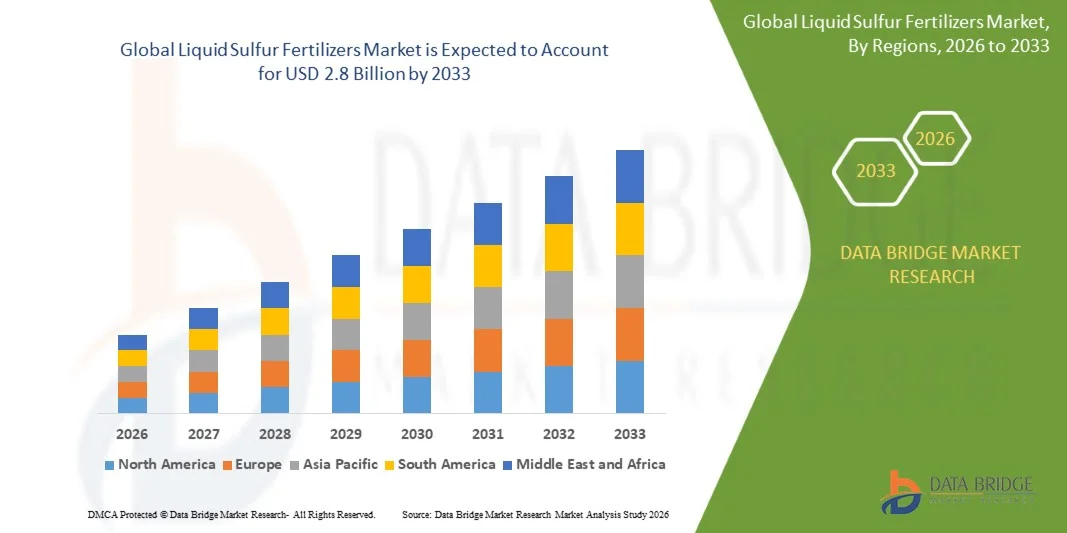
- As per Data Bridge Market Research analysis, the liquid sulfur fertilizers market was valued at USD 1.5 billion in 2025 and is projected to reach USD 2.8 billion by 2033, growing at a CAGR of 7.60% from 2026 to 2033.
- The market is experiencing consistent growth driven by rising demand for readily available, fast-acting sulfur nutrition in high-yield agriculture, rapid advancements in thiosulfate synthesis and nitrogen stabilization technologies, and expanding applications across cereals, oilseeds, and specialty crop production.
- The increasing incidence of sulfur-deficient soils globally, combined with stricter government regulations on sulfur dioxide emissions from traditional industrial sulfur sources, is compelling commercial farms, cooperatives, and custom applicators to adopt liquid sulfur fertilizers. Ammonium thiosulfate and potassium thiosulfate solutions are replacing dry elemental sulfur in many markets, offering fast-uptake, tank-mix-compatible, and precision-application-ready nutrient solutions for modern crop nutrition.
Market Size & Forecast
- Global Market Value (2025): USD 1.5 Billion
- Expected Market Value (2033): USD 2.8 Billion
- Forecast CAGR (2026–2033): 7.60%
- Leading Region in 2025: North America
- Fastest Growing Region: Asia-Pacific
What are the Major Takeaways of the Liquid Sulfur Fertilizers Market?
- North America dominated the liquid sulfur fertilizers market with the largest revenue share of 41.30% in 2025, supported by extensive ammonium thiosulfate production infrastructure, strong nitrogen stabilization adoption, and widespread use in cereal and specialty crop nutrition programs.
- Asia-Pacific is expected to be the fastest-growing region at a CAGR of 8.9% from 2026 to 2033, fueled by rising sulfur-deficient soil incidence, increasing fertigation infrastructure investments, and growing adoption in China, India, and Australia.
- The ammonium thiosulfate (ATS) segment led the market with a 44.65% share in 2025, driven by cost-effectiveness, nitrogen stabilization benefits, and widespread use in tank-mix and starter fertilizer applications.
- Calcium thiosulfate (CaTS) is the fastest-growing type, projected to register a CAGR of 8.4%, reflecting the surge in demand for combined calcium-sulfur nutrition in fruit and vegetable production.
- The cereals & grains segment dominated the crop type category with a 39.85% revenue share in 2025, led by large-scale growers adopting liquid sulfur fertilizers for nitrogen-use efficiency and yield optimization.
- Soil application accounted for 42.10% of the market share in 2025, preferred by commercial farms and cooperatives that require broad-acre, cost-effective sulfur delivery integrated with existing fertilization equipment.
Report Scope and Liquid Sulfur Fertilizers Market Segmentation
|
Attributes |
Liquid Sulfur Fertilizers Key Market Insights |
|
Segments Covered |
|
|
Countries Covered |
North America
Europe
Asia-Pacific
Middle East and Africa
South America
|
|
Key Market Players |
|
|
Market Opportunities |
|
|
Value Added Data Infosets |
In addition to the insights on market scenarios such as market value, growth rate, segmentation, geographical coverage, and major players, the market reports curated by the Data Bridge Market Research also include in-depth expert analysis, geographically represented company-wise production and capacity, network layouts of distributors and partners, detailed and updated price trend analysis and deficit analysis of supply chain and demand. |
What is the Key Trend in the Liquid Sulfur Fertilizers Market?
- Leading thiosulfate producers are increasingly expanding regional production and storage capacity to improve supply reliability, reduce logistics costs, and develop water-scarce and sulfur-deficient farming solutions while reducing the cost and risk associated with long-distance bulk transport.
- For instance, in December 2024, Tessenderlo Kerley opened a new 130,000 t/y ammonium thiosulfate (Thio-Sul) plant at Geleen, Netherlands, its third European production site, and received double inhibitor registration from ANSES, strengthening its European supply footprint for nitrogen-stabilizing liquid sulfur fertilizers.
- Real-time soil sulfur and nitrogen-loss monitoring enables agronomists to analyze deficiency levels, leaching risk, and application timing with high precision.
- Commercial farms and custom applicators are leveraging tank-mix-compatible liquid sulfur formulations to provide standardized, cost-efficient nutrient delivery alongside herbicides and starter fertilizers.
- For instance, in January 2023, Tessenderlo Kerley International expanded its ammonium thiosulfate portfolio by acquiring the marketing and sales operations of ATS fertilizers from Esseco Srl, strengthening its Thio-Sul range and enhancing distribution efficiency across European agricultural markets.
- As commercial growers and agricultural cooperatives continue to prioritize nitrogen-use efficiency and cost-effective sulfur correction, the adoption of advanced liquid sulfur fertilizers is expected to accelerate, reinforcing thiosulfate solutions as a core component of precision crop nutrition and nitrogen stabilization programs.
What are the Key Drivers of the Liquid Sulfur Fertilizers Market?
- The rapid advancement of nitrogen stabilization technology and precision agriculture has significantly increased demand for high-purity liquid sulfur fertilizers capable of reducing nitrogen loss and validating sulfur-deficient soil correction across millions of hectares of farmland.
- For instance, in 2025, Koch Fertilizer commissioned a new 2-million-gallon ammonium thiosulfate storage terminal in Fort Dodge, Iowa, expanding regional supply capacity to meet rising demand for nitrogen-stabilizing liquid sulfur fertilizers among Midwest corn and soybean growers.
- Commercial farms, agricultural cooperatives, and custom applicators are integrating liquid sulfur fertilizers into their crop nutrition programs to reduce nitrogen volatilization, shorten application cycles, and enhance sulfur-use efficiency.
- For instance, in 2025, Tessenderlo Group opened a new liquid fertilizer production facility in Illinois, expanding its thiosulfate manufacturing footprint to better serve growing customer demand for KTS and CaTS specialty liquid sulfur fertilizers across the U.S. Midwest.
- With the agriculture industry increasingly relying on precision nutrient stabilization to accelerate yield gains and ensure environmental compliance, liquid sulfur fertilizers will remain indispensable for the development of high-efficiency nitrogen management and sulfur-deficient soil correction.
Which Factors are Challenging the Growth of the Liquid Sulfur Fertilizers Market?
- Liquid sulfur fertilizer production requires significant raw material investment due to the volatility of ammonia and elemental sulfur prices, along with the need for specialized reaction, storage, and corrosion-resistant handling infrastructure.
- These high costs and raw material constraints limit adoption among smallholder farms, regional cooperatives, and organizations in emerging economies.
- For instance, between 2022 and 2023, global sulfur exports fell by approximately 55.1%, declining from USD 11.2 billion to USD 5.05 billion, demonstrating the substantial impact of raw sulfur supply and price volatility on downstream liquid sulfur fertilizer production economics.
- The high capital investment and recurring raw material costs associated with liquid sulfur fertilizer production continue to restrict adoption, particularly among small and medium-sized processors, regional applicators, and cooperatives. This cost barrier slows market penetration in price-sensitive and emerging regions, limiting the widespread deployment of advanced thiosulfate production infrastructure despite growing demand.
How is the Liquid Sulfur Fertilizers Market Segmented?
The liquid sulfur fertilizers market is segmented on the basis of type, crop type, application, end user, manufacturing process, formulation type, concentration grade, distribution channel, packaging, and support & services.
- By Type
On the basis of type, the global liquid sulfur fertilizers market is segmented into ammonium thiosulfate (ATS), potassium thiosulfate (KTS), calcium thiosulfate (CaTS), and elemental liquid sulfur suspensions. The ammonium thiosulfate (ATS) segment dominated the market with a 44.65% share in 2025, owing to cost-effectiveness, nitrogen stabilization benefits, and extensive use across tank-mix, starter fertilizer, and fertigation applications. These products deliver a stable, high-sulfur nutrient base without complex handling infrastructure, making them the preferred choice for commercial farms, custom applicators, and cooperative supply networks.
The calcium thiosulfate (CaTS) segment is projected to register the fastest growth at a CAGR of 8.4% from 2026 to 2033, driven by rising demand for combined calcium-sulfur nutrition in specialty crop production. Advances in thiosulfate synthesis, combined with declining production costs and growing adoption in fruit and vegetable cultivation, are accelerating segment expansion.
- By Crop Type
On the basis of crop type, the global liquid sulfur fertilizers market is segmented into cereals & grains, oilseeds & pulses, fruits & vegetables, and turf & ornamentals. The cereals & grains segment led the market with a 39.85% share in 2025, supported by extensive use in nitrogen-use efficiency programs, large-scale broad-acre application, and yield optimization by commercial growers and agricultural cooperatives globally.
The fruits & vegetables segment is expected to experience the fastest growth at a CAGR of 8.2% from 2026 to 2033, driven by increasing demand for precision sulfur and calcium nutrition in high-value horticultural crops, particularly across expanding specialty crop operations in North America and Asia-Pacific.
- By Application
On the basis of application, the global liquid sulfur fertilizers market is segmented into soil application, fertigation, foliar spray, nitrogen stabilization, and starter fertilizer blending. The soil application segment dominated the market with a share of 42.10% in 2025 due to its widespread adoption by commercial farms, agricultural cooperatives, and custom applicators, increasing demand for broad-acre sulfur correction, and growing integration with existing dry and liquid fertilization equipment. additionally, rising focus on nitrogen-use efficiency, sulfur-deficient soil correction, and cost-effective crop nutrition further supports the strong adoption of soil-applied liquid sulfur solutions.
The nitrogen stabilization segment is anticipated to witness the fastest CAGR of 8.6% from 2026 to 2033, driven by this growth is fueled by the increasing reliance on liquid sulfur fertilizers for reducing nitrogen volatilization and leaching losses in intensive row-crop production. commercial farms, agricultural retailers, and cooperatives are adopting thiosulfate-based nitrogen stabilizers to conduct cost-effective, controlled, and repeatable nutrient management. additionally, the integration of tank-mix-compatible formulations and real-time nitrogen-loss monitoring is enhancing the accuracy and efficiency of nitrogen stabilization processes, further driving segment growth.
- By End User
On the basis of end user, the global liquid sulfur fertilizers market is segmented into commercial farms, agricultural cooperatives, custom applicators & retailers, government & research institutions, and greenhouse & specialty crop growers. The commercial farms segment dominated the market with a share of 48.20% in 2025 due to its critical role in large-scale crop production, nitrogen-use efficiency, and adoption of thiosulfate-based nutrient stabilization for input-efficient farming. the widespread adoption of high-purity liquid sulfur fertilizers, tank-mix compatibility, and data-driven nutrient management for precision crop nutrition, deficiency correction, and yield validation is driving strong demand for fertilizer solutions. additionally, increasing focus on input cost efficiency, regulatory compliance, and sustainable farming practices is reinforcing the dominance of this segment across global markets.
The custom applicators & retailers segment is expected to witness the fastest CAGR of 8.3% from 2026 to 2033, driven by the rising need for precise, equipment-integrated sulfur application services for row-crop and specialty growers. Applicators are increasingly integrating liquid sulfur fertilizers into variable-rate and tank-mix application programs to reduce input waste and improve nutrient placement accuracy. additionally, the growing emphasis on precision timing, custom blending, and yield-consistency standards in commercial retail agronomy is further accelerating the adoption of fertilizer technologies across this segment.
- By Manufacturing Process
On the basis of manufacturing process, the global liquid sulfur fertilizers market is segmented into sulfur-ammonia reaction systems, thiosulfate synthesis units, blending & formulation systems, storage & handling infrastructure, and quality & purity testing systems. The sulfur-ammonia reaction systems segment dominated the market with a share of 34.60% in 2025 due to its critical role in producing stable, high-purity thiosulfate fertilizers from molten sulfur and liquid ammonia feedstock. high adoption is driven by the increasing need for consistent product concentration, integration with corrosion-resistant storage, and enhanced production efficiency. additionally, growing investment by fertilizer manufacturers, cooperatives, and research organizations to improve reaction yield, reduce impurities, and support large-scale processing is reinforcing the leading position of this segment in the market.
The thiosulfate synthesis units segment is expected to witness the fastest CAGR of 8.1% from 2026 to 2033, this growth is driven by increasing demand for specialized synthesis infrastructure that improves product stability and prevents crystallization during storage and transport. advanced synthesis technologies are improving yield efficiency and reducing production impurities. additionally, the adoption of these systems in export-oriented and premium specialty fertilizer production is further accelerating market expansion.
- By Formulation Type
On the basis of formulation type, the global liquid sulfur fertilizers market is segmented into straight liquid sulfur, sulfur-nitrogen blends, sulfur-micronutrient blends, nitrogen stabilizer-enhanced formulations, and chelated sulfur complexes. The sulfur-nitrogen blends segment dominated the market with a share of 37.40% in 2025 due to its widespread use in combined nitrogen-sulfur nutrition programs, cost-effective large-scale field application, and tank-mix compatibility with existing crop input systems. rising adoption of ammonium thiosulfate-based blended formulations, real-time nutrient monitoring, and precision-dosing systems is enabling growers to enhance nutrient-use efficiency, improve crop uniformity, and optimize input costs. additionally, increasing investment by commercial farms, cooperatives, and agricultural retailers is accelerating adoption and reinforcing this segment’s leading position in the market.
The nitrogen stabilizer-enhanced formulations segment is expected to witness the fastest CAGR of 8.7% from 2026 to 2033, driven by this growth is driven by the increasing adoption of nutrient formulations that combine liquid sulfur with urease and nitrification inhibitors for enhanced nitrogen retention and reduced volatilization. these products improve nutrient efficiency, support environmental compliance, and allow tailored crop nutrition programs, making fertilizers more efficient, sustainable, and valuable for premium, export, and regulation-sensitive farming applications.
- By Concentration Grade
On the basis of concentration grade, the global liquid sulfur fertilizers market is segmented into standard grade, high-analysis grade, and custom-blended grade. the standard grade segment dominated the market with a share of 46.80% in 2025 due to its widespread adoption in commercial soil application programs, cooperative bulk purchasing, and broad-acre crop nutrition, which require consistent sulfur concentration for reliable field application. high adoption is supported by commercial farms, cooperatives, and agri-input distributors that rely on standardized, low-impurity formulations to ensure consistency, efficiency, and measurable yield outcomes. additionally, increasing integration with bulk tanker logistics, automated dosing equipment, and digital agronomy platforms enhances application accuracy and reinforces the dominance of the standard grade segment.
the custom-blended grade segment is expected to witness the fastest CAGR of 8.5% from 2026 to 2033, driven by the growth is primarily driven by the increasing demand for site-specific, crop-tailored sulfur formulations that can integrate seamlessly with variable-rate application equipment across diverse soil types. by offering precise, deficiency-matched nutrient delivery, this grade enhances nutrient-use efficiency, yield consistency, and input cost control, making it highly attractive for precision agriculture, specialty crop production, and high-value farming regions.
- By Distribution Channel
On the basis of distribution channel, the global liquid sulfur fertilizers market is segmented into direct/bulk sales, agri-retailers & dealers, and custom application services. The agri-retailers & dealers segment dominated the market with a share of 49.70% in 2025 due to its critical role in enabling last-mile access to liquid sulfur fertilizers for mid-sized farms, agricultural cooperatives, and regional distributors. additionally, established partnerships with fertilizer manufacturers, agronomic advisory providers, and custom applicators are expanding reach, improving accessibility, and reinforcing the adoption of retail-based distribution across global markets.
The custom application services segment is expected to witness the fastest CAGR of 8.4% from 2026 to 2033, driven by this growth is primarily driven by the increasing demand for equipment-integrated, precision-timed application services among mid-sized and specialty crop growers. providers are leveraging variable-rate injection systems and tank-mix compatible delivery to enhance application accuracy, reduce labor requirements, and support niche nitrogen stabilization and micronutrient blending programs, thereby accelerating adoption across commercial and specialty buyer segments.
- By Packaging
On the basis of packaging, the global liquid sulfur fertilizers market is segmented into bulk tankers & rail cars, totes & drums, and bottles & small containers. The bulk tankers & rail cars segment dominated the market with a share of 58.90% in 2025 due to its preference among commercial farms, cooperatives, and agri-input distributors that require large-volume, cost-efficient transport for broad-acre soil application and fertigation programs. additionally, established distribution channels, regional terminals, and corrosion-resistant logistics infrastructure are facilitating faster delivery and adoption of bulk transport solutions, while strong quality assurance and traceability systems are improving accessibility, reliability, and trust, further reinforcing this segment’s leading market position.
The totes & drums segment is expected to witness the fastest CAGR of 8.0% from 2026 to 2033, driven by this growth is primarily driven by the increasing adoption of mid-volume, easy-to-handle packaging formats among custom applicators, greenhouse operators, and specialty crop growers. totes and drums offer scalable, cost-effective solutions for smaller-acreage and specialty applications, while providing simplified handling, reduced storage footprint, and seamless integration with variable-rate application equipment, enhancing overall logistics efficiency and flexibility.
- By Support & Services
On the basis of support & services, the global liquid sulfur fertilizers market is segmented into agronomic & soil testing advisory, custom blending services, application equipment & injection systems, and storage & logistics support. The agronomic & soil testing advisory segment dominated the market with a share of 32.80% in 2025 due to its critical role in ensuring optimal sulfur application rates, crop-specific formulation guidance, and yield outcomes across commercial farms, cooperatives, and custom applicators. the widespread presence of regional distributors, agronomists, and value-added resellers facilitates faster advisory delivery, localized recommendations, and timely in-season support. additionally, collaborations with research institutions, digital agronomy platforms, and fertilizer manufacturers are enhancing product accessibility, reliability, and trust, further reinforcing the leading position of the agronomic & soil testing advisory segment in the global market.
The application equipment & injection systems segment is expected to witness the fastest CAGR of 8.2% from 2026 to 2033, driven by this growth is primarily driven by the increasing need for corrosion-resistant injection pumps, tank-mix-compatible equipment, and precision application controllers to ensure accurate, efficient, and traceable sulfur delivery. as commercial farms and custom applicators adopt advanced liquid sulfur fertilizers, integrated application equipment becomes essential for maximizing nutrient-use efficiency, reducing labor costs, and enabling digital, sensor-based crop nutrition management.
Which Region Holds the Largest Share of the Liquid Sulfur Fertilizers Market?
- North America dominated the liquid sulfur fertilizers market and accounted for the largest revenue share of 41.30% in 2025, supported by extensive ammonium thiosulfate production capacity, strong nitrogen stabilization adoption, and the presence of established thiosulfate manufacturers and custom application networks.
- The region also benefits from strong environmental regulations on nitrogen and sulfur management, high adoption of tank-mix-compatible fertilizer formulations, and growing use of liquid sulfur fertilizers across commercial row-crop farms, cooperatives, and specialty crop operations. Increasing focus on nitrogen-use efficiency and soil health continues to strengthen North America’s leadership position in the global market.
U.S. Liquid Sulfur Fertilizers Market Insight
The U.S. liquid sulfur fertilizers market is experiencing steady growth, supported by rising adoption of nitrogen stabilization technologies in commercial row-crop farming, specialty horticultural production, and custom application services. Increasing investments in thiosulfate production and storage infrastructure and growing demand for cost-effective, tank-mix-compatible nutrient solutions are contributing to market growth. Furthermore, integration of digital agronomy, precision application, and soil analytics technologies is improving nutrient-use efficiency and yield outcomes, positioning the U.S. as a key innovation hub in the liquid sulfur fertilizers industry.
Germany Liquid Sulfur Fertilizers Market Insight
The Germany liquid sulfur fertilizers market is expanding steadily due to the country’s strong agricultural research base, advanced chemical processing capabilities, and increasing adoption of next-generation thiosulfate production technologies. Commercial farms, agricultural cooperatives, and research institutes are increasingly utilizing liquid sulfur fertilizers for precision nitrogen stabilization, sulfur-deficient soil correction, and R&D activities. Continuous advancements in synthesis technology, nitrogen stabilizer integration, and sustainable production formulations, along with strong government focus on environmental compliance and agricultural innovation, are further driving market growth in Germany.
Asia-Pacific Liquid Sulfur Fertilizers Market Insight
The Asia-Pacific liquid sulfur fertilizers market is expected to witness rapid growth, driven by increasing sulfur-deficient soil incidence, expanding fertigation infrastructure, and rising investments in thiosulfate production across countries such as China, India, and Australia. Growing awareness regarding nitrogen-use efficiency, rising adoption of precision application technologies, and increasing demand for scalable and cost-effective crop nutrition solutions are supporting regional market expansion. Additionally, the growing presence of large-scale commercial farming operations and export-oriented horticulture is accelerating liquid sulfur fertilizer adoption across commercial and cooperative sectors.
Japan Liquid Sulfur Fertilizers Market Insight
The Japan liquid sulfur fertilizers market is witnessing consistent growth due to rising investments in advanced crop nutrition technologies, precision farming, and soil health initiatives. Commercial growers, agricultural cooperatives, and research institutes are increasingly adopting high-purity liquid sulfur fertilizers for precision nitrogen stabilization, yield enhancement, and R&D purposes. Moreover, increasing integration of thiosulfate synthesis technologies and the country’s focus on efficient and sustainable farming practices are further contributing to market growth.
China Liquid Sulfur Fertilizers Market Insight
The China liquid sulfur fertilizers market is growing rapidly, driven by increasing farm modernization, expanding fertigation infrastructure, and rising government focus on soil health and agricultural sustainability. Growing adoption of nitrogen stabilization and sulfur-correction solutions across commercial, cooperative, and specialty crop sectors is significantly boosting market demand. In addition, rising investments in agricultural R&D, increasing awareness regarding precision crop nutrition, and rapid technological advancements are positioning China as one of the fastest-growing markets for liquid sulfur fertilizers globally.
Which are the Top Companies in Liquid Sulfur Fertilizers Market?
The liquid sulfur fertilizers industry is primarily led by well-established companies, including:
- Tessenderlo Group (Belgium)
- Tessenderlo Kerley, Inc. (U.S.)
- AgroLiquid (U.S.)
- Nutrien Ag Solutions (Canada)
- Yara International ASA (Norway)
- The Mosaic Company (U.S.)
- Coromandel International Limited (India)
- ICL Group Ltd. (Israel)
- Deepak Fertilisers and Petrochemicals Corporation Limited (India)
- Kugler Company (U.S.)
- Koch Fertilizer, LLC (U.S.)
- Uralchem JSC (Russia)
- Akash Agro Industries (India)
- Monty’s Plant Food Company (U.S.)
- Martin Midstream Partners L.P. (U.S.)
- TIB Chemicals AG (Germany)
- PCI Nitrogen (U.S.)
- Shakti Chemicals (India)
- Esseco Srl (Italy)
- Hydrite Chemical Co. (U.S.)
- Mears Fertilizer (U.S.)
- Rentech Nitrogen Partners, L.P. (U.S.)
- CF Industries Holdings, Inc. (U.S.)
- LANXESS AG (Germany)
- K+S Aktiengesellschaft (Germany)
- OCI N.V. (Netherlands)
What are Latest Developments in Liquid Sulfur Fertilizers Market?
- In December 2024, Tessenderlo Kerley opened its new 130,000 t/y ammonium thiosulfate (Thio-Sul) plant at Geleen, Netherlands, the company’s third European production site, and received double inhibitor registration from ANSES, strengthening its European supply footprint for nitrogen-stabilizing liquid sulfur fertilizers. This development reinforces Tessenderlo’s leadership in thiosulfate manufacturing across the European agricultural market.
- In 2025, Koch Fertilizer commissioned a new 2-million-gallon ammonium thiosulfate storage terminal in Fort Dodge, Iowa, expanding regional supply capacity to better serve rising demand for nitrogen-stabilizing liquid sulfur fertilizers among Midwest row-crop growers.
- In 2025, Tessenderlo Group opened a new liquid fertilizer production facility in Illinois, expanding its thiosulfate manufacturing footprint across the U.S. Midwest to better serve customers’ increasing requirements for KTS and CaTS specialty liquid sulfur fertilizers.
- In January 2023, Tessenderlo Kerley International expanded its ammonium thiosulfate portfolio by acquiring the marketing and sales operations of ATS fertilizers from Esseco Srl, strengthening its Thio-Sul range and enhancing distribution efficiency across European agricultural markets.
- In December 2023, LANXESS completed the expansion of its production capacity for sustainable light-color sulfur carriers at its Mannheim, Germany site, a double-digit-million-euro investment completed over approximately two years, strengthening upstream sulfur-carrier supply relevant to downstream liquid sulfur fertilizer production.

- Interactive Data Analysis Dashboard
- Company Analysis Dashboard for high growth potential opportunities
- Research Analyst Access for customization & queries
- Competitor Analysis with Interactive dashboard
- Latest News, Updates & Trend analysis
- Harness the Power of Benchmark Analysis for Comprehensive Competitor Tracking
Data collection and base year analysis are done using data collection modules with large sample sizes. The stage includes obtaining market information or related data through various sources and strategies. It includes examining and planning all the data acquired from the past in advance. It likewise envelops the examination of information inconsistencies seen across different information sources. The market data is analysed and estimated using market statistical and coherent models. Also, market share analysis and key trend analysis are the major success factors in the market report. To know more, please request an analyst call or drop down your inquiry.
The key research methodology used by DBMR research team is data triangulation which involves data mining, analysis of the impact of data variables on the market and primary (industry expert) validation. Data models include Vendor Positioning Grid, Market Time Line Analysis, Market Overview and Guide, Company Positioning Grid, Patent Analysis, Pricing Analysis, Company Market Share Analysis, Standards of Measurement, Global versus Regional and Vendor Share Analysis. To know more about the research methodology, drop in an inquiry to speak to our industry experts.
Data Bridge Market Research is a leader in advanced formative research. We take pride in servicing our existing and new customers with data and analysis that match and suits their goal. The report can be customized to include price trend analysis of target brands understanding the market for additional countries (ask for the list of countries), clinical trial results data, literature review, refurbished market and product base analysis. Market analysis of target competitors can be analyzed from technology-based analysis to market portfolio strategies. We can add as many competitors that you require data about in the format and data style you are looking for. Our team of analysts can also provide you data in crude raw excel files pivot tables (Fact book) or can assist you in creating presentations from the data sets available in the report.