


What is the Lithium Metal Anodes Market Size and Growth Rate?
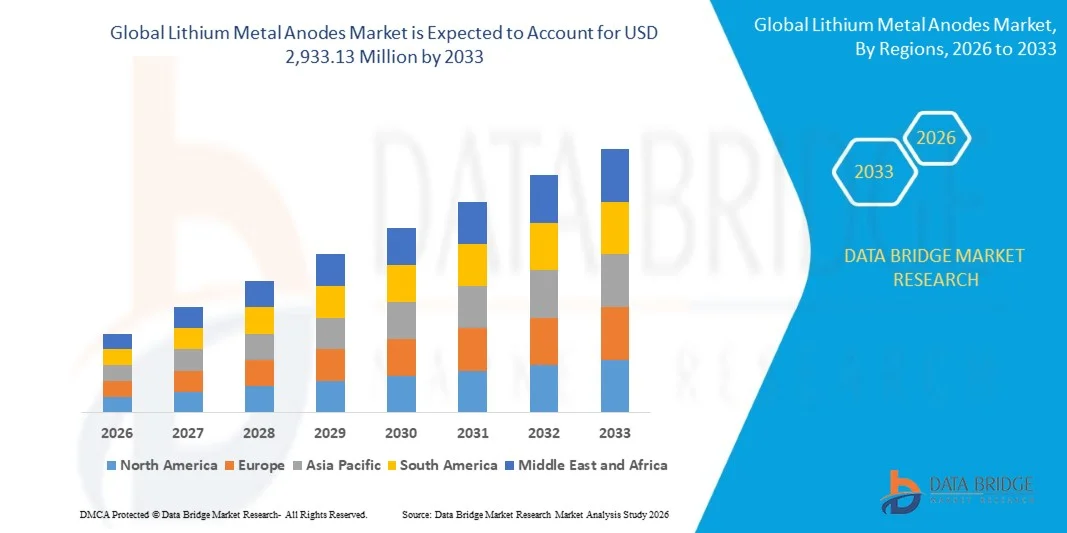
- As per Data Bridge Market Research analysis, the lithium metal anodes market was valued at USD 420 million in 2025 and is projected to reach USD 2,933.13 million by 2033, growing at a CAGR of 27.50% from 2026 to 2033.
- The market is experiencing exceptional growth driven by rapid advancements in solid-state and lithium-sulfur battery technologies, rising demand for higher energy-density batteries in electric vehicles and consumer electronics, and increasing investment by battery manufacturers and automakers in next-generation anode materials.
- The push toward lighter, longer-range EV batteries, combined with breakthroughs in dendrite-suppression coatings, protective interlayers, and advanced electrolyte formulations, is enabling lithium metal anodes to overcome historical safety and cycle-life limitations, accelerating commercialization across multiple end-use industries.
Market Size & Forecast
- Global Market Value (2025): USD 420 Million
- Expected Market Value (2033): USD 2,933.13 Million
- Forecast CAGR (2026-2033): 27.50%
- Leading Region in 2025: Asia-Pacific
- Fastest Growing Region: North America
What are the Major Takeaways of the Lithium Metal Anodes Market?
- Asia-Pacific dominated the global lithium metal anodes market with the largest revenue share of 41.28% in 2025, supported by large-scale battery manufacturing capacity, strong government backing for next-generation EV technologies, and the presence of leading lithium and battery material producers in China, Japan, and South Korea.
- North America is expected to be the fastest-growing region at a CAGR of 29.8% from 2026 to 2033, fueled by aggressive investment in solid-state battery gigafactories, rising EV production, and expanding aerospace and defense applications.
- The pure lithium metal foil segment led the market with a 48.60% share in 2025, driven by its high theoretical capacity, widespread compatibility with solid-state and lithium-sulfur cell designs, and established roll-to-roll manufacturing processes.
- The lithium metal composite segment is the fastest-growing anode type, projected to register a CAGR of 30.4%, reflecting increasing adoption of composite structures that improve dendrite resistance and cycling stability.
- The solid-state lithium batteries segment dominated the battery type category with a 39.75% revenue share in 2025, led by growing commercialization efforts from automotive OEMs seeking higher energy density and improved safety over conventional lithium-ion cells.
- The electric vehicles segment accounted for 44.10% of the market share in 2025, driven by automakers' pursuit of longer driving range and reduced battery weight through next-generation anode chemistries.
- The vapor deposition segment is the fastest-growing manufacturing process, with a CAGR of 29.1%, driven by its ability to produce ultra-thin, high-purity lithium films required for advanced solid-state cell architectures.
Report Scope and Lithium Metal Anodes Market Segmentation
|
Attributes |
Lithium Metal Anodes Key Market Insights |
|
Segments Covered |
|
|
Countries Covered |
North America
Europe
Asia-Pacific
Middle East and Africa
South America
|
|
Key Market Players |
|
|
Market Opportunities |
|
|
Value Added Data Infosets |
In addition to the insights on market scenarios such as market value, growth rate, segmentation, geographical coverage, and major players, the market reports curated by the Data Bridge Market Research also include in-depth expert analysis, geographically represented company-wise production and capacity, network layouts of distributors and partners, detailed and updated price trend analysis and deficit analysis of supply chain and demand. |
What is the Key Trend in the Lithium Metal Anodes Market?
- Battery manufacturers are increasingly adopting ultra-thin lithium metal foils paired with protective interlayers to suppress dendrite formation, improving cycle life and safety for high-energy-density cell designs.
- For instance, in April 2025, SES AI Corporation unveiled an upgraded lithium metal cell design incorporating a proprietary electrolyte and anode-protection layer, aimed at improving cycle stability for automotive-grade applications.
- Growing collaboration between lithium metal anode suppliers and automotive OEMs is accelerating the development of pilot-scale and gigafactory-level production lines for next-generation EV batteries.
- Suppliers are increasingly investing in vapor deposition and electrodeposition techniques to produce thinner, higher-purity lithium films that enable greater energy density within solid-state cell formats.
- For instance, in January 2025, ProLogium Technology Co., Ltd. announced the expansion of its lithium metal anode production line in Taiwan to support growing demand from European and North American EV manufacturers.
- As automakers and battery producers continue to prioritize energy density, safety, and fast-charging performance, the adoption of lithium metal anodes is expected to accelerate, reinforcing their role as a core enabling material for next-generation battery chemistries.
What are the Key Drivers of the Lithium Metal Anodes Market?
- The rapid advancement of solid-state and lithium-sulfur battery technologies has significantly increased demand for lithium metal anodes capable of delivering higher energy density and longer driving range for electric vehicles.
- For instance, in March 2025, QuantumScape Corporation reported progress on its B-sample solid-state lithium metal battery cells, highlighting improved energy density and cycle performance for automotive customers.
- Automotive OEMs and battery cell manufacturers are integrating lithium metal anodes into their next-generation battery roadmaps to reduce cell weight, shorten charging times, and enhance overall vehicle range.
- For instance, in November 2024, Factorial Inc. expanded its partnership with a major automaker to co-develop lithium metal solid-state battery cells for future EV platforms, targeting improved safety and energy density.
- With the global push toward electrification and increasing demand for lightweight, high-performance energy storage in aerospace, defense, and consumer electronics, lithium metal anodes will remain a critical enabling material for next-generation battery systems.
Which Factors are Challenging the Growth of the Lithium Metal Anodes Market?
- Lithium metal anodes remain prone to dendrite formation during repeated charge-discharge cycles, which can compromise battery safety and limit long-term cycle stability in commercial applications.
- These technical challenges require significant investment in protective coatings, advanced electrolytes, and precision manufacturing processes, increasing overall production costs and slowing large-scale commercialization.
- For instance, in September 2024, several battery developers cited persistent challenges in achieving consistent lithium foil thickness and purity at commercial production scale, limiting yield and increasing manufacturing costs.
- The need for specialized dry-room manufacturing environments, high-purity raw lithium supply, and rigorous quality control further adds to production complexity, restraining broader adoption among smaller battery developers and limiting the pace of market penetration in cost-sensitive applications.
How is the Lithium Metal Anodes Market Segmented?
The lithium metal anodes market is segmented on the basis of anode type, battery type, application, manufacturing process, thickness, end user, and sales channel.
- By Anode Type
On the basis of anode type, the global lithium metal anodes market is segmented into pure lithium metal foil, lithium metal composite, and stabilized lithium metal powder. The pure lithium metal foil segment dominated the market with a 48.60% share in 2025, owing to its high theoretical specific capacity, established roll-to-roll manufacturing processes, and broad compatibility with solid-state and lithium-sulfur cell designs. These systems deliver high energy density without requiring major redesign of existing cell architectures, making them the preferred choice for battery developers and research institutions.
The lithium metal composite segment is projected to register the fastest growth at a CAGR of 30.4% from 2026 to 2033, driven by rising demand for dendrite-resistant, mechanically stable anode structures. Advances in composite reinforcement techniques, combined with growing adoption in automotive-grade solid-state cells, are accelerating segment expansion.
- By Battery Type
On the basis of battery type, the global lithium metal anodes market is segmented into lithium-sulfur batteries, lithium-air batteries, solid-state lithium batteries, and lithium-metal rechargeable batteries. The solid-state lithium batteries segment led the market with a 39.75% share in 2025, supported by growing commercialization efforts from automotive OEMs seeking higher energy density, improved safety, and reduced fire risk compared to conventional lithium-ion batteries.
The lithium-sulfur batteries segment is expected to experience the fastest growth at a CAGR of 31.2% from 2026 to 2033, driven by increasing demand for lightweight, high-capacity energy storage in aerospace and defense applications.
- By Application
On the basis of application, the global lithium metal anodes market is segmented into electric vehicles, consumer electronics, aerospace & defense, grid energy storage, and medical devices. The electric vehicles segment dominated the market with a share of 44.10% in 2025 due to automakers' pursuit of longer driving range, faster charging, and reduced battery weight through next-generation anode chemistries. Additionally, rising investment in solid-state battery gigafactories and growing consumer demand for extended-range EVs further supports strong adoption of lithium metal anode solutions.
The aerospace & defense segment is anticipated to witness the fastest CAGR of 29.6% from 2026 to 2033, driven by increasing demand for lightweight, high-energy-density power sources in unmanned aerial vehicles, satellites, and portable defense equipment.
- By Manufacturing Process
On the basis of manufacturing process, the global lithium metal anodes market is segmented into extrusion, roll pressing, vapor deposition, and electrodeposition. The roll pressing segment dominated the market with a share of 36.90% in 2025 due to its scalability, cost-effectiveness, and compatibility with existing battery manufacturing lines. The widespread adoption of roll pressing by established anode foil producers to ensure consistent, high-throughput production is reinforcing the dominance of this segment.
The vapor deposition segment is expected to witness the fastest CAGR of 29.1% from 2026 to 2033, driven by its ability to produce ultra-thin, high-purity lithium films required for advanced solid-state cell architectures.
- By Thickness
On the basis of thickness, the global lithium metal anodes market is segmented into below 20 microns, 20-50 microns, and above 50 microns. The 20-50 microns segment dominated the market with a share of 42.30% in 2025 due to its balance of energy density and mechanical handling stability during cell assembly.
The below 20 microns segment is expected to witness the fastest CAGR through 2033, driven by increasing demand for ultra-thin foils that maximize energy density in compact solid-state and lithium-sulfur cell designs.
- By End User
On the basis of end user, the global lithium metal anodes market is segmented into automotive OEMs, battery manufacturers, aerospace & defense contractors, and consumer electronics companies. The battery manufacturers segment dominated the market in 2025, supported by large-scale procurement of lithium metal anode materials for pilot and commercial-scale solid-state and lithium-sulfur cell production.
The automotive OEMs segment is gaining share rapidly as manufacturers increasingly co-develop proprietary battery chemistries in-house to secure long-term supply and differentiate vehicle performance.
- By Sales Channel
On the basis of sales channel, the global lithium metal anodes market is segmented into direct/OEM and distributors. The direct/OEM segment dominated the market in 2025, supported by long-term supply agreements between lithium metal anode producers and battery cell manufacturers that require customized formulations and technical collaboration.
The distributors segment continues to support smaller battery developers and research institutions, providing broader access to specialty and research-grade lithium metal materials.
Which Region Holds the Largest Share of the Lithium Metal Anodes Market?
- Asia-Pacific dominated the lithium metal anodes market and accounted for the largest revenue share of 41.28% in 2025, supported by large-scale battery manufacturing capacity, strong government backing for next-generation EV technologies, and the presence of leading lithium and battery material producers in China, Japan, and South Korea.
- The region also benefits from vertically integrated lithium supply chains, growing investment in solid-state battery pilot lines, and increasing collaboration between battery makers and automotive OEMs. Continued expansion of gigafactory-scale production capacity across China, Japan, and South Korea is expected to further strengthen Asia-Pacific's leadership position in the global market.
China Lithium Metal Anodes Market Insight
The China lithium metal anodes market is growing rapidly, driven by the country's dominant position in global battery manufacturing and lithium supply chains. Rising government investment in next-generation battery research, growing domestic production of lithium foil and composite anode materials, and increasing focus on EV range improvement are supporting strong market growth.
South Korea Lithium Metal Anodes Market Insight
The South Korea lithium metal anodes market is expanding steadily due to the country's strong battery cell manufacturing base, advanced materials research capabilities, and increasing collaboration between battery makers and automotive OEMs on solid-state cell development. Continuous innovation in dendrite-suppression technologies and strong government support for next-generation battery research are further driving market growth in South Korea.
U.S. Lithium Metal Anodes Market Insight
The U.S. lithium metal anodes market is experiencing rapid growth, supported by large-scale private investment in solid-state battery gigafactories, rising EV production, and growing demand for high-energy-density power sources in aerospace and defense applications. Increasing federal support for domestic battery material production is further contributing to market expansion.
Japan Lithium Metal Anodes Market Insight
The Japan lithium metal anodes market is witnessing consistent growth due to the country's long-standing leadership in advanced battery materials research and strong automotive industry demand for next-generation energy storage. Automotive manufacturers and materials companies are increasingly investing in solid-state and lithium metal battery development to maintain competitive advantage in the global EV market.
Which are the Top Companies in Lithium Metal Anodes Market?
The lithium metal anodes industry is primarily led by well-established companies, including:
- QuantumScape Corporation (U.S.)
- Livent Corporation (U.S.)
- Albemarle Corporation (U.S.)
- Ganfeng Lithium Group Co., Ltd. (China)
- ProLogium Technology Co., Ltd. (Taiwan)
- Sion Power Corporation (U.S.)
- NanoGraf Corporation (U.S.)
- Blue Solutions (France)
- Ilika plc (U.K.)
- Mitsubishi Chemical Corporation (Japan)
- Targray Technology International Inc. (Canada)
- Amprius Technologies, Inc. (U.S.)
- Factorial Inc. (U.S.)
What are Latest Developments in Lithium Metal Anodes Market?
- In September 2025, SES AI Corporation announced progress on its Apollo automated lithium metal battery production platform, aimed at accelerating quality control and scale-up of lithium metal cell manufacturing for automotive customers.
- In March 2025, QuantumScape Corporation began shipping B-sample solid-state lithium metal battery cells to automotive partners for qualification testing, marking a key milestone toward commercial-scale production.
- In November 2024, Solid Power, Inc. expanded its pilot-scale lithium metal anode and electrolyte production capacity in Colorado to support increased sampling volumes for automotive OEM partners.
- In July 2024, Ganfeng Lithium Group Co., Ltd. announced investment in a new lithium metal foil production facility in China to meet rising demand from domestic solid-state battery developers.
- In April 2024, ProLogium Technology Co., Ltd. partnered with a European automaker to co-develop lithium metal solid-state battery cells for next-generation EV platforms, targeting improved energy density and safety.

- Interactive Data Analysis Dashboard
- Company Analysis Dashboard for high growth potential opportunities
- Research Analyst Access for customization & queries
- Competitor Analysis with Interactive dashboard
- Latest News, Updates & Trend analysis
- Harness the Power of Benchmark Analysis for Comprehensive Competitor Tracking
Global Lithium Metal Anodes Market, Supply Chain Analysis and Ecosystem Framework
To support market growth and help clients navigate the impact of geopolitical shifts, DBMR has integrated in-depth supply chain analysis into its Global Lithium Metal Anodes Market research reports. This addition empowers clients to respond effectively to global changes affecting their industries. The supply chain analysis section includes detailed insights such as Global Lithium Metal Anodes Market consumption and production by country, price trend analysis, the impact of tariffs and geopolitical developments, and import and export trends by country and HSN code. It also highlights major suppliers with data on production capacity and company profiles, as well as key importers and exporters. In addition to research, DBMR offers specialized supply chain consulting services backed by over a decade of experience, providing solutions like supplier discovery, supplier risk assessment, price trend analysis, impact evaluation of inflation and trade route changes, and comprehensive market trend analysis.
Data collection and base year analysis are done using data collection modules with large sample sizes. The stage includes obtaining market information or related data through various sources and strategies. It includes examining and planning all the data acquired from the past in advance. It likewise envelops the examination of information inconsistencies seen across different information sources. The market data is analysed and estimated using market statistical and coherent models. Also, market share analysis and key trend analysis are the major success factors in the market report. To know more, please request an analyst call or drop down your inquiry.
The key research methodology used by DBMR research team is data triangulation which involves data mining, analysis of the impact of data variables on the market and primary (industry expert) validation. Data models include Vendor Positioning Grid, Market Time Line Analysis, Market Overview and Guide, Company Positioning Grid, Patent Analysis, Pricing Analysis, Company Market Share Analysis, Standards of Measurement, Global versus Regional and Vendor Share Analysis. To know more about the research methodology, drop in an inquiry to speak to our industry experts.
Data Bridge Market Research is a leader in advanced formative research. We take pride in servicing our existing and new customers with data and analysis that match and suits their goal. The report can be customized to include price trend analysis of target brands understanding the market for additional countries (ask for the list of countries), clinical trial results data, literature review, refurbished market and product base analysis. Market analysis of target competitors can be analyzed from technology-based analysis to market portfolio strategies. We can add as many competitors that you require data about in the format and data style you are looking for. Our team of analysts can also provide you data in crude raw excel files pivot tables (Fact book) or can assist you in creating presentations from the data sets available in the report.













