


What is the Live Streaming Market Size and Growth Rate?
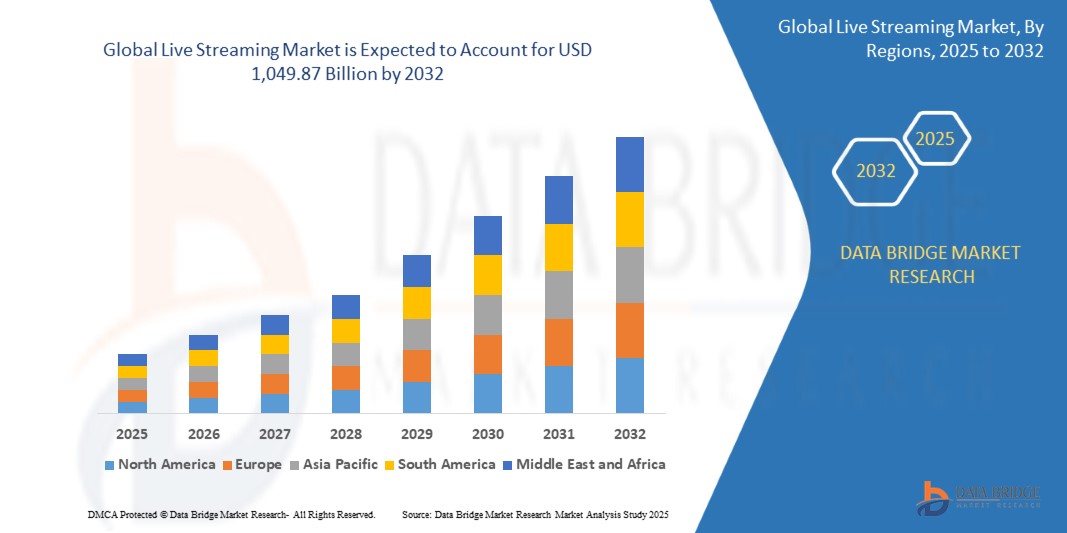
- As per Data Bridge Market Research Analysis the global live streaming market size was valued at USD 143.89 billion in 2024 and is expected to reach USD 1,049.87 billion by 2032, at a CAGR of 28.20% during the forecast period
- The market growth is largely fuelled by the rising demand for real-time content consumption across entertainment, gaming, education, and enterprise communication sectors
- The increasing penetration of high-speed internet, widespread smartphone adoption, and the expansion of social media platforms with integrated live-streaming features are further contributing to market growth
Market Size & Forecast
Global Market Value (2024): USD 143.89 billion
Expected Market Value (2032): USD 1,049.87 billion
Forecast CAGR (2024–2032): 28.20%
What are the Major Takeaways of Live Streaming Market?
- The market is experiencing rapid growth due to the growing popularity of user-generated content and interactive video formats that offer real-time viewer engagement
- Emerging monetization models such as virtual gifting, subscriptions, and brand sponsorships are creating new revenue streams for content creators and platforms, boosting overall market potential
- North America dominated the live streaming market with the largest revenue share of 38.92% in 2024, driven by widespread broadband access, advanced content delivery infrastructure, and increasing consumer preference for real-time digital content consumption
- Asia-Pacific region is expected to witness the highest growth rate in the global Live Streaming market, driven by the rising popularity of mobile-first video content, technological advancements, and the growing trend of social commerce. Countries such as China, Japan, and South Korea are leading the regional surge, with expanding creator economies and the integration of live streaming across multiple industries including retail, education, and gaming
- The platforms segment dominated the market with the largest market revenue share of 61.4% in 2024, driven by the rising demand for centralized streaming interfaces and scalable distribution solutions across entertainment, gaming, and corporate sectors. Live streaming platforms offer robust features including content scheduling, audience analytics, and monetization tools, making them highly valuable for both creators and enterprises. The ability of platforms to integrate with social media and advertising ecosystems further enhances their utility and commercial appeal
Report Scope and Live Streaming Market Segmentation
|
Attributes |
Live Streaming Key Market Insights |
|
Segments Covered |
|
|
Countries Covered |
North America
Europe
Asia-Pacific
Middle East and Africa
South America
|
|
Key Market Players |
|
|
Market Opportunities |
|
|
Value Added Data Infosets |
In addition to the market insights such as market value, growth rate, market segments, geographical coverage, market players, and market scenario, the market report curated by the Data Bridge Market Research team includes in-depth expert analysis, import/export analysis, pricing analysis, production consumption analysis, and pestle analysis. |
What is the Key Trend in the Live Streaming Market?
“Rise of Shoppable Live Streams Reshaping E-Commerce Integration”
- The integration of e-commerce with live streaming is becoming a powerful trend, allowing real-time product showcases and instant purchase opportunities which enhance viewer engagement and accelerate purchase decisions, especially among mobile-first users and digital-native shoppers
- Live commerce platforms are transforming traditional retail models by enabling influencers and brands to present products in authentic settings, fostering trust and driving impulse purchases through time-limited deals and interactive Q&A sessions
- Retailers are leveraging interactive tools such as polls, product pinning, and audience shoutouts during live streams to boost viewer retention and create a more immersive shopping experience that mirrors in-store engagement digitally
- The trend is especially dominant in Asia-Pacific markets such as China, where apps such as Taobao Live and Douyin drive billions in sales through live commerce; global platforms such as YouTube and Amazon Live are also expanding in this space
- For instance, in 2023, Amazon Live saw a 50% year-on-year growth in shoppable stream sessions in the U.S., while Myntra in India integrated live shopping during its festive sales, combining influencer-led styling tips with flash sales, illustrating the growing fusion of video and retail
Live Streaming Market Dynamics
Driver
“Growing Content Consumption Among Younger Audiences is Fueling Live Streaming Demand”
- Growing content consumption among younger audiences is propelling live streaming adoption, as Gen Z and millennials favor interactive, real-time content over static media, which is encouraging platforms and creators to prioritize live sessions for engagement and retention
- The rise in online events such as webinars, live product launches, and corporate broadcasts post-pandemic has made live streaming an essential communication tool, helping businesses reach remote audiences cost-effectively and in real time
- The widespread adoption of 5G and broadband infrastructure is enhancing video quality, reducing latency, and supporting uninterrupted streaming experiences, making it feasible to broadcast HD and 4K live content across various consumer and professional platforms
- Integration of monetization features such as virtual gifts, pay-per-view access, and ad insertions is turning live streaming into a viable revenue stream for creators, organizations, and platforms, thereby fueling its market demand and technological advancement
- For instance, in 2024, YouTube Live expanded its Super Chat and Memberships features globally, allowing creators to earn through real-time fan engagement, which led to a 35% increase in livestream revenue for entertainment streamers on the platform
Restraint/Challenge
“Real-Time Content Moderation and Infrastructure Barriers Hamper Market Expansion”
- Concerns over content moderation and privacy are a major restraint, as real-time nature of live streaming makes it difficult to prevent the spread of offensive, misleading, or harmful material, which risks user safety and regulatory scrutiny across different regions
- High infrastructure and bandwidth requirements pose a barrier to entry for smaller platforms and developing regions, as reliable live streaming demands scalable servers, advanced encoding technologies, and strong connectivity, which are not always accessible
- Intellectual property protection remains a significant challenge, with unauthorized live broadcasts of copyrighted content, sports events, and music performances continuing to cause legal conflicts and revenue losses for rights holders and media companies
- Viewer fatigue due to excessive notifications, repetitive content, and poor-quality streams may lead to disengagement over time, requiring platforms to invest continuously in personalization, stream quality, and content diversity to retain audiences
- For instance, in 2023, Twitch faced backlash for failing to adequately moderate controversia streams, resulting in temporary advertiser pullback and stricter enforcement guidelines, which underlined the need for real-time content governance and policy compliance
How is the Live Streaming Market Segmented?
The market is segmented on the basis of component, offering model, streaming type, and end user.
• By Component
On the basis of component, the live streaming market is segmented into platforms and services. The platforms segment dominated the market with the largest market revenue share of 61.4% in 2024, driven by the rising demand for centralized streaming interfaces and scalable distribution solutions across entertainment, gaming, and corporate sectors. Live streaming platforms offer robust features including content scheduling, audience analytics, and monetization tools, making them highly valuable for both creators and enterprises. The ability of platforms to integrate with social media and advertising ecosystems further enhances their utility and commercial appeal.
The services segment is expected to witness the fastest growth rate from 2025 to 2032, supported by the increasing need for managed streaming, cloud-based broadcasting, and end-to-end production solutions. Businesses and institutions are adopting live streaming services for reliable infrastructure, security compliance, and technical support, especially for large-scale virtual events. This trend is further reinforced by service providers offering customized packages for education, government, and enterprise use cases.
• By Offering Model
On the basis of offering model, the live streaming market is segmented into business-to-business (B2B) and business-to-consumer (B2C). The B2C segment held the largest market revenue share in 2024, led by the surging popularity of influencer-driven content, live commerce, and user-generated videos on platforms such as YouTube Live, Instagram Live, and Twitch. Consumers are increasingly drawn to real-time interaction, contributing to greater engagement and monetization potential for content creators.
The B2B segment is expected to witness the fastest growth rate from 2025 to 2032, driven by growing demand across virtual conferences, corporate training, webinars, and internal communication. Businesses are leveraging live streaming to reduce event costs, expand global reach, and deliver immersive content to employees and stakeholders. The shift toward hybrid work environments is expected to further propel demand for scalable B2B streaming models.
• By Streaming Type
On the basis of streaming type, the market is segmented into audio streaming, video streaming, and game streaming. The video streaming segment accounted for the largest market revenue share in 2024, owing to widespread consumption of entertainment content, real-time events, and educational lectures through platforms such as Facebook Live and Zoom. Improved broadband speeds and high-definition formats have significantly enhanced the user experience, making video content more accessible and engaging.
The game streaming segment is expected to witness the fastest growth rate from 2025 to 2032, supported by the rapid expansion of esports and interactive gameplay content. Platforms such as Twitch and YouTube Gaming are witnessing massive viewer bases, and gaming influencers are driving high traffic and monetization. The ability to build communities, integrate chat, and offer real-time playthroughs further accelerates the appeal of game streaming.
• By End User
On the basis of end user, the live streaming market is segmented into media and entertainment, esports, events, education, retail, government, and others. The media and entertainment segment led the market in 2024 with the highest revenue share, as broadcasters and content creators increasingly adopt live formats to reach broader audiences with greater immediacy. Streaming concerts, talk shows, and interactive sessions provide a dynamic user experience that fosters deeper audience engagement.
The education segment is expected to witness the fastest growth rate from 2025 to 2032, driven by the mainstreaming of virtual learning and demand for remote teaching solutions. Institutions are leveraging live streaming for virtual classrooms, online lectures, and hybrid education models. The ability to conduct real-time sessions with interactive features such as Q&A and whiteboarding enhances learning outcomes and adoption rates.
Which Region Holds the Largest Share of the Live Streaming Market?
- North America dominated the live streaming market with the largest revenue share of 38.92% in 2024, driven by widespread broadband access, advanced content delivery infrastructure, and increasing consumer preference for real-time digital content consumption
- Consumers in the region actively engage with live events across entertainment, esports, and shopping platforms, supported by high smartphone penetration and the rise of social media integrations with streaming
- The presence of major platforms such as YouTube Live, Facebook Live, and Twitch, combined with robust monetization models and creator ecosystems, contributes significantly to regional growth
U.S. Live Streaming Market Insight
The U.S. live streaming market captured the largest revenue share in North America in 2024, led by the increasing adoption of on-demand content and the mainstreaming of creator-driven streaming culture. The growing popularity of e-commerce live streams, virtual concerts, and influencer-hosted sessions is reshaping online engagement. Furthermore, corporate reliance on virtual events, webinars, and hybrid communication models post-pandemic has solidified live streaming as a core tool. High-speed 5G rollout and platform innovations continue to bolster audience retention and monetization capabilities in the U.S.
Europe Live Streaming Market Insight
The Europe live streaming market is expected to witness the fastest growth rate from 2025 to 2032, fueled by regulatory support for digital transformation and a growing appetite for immersive digital entertainment. Consumers are increasingly engaging with live sports, gaming streams, and music events, driven by improved internet connectivity and smart device usage. European brands are also investing in live commerce and customer engagement tools, enhancing the scope of live streaming across retail and advertising sectors. Countries such as Germany, France, and the U.K. are at the forefront of this expansion.
U.K. Live Streaming Market Insight
The U.K. live streaming market is expected to witness the fastest growth rate from 2025 to 2032, supported by a digitally savvy population and increasing demand for live sports coverage, news, and entertainment. Content creators and businesses are leveraging live streams to drive interactive marketing, product launches, and influencer-led shopping experiences. The expansion of OTT services and strong social media consumption trends are further strengthening the ecosystem. In addition, public broadcasters and private players are integrating real-time features to retain younger viewers.
Germany Live Streaming Market Insight
The Germany live streaming market is expected to witness the fastest growth rate from 2025 to 2032, driven by high-speed internet accessibility, a strong online user base, and the rise of professional streaming platforms. German consumers are increasingly turning to live streaming for cultural events, concerts, and interactive sessions. With a growing focus on local-language content and regulatory emphasis on digital media standards, the market is seeing investments from domestic broadcasters and international platforms alike. Educational institutions and corporations are also adopting live streaming for hybrid learning and remote conferencing solutions.
Asia-Pacific Live Streaming Market Insight
The Asia-Pacific live streaming market is expected to witness the fastest growth rate from 2025 to 2032, owing to rising smartphone penetration, affordable internet access, and a booming creator economy across China, India, and Southeast Asia. Government initiatives promoting digital entertainment, combined with local platforms such as Kuaishou, Nimo TV, and BIGO Live, are fueling regional adoption. From live game broadcasts to shopping and fan interactions, APAC consumers are increasingly embracing real-time video formats. The region's vibrant youth population and cultural affinity for digital content are key enablers.
Japan Live Streaming Market Insight
The Japan live streaming market is expected to witness the fastest growth rate from 2025 to 2032, due to the country’s technologically advanced infrastructure and growing demand for interactive digital experiences. Platforms are capitalizing on the rising trend of anime-related live events, virtual concerts, and game streams. Japan’s aging population is also turning to live streaming for educational and lifestyle content, increasing platform diversity. Innovations in virtual avatars and mixed reality integration are adding new dimensions to live broadcast formats, further enriching the consumer experience.
China Live Streaming Market Insight
The China live streaming market captured the largest revenue share in Asia-Pacific in 2024, driven by a well-developed ecosystem of domestic platforms, high digital engagement, and integration of live commerce in retail strategies. With platforms such as Douyin, Taobao Live, and Huya leading the charge, live streaming in China spans entertainment, education, shopping, and social networking. The government’s support for new media and rapid urbanization are creating new growth avenues, making China a global leader in live streaming adoption and monetization.
Live Streaming Market Share
The Live Streaming industry is primarily led by well-established companies, including:
- Flux Broadcast (U.K.)
- dacast (U.S.)
- Microsoft (U.S.)
- Google (U.S.)
- Facebook (U.S.)
- IBM (U.S.)
- Instagram (U.S.)
- STREAMING.HR (Croatia)
- Mansueto Ventures LLC (U.S.)
- Amazon Inc. (U.S.)
- CAST (U.K.)
- HUYA Inc. (China)
- Periscope (U.S.)
- Agile Content (Spain)
Which are the Top Companies in Live Streaming Market?
- In March 2024, Verb Technology Company, Inc. announced a strategic partnership with TikTok Shop, becoming an official TikTok Shop Partner (TSP). This collaboration allows Verb’s MARKET.live platform to deliver services such as onboarding, training, studio rental, content creation, and account management to TikTok Shop clients. The alliance is expected to drive revenue through service fees and a share of monthly store earnings, enhancing MARKET.live’s role in social commerce
- In January 2024, Twitch introduced its Twitch Enhanced Broadcasting beta in collaboration with Open Broadcaster Software (OBS) and NVIDIA. The new feature utilizes GeForce RTX GPUs to enable streamers to broadcast up to three simultaneous streams at 1080p, offering higher video quality and streaming flexibility. This advancement strengthens Twitch’s technological leadership and supports creators seeking more powerful tools for multi-streaming
- In January 2024, Huya Inc. partnered with Tencent’s WeChat Channels to expand its presence in game livestreaming. The collaboration aims to tap into WeChat’s growing user engagement and content consumption by integrating Huya’s gaming streams into the platform. This move is expected to increase Huya’s reach and strengthen its position in China’s competitive streaming market
- In July 2023, MediaKind launched MK/IO, a cloud-based streaming solution powered by Microsoft Azure. The platform offers live and on-demand video services, including encoding, packaging, digital rights management, and playback features. By delivering high-quality, scalable streaming infrastructure, MK/IO aims to support content providers in building seamless viewing experiences and accelerating digital media transformation

- Interactive Data Analysis Dashboard
- Company Analysis Dashboard for high growth potential opportunities
- Research Analyst Access for customization & queries
- Competitor Analysis with Interactive dashboard
- Latest News, Updates & Trend analysis
- Harness the Power of Benchmark Analysis for Comprehensive Competitor Tracking
Data collection and base year analysis are done using data collection modules with large sample sizes. The stage includes obtaining market information or related data through various sources and strategies. It includes examining and planning all the data acquired from the past in advance. It likewise envelops the examination of information inconsistencies seen across different information sources. The market data is analysed and estimated using market statistical and coherent models. Also, market share analysis and key trend analysis are the major success factors in the market report. To know more, please request an analyst call or drop down your inquiry.
The key research methodology used by DBMR research team is data triangulation which involves data mining, analysis of the impact of data variables on the market and primary (industry expert) validation. Data models include Vendor Positioning Grid, Market Time Line Analysis, Market Overview and Guide, Company Positioning Grid, Patent Analysis, Pricing Analysis, Company Market Share Analysis, Standards of Measurement, Global versus Regional and Vendor Share Analysis. To know more about the research methodology, drop in an inquiry to speak to our industry experts.
Data Bridge Market Research is a leader in advanced formative research. We take pride in servicing our existing and new customers with data and analysis that match and suits their goal. The report can be customized to include price trend analysis of target brands understanding the market for additional countries (ask for the list of countries), clinical trial results data, literature review, refurbished market and product base analysis. Market analysis of target competitors can be analyzed from technology-based analysis to market portfolio strategies. We can add as many competitors that you require data about in the format and data style you are looking for. Our team of analysts can also provide you data in crude raw excel files pivot tables (Fact book) or can assist you in creating presentations from the data sets available in the report.













