What is the Liver Function Test Market Size and Growth Rate?
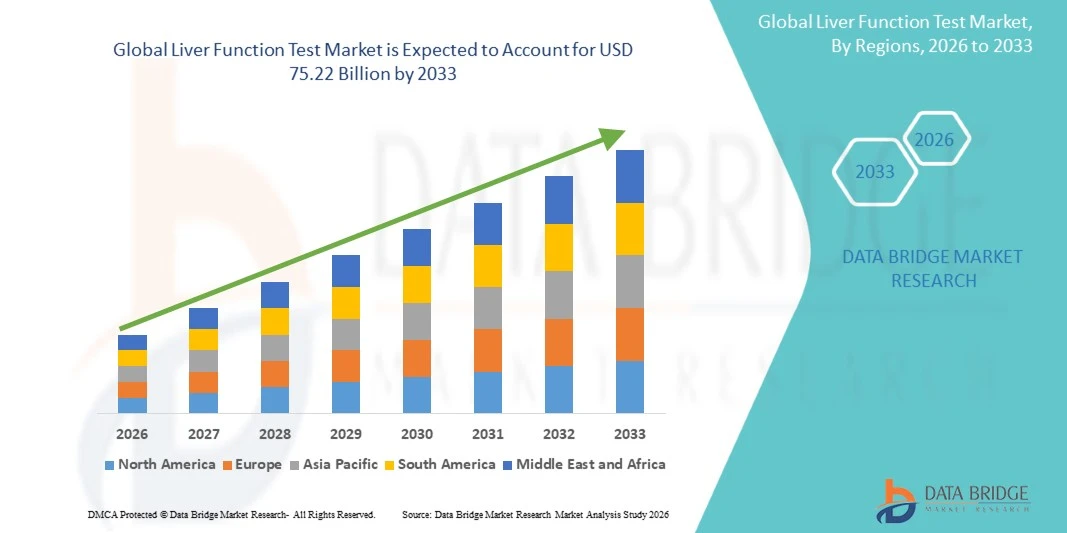
- As per Data Bridge Market Research analysis, the liver function test market was valued at USD 43.78 billion in 2025 and is projected to reach USD 75.22 billion by 2033, growing at a CAGR of 7.00% from 2026 to 2033.
- The market is experiencing consistent growth driven by the rising prevalence of liver diseases, increasing demand for early and accurate diagnosis, and expanding adoption of routine clinical testing across hospitals and diagnostic laboratories.
- The increasing incidence of hepatitis, fatty liver disease, liver cirrhosis, and other chronic liver conditions, combined with growing awareness of preventive healthcare, is encouraging healthcare providers to expand liver function testing. Advancements in automated laboratory analyzers, clinical chemistry assays, and point-of-care testing are improving testing efficiency, accessibility, and disease monitoring, supporting market growth.
Market Size & Forecast
- Global Market Value (2025): USD 43.78 Billion
- Expected Market Value (2033): USD 75.22 Billion
- Forecast CAGR (2026–2033): 7.00%
What are the Major Takeaways of the Liver Function Test Market?
- North America dominated the liver function test market with the largest revenue share of 39.1% in 2025, supported by advanced healthcare infrastructure, high diagnostic testing volumes, and widespread adoption of automated laboratory technologies.
- Asia-Pacific is expected to be the fastest-growing region at a CAGR of 9.14% from 2026 to 2033, fueled by expanding healthcare infrastructure, rising diagnostic awareness, and increasing demand for liver disease screening.
- The alanine aminotransferase (ALT) test segment led the market with a 44.2% share in 2025, driven by its widespread use in detecting liver cell injury, diagnosing suspected liver disorders and its inclusion in routine liver function panels across hospitals and diagnostic laboratories.
- Gamma-glutamyl transferase (GGT) test are the fastest-growing product type, projected to register a CAGR of 7.8%, reflecting the surge in demand for early detection of hepatobiliary disorders, increasing prevalence of liver diseases, and growing use of GGT testing to evaluate abnormal liver enzyme levels
- The hepatitis segment dominated the disease category with a 35.4% revenue share in 2025, led by high global burden of viral hepatitis, increasing demand for early diagnosis and the widespread use of ALT and AST tests to assess liver inflammation, evaluate disease progression, and monitor treatment response.
- Hepatocellular labs accounted for 42.3% of the market share in 2025, preferred by healthcare providers for their effectiveness in detecting liver cell injury, evaluating elevated ALT and AST levels and enabling routine monitoring of liver health across hospitals and diagnostic laboratories.
- The synthetic function tests segment is the fastest-growing components category, with a CAGR of 8.5%, driven by rising demand for assessing liver function and disease severity and growing use of albumin and prothrombin time tests to monitor liver synthetic capacity and identify complications.
Report Scope and Liver Function Test Market Segmentation
|
Attributes |
Liver Function Test Key Market Insights |
|
Segments Covered |
|
|
Countries Covered |
North America
Europe
Asia-Pacific
Middle East and Africa
South America
|
|
Key Market Players |
|
|
Market Opportunities |
|
|
Value Added Data Infosets |
In addition to the insights on market scenarios such as market value, growth rate, segmentation, geographical coverage, and major players, the market reports curated by the Data Bridge Market Research also include in-depth expert analysis, patient epidemiology, pipeline analysis, pricing analysis, and regulatory framework. |
What is the Key Trend in the Liver Function Test Market?
- Healthcare providers are increasingly adopting advanced liver function testing solutions to improve diagnostic accuracy, identify liver abnormalities earlier, and support the monitoring of chronic liver diseases.
- For instance, in May 2025, Roche introduced its Elecsys PRO-C3 test to assess liver fibrosis severity in patients with metabolic dysfunction-associated steatotic liver disease (MASLD), delivering results in 18 minutes on compatible cobas analyzers.
- Automated clinical chemistry analyzers enable laboratories to process liver enzyme, bilirubin, and protein measurements efficiently, supporting consistent and high-volume diagnostic testing.
- Diagnostic laboratories are also exploring point-of-care testing solutions to reduce turnaround times and improve access to liver function assessment outside conventional laboratory settings.
- For instance, in March 2024, a study published in Practical Laboratory Medicine evaluated the LINX EVO point-of-care testing device for liver function assessment, investigating a panel designed to provide results in approximately 15 minutes.
- As healthcare systems increasingly prioritize early diagnosis, faster test results, and improved disease monitoring, technological advancements in liver function testing are expected to strengthen demand for automated, rapid, and clinically reliable diagnostic solutions.
What are the Key Drivers of the Liver Function Test Market?
- The rising global burden of liver diseases, including viral hepatitis, fatty liver disease, and cirrhosis, is increasing demand for liver function tests that support early detection and ongoing assessment of liver health.
- For instance, in April 2026, the World Health Organization reported that approximately 287 million people were living with chronic hepatitis B or C in 2024, highlighting the substantial need for improved diagnosis and monitoring.
- Hospitals, diagnostic laboratories, and healthcare providers are expanding routine biochemical testing to identify liver abnormalities, assess treatment responses, and monitor patients with chronic conditions.
- For instance, in April 2024, the World Health Organization published its Global Hepatitis Report, covering disease burden and diagnostic service access across 187 countries and emphasizing the need to expand hepatitis testing and treatment services.
- With increasing awareness of liver health and growing emphasis on preventive healthcare, liver function tests will remain essential tools for clinical evaluation, treatment monitoring, and the timely identification of liver-related complications.
What Factors are Challenging the Growth of the Liver Function Test Market?
- Advanced liver function testing systems require substantial investment in automated analyzers, laboratory infrastructure, quality-control procedures, and specialized diagnostic equipment.
- For instance, in April 2024, the World Health Organization published its Global Hepatitis Report 2024, identifying gaps in diagnostic service coverage, laboratory capacity, and access to hepatitis testing across low- and middle-income countries. These barriers can restrict demand for liver disease testing and related diagnostic services.
- These costs can limit adoption among smaller diagnostic laboratories and healthcare facilities in resource-constrained regions, where access to advanced testing infrastructure and trained personnel remains uneven.
- In addition, variations in liver enzyme levels caused by medications, alcohol consumption, and other medical conditions can complicate test interpretation, sometimes requiring additional investigations to establish an accurate diagnosis.
- For instance, in November 2025, The BMJ published guidance highlighting that routine liver blood tests have limited sensitivity and specificity for diagnosing liver disease, meaning abnormal results may require additional investigations to establish the underlying cause. This can increase diagnostic complexity and healthcare costs.
- The combined impact of infrastructure costs, unequal access to diagnostic services, and limitations in interpreting liver function results can constrain market penetration, particularly in underserved regions, despite the growing need for early liver disease detection.
How is the Liver Function Test Market Segmented?
The liver function test market is segmented on the basis of product, disease, end-use, and components.
- By Product
On the basis of product, the liver function test market is segmented into alanine aminotransferase (ALT) test, aspartate aminotransferase (AST) test, alkaline phosphatase (ALP) test, gamma-glutamyl transferase (GGT) test, albumin, total bilirubin, and others. The alanine aminotransferase (ALT) test segment is estimated to account for 44.2% share of market in 2025, reflecting its widespread use in assessing liver cell injury. ALT is primarily present in liver cells, making elevated levels an important indicator of hepatocellular damage. Healthcare professionals routinely use ALT measurements when investigating suspected hepatitis, fatty liver disease, and drug-induced liver injury. The test is commonly included in routine liver chemistry panels, supporting its use across hospitals and diagnostic laboratories. Automated analyzers enable rapid and standardized measurement of ALT levels.
The gamma-glutamyl transferase (GGT) test segment is expected to experience strong growth, with CAGR of 7.8% during forecast period. GGT measurements help clinicians investigate hepatobiliary disorders and interpret abnormal liver enzyme profiles. The test is often used alongside ALP to help assess whether elevated enzyme levels may be associated with liver or bile duct conditions. It can also support the evaluation of alcohol-related liver injury, although elevated GGT is not specific to alcohol consumption. Increasing recognition of metabolic liver disease and medication-associated liver abnormalities is supporting demand for complementary enzyme testing. Improvements in automated clinical chemistry platforms are facilitating efficient GGT measurement.
- By Disease
On the basis of disease, the liver function test market is segmented into hepatitis, liver cirrhosis, fatty liver disease, alcoholic liver disease, liver cancer, autoimmune liver diseases, drug-induced liver injury, and other liver disorders. The hepatitis segment is estimated to account for 35.4% share of market in 2025. This segment benefits from the continued global burden of viral hepatitis and the need for timely assessment of liver injury. Liver function tests help evaluate elevations in ALT and AST levels associated with hepatocellular inflammation. These tests are frequently used alongside viral serology and molecular diagnostic methods to assess patients with suspected hepatitis. Monitoring liver enzyme levels also helps healthcare professionals evaluate disease progression and treatment response.
The fatty liver disease segment is expected to experience the fastest growth, with an indicative CAGR of 7.5% during forecast period. Growth is driven by the increasing prevalence of obesity, diabetes, and other metabolic risk factors. Metabolic dysfunction-associated steatotic liver disease (MASLD) is increasing the need for liver health assessments among at-risk populations. ALT and AST measurements are commonly included in initial clinical evaluations, although normal enzyme levels do not exclude significant liver disease. Growing awareness of metabolic liver complications is encouraging healthcare providers to incorporate liver assessment into routine health checks.
- By End-Use
On the basis of end-use, the liver function test market is segmented into disease diagnosis, blood routine analysis, disease prevention, and others. The disease diagnosis segment is estimated to account for 51.3% share of market in 2025. Measurements of ALT, AST, ALP, GGT, bilirubin, and albumin help clinicians identify patterns associated with hepatocellular injury, cholestasis, and impaired liver function. These tests are commonly ordered when patients present with symptoms such as jaundice, abdominal discomfort, or unexplained fatigue. Liver function testing also supports the investigation of abnormal findings identified during routine medical examinations. Integration with clinical chemistry analyzers enables laboratories to provide timely results for diagnostic decision-making. Increasing demand for early disease identification and clinical assessment continues to support this segment.
The disease prevention segment is expected to offer strong growth potential, with an indicative CAGR of 8.0% during forecast period. Preventive health checkups increasingly include biochemical assessments for individuals with metabolic risk factors or a family history of liver disease. Routine testing can help identify abnormalities that warrant further clinical evaluation. Growing rates of obesity, diabetes, and metabolic disorders are expanding the population that may benefit from liver health assessment. Employer-sponsored health screenings and preventive healthcare programs may further increase testing volumes. Greater emphasis on early intervention and periodic monitoring is expected to support the role of liver function tests in preventive care.
- By Components
On the basis of components, the liver function test market is segmented into hepatocellular labs, cholestasis labs, and synthetic function tests. The hepatocellular labs segment is estimated to account for 42.3% share of market in 2025. These tests are widely used to identify biochemical patterns associated with liver cell injury. ALT and AST measurements are routinely included in liver chemistry panels ordered during initial clinical evaluations. Their measurement helps healthcare professionals investigate suspected hepatitis, fatty liver disease, and drug-induced liver injury. Automated laboratory platforms support efficient processing of these tests across high-volume diagnostic settings.
The synthetic function tests segment is expected to offer growth potential, with an indicative CAGR of 8.5% during forecast period. These tests assess aspects of the liver's ability to produce proteins and support normal blood clotting. Albumin measurement and prothrombin time or international normalized ratio (PT/INR) are particularly relevant when evaluating suspected advanced liver disease and cirrhosis. Greater emphasis on monitoring disease progression and identifying complications is supporting their use in comprehensive clinical evaluations. Combining synthetic function markers with other biochemical and imaging assessments can improve overall patient evaluation. Growing demand for comprehensive liver disease assessment is expected to support this category.
Which Region Holds the Largest Share of the Liver Function Test Market?
- North America dominated the liver function test market with the largest revenue share of 39.1% in 2025, supported by advanced healthcare infrastructure, high diagnostic testing volumes, and widespread adoption of automated laboratory technologies.
- The region also benefits from established diagnostic laboratory networks, strong healthcare expenditure, and increasing demand for liver disease screening amid the rising prevalence of obesity, metabolic disorders, and chronic liver conditions. Extensive use of routine liver function panels, alongside continued investments in automated diagnostic systems, further strengthens North America's leading position in the global market.
U.S. Liver Function Test Market Insight
The U.S. liver function test market is witnessing strong growth due to rising demand for early liver disease diagnosis, increasing prevalence of fatty liver disease, and growing adoption of routine diagnostic testing. The country’s advanced healthcare infrastructure, established diagnostic laboratory networks, and widespread use of automated clinical chemistry systems are driving demand across hospitals, clinics, and independent laboratories. In addition, growing emphasis on preventive healthcare, chronic disease monitoring, and improved access to diagnostic services is accelerating the use of liver function tests across the country.
Asia-Pacific Liver Function Test Market Insight
The Asia-Pacific liver function test market is expected to witness rapid growth, driven by increasing healthcare expenditure, expanding diagnostic infrastructure, and rising awareness of liver diseases across countries such as China, India, and Japan. Growing prevalence of hepatitis, fatty liver disease, and other chronic liver conditions is increasing demand for accessible and cost-effective diagnostic solutions. In addition, expanding hospital networks, improving laboratory capabilities, and rising adoption of automated testing technologies are supporting regional market expansion.
Japan Liver Function Test Market Insight
The Japan liver function test market is witnessing consistent growth due to rising demand for routine health examinations, early disease detection, and continuous monitoring of chronic liver conditions. Hospitals, diagnostic laboratories, and healthcare providers are increasingly utilizing automated biochemical testing systems to assess liver enzymes, bilirubin levels, and other indicators of liver health. Moreover, the country's advanced healthcare infrastructure, aging population, and emphasis on preventive medicine are further contributing to market growth.
China Liver Function Test Market Insight
The China liver function test market is growing rapidly, driven by increasing awareness of liver health, expanding healthcare infrastructure, and rising demand for early diagnosis of chronic liver diseases. Growing prevalence of hepatitis, metabolic dysfunction-associated steatotic liver disease, and other liver disorders is boosting demand for biochemical testing across hospitals and diagnostic laboratories. In addition, government initiatives to strengthen disease screening, expanding access to laboratory services, and technological advancements in automated diagnostic systems are supporting China's position as an important growth market for liver function testing.
U.K. Liver Function Test Market Insight
The U.K. liver function test market is experiencing steady growth, supported by rising demand for routine diagnostic testing, early detection of liver abnormalities, and monitoring of chronic liver diseases. Increased awareness of alcohol-related liver disease, obesity-associated liver conditions, and viral hepatitis is contributing to demand across hospitals, primary care facilities, and diagnostic laboratories. Furthermore, improvements in laboratory automation, established healthcare services, and greater emphasis on preventive screening are strengthening the adoption of liver function tests across the country.
Germany Liver Function Test Market Insight
The Germany liver function test market is expanding steadily due to the country's well-developed healthcare infrastructure, established diagnostic laboratory network, and increasing demand for accurate clinical testing. Hospitals and laboratories are increasingly using automated clinical chemistry analyzers to assess liver enzymes, bilirubin, albumin, and other biomarkers for diagnosing and monitoring liver disorders. Continuous improvements in laboratory technology, rising awareness of metabolic liver disease, and growing emphasis on early diagnosis and preventive healthcare are further supporting market growth in Germany.
Which are the Top Companies in Liver Function Test Market?
The liver function test industry is primarily led by well-established companies, including:
- F. Hoffmann-La Roche Ltd (Switzerland)
- Abbott (U.S.)
- Siemens Healthneers (Germany)
- Beckman Coulter, Inc. (U.S.)
- Thermo Fisher Scientific Inc. (U.S.)
- BIOMÉRIEUX (France)
- Shenzhen Mindray Bio-Medical Electronics Co., Ltd. (China)
- Danaher Corporation (U.S.)
- Randox Laboratories Ltd. (U.K.)
- DiaSys Diagnostic Systems GmbH (Germany)
- BioSystems S.A. (Spain)
- HORIBA, Ltd. (Japan)
- Sekisui Diagnostics, LLC (U.S.)
- Erba Mannheim (India)
- Transasia Bio-Medicals Ltd. (India)
- Agappe Diagnostics Ltd. (India)
- Spinreact, S.A.U. (Spain)
- Genrui Biotech Inc. (China)
- FUJIFILM Wako Pure Chemical Corporation (Japan)
What are Latest Developments in Liver Function Test Market?
- In May 2025, Roche announced the launch of its Elecsys PRO-C3 test, developed in partnership with Nordic Bioscience to assess liver fibrosis severity in patients with metabolic dysfunction-associated steatotic liver disease (MASLD). The blood-based test delivers results in approximately 18 minutes on compatible cobas analyzers and supports the identification of significant and advanced liver fibrosis. The launch strengthens the availability of non-invasive diagnostic approaches for assessing liver disease severity and supporting clinical management.
- In November 2024, HepQuant announced the broad clinical availability of HepQuant DuO, a minimally invasive, blood-based quantitative liver function test designed to support the management of patients with liver disease. The test evaluates liver function and portal-systemic shunting and provides measures including a Disease Severity Index, SHUNT percentage, and Hepatic Reserve. Its introduction expanded the availability of specialized testing to help clinicians assess disease severity and inform patient management decisions.
- In May 2023, GENFIT announced the publication of the development and validation of NIS2+, a next-generation non-invasive diagnostic technology designed to identify patients with at-risk non-alcoholic steatohepatitis (NASH). The technology builds on the company's NIS4 blood-based biomarker panel and aims to improve the identification of patients at risk of advanced liver disease. This development highlights continued progress in biomarker-based diagnostics that may help reduce reliance on invasive procedures and support earlier clinical assessment.
- In January 2022, Labcorp announced that it would offer the Enhanced Liver Fibrosis (ELF) Test, developed by Siemens Healthineers, to assess the likelihood of disease progression in patients with advanced fibrosis caused by NASH. The blood test generates a numerical score to help healthcare professionals evaluate the risk of cirrhosis and other liver-related complications. Its availability expanded access to non-invasive prognostic testing and supported clinical decisions concerning monitoring and patient management.
- In May 2021, GENFIT announced the launch of NASHnext, a non-invasive blood-based diagnostic test powered by its NIS4 technology, available exclusively through Labcorp in the U.S. and Canada. The test was developed to identify patients with at-risk NASH and significant liver fibrosis, particularly among individuals with metabolic risk factors. By combining blood-based biomarkers into a diagnostic assessment, NASHnext aimed to support earlier identification of patients who may require further evaluation and management. The launch represented an advancement in non-invasive testing for metabolic liver disease.

- Interactive Data Analysis Dashboard
- Company Analysis Dashboard for high growth potential opportunities
- Research Analyst Access for customization & queries
- Competitor Analysis with Interactive dashboard
- Latest News, Updates & Trend analysis
- Harness the Power of Benchmark Analysis for Comprehensive Competitor Tracking
Data collection and base year analysis are done using data collection modules with large sample sizes. The stage includes obtaining market information or related data through various sources and strategies. It includes examining and planning all the data acquired from the past in advance. It likewise envelops the examination of information inconsistencies seen across different information sources. The market data is analysed and estimated using market statistical and coherent models. Also, market share analysis and key trend analysis are the major success factors in the market report. To know more, please request an analyst call or drop down your inquiry.
The key research methodology used by DBMR research team is data triangulation which involves data mining, analysis of the impact of data variables on the market and primary (industry expert) validation. Data models include Vendor Positioning Grid, Market Time Line Analysis, Market Overview and Guide, Company Positioning Grid, Patent Analysis, Pricing Analysis, Company Market Share Analysis, Standards of Measurement, Global versus Regional and Vendor Share Analysis. To know more about the research methodology, drop in an inquiry to speak to our industry experts.
Data Bridge Market Research is a leader in advanced formative research. We take pride in servicing our existing and new customers with data and analysis that match and suits their goal. The report can be customized to include price trend analysis of target brands understanding the market for additional countries (ask for the list of countries), clinical trial results data, literature review, refurbished market and product base analysis. Market analysis of target competitors can be analyzed from technology-based analysis to market portfolio strategies. We can add as many competitors that you require data about in the format and data style you are looking for. Our team of analysts can also provide you data in crude raw excel files pivot tables (Fact book) or can assist you in creating presentations from the data sets available in the report.