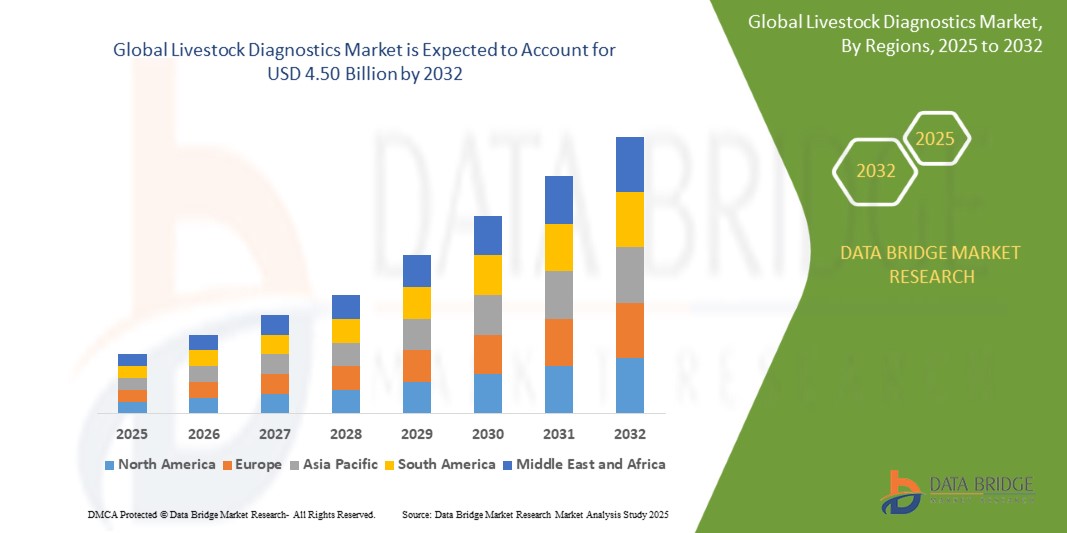
Livestock Diagnostics Market Size
- The global livestock diagnostics market size was valued at USD 2.46 billion in 2024 and is expected to reach USD 4.50 billion by 2032, at a CAGR of 7.80% during the forecast period
- The market growth is largely fuelled by the rising prevalence of zoonotic diseases, increasing livestock population, and growing demand for animal-derived food products
- Technological advancements in diagnostic tools, increasing veterinary healthcare expenditure, and awareness among farmers regarding early disease detection are also contributing significantly to market expansion
Livestock Diagnostics Market Analysis
- The livestock diagnostics market is witnessing steady growth as a result of growing concerns regarding animal health and productivity
- Government initiatives supporting animal disease control and mandatory testing requirements are driving demand for advanced diagnostic solutions
- Asia-Pacific dominated the livestock diagnostics market with the largest revenue share in 2024, driven by a significant rise in livestock populations and government initiatives supporting animal health management
- North America region is expected to witness the highest growth rate in the global livestock diagnostics market, driven by a strong focus on preventive animal healthcare, rising pet and livestock ownership, and continuous innovations in molecular and immunodiagnostic technologies
- The immunodiagnosis segment held the largest market revenue share in 2024, driven by its widespread use in disease surveillance and its suitability for high-throughput testing in large herds. The affordability, reliability, and broad availability of enzyme-linked immunosorbent assay (ELISA) and lateral flow tests have made immunodiagnostic tools a primary choice for routine livestock screening. Their compatibility with multiple sample types and ability to detect various pathogens quickly contribute to sustained demand across both developed and developing regions
Report Scope and Livestock Diagnostics Market Segmentation
|
Attributes |
Livestock Diagnostics Key Market Insights |
|
Segments Covered |
|
|
Countries Covered |
North America
Europe
Asia-Pacific
Middle East and Africa
South America
|
|
Key Market Players |
|
|
Market Opportunities |
|
|
Value Added Data Infosets |
In addition to the insights on market scenarios such as market value, growth rate, segmentation, geographical coverage, and major players, the market reports curated by the Data Bridge Market Research also include import export analysis, production capacity overview, production consumption analysis, price trend analysis, climate change scenario, supply chain analysis, value chain analysis, raw material/consumables overview, vendor selection criteria, PESTLE Analysis, Porter Analysis, and regulatory framework. |
Livestock Diagnostics Market Trends
Rise of Point-of-Care Testing in Livestock Diagnostics
- The growing shift toward point-of-care (POC) testing is transforming the livestock diagnostics landscape by enabling real-time, on-site disease detection. The portability and speed of these devices allow for immediate treatment decisions, especially in large farms where early isolation of infected animals is critical. This results in improved productivity and lower disease-related losses
- The high demand for rapid diagnostics in remote and under-resourced regions is accelerating the adoption of handheld test kits and mobile diagnostic platforms. These tools are particularly effective where veterinary lab access is limited, helping reduce diagnostic delays and ensuring timely interventions. The trend is further supported by governments and NGOs focusing on animal health in rural settings
- The affordability and ease of use of modern POC devices are making them attractive for routine herd screening, leading to improved disease surveillance. Farmers benefit from more frequent testing without incurring excessive costs or logistical hurdles, which ultimately improves overall herd health management
- For instance, in 2023, several dairy cooperatives across rural India reported a reduction in milk contamination rates after implementing on-farm mastitis testing kits developed by local biotechnology firms. These kits allowed early detection and treatment, improving milk quality and animal welfare while reducing treatment expenses
- While POC diagnostics are accelerating early detection and supporting biosecurity, their impact depends on continued innovation, user training, and affordability. Manufacturers must focus on localized product development and deployment strategies to fully capitalize on this growing demand
Livestock Diagnostics Market Dynamics
Driver
Growing Prevalence of Zoonotic Diseases and Rising Awareness Among Farmers
- The rise in zoonotic diseases is pushing both governments and livestock producers to prioritize diagnostics as a frontline defense. Diseases such as brucellosis, leptospirosis, and bovine tuberculosis have cross-species implications, prompting a strong focus on early identification and control. This has accelerated investment in veterinary diagnostics
- Farmers are increasingly aware of the financial risks associated with undiagnosed infections, including reduced productivity, increased mortality, and restricted access to export markets. This awareness has led to the regular use of diagnostic kits, even among small and mid-sized operators. The shift is supported by evolving consumer demands for safe animal-derived products
- Public sector efforts and international agencies have strengthened diagnostic infrastructure and surveillance protocols. From subsidized testing programs to nationwide disease control initiatives, supportive frameworks are helping farmers detect threats early and act decisively to prevent spread.
- For instance, in 2022, the European Union implemented a mandatory testing protocol for select zoonotic diseases across commercial farms, boosting demand for rapid diagnostics and portable analyzers across the regio
- While awareness and institutional support are driving the market, there is still a need to enhance last-mile connectivity, ensure diagnostic affordability, and integrate technology into routine livestock management practices to ensure sustained adoption
Restraint/Challenge
High Cost of Advanced Diagnostic Equipment and Limited Access in Rural Regions
- The high price point of advanced diagnostic equipment such as PCR analyzers and ELISA systems makes them inaccessible for smallholder farmers and underfunded veterinary centers. These systems are often reserved for large commercial operations or research institutes. Cost remains a major limiting factor for widespread usage
- In many rural areas, there is a lack of trained personnel capable of using or maintaining complex diagnostic tools. The absence of supporting infrastructure and logistical barriers further reduce access to timely and accurate testing. This leads to underreporting and delayed disease responses in high-risk zones
- Market penetration is also restricted by supply chain challenges in remote areas, where consistent availability of diagnostic kits and reagents is not guaranteed. These regions often rely on symptomatic treatment, which is less effective and can lead to increased animal mortality and productivity losses
- For instance, in 2023, livestock agencies in Sub-Saharan Africa revealed that over 70% of small-scale farmers had no access to formal diagnostic services, citing equipment cost and infrastructure gaps as the primary barriers
- While diagnostic technologies continue to evolve, solving cost and access challenges remains crucial. Market stakeholders must focus on decentralized solutions, mobile testing units, and scalable tools to bridge the rural diagnostic divide and unlock long-term market potential
Livestock Diagnostics Market Scope
The market is segmented on the basis of type, animal type, and end user.
• By Type
On the basis of type, the livestock diagnostics market is segmented into immunodiagnosis, molecular diagnosis, and other technologies. The immunodiagnosis segment held the largest market revenue share in 2024, driven by its widespread use in disease surveillance and its suitability for high-throughput testing in large herds. The affordability, reliability, and broad availability of enzyme-linked immunosorbent assay (ELISA) and lateral flow tests have made immunodiagnostic tools a primary choice for routine livestock screening. Their compatibility with multiple sample types and ability to detect various pathogens quickly contribute to sustained demand across both developed and developing regions.
The molecular diagnosis segment is expected to witness the fastest growth rate from 2025 to 2032, propelled by the increasing emphasis on precision diagnostics and early disease detection. Techniques such as polymerase chain reaction (PCR) are gaining traction for their superior accuracy and ability to detect low pathogen loads. The rising application of molecular tools for the identification of emerging zoonotic infections and antimicrobial resistance also supports the segment’s rapid growth, particularly in high-risk farming regions.
• By Animal Type
On the basis of animal type, the market is segmented into ruminants, poultry, and swine. The ruminants segment dominated the market in 2024 with the largest share, supported by the high global population of cattle and the economic importance of dairy and meat production. The frequent occurrence of diseases such as bovine tuberculosis, brucellosis, and mastitis necessitates regular health monitoring and diagnostic testing in ruminants. Large-scale cattle farming operations and government-backed herd health programs have further driven diagnostic demand in this segment.
The poultry segment is expected to witness the fastest growth rate from 2025 to 2032, driven by the intensification of poultry farming and the increased risk of highly infectious diseases such as avian influenza and Newcastle disease. The segment benefits from the adoption of rapid diagnostic solutions that support mass screening and quick containment. Poultry producers are increasingly adopting diagnostics to maintain flock health, ensure biosecurity, and meet export and regulatory standards.
• By End User
On the basis of end user, the livestock diagnostics market is segmented into reference lab, veterinary hospital and clinic, and point-of-care (POC). The reference lab segment accounted for the largest revenue share in 2024, owing to the high volume of diagnostic samples processed and the advanced capabilities available in centralized testing facilities. Reference laboratories often provide comprehensive testing services for disease surveillance, outbreak confirmation, and regulatory compliance. Their strong presence in developed markets and partnerships with government veterinary programs further boost their market share.
The point-of-care (POC) segment is expected to witness the fastest growth rate from 2025 to 2032, driven by the rising need for on-site, rapid diagnostics in farm settings. POC diagnostics offer timely results, enabling farmers and veterinarians to make immediate treatment decisions and reduce losses. Technological advancements in portable testing kits and the growing availability of user-friendly tools for field use are accelerating adoption, particularly in remote and resource-limited areas.
Livestock Diagnostics Market Regional Analysis
- Asia-Pacific dominated the livestock diagnostics market with the largest revenue share in 2024, driven by a significant rise in livestock populations and government initiatives supporting animal health management
- The growing demand for high-quality animal-derived food products, increasing awareness of zoonotic diseases, and the presence of key diagnostic manufacturers contribute to the region's leadership
- Technological advancements in veterinary diagnostics, expansion of commercial farms, and strong investment in improving animal healthcare infrastructure are also promoting rapid market adoption
China Livestock Diagnostics Market Insight
The China livestock diagnostics market accounted for the largest market revenue share in Asia-Pacific in 2024, propelled by the country’s massive livestock population, including swine and poultry, and the rising occurrence of animal-borne diseases. China’s increased focus on food safety, combined with aggressive government efforts to improve veterinary public health, supports high diagnostic adoption. Moreover, collaborations between local players and international firms are fostering market development and access to advanced diagnostic tools.
Japan Livestock Diagnostics Market Insight
The Japan livestock diagnostics market is expected to witness the fastest growth rate from 2025 to 2032, due to its advanced technological capabilities and increasing need for disease control in poultry and swine farms. The country's strong regulatory framework ensures early diagnosis and reporting of livestock diseases, encouraging the use of molecular and immunodiagnostic tools. Furthermore, Japan’s aging farming population is prompting the adoption of more efficient, automated diagnostic solutions to maintain productivity and quality in the sector.
North America Livestock Diagnostics Market Insight
The North America livestock diagnostics market is expected to witness the fastest growth rate from 2025 to 2032, driven by well-established veterinary healthcare infrastructure, high animal health awareness, and a growing focus on productivity and biosecurity. The increasing prevalence of zoonotic infections and favorable reimbursement policies for veterinary care contribute to strong market performance. The presence of leading diagnostic firms and investment in research and development activities are further accelerating the region's market growth.
U.S. Livestock Diagnostics Market Insight
The U.S. livestock diagnostics market is expected to witness the fastest growth rate from 2025 to 2032, supported by the country’s large-scale commercial livestock operations and stringent regulatory requirements for disease monitoring. High expenditure on veterinary services, integration of cutting-edge molecular technologies, and the growing popularity of point-of-care diagnostics enhance adoption rates. Moreover, partnerships between academic institutions, government bodies, and private players are driving continuous innovation in the diagnostic landscape.
Europe Livestock Diagnostics Market Insight
The Europe livestock diagnostics market is expected to witness the fastest growth rate from 2025 to 2032, fuelled by increasing emphasis on food safety, animal welfare, and sustainable livestock management practices. The region’s strong regulatory environment and funding for disease surveillance programs promote the use of advanced diagnostics across both small- and large-scale farms. The growing trend of precision livestock farming further supports market expansion.
Germany Livestock Diagnostics Market Insight
The Germany livestock diagnostics market is expected to witness the fastest growth rate from 2025 to 2032, driven by the country’s structured animal health regulations and extensive veterinary network. The push towards early disease detection and prevention in dairy and pig farming, coupled with the adoption of automated diagnostic systems, is propelling market growth. Germany's active participation in European-wide disease monitoring initiatives also enhances diagnostic standardization and market penetration.
U.K. Livestock Diagnostics Market Insight
The U.K. livestock diagnostics market is expected to witness the fastest growth rate from 2025 to 2032, attributed to increasing awareness of zoonotic threats and the growing adoption of livestock health monitoring technologies. Government support for sustainable farming and improved biosecurity measures is encouraging veterinary professionals to invest in advanced diagnostics. Moreover, the expansion of livestock exports and the demand for quality certification drive the need for routine diagnostic testing across the country.
Livestock Diagnostics Market Share
The livestock diagnostics industry is primarily led by well-established companies, including:
- IDEXX Laboratories (U.S.)
- Abaxis (U.S.)
- Heska Corporation (U.S.)
- Zoetis (U.S.)
- Randox Laboratories Ltd. (U.K.)
- Thermo Fisher Scientific (U.S.)
- Bio-Rad Laboratories, Inc. (U.S.)
- Eurolyser Diagnostica GmbH (Germany)
- ARKRAY USA, Inc. (U.S.)
- Diconex (U.S.)
- Alfa Wassermann (Italy)
- bioMérieux S.A. (France)
- Chengdu Seamaty Technology Co., Ltd. (China)
- DiaSys Diagnostic Systems GmbH (Germany)
- biosys (Germany)
- URIT Medical Electronic Group Co. Ltd. (China)
- Neogen Corporation (U.S.)
- ELITech Group (France)
Latest Developments in Global Livestock Diagnostics Market
- In January 2024, Center Point Bio-Tech, LLC (CPB) launched a new patent-pending diagnostic platform named AlphaION during the 2024 Veterinary Meeting & Expo in the U.S. This innovative system is designed to enhance diagnostic efficiency and accuracy in veterinary practices. The introduction of AlphaION is expected to streamline veterinary diagnostics, improve patient care, and strengthen CPB’s footprint in the global livestock diagnostics market
- In November 2023, Antech expanded its diagnostic capabilities by opening a new veterinary diagnostics laboratory in Warwick, U.K. This strategic move aims to improve regional service coverage and reduce turnaround times for diagnostic results. The expansion reinforces Antech’s commitment to providing timely and precise diagnostics, which is likely to elevate the standard of veterinary healthcare in Europe
- In March 2023, QIAGEN N.V. entered a partnership with Servier to develop a companion diagnostic test for TIBSOVO, a treatment targeting Acute Myeloid Leukemia (AML). The collaboration involves QIAGEN designing a real-time PCR-based test to detect IDH1 gene mutations in whole blood and bone marrow aspirates. This development is expected to advance precision medicine and enable more effective treatment plans for AML patients, expanding QIAGEN’s influence in the molecular diagnostics space

- Interactive Data Analysis Dashboard
- Company Analysis Dashboard for high growth potential opportunities
- Research Analyst Access for customization & queries
- Competitor Analysis with Interactive dashboard
- Latest News, Updates & Trend analysis
- Harness the Power of Benchmark Analysis for Comprehensive Competitor Tracking
Data collection and base year analysis are done using data collection modules with large sample sizes. The stage includes obtaining market information or related data through various sources and strategies. It includes examining and planning all the data acquired from the past in advance. It likewise envelops the examination of information inconsistencies seen across different information sources. The market data is analysed and estimated using market statistical and coherent models. Also, market share analysis and key trend analysis are the major success factors in the market report. To know more, please request an analyst call or drop down your inquiry.
The key research methodology used by DBMR research team is data triangulation which involves data mining, analysis of the impact of data variables on the market and primary (industry expert) validation. Data models include Vendor Positioning Grid, Market Time Line Analysis, Market Overview and Guide, Company Positioning Grid, Patent Analysis, Pricing Analysis, Company Market Share Analysis, Standards of Measurement, Global versus Regional and Vendor Share Analysis. To know more about the research methodology, drop in an inquiry to speak to our industry experts.
Data Bridge Market Research is a leader in advanced formative research. We take pride in servicing our existing and new customers with data and analysis that match and suits their goal. The report can be customized to include price trend analysis of target brands understanding the market for additional countries (ask for the list of countries), clinical trial results data, literature review, refurbished market and product base analysis. Market analysis of target competitors can be analyzed from technology-based analysis to market portfolio strategies. We can add as many competitors that you require data about in the format and data style you are looking for. Our team of analysts can also provide you data in crude raw excel files pivot tables (Fact book) or can assist you in creating presentations from the data sets available in the report.