




Global Loan Servicing Software Market
Market Size in USD Billion
CAGR :
% 
 USD
4.53 Billion
USD
11.72 Billion
2025
2033
USD
4.53 Billion
USD
11.72 Billion
2025
2033
 Forecast Period Forecast Period |
2026 - 2033 |
 Market Size (Base Year) Market Size (Base Year) |
USD 4.53 Billion |
 Market Size (Forecast Year) Market Size (Forecast Year) |
USD 11.72 Billion |
 CAGR CAGR |
% |
| Major Markets Players |
|
Loan Servicing Software Market Overview
The Loan Servicing Software Market was valued at USD 4.53 billion in 2025 and is projected to reach USD 11.72 billion by 2033, growing at a CAGR of 12.62% from 2026 to 2033. The market is witnessing robust growth driven by the increasing digital transformation of financial institutions, rising demand for automated loan management processes, and the growing need for regulatory compliance and risk management solutions across lending operations.
The expansion of consumer, mortgage, commercial, and digital lending activities has intensified the need for efficient loan servicing platforms capable of managing payment processing, escrow administration, collections, customer communications, and compliance reporting. Financial institutions, credit unions, and non-bank lenders are increasingly adopting cloud-based loan servicing software to improve operational efficiency, reduce servicing costs, enhance borrower experiences, and streamline end-to-end loan lifecycle management. In addition, advancements in artificial intelligence, machine learning, and data analytics are enabling predictive servicing, automated decision-making, and real-time portfolio monitoring, further accelerating market adoption. The growing popularity of digital lending ecosystems, coupled with evolving regulatory requirements and increasing demand for scalable SaaS-based solutions, continues to create significant growth opportunities for the Loan Servicing Software Market.
Key Market Trends & Insights
- North America dominated the loan servicing software market with the largest revenue share of 38.92% in 2025, supported by the presence of a mature financial services sector, widespread adoption of digital banking technologies, and significant investments in cloud-based lending and servicing infrastructure.
- Asia-Pacific is expected to be the fastest-growing region, recording a CAGR of 14.35% from 2026 to 2033. Growth is driven by rapid expansion of digital lending platforms, increasing financial inclusion initiatives, rising fintech adoption, and growing investments in banking technology modernization across countries such as China, India, and Japan.
- The Cloud Based segment held the largest market revenue share of approximately 46.9% in 2025 driven by increasing digital transformation initiatives across financial institutions and growing demand for scalable, secure, and remotely accessible servicing platforms. Cloud-based solutions are widely adopted due to lower infrastructure costs, faster deployment capabilities, automatic software updates, and improved operational flexibility for banks and lending organizations managing large loan portfolios.
- The SaaS Based segment is projected to register the fastest growth at a CAGR of 14.2% from 2026 to 2033, driven by rising adoption among fintech companies, mortgage servicers, and non-bank lenders seeking subscription-based software models with minimal upfront investment. Increasing demand for AI-enabled servicing capabilities, real-time analytics, and seamless regulatory compliance management is accelerating segment growth.
- The Banks segment accounted for the largest market revenue share of approximately 42.7% in 2025 driven by high loan origination volumes, extensive servicing requirements, and ongoing modernization of legacy banking infrastructure. Large commercial and retail banks continue to invest heavily in automated servicing platforms to improve customer experience, reduce operational costs, and strengthen regulatory compliance across diverse lending portfolios.
- The Mortgage Lenders and Brokers segment is expected to witness the fastest growth at a CAGR of 13.8% from 2026 to 2033, driven by increasing mortgage digitization, growing demand for automated payment processing, and expanding adoption of cloud-based servicing technologies. Rising residential lending activity, coupled with increasing focus on borrower engagement and delinquency management, is supporting strong growth across this segment.
Market Size & Forecast
- Global Market Value (2025): USD 4.53 Billion
- Expected Market Value (2033): USD 11.72 Billion
- Forecast CAGR (2026–2033): 12.62%
- Leading Region in 2025: North America
- Fastest Growing Region: Asia-Pacific
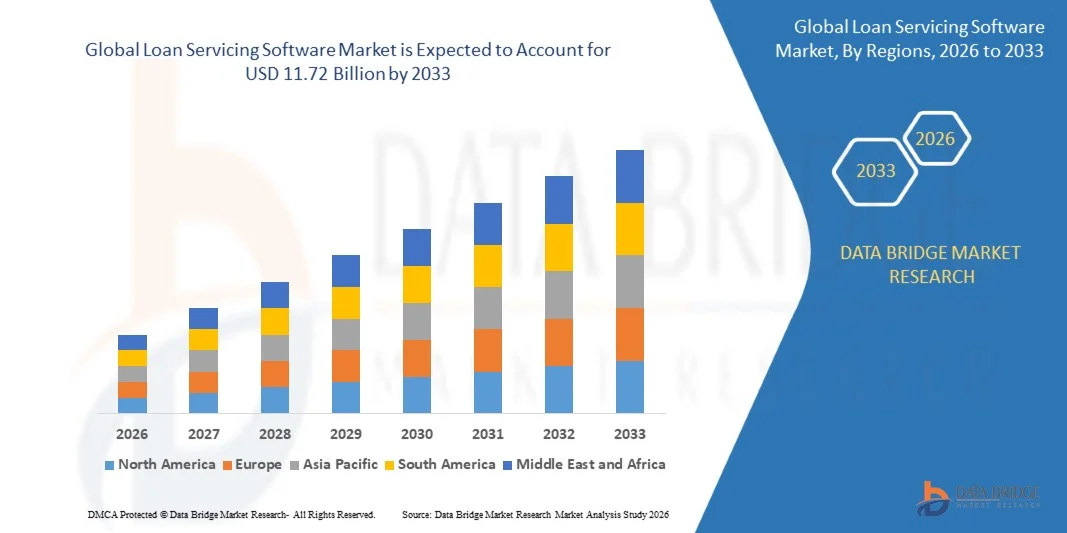
Report Scope and Loan Servicing Software Market Segmentation
|
Attributes |
Loan Servicing Software Key Market Insights |
|
Segments Covered |
|
|
Countries Covered |
North America
Europe
Asia-Pacific
Middle East and Africa
South America
|
|
Key Market Players |
• DownHome Solutions (U.S.) |
|
Market Opportunities |
• Expansion Of Cloud-Based Loan Servicing Platforms • Growing Adoption Of AI-Powered Loan Management And Analytics Solutions |
|
Value Added Data Infosets |
In addition to the market insights such as market value, growth rate, market segments, geographical coverage, market players, and market scenario, the market report curated by the Data Bridge Market Research team includes in-depth expert analysis, import/export analysis, pricing analysis, production consumption analysis, and pestle analysis. |
Loan Servicing Software Market Trends
Trend: Growing Adoption Of AI-Driven Loan Automation And Cloud-Based Servicing Platforms
Financial institutions are increasingly modernizing loan servicing operations through cloud computing, artificial intelligence, and workflow automation to improve operational efficiency and borrower engagement. Traditional loan servicing systems often rely on fragmented processes, manual documentation, and legacy infrastructure, creating operational bottlenecks, compliance risks, and higher servicing costs. As lending volumes continue to increase across consumer, mortgage, auto, and commercial lending segments, organizations are accelerating investments in intelligent servicing platforms capable of managing complex loan portfolios at scale.
Modern loan servicing software integrates AI-powered customer support, automated payment processing, predictive delinquency management, and real-time compliance monitoring to streamline servicing activities. For instance, major lenders are deploying machine learning models to identify borrowers at risk of default and initiate proactive engagement strategies before delinquency occurs. Cloud-native servicing platforms are also enabling financial institutions to reduce infrastructure costs while supporting remote operations and faster software deployment cycles.
The rapid growth of digital lending ecosystems and embedded finance is further driving demand for scalable servicing technologies capable of handling high transaction volumes. In addition, regulatory authorities continue to emphasize transparency, consumer protection, and reporting accuracy, encouraging adoption of advanced servicing solutions. Industry surveys conducted in 2025 indicated that financial institutions implementing AI-enabled loan servicing platforms achieved operational cost reductions of approximately 20–30% while improving customer response times by nearly 40%.
Loan Servicing Software Market Dynamics
Key Market Driver: Rising Demand For Automated Loan Lifecycle Management
Financial institutions worldwide are facing increasing pressure to improve efficiency, reduce servicing costs, and enhance borrower experiences amid growing loan volumes and evolving regulatory requirements. Manual servicing processes often create delays in payment administration, collections management, customer communications, and compliance reporting, driving demand for software platforms capable of automating end-to-end loan servicing operations.
Banks, credit unions, mortgage lenders, and fintech companies are increasingly deploying loan servicing software to streamline payment processing, escrow management, delinquency tracking, and regulatory reporting. For instance, large mortgage servicers are integrating automated servicing platforms to manage millions of active loan accounts while maintaining compliance with changing regulatory standards. The growth of digital lending channels is further increasing the need for scalable servicing infrastructure capable of supporting faster loan origination-to-servicing transitions.
Similarly, financial institutions are leveraging analytics-driven servicing platforms to improve portfolio visibility and borrower retention while reducing administrative workloads. Real-world banking modernization initiatives implemented across North America and Europe during 2024 reported processing efficiency improvements of approximately 25–35% after migrating from legacy servicing systems to cloud-based automated loan servicing platforms.
Key Restraint/Challenge: Data Security Risks And Complex Legacy System Integration
Loan servicing platforms manage large volumes of sensitive financial and personal borrower information, making cybersecurity, privacy protection, and regulatory compliance critical concerns for lenders. Increasing incidents of cyberattacks targeting financial institutions are creating challenges for software providers and lending organizations seeking to protect customer data while maintaining uninterrupted servicing operations.
In addition, many established banks and mortgage institutions continue to operate on legacy core banking infrastructure that can be difficult and expensive to integrate with modern servicing platforms. Complex migration processes, customization requirements, and operational disruptions during implementation often increase deployment timelines and overall project costs. Smaller financial institutions may also face budget limitations when upgrading existing servicing environments.
Regulatory compliance requirements across multiple jurisdictions further add complexity to software deployment and ongoing system maintenance. Industry assessments indicate that financial institutions undertaking large-scale servicing platform modernization projects typically allocate 20–30% of total implementation budgets toward cybersecurity enhancements, compliance controls, and legacy system integration activities.
Key Market Opportunity: Expansion Of Digital Lending And Embedded Finance Ecosystems
The rapid growth of digital lending platforms, fintech partnerships, and embedded finance solutions is creating substantial opportunities for advanced loan servicing software providers. Consumers and businesses increasingly expect seamless digital borrowing experiences supported by real-time account access, automated payment options, and personalized servicing interactions, encouraging lenders to invest in next-generation servicing technologies.
Financial institutions are increasingly adopting cloud-based servicing platforms, For instance to support online personal loans, buy now pay later programs, mortgage lending, and small business financing products. Embedded finance providers are also integrating loan servicing capabilities directly into digital commerce and banking ecosystems to simplify borrower management and improve customer retention. Rising adoption of open banking frameworks is further enabling servicing platforms to deliver enhanced data-driven insights and personalized financial services.
In addition, advancements in artificial intelligence, predictive analytics, and API-based architectures are expanding opportunities across digital banking, fintech, and alternative lending markets globally. Digital lending initiatives launched across Asia-Pacific and North America during 2025 reported loan processing and servicing cycle reductions of approximately 30–50% following implementation of integrated cloud-based loan servicing software solutions.
Loan Servicing Software Market Scope
The market is segmented on the basis of type and application.
• By Type
On the basis of type, the loan servicing software market is segmented into Cloud Based, SaaS Based, and On-Premises. The Cloud Based segment held the largest market revenue share of approximately 46.9% in 2025 driven by increasing digital transformation initiatives across financial institutions and growing demand for scalable, secure, and remotely accessible servicing platforms. Cloud-based solutions are widely adopted due to lower infrastructure costs, faster deployment capabilities, automatic software updates, and improved operational flexibility for banks and lending organizations managing large loan portfolios.
The SaaS Based segment is projected to register the fastest growth at a CAGR of 14.2% from 2026 to 2033, driven by rising adoption among fintech companies, mortgage servicers, and non-bank lenders seeking subscription-based software models with minimal upfront investment. Increasing demand for AI-enabled servicing capabilities, real-time analytics, and seamless regulatory compliance management is accelerating segment growth.
• By Application
On the basis of application, the loan servicing software market is segmented into Banks, Credit Unions, Mortgage Lenders and Brokers, and Other. The Banks segment accounted for the largest market revenue share of approximately 42.7% in 2025 driven by high loan origination volumes, extensive servicing requirements, and ongoing modernization of legacy banking infrastructure. Large commercial and retail banks continue to invest heavily in automated servicing platforms to improve customer experience, reduce operational costs, and strengthen regulatory compliance across diverse lending portfolios.
The Mortgage Lenders and Brokers segment is expected to witness the fastest growth at a CAGR of 13.8% from 2026 to 2033, driven by increasing mortgage digitization, growing demand for automated payment processing, and expanding adoption of cloud-based servicing technologies. Rising residential lending activity, coupled with increasing focus on borrower engagement and delinquency management, is supporting strong growth across this segment.
Loan Servicing Software Market Regional Analysis
North America Loan Servicing Software Market Insight
North America dominated the loan servicing software market with the largest revenue share of 38.92% in 2025, supported by the presence of a mature financial services industry, high adoption of digital banking technologies, and increasing investments in cloud-based lending infrastructure. Financial institutions across the region are actively modernizing legacy servicing systems to improve operational efficiency, regulatory compliance, and borrower engagement. The growing demand for automated loan management, real-time reporting, and AI-powered servicing solutions continues to strengthen market growth across banks, mortgage lenders, and fintech companies.
U.S. Loan Servicing Software Market Insight
The U.S. loan servicing software market captured the largest revenue share in 2025 within North America, fueled by the rapid digitalization of lending operations and increasing adoption of automated servicing platforms across banking and mortgage sectors. Financial institutions are increasingly prioritizing technologies that streamline payment processing, collections management, compliance reporting, and customer communications. The growing presence of fintech lenders, coupled with strong demand for cloud-native servicing solutions and analytics-driven portfolio management, continues to support market expansion across the country.
Europe Loan Servicing Software Market Insight
The Europe loan servicing software market is expected to witness the fastest growth rate from 2026 to 2033, primarily driven by evolving regulatory requirements, growing adoption of digital lending platforms, and increasing demand for operational efficiency within financial institutions. Lenders across the region are investing in advanced servicing technologies to improve transparency, automate compliance workflows, and enhance borrower experiences. The expansion of open banking initiatives and rising focus on digital financial services are further accelerating software adoption across European markets.
U.K. Loan Servicing Software Market Insight
The U.K. loan servicing software market is expected to witness the fastest growth rate from 2026 to 2033, driven by the increasing digital transformation of banking operations and strong growth in online lending activities. Financial institutions are actively implementing automated servicing platforms to improve customer retention, strengthen risk management, and comply with changing regulatory standards. The country's advanced fintech ecosystem and growing demand for cloud-based financial software solutions are expected to continue driving market growth.
Germany Loan Servicing Software Market Insight
The Germany loan servicing software market is expected to witness the fastest growth rate from 2026 to 2033, fueled by increasing investments in banking technology modernization and rising demand for efficient loan portfolio management solutions. German financial institutions are adopting advanced servicing platforms to improve compliance processes, reduce operational costs, and enhance data security. The growing emphasis on digital transformation, combined with strong regulatory oversight and increasing automation across financial services, is supporting market expansion.
Asia-Pacific Loan Servicing Software Market Insight
The Asia-Pacific loan servicing software market is expected to witness the fastest growth rate from 2026 to 2033, supported by rapid growth in digital lending, expanding financial inclusion initiatives, and increasing adoption of cloud-based banking technologies. Countries such as China, India, Japan, and Australia are experiencing rising demand for automated servicing solutions as lending volumes continue to increase across consumer and commercial segments. Government-led digitalization programs and the expansion of fintech ecosystems are further contributing to regional market growth.
Japan Loan Servicing Software Market Insight
The Japan loan servicing software market is expected to witness the fastest growth rate from 2026 to 2033 due to increasing investments in financial technology, growing demand for process automation, and modernization of traditional banking systems. Japanese lenders are adopting intelligent servicing platforms to improve customer service, strengthen compliance management, and optimize operational efficiency. The integration of artificial intelligence and data analytics into loan servicing processes is further supporting market development across the country.
China Loan Servicing Software Market Insight
The China loan servicing software market accounted for the largest market revenue share in Asia-Pacific in 2025, attributed to the country's rapidly expanding digital finance sector, large lending ecosystem, and widespread adoption of financial technology solutions. Chinese banks, fintech firms, and online lending platforms are increasingly implementing advanced servicing software to manage growing loan portfolios, improve borrower engagement, and enhance risk monitoring capabilities. Strong government support for digital transformation and continuous innovation within the financial services sector remain key factors driving market growth in China.
Loan Servicing Software Market Share
The Loan Servicing Software industry is primarily led by well-established companies, including:
• DownHome Solutions (U.S.)
• AUTOPAL SOFTWARE, LLC (U.S.)
• Nortridge Software, LLC. (U.S.)
• Fiserv, Inc. (U.S.)
• Q2 Software, Inc. (U.S.)
• Emphasys Software (U.S.)
• NBFC Software (India)
• Shaw Systems Associates, LLC (U.S.)
• Simnang LLC (U.S.)
• Graveco Software Inc. (Canada)
• Oracle Corporation (U.S.)
• Sopra Banking Software (France)
• Altisource (Luxembourg)
• Nucleus Software Exports Ltd. (India)
• IBM (U.S.)
• LOAN SERVICING SOFT INC. (U.S.)
• PCFS Solutions (U.S.)
Latest Developments in Loan Servicing Software Market
• In September 2025, Black Knight (U.S.) launched an advanced compliance management solution for loan servicing operations. The development was aimed at helping lenders address evolving regulatory requirements through automated monitoring and reporting capabilities. This strengthened operational transparency, reduced compliance risks, and supported wider adoption of digital loan servicing platforms across financial institutions.
• In August 2025, FIS (U.S.) enhanced its loan servicing platform by integrating machine learning-powered predictive analytics capabilities. The upgrade was designed to help lenders improve risk assessment, borrower behavior analysis, and portfolio performance management. The initiative accelerated the adoption of AI-driven servicing technologies and improved decision-making efficiency across lending operations.
• In July 2025, Ellie Mae (U.S.) expanded its partnership with a major mortgage lender to strengthen its digital mortgage and servicing ecosystem. The collaboration focused on streamlining loan processing workflows, improving borrower experiences, and increasing operational efficiency. The development reinforced the industry's shift toward end-to-end digital lending and servicing solutions.
• In March 2024, Bain Capital Tech Opportunities announced an investment in Finova and the acquisition of a complementary software business. The strategic move was intended to expand product offerings across mortgage origination, savings, and loan servicing operations. The transaction enhanced platform capabilities and increased competitive pressure within the financial software market.
• In February 2024, Sagent (U.S.) introduced the Dara mortgage servicing platform to unify servicing data and customer interactions throughout the loan lifecycle. The platform was developed to improve operational efficiency, enhance homeowner engagement, and simplify servicing workflows. The launch supported growing demand for integrated and borrower-centric servicing technologies.
• In October 2023, Oracle Corporation (U.S.) expanded its cloud-based financial services technology portfolio with enhanced automation and analytics capabilities for lending institutions. The development was aimed at improving loan portfolio management, compliance oversight, and customer service efficiency. The initiative accelerated digital transformation trends and strengthened cloud adoption across the loan servicing software market.
SKU-
Get online access to the report on the World's First Market Intelligence Cloud

- Interactive Data Analysis Dashboard
- Company Analysis Dashboard for high growth potential opportunities
- Research Analyst Access for customization & queries
- Competitor Analysis with Interactive dashboard
- Latest News, Updates & Trend analysis
- Harness the Power of Benchmark Analysis for Comprehensive Competitor Tracking
Research Methodology
Data collection and base year analysis are done using data collection modules with large sample sizes. The stage includes obtaining market information or related data through various sources and strategies. It includes examining and planning all the data acquired from the past in advance. It likewise envelops the examination of information inconsistencies seen across different information sources. The market data is analysed and estimated using market statistical and coherent models. Also, market share analysis and key trend analysis are the major success factors in the market report. To know more, please request an analyst call or drop down your inquiry.
The key research methodology used by DBMR research team is data triangulation which involves data mining, analysis of the impact of data variables on the market and primary (industry expert) validation. Data models include Vendor Positioning Grid, Market Time Line Analysis, Market Overview and Guide, Company Positioning Grid, Patent Analysis, Pricing Analysis, Company Market Share Analysis, Standards of Measurement, Global versus Regional and Vendor Share Analysis. To know more about the research methodology, drop in an inquiry to speak to our industry experts.
Customization Available
Data Bridge Market Research is a leader in advanced formative research. We take pride in servicing our existing and new customers with data and analysis that match and suits their goal. The report can be customized to include price trend analysis of target brands understanding the market for additional countries (ask for the list of countries), clinical trial results data, literature review, refurbished market and product base analysis. Market analysis of target competitors can be analyzed from technology-based analysis to market portfolio strategies. We can add as many competitors that you require data about in the format and data style you are looking for. Our team of analysts can also provide you data in crude raw excel files pivot tables (Fact book) or can assist you in creating presentations from the data sets available in the report.












