


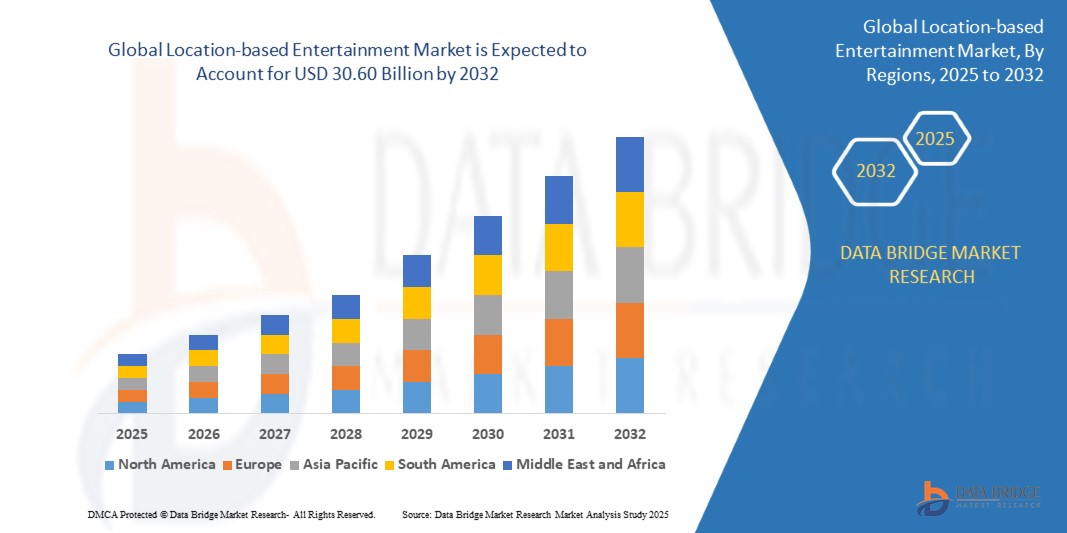
Location-based Entertainment Market Size
- The global location-based entertainment market size was valued at USD 5.44 billion in 2024 and is expected to reach USD 30.60 billion by 2032, at a CAGR of 24.10% during the forecast period
- The market growth is primarily driven by increasing consumer demand for immersive and interactive entertainment experiences, advancements in virtual and augmented reality technologies, and the rising popularity of themed amusement parks and arcade studios
- Growing consumer interest in experiential entertainment and the integration of advanced technologies such as CMR are further propelling the demand for location-based entertainment across various end-use segments
Location-based Entertainment Market Analysis
- The location-based entertainment market is experiencing robust growth as consumers increasingly seek immersive, interactive, and technology-driven experiences for entertainment and leisure
- The growing adoption of advanced technologies, such as 3D, 4D, and CMR, across amusement parks and arcade studios is encouraging providers to innovate with high-quality, engaging, and personalized entertainment solutions
- North America dominated the location-based entertainment market with the largest revenue share of 33.8% in 2024, driven by a well-established entertainment industry, high consumer spending on leisure activities, and the presence of major theme parks and technology providers
- Asia-Pacific is expected to be the fastest-growing region during the forecast period, fueled by rapid urbanization, increasing disposable incomes, and growing demand for immersive entertainment experiences in countries such as China, Japan, India, and Southeast Asian nations
- The hardware segment dominated the largest market revenue share of 58.2% in 2024, driven by the critical role of advanced equipment such as VR headsets, motion simulators, and interactive displays in delivering immersive experiences. Hardware solutions provide the foundation for high-quality, engaging entertainment environments, particularly in amusement parks and arcade studios, where durability and performance are paramount
Report Scope and Location-based Entertainment Market Segmentation
|
Attributes |
Location-based Entertainment Key Market Insights |
|
Segments Covered |
|
|
Countries Covered |
North America
Europe
Asia-Pacific
Middle East and Africa
South America
|
|
Key Market Players |
|
|
Market Opportunities |
|
|
Value Added Data Infosets |
In addition to the insights on market scenarios such as market value, growth rate, segmentation, geographical coverage, and major players, the market reports curated by the Data Bridge Market Research also include import export analysis, production capacity overview, production consumption analysis, price trend analysis, climate change scenario, supply chain analysis, value chain analysis, raw material/consumables overview, vendor selection criteria, PESTLE Analysis, Porter Analysis, and regulatory framework. |
Location-based Entertainment Market Trends
Increasing Integration of Advanced Immersive Technologies
- The global location-based entertainment (LBE) market is experiencing a significant trend toward the integration of advanced immersive technologies such as Virtual Reality (VR), Augmented Reality (AR), and Cloud Merged Reality (CMR)
- These technologies enable highly interactive and engaging experiences, offering consumers realistic and personalized entertainment at venues such as amusement parks, arcade studios, and 4D film theaters
- VR and AR-powered solutions allow for dynamic content creation, such as immersive storytelling and gamified experiences, enhancing visitor engagement and attracting tech-savvy audiences
- For instance, companies are developing CMR platforms that blend physical and digital environments in real-time, enabling seamless interactions in attractions such as VR arcades and theme park rides
- This trend is enhancing the appeal of location-based entertainment (LBE) venues, making them more competitive by offering unique, shareable experiences that resonate with younger generations and social media users
- Advanced technologies also analyze visitor preferences and behaviors, enabling personalized experiences, such as tailored game challenges or customized ride interactions, further driving footfall and revenue
Location-based Entertainment Market Dynamics
Driver
Rising Demand for Immersive and Interactive Entertainment
- Increasing consumer demand for immersive and interactive experiences, such as VR arcades, escape rooms, and themed attractions, is a major driver for the global location-based entertainment (LBE) market
- LBE systems enhance visitor experiences by offering features such as 3D and 4D simulations, real-time interactive gaming, and personalized storytelling, which cannot be replicated at home
- Government initiatives promoting tourism and entertainment infrastructure, particularly in regions such as Asia-Pacific, are contributing to the widespread adoption of location-based entertainment (LBE) technologies
- The proliferation of 5G technology and IoT advancements enables faster data processing and lower latency, supporting sophisticated location-based entertainment (LBE) applications such as real-time multiplayer gaming and AR-enhanced attractions
- Venue operators are increasingly incorporating advanced location-based entertainment (LBE) systems as standard offerings to meet consumer expectations for innovative entertainment and enhance venue appeal
Restraint/Challenge
High Implementation Costs and Data Privacy Concerns
- The substantial initial investment required for hardware, software, and integration of advanced location-based entertainment (LBE) systems, such as VR headsets, haptic suits, and CMR platforms, can be a significant barrier, particularly in cost-sensitive markets
- Retrofitting existing venues with location-based entertainment (LBE) technologies can be complex and expensive, limiting adoption among smaller operators or in emerging markets
- Data privacy and security concerns pose a major challenge, as location-based entertainment (LBE) systems collect sensitive user data, such as behavioral patterns and location information, raising risks of breaches or misuse
- The fragmented regulatory landscape across countries regarding data collection, storage, and usage complicates compliance for international location-based entertainment (LBE) providers and venue operators
- These factors can deter potential investors and limit market expansion, especially in regions with high awareness of data privacy or where cost sensitivity is a significant concern
Location-based Entertainment market Scope
The market is segmented on the basis of component, technology, and end use.
- By Component
On the basis of component, the global location-based entertainment market is segmented into hardware and software. The hardware segment dominated the largest market revenue share of 58.2% in 2024, driven by the critical role of advanced equipment such as VR headsets, motion simulators, and interactive displays in delivering immersive experiences. Hardware solutions provide the foundation for high-quality, engaging entertainment environments, particularly in amusement parks and arcade studios, where durability and performance are paramount. The ease of integrating hardware with existing infrastructure and its ability to support cutting-edge technologies have solidified its dominance.
The software segment is expected to register the fastest growth rate from 2025 to 2032, as demand for customizable and scalable digital solutions rises. Software enables dynamic content creation, real-time analytics, and seamless integration with emerging technologies such as augmented reality (AR) and virtual reality (VR). This flexibility allows operators to enhance user experiences, optimize operational efficiency, and introduce innovative storytelling, making software increasingly vital for location-based entertainment venues seeking to differentiate and retain customers.
- By Technology
On the basis of technology, the global location-based entertainment market is categorized into 2 Dimensional (2D), 3- & 4-Dimensional (3D & 4D), and Cloud Merged Reality (CMR). The 3D & 4D segment accounted for the highest revenue share in 2024, fueled by its ability to deliver immersive and sensory-rich experiences that captivate audiences. Technologies such as 3D visuals and 4D effects, such as motion, vibration, and environmental simulation, are widely adopted in amusement parks and 4D films, offering unparalleled engagement. The demand for realistic and interactive entertainment experiences, coupled with advancements in projection and haptic technologies, drives this segment’s dominance.
The CMR segment is anticipated to grow at the fastest CAGR from 2025 to 2032, propelled by the integration of cloud-based technologies with AR and VR. CMR enables seamless, scalable, and real-time content delivery, enhancing user engagement through personalized and interactive experiences. Its adoption is driven by the need for cost-effective, flexible solutions that support multi-user environments and remote content updates, particularly in arcade studios and next-generation amusement parks. Rising consumer expectations for innovative and connected entertainment further accelerate this trend.
- By End Use
On the basis of end use, the global location-based entertainment market is segmented into amusement parks, arcade studios, and 4D films. The amusement parks segment held the largest revenue share in 2024, attributed to the global popularity of theme parks and the integration of advanced technologies to create immersive attractions. Amusement parks leverage location-based entertainment to offer unique, memorable experiences that drive visitor footfall and repeat visits. The adoption of VR, AR, and 4D technologies, combined with the demand for family-friendly and interactive entertainment, strengthens this segment’s market position.
The arcade studios segment is projected to grow at the fastest rate from 2025 to 2032, fueled by the resurgence of interactive and social gaming experiences. Arcade studios are increasingly adopting VR and AR technologies to offer cutting-edge, location-based entertainment that appeals to younger audiences and gaming enthusiasts. The compact nature of arcade venues, combined with affordable and scalable technology solutions, enables rapid expansion and innovation. Growing urbanization, rising disposable incomes, and consumer preference for experiential entertainment further drive this segment’s growth.
Location-based Entertainment Market Regional Analysis
- North America dominated the location-based entertainment market with the largest revenue share of 33.8% in 2024, driven by a well-established entertainment industry, high consumer spending on leisure activities, and the presence of major theme parks and technology providers
- The region is a hub for major industry players and benefits from the early and widespread adoption of advanced technologies such as virtual reality (VR) and augmented reality (AR)
- Growth is supported by a strong consumer preference for immersive and social experiences that cannot be replicated at home, such as VR arcades and interactive theme parks
U.S. Location-based Entertainment Market Insight
The U.S. location-based entertainment market captured the largest revenue share of 73.7% in 2024 within North America, fueled by a diverse range of theme parks, arcades, and gaming centers. The country's market expansion is propelled by consumer interest in cutting-edge technology and a robust network of world-renowned entertainment destinations. Strategic investments by major companies and the development of new, innovative experiences based on popular franchises further boost market growth.
Europe Location-based Entertainment Market Insight
The Europe location-based entertainment market is expected to witness significant growth, supported by regulatory emphasis on vehicle safety and comfort. The market is seeing a rise in demand for immersive experiences that combine physical and digital elements. Countries such as Germany and the U.K. are showing significant uptake due to a strong consumer base for both traditional amusement parks and modern VR-based attractions, driven by increased disposable incomes and a desire for unique leisure activities
U.K. Location-based Entertainment Market Insight
The U.K. market for location-based entertainment is experiencing rapid growth, driven by a strong demand for immersive and unique experiences. Consumers, particularly from the younger generations, are increasingly seeking out interactive and social activities that are shareable on social media. This trend is supported by a robust technology and innovation ecosystem, with London serving as a global tech hub. The U.K. market is seeing significant growth in areas such as virtual reality (VR) arcades, escape rooms, and interactive gaming.
Germany Location-based Entertainment Market Insight
The Germany location-based entertainment market is projected to be a leader in Europe, driven by its advanced economy, high consumer interest in technological innovation, and a thriving tourism industry. German consumers are drawn to technologically advanced experiences that offer both entertainment and efficiency. The market benefits from the country's rich cultural heritage, which provides a strong foundation for a variety of themed experiences, and from a growing interest in VR and AR attractions. The market is expanding across amusement parks, arcade studios, and other immersive entertainment venues.
Asia-Pacific Location-based Entertainment Market Insight
The Asia-Pacific region is expected to witness the fastest growth rate, driven by expanding automotive production and rising disposable incomes in countries such as China, India, and Japan. This growth is a result of increasing urbanization, a burgeoning middle class, and a tech-savvy young demographic with a strong interest in new and immersive experiences. Government initiatives and investments in infrastructure also play a significant role in encouraging the development of location-based entertainment venues.
Japan Location-based Entertainment Market Insight
Japan’s location-based entertainment market is expected to witness the fastest growth rate due to strong consumer preference for high-quality, technologically advanced experiences. The country's advanced gaming culture and the presence of major technology and entertainment companies accelerate market penetration. Rising interest in both high-end amusement parks and smaller, urban-based VR arcades contributes to sustained market growth.
China Location-based Entertainment Market Insight
The China holds the largest share of the Asia-Pacific location-based entertainment market, propelled by rapid urbanization, rising vehicle ownership, and increasing demand for heat and UV protection solutions. The country's growing middle class and focus on smart mobility support the adoption of advanced tint films. Strong domestic manufacturing capabilities and competitive pricing enhance market accessibility.
Location-based Entertainment Market Share
The location-based entertainment industry is primarily led by well-established companies, including:
- CamOnApp (Argentina)
- Google LLC (U.S.)
- Cisco HQ Software, Inc (U.S.)
- HTC Corporation (Taiwan)
- Huawei Technologies Co., Ltd (China)
- Magic Leap, Inc (U.S.)
- Microsoft Corporation (U.S.)
- Niantic, Inc. (U.S.)
- Samsung Electronics Co. Ltd. (South Korea)
- Springboard VR (U.S.)
- VRstudios Inc (U.S.)
What are the Recent Developments in Global Location-based Entertainment Market?
- In November 2024, Blacklist Experiences partnered with Lionsgate to develop innovative location-based entertainment (LBE) concepts inspired by Lionsgate’s blockbuster franchises, including The Hunger Games and John Wick. This collaboration aims to create scalable attractions for venues such as theme parks, luxury resorts, and multi-IP destinations, blending immersive storytelling with global brand appeal. The initiative reflects a strategic push to expand Lionsgate’s experiential footprint and engage fans through dynamic, real-world experiences that celebrate its iconic film and television properties
- In October 2024, Sandbox VR announced a strategic franchise partnership with LOL Entertainment to expand its immersive virtual reality experiences to new locations in Baltimore, Boston, Philadelphia, and Washington D.C. This move aligns with LOL Entertainment’s broader strategy to grow its footprint in location-based entertainment (LBE). The collaboration leverages Sandbox VR’s cutting-edge motion-tracking and haptic technology to deliver fully immersive group experiences, while LOL Entertainment brings its expertise in interactive attractions such as Museum of Illusions and Cluville Kids Escape Room. Together, they aim to redefine entertainment across key East Coast markets
- In June 2024, iQIYI, a leading online entertainment platform in China, unveiled plans to launch VR location-based entertainment (LBE) venues across major Chinese cities. This initiative reflects iQIYI’s commitment to expanding into offline commercial spaces and the cultural tourism market, transforming its popular IPs into immersive, multisensory experiences. The rollout includes new attractions in Shenzhen, Beijing, and other cities, featuring advanced VR technology, interactive gameplay, and theatrical effects. With over 100,000 cumulative visitors already, iQIYI also plans global expansion to destinations such as Dubai and Bangkok, showcasing Chinese storytelling on an international stage
- In April 2024, Barco introduced its latest RGB laser projectors, engineered to elevate premium cinema experiences with exceptional brightness, color accuracy, and image quality. These projectors are part of Barco’s Series 4 lineup, which integrates advanced technologies such as Barco Colorgenic™ and Active Image Management™, delivering vibrant visuals and consistent performance. Designed in collaboration with cinema operators, the new models support 4K resolution at 120fps, ensuring immersive viewing for both 2D and 3D formats. With ultra-low maintenance and energy-efficient laser systems, Barco’s launch sets a new benchmark for cinematic projection
- In February 2024, Meta unveiled the Quest 3S at Connect 2024, showcasing its most advanced mixed reality headset to date. The Quest 3S features significant upgrades in visual clarity, performance, and immersive capabilities, including a high-definition resolution of 1832×1920 pixels per eye, enhanced GPU power, and improved hand and eye tracking. With a sleek design and ergonomic fit, it offers a seamless blend of virtual and real-world interaction. Meta also introduced new AI tools and accessories, reinforcing its commitment to shaping the future of VR, AR, and AI-powered experiences

- Interactive Data Analysis Dashboard
- Company Analysis Dashboard for high growth potential opportunities
- Research Analyst Access for customization & queries
- Competitor Analysis with Interactive dashboard
- Latest News, Updates & Trend analysis
- Harness the Power of Benchmark Analysis for Comprehensive Competitor Tracking
Data collection and base year analysis are done using data collection modules with large sample sizes. The stage includes obtaining market information or related data through various sources and strategies. It includes examining and planning all the data acquired from the past in advance. It likewise envelops the examination of information inconsistencies seen across different information sources. The market data is analysed and estimated using market statistical and coherent models. Also, market share analysis and key trend analysis are the major success factors in the market report. To know more, please request an analyst call or drop down your inquiry.
The key research methodology used by DBMR research team is data triangulation which involves data mining, analysis of the impact of data variables on the market and primary (industry expert) validation. Data models include Vendor Positioning Grid, Market Time Line Analysis, Market Overview and Guide, Company Positioning Grid, Patent Analysis, Pricing Analysis, Company Market Share Analysis, Standards of Measurement, Global versus Regional and Vendor Share Analysis. To know more about the research methodology, drop in an inquiry to speak to our industry experts.
Data Bridge Market Research is a leader in advanced formative research. We take pride in servicing our existing and new customers with data and analysis that match and suits their goal. The report can be customized to include price trend analysis of target brands understanding the market for additional countries (ask for the list of countries), clinical trial results data, literature review, refurbished market and product base analysis. Market analysis of target competitors can be analyzed from technology-based analysis to market portfolio strategies. We can add as many competitors that you require data about in the format and data style you are looking for. Our team of analysts can also provide you data in crude raw excel files pivot tables (Fact book) or can assist you in creating presentations from the data sets available in the report.













