


What is the Location Based Mapping Market Size and Growth Rate?
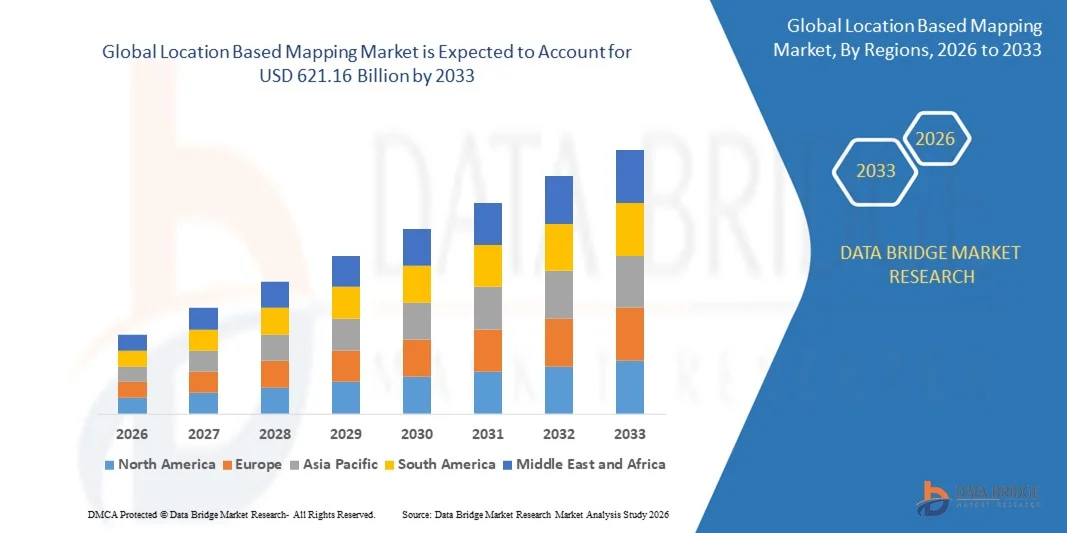
- As per Data Bridge Market Research Analysis the global location based mapping market size was valued at USD 95.33 billion in 2025 and is expected to reach USD 621.16 billion by 2033, at a CAGR of 26.40% during the forecast period
- The market growth is largely fueled by the increasing adoption of digital mapping solutions, real-time location tracking, and geospatial analytics across industries such as transportation, logistics, retail, and smart cities, driving demand for accurate and scalable location based mapping platforms
- Furthermore, rising enterprise demand for enhanced operational efficiency, route optimization, asset tracking, and location-aware decision-making is establishing location based mapping as a critical tool for business intelligence and infrastructure planning. These converging factors are accelerating the uptake of mapping solutions, thereby significantly boosting market growth
Market Size & Forecast
- Global Market Value (2025): USD 95.33 billion
- Expected Market Value (2033): USD 621.16 billion
- Forecast CAGR (2026–2033): 26.40%
What are the Major Takeaways of Location Based Mapping Market?
- Location based mapping solutions provide real-time geospatial data visualization, analytics, and navigation capabilities for both indoor and outdoor environments. These platforms integrate with enterprise software, IoT devices, and cloud infrastructure to enable efficient decision-making, precise asset tracking, and optimized operational workflows across multiple sectors
- The escalating demand for location based mapping is primarily driven by the growth of smart transportation networks, the rise of e-commerce and logistics operations, increasing government initiatives for smart cities, and the need for high-precision geospatial data in sectors such as retail, healthcare, and manufacturing
- North America dominated the location based mapping market with a share of around 40% in 2025, due to widespread adoption of location intelligence in transportation, logistics, and retail sectors
- Asia-Pacific is expected to be the fastest growing region in the location based mapping market during the forecast period due to rapid urbanization, rising smartphone penetration, and growing adoption of smart city projects in countries such as China, Japan, and India
- Outdoor segment dominated the market with a market share of 60.5% in 2025, due to extensive use in navigation, transportation management, urban planning, and asset tracking. Outdoor mapping benefits from mature satellite-based technologies and large-scale deployment across public and commercial infrastructure
Report Scope and Location Based Mapping Market Segmentation
|
Attributes |
Location Based Mapping Key Market Insights |
|
Segments Covered |
|
|
Countries Covered |
North America
Europe
Asia-Pacific
Middle East and Africa
South America
|
|
Key Market Players |
|
|
Market Opportunities |
|
|
Value Added Data Infosets |
In addition to the market insights such as market value, growth rate, market segments, geographical coverage, market players, and market scenario, the market report curated by the Data Bridge Market Research team includes in-depth expert analysis, import/export analysis, pricing analysis, production consumption analysis, and pestle analysis. |
What is the Key Trend in the Location Based Mapping Market?
Rising Adoption of Real-Time Location Analytics
- A significant trend in the location based mapping market is the increasing adoption of real-time location analytics across transportation, logistics, retail, and smart city applications. The rising need for precise location tracking, route optimization, and operational visibility is driving enterprises and government agencies to invest in platforms that provide actionable geospatial insights
- For instance, companies such as HERE Technologies and Esri provide advanced GIS platforms and location analytics tools that enable organizations to monitor real-time movements of assets, vehicles, and personnel across large-scale operations. These solutions support data-driven decision-making and improve the overall responsiveness of logistics and city management systems
- The integration of location-based analytics with Internet of Things (IoT) devices is expanding rapidly as sensors and tracking modules capture real-time data from connected assets and infrastructure. This development allows enterprises to create dynamic operational models that optimize routes, reduce costs, and improve service efficiency
- Retail and e-commerce companies are leveraging mapping platforms to analyze customer foot traffic, optimize store layouts, and manage last-mile deliveries more effectively. The adoption of such technologies is reshaping operational strategies and enabling personalized, location-aware services
- In the smart city sector, municipal authorities are deploying location-based mapping to enhance traffic management, emergency response, and public safety initiatives. Real-time geospatial monitoring enables proactive planning and rapid response to urban challenges
- The market is witnessing strong growth in sectors requiring high-precision location data, such as healthcare, manufacturing, and utilities, where real-time analytics improve operational efficiency, resource allocation, and service delivery. The rising incorporation of these platforms is reinforcing the overall trend toward smarter, data-driven environments globally
Location Based Mapping Market Dynamics
Driver
Increasing Enterprise Demand for Operational Efficiency
- The growing requirement for operational efficiency across enterprises is driving the adoption of location based mapping solutions that provide real-time insights, geospatial intelligence, and predictive analytics. Companies are deploying these platforms to monitor assets, optimize supply chains, and enhance decision-making processes, thereby reducing operational costs and improving service quality
- For instance, SAP’s integration of HERE Technologies location data into its Logistics Cloud allows enterprises to track shipments, optimize routing, and gain visibility into supply chain operations, increasing efficiency and reducing delays. Such integrations demonstrate the value of mapping solutions in streamlining complex business processes
- Transportation and logistics firms are increasingly relying on geospatial data to manage fleet performance, optimize delivery schedules, and minimize fuel consumption. Location mapping platforms support these objectives by providing accurate, real-time tracking and route planning capabilities
- Retail chains are leveraging location analytics to optimize inventory placement, store layouts, and delivery logistics, directly impacting operational efficiency and customer satisfaction. The ability to visualize and analyze spatial data enables better strategic decisions and resource allocation
- The demand for smart city initiatives is also contributing to market growth, as municipal agencies use mapping platforms to monitor infrastructure, manage traffic, and allocate emergency services efficiently. These applications reinforce the role of location-based solutions as essential enablers of operational excellence
Restraint/Challenge
Data Privacy and Regulatory Compliance
- The location based mapping market faces challenges related to data privacy, security, and adherence to regulatory frameworks governing geospatial and personal data collection. Enterprises and governments must navigate strict compliance requirements such as GDPR in Europe and similar regulations in other regions, which may limit the collection, storage, and use of real-time location information
- For instance, companies such as Google and Apple continuously update their mapping platforms to comply with privacy standards and user consent protocols, balancing the need for accurate geospatial data with regulatory restrictions. Failure to comply can result in fines, reputational risks, and restrictions on service deployment
- Managing sensitive location data also requires robust cybersecurity measures to prevent unauthorized access, data breaches, or misuse, which can complicate system design and increase operational costs
- The complexity of navigating multiple regulatory environments across different countries adds an additional layer of challenge for global enterprises deploying location-based mapping solutions. Maintaining compliance while providing real-time insights requires careful planning and governance
- Furthermore, public concern over privacy and ethical use of location tracking can impact adoption rates, requiring companies to implement transparent policies and secure data handling practices to maintain trust and sustain market growth
How is the Location Based Mapping Market Segmented?
The market is segmented on the basis of component, technology, location type, and end user.
- By Component
On the basis of component, the Location Based Mapping market is segmented into platform, hardware, and services. The platform segment accounted for the largest market revenue share in 2025, supported by widespread adoption of centralized mapping platforms that enable real-time visualization, analytics, and integration with enterprise systems. Organizations increasingly rely on platforms to aggregate geospatial data from multiple sources and support scalable deployment across regions. Strong demand is further reinforced by the growing use of cloud-based mapping platforms that support AI-driven insights and API-based customization for diverse applications.
The services segment is expected to register the fastest growth rate from 2026 to 2033, driven by rising demand for consulting, integration, and managed services. Enterprises adopting advanced location intelligence often require specialized services for data integration, customization, and ongoing optimization. The expansion of smart city projects and enterprise digital transformation initiatives continues to accelerate service-based revenue growth.
- By Technology
On the basis of technology, the market is segmented into GPS, Assisted GPS (A-GPS), Enhanced GPS (E-GPS), Enhanced Observed Time Difference, Observed Time Difference, Cell ID, Wi-Fi, and others. GPS dominated the market revenue share in 2025 due to its global coverage, high accuracy in outdoor environments, and established use across navigation, logistics, and mobility applications. Continuous improvements in satellite infrastructure and receiver sensitivity have strengthened GPS reliability for large-scale mapping deployments.
Wi-Fi-based location technology is projected to witness the fastest growth during the forecast period, supported by increasing demand for high-precision indoor positioning. Wi-Fi mapping enables accurate location tracking within commercial buildings, retail spaces, and healthcare facilities where satellite signals are limited. The rapid expansion of connected indoor environments is accelerating adoption of Wi-Fi-based solutions.
- By Location Type
On the basis of location type, the Location Based Mapping market is segmented into indoor and outdoor. The outdoor segment held the largest market share of 60.5% in 2025, driven by extensive use in navigation, transportation management, urban planning, and asset tracking. Outdoor mapping benefits from mature satellite-based technologies and large-scale deployment across public and commercial infrastructure.
The indoor segment is anticipated to grow at the fastest rate from 2026 to 2033, fueled by rising adoption of indoor navigation and asset tracking solutions. Retailers, airports, hospitals, and corporate campuses are increasingly investing in indoor mapping to enhance operational efficiency and user experience. Advances in sensor fusion and connectivity technologies continue to support rapid indoor segment growth.
- By End User
On the basis of end user, the market is segmented into transportation and logistics, retail, government, tourism and hospitality, manufacturing, healthcare and life sciences, media and entertainment, and others. Transportation and logistics dominated the market revenue share in 2025 due to extensive use of location mapping for fleet management, route optimization, and real-time tracking. The need for operational efficiency and cost optimization has made location intelligence a core component of logistics operations.
Retail is expected to be the fastest growing end-user segment during the forecast period, supported by increasing adoption of location-based analytics for customer engagement and store optimization. Retailers are leveraging mapping solutions for footfall analysis, personalized promotions, and omnichannel strategies. The convergence of digital retail platforms and physical store analytics continues to accelerate growth in this segment.
Which Region Holds the Largest Share of the Location Based Mapping Market?
- North America dominated the location based mapping market with the largest revenue share of around 40% in 2025, driven by widespread adoption of location intelligence in transportation, logistics, and retail sectors
- Enterprises in the region are leveraging mapping solutions to enhance operational efficiency, optimize supply chains, and improve customer engagement
- The market growth is further supported by high technological readiness, extensive smartphone penetration, and growing investments in smart city initiatives, establishing location based mapping as a key tool for business and public infrastructure
U.S. Location Based Mapping Market Insight
The U.S. captured the largest revenue share in North America in 2025, fueled by the rapid adoption of GPS- and cloud-based mapping solutions across multiple industries. Companies are increasingly integrating real-time location tracking for fleet management, asset monitoring, and urban mobility solutions. The growth is further driven by demand for advanced analytics, API integration with enterprise software, and enhanced navigation solutions in transportation and logistics sectors. Moreover, government investments in smart transportation projects and digital infrastructure are significantly contributing to market expansion.
Europe Location Based Mapping Market Insight
The Europe location based mapping market is projected to expand at a substantial CAGR throughout the forecast period, supported by increasing deployment of smart city solutions and location intelligence across industrial, retail, and government applications. European organizations are focusing on operational efficiency, supply chain visibility, and customer analytics, driving adoption of mapping technologies. The region also benefits from stringent regulatory requirements for location tracking and geospatial data, fostering investments in advanced mapping platforms and integrated location services.
U.K. Location Based Mapping Market Insight
The U.K. location based mapping market is expected to grow at a notable CAGR during the forecast period, driven by urban mobility projects, increasing smart city initiatives, and the rising adoption of connected technologies. Enterprises and government agencies are increasingly leveraging mapping solutions for public transportation management, retail analytics, and logistics optimization. The robust IT infrastructure, strong e-commerce ecosystem, and government policies promoting digitalization are further expected to stimulate market growth in the U.K.
Germany Location Based Mapping Market Insight
The Germany location based mapping market is anticipated to expand at a considerable CAGR during the forecast period, fueled by investments in industrial automation, smart mobility, and digital logistics platforms. Germany’s focus on innovation, digital infrastructure, and sustainability promotes adoption of location based mapping solutions in manufacturing, transportation, and government projects. The integration of geospatial analytics with enterprise resource planning and smart city applications is further enhancing market traction, with enterprises seeking real-time insights for operational efficiency.
Asia-Pacific Location Based Mapping Market Insight
The Asia-Pacific location based mapping market is poised to grow at the fastest CAGR during the forecast period of 2026 to 2033, driven by rapid urbanization, rising smartphone penetration, and growing adoption of smart city projects in countries such as China, Japan, and India. The region’s expanding transportation and logistics networks, coupled with government initiatives promoting digital infrastructure and smart mobility, are accelerating market adoption. In addition, the increasing deployment of location-based analytics in retail, healthcare, and manufacturing sectors is fueling demand for accurate and scalable mapping solutions.
Japan Location Based Mapping Market Insight
The Japan market is witnessing significant growth due to high technological adoption, a strong focus on smart cities, and the demand for precision location services in transportation and logistics. Enterprises are leveraging mapping solutions for indoor navigation, fleet tracking, and urban mobility planning. The growing integration of location-based analytics with IoT platforms and AI-driven insights is further driving market expansion. In addition, Japan’s aging population is encouraging the use of location technologies for assisted mobility and smart healthcare services.
China Location Based Mapping Market Insight
China accounted for the largest market revenue share in Asia-Pacific in 2025, driven by rapid urbanization, high adoption of smartphones, and expanding transportation and logistics networks. Government initiatives promoting smart cities and digital infrastructure are key factors supporting growth. Enterprises across retail, manufacturing, and transportation sectors are increasingly using mapping solutions for real-time tracking, route optimization, and geospatial analytics. Moreover, the presence of leading domestic technology providers and affordable mapping solutions is further propelling market expansion across both urban and industrial sectors.
Which are the Top Companies in Location Based Mapping Market?
The location based mapping industry is primarily led by well-established companies, including:
- Cisco Systems, Inc. (U.S.)
- Google (U.S.)
- IBM (U.S.)
- Microsoft (U.S.)
- Oracle (U.S.)
- Telefonaktiebolaget LM Ericsson (Sweden)
- Qualcomm Technologies, Inc. (U.S.)
- TomTom International BV. (Netherlands)
- Esri (U.S.)
- Zebra Technologies Corp. (U.S.)
- Teldio Corporation (Canada)
- HERE Technologies (Netherlands)
- Navigine (Russia)
- AiRISTA Flow, Inc. (U.S.)
- Quuppa (Finland)
- UBISENSE (U.K.)
- Apple Inc. (U.S.)
- Leantegra Inc. (U.S.)
- Trimble Inc. (U.S.)
- KDDI CORPORATION (Japan)
What are Latest Developments in Location Based Mapping Market?
- In July 2025, HERE Technologies launched the HERE GIS Data Suite, introducing a comprehensive, high-quality foundational dataset designed for seamless integration with Esri’s ArcGIS Pro platform. This development significantly reduces the time and complexity associated with preparing geospatial data for analysis, enabling enterprises and government organizations to deploy accurate mapping and location analytics more efficiently. The new suite strengthens market adoption by providing highly reliable spatial data that supports advanced applications such as urban planning, asset tracking, and logistics optimization. It also positions HERE as a leading provider in the enterprise GIS space, driving increased usage of its location services across industries
- In July 2025, Esri and Dataminr integrated Esri’s ArcGIS Basemaps with Dataminr’s First Alert real-time event discovery platform, enhancing capabilities for situational awareness and early detection of critical events. This integration allows public sector agencies, emergency responders, and enterprises to visualize emerging incidents on accurate geospatial maps in real time, improving decision-making and response times. By combining Esri’s high-quality mapping infrastructure with Dataminr’s AI-powered event detection, the partnership expands market utility of location intelligence solutions, encouraging broader adoption of geospatial analytics for risk management, operational planning, and security monitoring
- In May 2025, LocationMind completed the acquisition of Irys Inc., expanding its geospatial data coverage to over 150 countries and integrating advanced AI-driven spatial analytics into its platform. This acquisition strengthens LocationMind’s market position by providing clients with more comprehensive and precise location intelligence solutions for applications such as logistics optimization, supply chain visibility, and mobility planning. By combining data depth with AI-powered insights, LocationMind can deliver higher-value services to enterprise clients, accelerating adoption of location-based solutions and expanding the overall market potential
- In March 2025, Esri announced a collaboration with Google Maps Platform to integrate Photorealistic 3D Tiles into ArcGIS, enabling organizations to create visually immersive 3D maps of thousands of cities worldwide. This advancement supports enhanced spatial analysis for urban planning, infrastructure management, and smart city initiatives, allowing enterprises to simulate and analyze complex environments with greater precision. The development is expected to drive adoption of advanced mapping technologies across industries such as real estate, transportation, and government, by offering richer data visualization and actionable insights for decision-makers
- In March 2025, HERE Technologies partnered with SAP to embed real-time location data into SAP’s Logistics Cloud and S/4HANA, enhancing route optimization, asset tracking, and operational decision-making for enterprises. This integration enables businesses to leverage location intelligence directly within core business processes, improving supply chain efficiency and visibility. The partnership is expected to drive higher adoption of location-based mapping solutions among enterprises seeking to digitalize logistics operations, while positioning HERE and SAP as leaders in providing integrated, data-driven solutions for global supply chain management

- Interactive Data Analysis Dashboard
- Company Analysis Dashboard for high growth potential opportunities
- Research Analyst Access for customization & queries
- Competitor Analysis with Interactive dashboard
- Latest News, Updates & Trend analysis
- Harness the Power of Benchmark Analysis for Comprehensive Competitor Tracking
Data collection and base year analysis are done using data collection modules with large sample sizes. The stage includes obtaining market information or related data through various sources and strategies. It includes examining and planning all the data acquired from the past in advance. It likewise envelops the examination of information inconsistencies seen across different information sources. The market data is analysed and estimated using market statistical and coherent models. Also, market share analysis and key trend analysis are the major success factors in the market report. To know more, please request an analyst call or drop down your inquiry.
The key research methodology used by DBMR research team is data triangulation which involves data mining, analysis of the impact of data variables on the market and primary (industry expert) validation. Data models include Vendor Positioning Grid, Market Time Line Analysis, Market Overview and Guide, Company Positioning Grid, Patent Analysis, Pricing Analysis, Company Market Share Analysis, Standards of Measurement, Global versus Regional and Vendor Share Analysis. To know more about the research methodology, drop in an inquiry to speak to our industry experts.
Data Bridge Market Research is a leader in advanced formative research. We take pride in servicing our existing and new customers with data and analysis that match and suits their goal. The report can be customized to include price trend analysis of target brands understanding the market for additional countries (ask for the list of countries), clinical trial results data, literature review, refurbished market and product base analysis. Market analysis of target competitors can be analyzed from technology-based analysis to market portfolio strategies. We can add as many competitors that you require data about in the format and data style you are looking for. Our team of analysts can also provide you data in crude raw excel files pivot tables (Fact book) or can assist you in creating presentations from the data sets available in the report.













