


What is the Location-Based Services Market Size and Growth Rate?
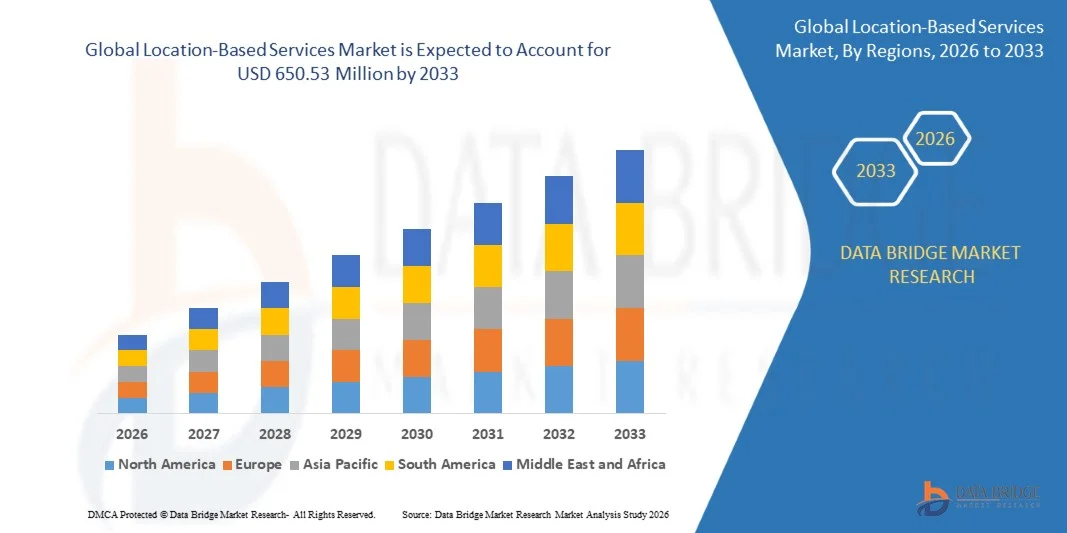
- As per Data Bridge Market Research Analysis the global location-based services market size was valued at USD 120.59 Million in 2025 and is expected to reach USD 650.53 million by 2033, at a CAGR of 23.45% during the forecast period
- The market growth is largely fueled by the rapid expansion of smartphone usage, increasing penetration of high-speed internet, and continuous advancements in GPS, Wi-Fi, and BLE technologies, leading to greater digital transformation across transportation, retail, healthcare, and logistics sectors
- Furthermore, rising enterprise demand for real-time location intelligence, route optimization, proximity marketing, and asset tracking solutions is positioning location-based services as a critical enabler of operational efficiency and personalized customer engagement. These converging factors are accelerating the adoption of advanced geospatial analytics platforms, thereby significantly strengthening the market’s growth trajectory
Market Size & Forecast
- Global Market Value (2025): USD 120.59 Million
- Expected Market Value (2033): USD 650.53 million
- Forecast CAGR (2026–2033): 23.45%
Location-Based Services Market Analysis
- Location-based services, enabling the collection, processing, and analysis of geographic data through connected devices and applications, are becoming essential components of digital ecosystems across commercial and public infrastructure due to their ability to enhance navigation accuracy, improve decision-making, and support context-aware service delivery
- The escalating demand for location-based services is primarily driven by the expansion of smart city initiatives, increasing reliance on on-demand mobility and delivery platforms, and a growing preference among enterprises for data-driven strategies that optimize customer targeting, supply chain visibility, and real-time operational monitoring
- North America dominated the location-based services market with a share of 36.85% in 2025, due to widespread smartphone penetration, strong adoption of advanced analytics, and early integration of geospatial technologies across industries
- Asia-Pacific is expected to be the fastest growing region in the location-based services market during the forecast period due to rapid urbanization, expanding smartphone user base, and growing investments in digital infrastructure across emerging economies
- Outdoor segment dominated the market with a market share of 68.44% in 2025, due to extensive usage of GPS-based navigation, fleet management, and location tracking applications across transportation and logistics sectors. Outdoor location services are widely integrated into navigation apps, ride-hailing platforms, and delivery tracking systems, supporting large-scale commercial operations and consumer mobility solutions
Report Scope and Location-Based Services Market Segmentation
|
Attributes |
Location-Based Services Key Market Insights |
|
Segments Covered |
|
|
Countries Covered |
North America
Europe
Asia-Pacific
Middle East and Africa
South America
|
|
Key Market Players |
|
|
Market Opportunities |
|
|
Value Added Data Infosets |
In addition to the market insights such as market value, growth rate, market segments, geographical coverage, market players, and market scenario, the market report curated by the Data Bridge Market Research team includes in-depth expert analysis, import/export analysis, pricing analysis, production consumption analysis, and pestle analysis. |
What is the Key Trend in the Location-Based Services Market?
“Increasing Integration of AI-Driven Geospatial Analytics”
- A significant trend in the Location-Based Services market is the increasing integration of artificial intelligence with geospatial analytics to deliver predictive insights, contextual recommendations, and advanced spatial intelligence across industries. This integration is strengthening the role of location intelligence in retail, transportation, urban planning, and digital advertising ecosystems
- For instance, Google integrates AI-driven geospatial analytics within Google Maps Platform to enable businesses to analyze mobility patterns, optimize delivery routes, and improve targeted marketing strategies. Such capabilities enhance decision-making accuracy and support dynamic location-based engagement across large consumer bases
- The adoption of AI-powered mapping and spatial data platforms is expanding as enterprises seek real-time traffic forecasting, crowd density monitoring, and behavioral analytics. This is positioning advanced geospatial solutions as critical components for smart city initiatives and infrastructure modernization programs
- Retail and e-commerce companies are leveraging AI-based location analytics to personalize promotions, assess store performance, and optimize supply chain distribution networks. This trend is enabling more precise customer targeting and improving conversion rates through contextual marketing approaches
- Telecommunication providers are incorporating AI-enhanced geospatial insights to improve network planning, coverage optimization, and resource allocation in high-demand urban areas. These applications are strengthening service reliability and enhancing overall user experience across connected environments
- The market is witnessing stronger alignment between AI technologies and spatial data platforms that support automation, predictive modeling, and intelligent mobility solutions. This growing integration of AI-driven geospatial analytics is reinforcing the transition toward data-centric location intelligence frameworks across global industries
Location-Based Services Market Dynamics
Driver
“Rising Adoption of Real-Time Asset Tracking and Mobility Solutions”
- The increasing demand for real-time asset tracking across logistics, transportation, and fleet management sectors is driving the growth of the Location-Based Services market. Organizations are adopting advanced positioning technologies to enhance operational visibility, reduce transit delays, and improve overall asset utilization efficiency
- For instance, Uber relies on real-time GPS-based tracking systems to monitor driver locations, optimize ride allocation, and provide accurate arrival time predictions to users. These capabilities enhance service reliability and demonstrate the practical value of continuous location monitoring in mobility ecosystems
- Logistics providers are implementing geofencing and live tracking solutions to monitor shipment movement, reduce losses, and improve supply chain transparency. This adoption is strengthening operational control and supporting faster response to route deviations or delivery disruptions
- Public transportation authorities are integrating real-time tracking technologies to provide passengers with live updates and improve scheduling efficiency. Such implementations are improving commuter satisfaction and supporting smarter urban mobility systems
- The sustained expansion of mobility services and connected asset ecosystems continues to reinforce this driver. The requirement for precise, continuous, and scalable tracking solutions is positioning location-based technologies as essential enablers of operational optimization and service efficiency
Restraint/Challenge
“Growing Concerns Over Data Privacy and Location Security”
- The Location-Based Services market faces challenges due to rising concerns over user data privacy, unauthorized tracking, and misuse of sensitive location information. Increasing regulatory scrutiny and public awareness are placing pressure on service providers to strengthen data governance frameworks
- For instance, Meta Platforms has faced regulatory investigations in regions such as the European Union regarding the handling of user location data across its social media platforms. Such scrutiny highlights the complexities associated with collecting, storing, and processing precise geolocation information at scale
- Stringent regulations such as the General Data Protection Regulation impose strict compliance requirements related to user consent, transparency, and data minimization. These legal frameworks increase operational costs and require continuous monitoring to avoid penalties
- Consumers are becoming more cautious about sharing real-time location data due to risks associated with cyberattacks and identity exposure. This growing sensitivity is influencing opt-in rates and limiting the extent of granular data collection in certain applications
- The persistent concerns regarding privacy protection and data security continue to restrain broader adoption in sensitive sectors. Addressing these challenges remains critical for sustaining consumer trust and ensuring long-term market expansion in the global Location-Based Services industry
Location-Based Services Market Scope
The market is segmented on the basis of component, location type, application, technology, and industry vertical.
- By Component
On the basis of component, the location-based services market is segmented into hardware and software and services. The software and services segment dominated the market with the largest market revenue share of 61.8% in 2025, driven by the growing need for real-time analytics, cloud-based platforms, and application programming interfaces that enable seamless integration of geospatial data across enterprise systems. Businesses increasingly rely on advanced mapping software, geofencing tools, and analytics dashboards to derive actionable insights from user location data, enhancing operational efficiency and customer engagement. The scalability of cloud deployment models and recurring revenue from subscription-based services further strengthen the dominance of this segment.
The hardware segment is anticipated to witness the fastest growth rate of 20.9% from 2026 to 2033, fueled by the rising deployment of beacons, sensors, and GPS-enabled devices across retail, transportation, and smart city projects. Increasing investments in IoT infrastructure and connected devices are accelerating the demand for robust location-tracking hardware. The expansion of asset tracking systems and in-store navigation infrastructure is expected to further drive growth in this segment.
- By Location Type
On the basis of location type, the market is segmented into indoor and outdoor. The outdoor segment dominated the market with the largest revenue share of 68.44% in 2025, driven by extensive usage of GPS-based navigation, fleet management, and location tracking applications across transportation and logistics sectors. Outdoor location services are widely integrated into navigation apps, ride-hailing platforms, and delivery tracking systems, supporting large-scale commercial operations and consumer mobility solutions. The global reliance on satellite-based positioning systems contributes significantly to this segment’s leadership.
The indoor segment is expected to witness the fastest CAGR of 22.3% from 2026 to 2033, propelled by increasing adoption of indoor positioning systems in malls, airports, hospitals, and manufacturing facilities. The need for precise asset tracking and personalized in-store navigation is encouraging enterprises to deploy beacon and Wi-Fi-based solutions. Growth in smart building initiatives and enhanced customer experience strategies is further supporting the rapid expansion of indoor location services.
- By Application
On the basis of application, the market is segmented into tracking and navigation, marketing and advertising, location-based social networks, location-based health monitoring, and others. The tracking and navigation segment dominated the market with a revenue share of 39.6% in 2025, driven by the widespread use of navigation apps, fleet monitoring systems, and real-time asset tracking platforms. Enterprises leverage these solutions to optimize routes, reduce fuel consumption, and improve delivery timelines, while consumers depend on navigation services for daily commuting and travel planning. Continuous improvements in mapping accuracy and traffic analytics reinforce the dominance of this segment.
The marketing and advertising segment is anticipated to register the fastest growth rate of 23.1% from 2026 to 2033, fueled by the increasing use of geofencing and proximity marketing strategies by retailers and brands. Businesses utilize real-time location insights to deliver personalized promotions and targeted advertisements to customers based on their geographic proximity. The rising emphasis on data-driven marketing and higher return on advertising investment is accelerating adoption in this segment.
- By Technology
On the basis of technology, the market is segmented into BLE beacons, Wi-Fi, GPS/GNSS, and others. The GPS/GNSS segment dominated the market with the largest revenue share of 48.7% in 2025, driven by its extensive use in outdoor navigation, vehicle tracking, and mobile mapping applications. The reliability of satellite-based positioning systems and their global coverage make GPS/GNSS the backbone of large-scale location-based services. Integration with smartphones, wearable devices, and automotive systems further strengthens its leading position.
The BLE beacons segment is projected to witness the fastest CAGR of 24.5% from 2026 to 2033, propelled by increasing deployment in indoor environments for proximity marketing and asset tracking. BLE technology offers low energy consumption and cost-effective installation, making it suitable for retail stores, airports, and event venues. The growing focus on personalized customer engagement and precise indoor navigation is expected to boost demand for beacon-based solutions.
- By Industry Vertical
On the basis of industry vertical, the market is segmented into transportation and logistics, retail, government, tourism and hospitality, manufacturing, healthcare and life sciences, media and entertainment, and others. The transportation and logistics segment dominated the market with the largest revenue share of 28.9% in 2025, driven by the extensive adoption of fleet management, route optimization, and shipment tracking solutions. Companies rely on real-time location data to enhance operational transparency, reduce delays, and improve overall supply chain efficiency. The rapid growth of e-commerce and last-mile delivery services further reinforces the dominance of this vertical.
The healthcare and life sciences segment is expected to witness the fastest growth rate of 22.8% from 2026 to 2033, fueled by increasing adoption of location-based patient monitoring, asset tracking within hospitals, and emergency response optimization systems. Healthcare providers utilize real-time location systems to improve workflow efficiency and patient safety. The expansion of digital health infrastructure and smart hospital initiatives is anticipated to accelerate growth in this segment.
Location-Based Services Market Regional Analysis
- North America dominated the location-based services market with the largest revenue share of 36.85% in 2025, driven by widespread smartphone penetration, strong adoption of advanced analytics, and early integration of geospatial technologies across industries
- Enterprises in the region actively utilize real-time location intelligence to enhance customer engagement, optimize logistics operations, and improve targeted advertising strategies
- The presence of major technology providers, robust digital infrastructure, and high investment in IoT and connected solutions further support market leadership across commercial and government applications
U.S. Location-Based Services Market Insight
The U.S. location-based services market captured the largest revenue share in 2025 within North America, fueled by rapid digital transformation and extensive use of GPS-enabled applications across transportation, retail, and media sectors. Businesses increasingly leverage geofencing, proximity marketing, and fleet tracking platforms to improve operational efficiency and customer personalization. Strong adoption of cloud-based analytics platforms and integration with mobile applications continue to accelerate market expansion across enterprise and consumer segments.
Europe Location-Based Services Market Insight
The Europe location-based services market is projected to expand at a substantial CAGR throughout the forecast period, primarily driven by growing emphasis on data-driven decision-making and increasing demand for smart mobility solutions. Rising urbanization and investments in smart city initiatives are encouraging the deployment of advanced location intelligence systems. Regulatory focus on data privacy and secure digital infrastructure is also shaping the development of compliant and secure LBS platforms across multiple industry verticals.
U.K. Location-Based Services Market Insight
The U.K. location-based services market is anticipated to grow at a noteworthy CAGR during the forecast period, driven by strong adoption of mobile commerce, digital advertising, and connected transportation networks. Organizations are increasingly deploying location analytics to optimize delivery services, enhance retail engagement, and improve urban planning initiatives. The country’s advanced telecommunications infrastructure and growing reliance on app-based consumer services are expected to sustain market growth.
Germany Location-Based Services Market Insight
The Germany location-based services market is expected to expand at a considerable CAGR during the forecast period, fueled by increasing adoption of Industry 4.0 technologies and advanced fleet management systems. Enterprises across manufacturing and logistics sectors are integrating real-time tracking solutions to enhance operational transparency and supply chain efficiency. Germany’s strong focus on technological innovation and smart infrastructure development is further promoting the integration of precise positioning systems in commercial environments.
Asia-Pacific Location-Based Services Market Insight
The Asia-Pacific location-based services market is poised to grow at the fastest CAGR during the forecast period of 2026 to 2033, driven by rapid urbanization, expanding smartphone user base, and growing investments in digital infrastructure across emerging economies. Governments in the region are promoting smart city programs and digital transformation strategies that encourage widespread adoption of location intelligence platforms. Increasing demand for ride-hailing, e-commerce delivery tracking, and mobile-based advertising solutions is significantly accelerating market growth.
Japan Location-Based Services Market Insight
The Japan location-based services market is gaining momentum due to the country’s advanced technological ecosystem and strong demand for precision navigation and indoor positioning solutions. Enterprises are increasingly integrating LBS platforms with IoT devices to enhance smart building management, public transportation systems, and disaster response planning. Continuous innovation in mapping accuracy and mobile connectivity is supporting sustained market development across commercial and public sectors.
China Location-Based Services Market Insight
The China location-based services market accounted for the largest revenue share in Asia-Pacific in 2025, attributed to rapid expansion of digital payment platforms, super apps, and on-demand services. The country’s extensive use of mobile applications for transportation, retail, and food delivery services drives large-scale adoption of real-time location tracking technologies. Strong domestic technology providers and government-backed smart city initiatives continue to reinforce China’s leading position in the regional market.
Location-Based Services Market Share
The location-based services industry is primarily led by well-established companies, including:
- Alphabet Inc. (U.S.)
- Microsoft (U.S.)
- IBM (U.S.)
- Cisco Systems, Inc. (U.S.)
- Hewlett Packard Enterprise Development LP (U.S.)
- Telefonaktiebolaget LM Ericsson (Sweden)
- Maxar Technologies (U.S.)
- ALE International (France)
- ALE USA Inc. (U.S.)
- Qualcomm Technologies Inc. (U.S.)
- Qubercomm (U.S.)
- Esri (U.S.)
- Zebra Technologies Corp. (U.S.)
- Polaris Wireless (U.S.)
- HERE (Germany)
- Comtech Telecommunications Corp. (U.S.)
- Phunware Inc. (U.S.)
- Oracle (U.S.)
- Google LLC (U.S.)
Latest Developments in Global Location-Based Services Market
- In July 2025, Uber Technologies Inc. partnered with Baidu Inc. to deploy driverless vehicles globally, leveraging Baidu’s Apollo Go platform with a track record of over 11 million rides. This collaboration strengthens the integration of autonomous mobility with advanced location-based services by enhancing real-time mapping, route optimization, and high-precision positioning capabilities. The development is expected to accelerate the adoption of AI-powered navigation and expand the commercial deployment of autonomous transport ecosystems worldwide
- In March 2025, Google LLC expanded advanced geospatial AI features within its mapping ecosystem to improve real-time traffic prediction and immersive route visualization. This advancement enhances the accuracy and scalability of location intelligence platforms used across mobility, retail, and logistics sectors. The update reinforces competitive innovation in AI-driven mapping services and supports enterprises seeking predictive and context-aware location insights
- In January 2025, HERE Technologies announced a USD 1 billion collaboration with Amazon Web Services to deliver AI-powered live-streaming maps aimed at automating enterprise workflows. This initiative is designed to provide dynamic, continuously updated mapping data to support fleet management, supply chain optimization, and smart city applications. The partnership significantly strengthens cloud-based location intelligence infrastructure and accelerates enterprise adoption of real-time geospatial analytics
- In January 2025, Qualcomm Incorporated introduced the next evolution of Qualcomm Aware™, enabling enhanced asset observability and location telemetry across logistics, retail, and energy sectors. The solution improves device-level tracking and contextual monitoring through scalable IoT connectivity. This development expands the role of embedded location intelligence in industrial operations and strengthens demand for end-to-end asset tracking solutions
- In January 2025, Mapbox Inc. and Hyundai AutoEver showcased AI-driven 3D navigation integrated with MapGPT voice assistance at CES 2025. The collaboration highlights advancements in immersive in-vehicle navigation and conversational AI interfaces that enhance driver engagement and route accuracy. This innovation supports the evolution of connected vehicle ecosystems and increases demand for intelligent, voice-enabled location-based platforms

- Interactive Data Analysis Dashboard
- Company Analysis Dashboard for high growth potential opportunities
- Research Analyst Access for customization & queries
- Competitor Analysis with Interactive dashboard
- Latest News, Updates & Trend analysis
- Harness the Power of Benchmark Analysis for Comprehensive Competitor Tracking
Data collection and base year analysis are done using data collection modules with large sample sizes. The stage includes obtaining market information or related data through various sources and strategies. It includes examining and planning all the data acquired from the past in advance. It likewise envelops the examination of information inconsistencies seen across different information sources. The market data is analysed and estimated using market statistical and coherent models. Also, market share analysis and key trend analysis are the major success factors in the market report. To know more, please request an analyst call or drop down your inquiry.
The key research methodology used by DBMR research team is data triangulation which involves data mining, analysis of the impact of data variables on the market and primary (industry expert) validation. Data models include Vendor Positioning Grid, Market Time Line Analysis, Market Overview and Guide, Company Positioning Grid, Patent Analysis, Pricing Analysis, Company Market Share Analysis, Standards of Measurement, Global versus Regional and Vendor Share Analysis. To know more about the research methodology, drop in an inquiry to speak to our industry experts.
Data Bridge Market Research is a leader in advanced formative research. We take pride in servicing our existing and new customers with data and analysis that match and suits their goal. The report can be customized to include price trend analysis of target brands understanding the market for additional countries (ask for the list of countries), clinical trial results data, literature review, refurbished market and product base analysis. Market analysis of target competitors can be analyzed from technology-based analysis to market portfolio strategies. We can add as many competitors that you require data about in the format and data style you are looking for. Our team of analysts can also provide you data in crude raw excel files pivot tables (Fact book) or can assist you in creating presentations from the data sets available in the report.













