


Locomotive Lighting Batteries Market Size
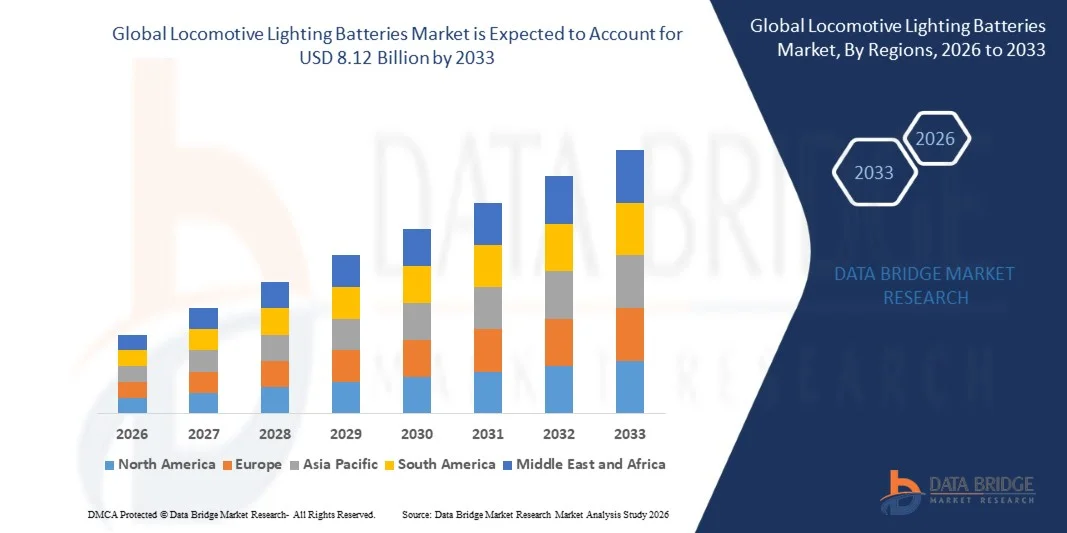
- The global locomotive lighting batteries market size was valued at USD 4.91 billion in 2025 and is expected to reach USD 8.12 billion by 2033, at a CAGR of 6.50% during the forecast period
- The market growth is largely fueled by increasing railway electrification projects and modernization of locomotive fleets across both developed and emerging economies, leading to higher demand for reliable auxiliary power systems such as lighting batteries. Expansion of freight corridors and urban rail networks is further strengthening the need for efficient energy storage solutions in locomotives
- Furthermore, rising focus on passenger safety, operational reliability, and uninterrupted lighting systems during transit is driving adoption of advanced locomotive lighting batteries. For instance, railway operators are increasingly integrating lithium-ion and hybrid battery systems to ensure consistent performance during power fluctuations and non-electrified routes, which is accelerating market growth
Locomotive Lighting Batteries Market Analysis
- Locomotive lighting batteries, used to provide backup and auxiliary power for lighting and essential onboard systems in trains, are becoming critical components of modern railway infrastructure due to their role in ensuring safety, reliability, and uninterrupted operations across freight and passenger transport networks
- The increasing shift toward energy-efficient and low-maintenance battery technologies, along with growing investments in high-speed rail, metro systems, and hybrid locomotives, is significantly boosting demand for advanced locomotive lighting battery solutions across global railway systems
- Asia-Pacific dominated the locomotive lighting batteries market with a share of 47.80% in 2025, due to extensive railway network expansion and strong demand from freight and passenger transportation systems
- North America is expected to be the fastest growing region in the locomotive lighting batteries market during the forecast period due to rising freight rail activity and increasing modernization of locomotive fleets
- Lead-acid battery segment dominated the market with a market share in 2025, due to its established usage in railway applications and cost-effective deployment. These batteries are widely used for locomotive lighting systems because of their proven reliability and ease of maintenance. Rail operators continue to prefer lead-acid systems for legacy fleets and budget-sensitive operations
Report Scope and Locomotive Lighting Batteries Market Segmentation
|
Attributes |
Locomotive Lighting Batteries Key Market Insights |
|
Segments Covered |
|
|
Countries Covered |
North America · U.S. · Canada · Mexico Europe · Germany · France · U.K. · Netherlands · Switzerland · Belgium · Russia · Italy · Spain · Turkey · Rest of Europe Asia-Pacific · China · Japan · India · South Korea · Singapore · Malaysia · Australia · Thailand · Indonesia · Philippines · Rest of Asia-Pacific Middle East and Africa · Saudi Arabia · U.A.E. · South Africa · Egypt · Israel · Rest of Middle East and Africa South America · Brazil · Argentina · Rest of South America |
|
Key Market Players |
· Saft (France) · Lithium Energy Japan (Japan) · Tianjin Lishen Battery Co., Ltd (China) · Shenzhen A&S Power Technology Co., Ltd. (China) · LITHIUMWERKS (U.S.) · BYD Company Ltd. (China) · VARTA AG (Germany) · Dalian CBAK Power Battery Co., Ltd (China) · TOSHIBA CORPORATION (Japan) · CALB USA Inc. (U.S.) · Shenzhen BAK Technology Co., Ltd. (China) · A123 Systems LLC (U.S.) · Amperex Technology Limited (Hong Kong) · XALT Energy (U.S.) |
|
Market Opportunities |
· Expansion of High Speed Rail and Metro Infrastructure Projects · Growing Retrofit and Replacement Demand in Aging Locomotive Fleets |
|
Value Added Data Infosets |
In addition to the market insights such as market value, growth rate, market segments, geographical coverage, market players, and market scenario, the market report curated by the Data Bridge Market Research team includes in-depth expert analysis, import/export analysis, pricing analysis, production consumption analysis, and pestle analysis. |
Locomotive Lighting Batteries Market Trends
“Rising Shift Toward Lithium Ion Based Railway Battery Systems”
- A significant trend in the locomotive lighting batteries market is the increasing shift from conventional lead acid systems to lithium ion based railway battery solutions, driven by the need for higher energy efficiency, longer lifecycle, and reduced maintenance requirements in modern rail operations. This transition is strengthening the adoption of advanced battery technologies across passenger and freight locomotive fleets operated by major rail networks globally
- For instance, Saft has developed lithium ion railway battery systems used in European rail applications to support auxiliary power functions including lighting and onboard safety systems. Such deployments enhance energy efficiency and reduce lifecycle maintenance costs for rail operators while improving operational reliability under variable load conditions
- The growing integration of smart battery management systems in locomotive applications is enabling real time monitoring of battery health, temperature control, and performance optimization. This is improving safety standards and supporting predictive maintenance strategies in railway operations
- Rail operators are increasingly focusing on lightweight battery systems to reduce overall locomotive weight and improve energy utilization efficiency. This is driving innovation in compact and high density energy storage solutions suitable for modern rolling stock
- The expansion of high speed rail and metro networks is accelerating demand for advanced battery technologies that can support frequent charging cycles and high reliability requirements. This is further reinforcing the transition toward lithium ion based systems in railway applications
- The trend is also being supported by global sustainability initiatives aimed at reducing carbon emissions in transportation systems, encouraging railway operators to adopt cleaner and more energy efficient battery technologies for auxiliary applications
Locomotive Lighting Batteries Market Dynamics
Driver
“Rising Railway Electrification and Fleet Modernization Demand”
- The increasing electrification of railway networks and modernization of locomotive fleets is a key driver supporting the growth of the locomotive lighting batteries market, as operators require reliable auxiliary power systems to ensure uninterrupted lighting and onboard safety functions during operations. Expansion of electrified routes and upgrading of aging rolling stock is significantly boosting demand for advanced battery solutions
- For instance, Indian Railways has been actively investing in electrification projects and modernization of its locomotive fleet, which has increased the deployment of advanced battery systems for auxiliary lighting and backup power applications. Such large scale infrastructure upgrades are enhancing the adoption of efficient and durable battery technologies across both passenger and freight segments
- The rising development of metro rail systems and suburban transit networks is further increasing demand for dependable lighting battery systems that ensure passenger safety during station halts and power fluctuations. This is strengthening the role of batteries in supporting uninterrupted rail operations in urban mobility systems
- Freight rail expansion projects in regions such as North America and Asia Pacific are driving the need for robust locomotive battery systems capable of operating under long distance and heavy load conditions. This is contributing to sustained demand for high reliability energy storage solutions
- Continuous government investments in railway infrastructure upgrades are reinforcing long term demand for locomotive lighting batteries, supporting fleet expansion and replacement programs across global rail networks
Restraint/Challenge
“High Initial Cost and Maintenance Complexity of Advanced Battery Systems”
- The locomotive lighting batteries market faces a significant challenge due to the high initial investment required for advanced battery systems, particularly lithium ion based solutions, which increases procurement costs for railway operators. This cost barrier slows down large scale adoption despite the long term efficiency benefits offered by modern technologies
- For instance, companies such as Toshiba Corporation provide advanced railway battery solutions that offer high performance and durability, but their initial deployment costs remain higher compared to traditional lead acid systems. This limits rapid adoption among cost sensitive railway operators in emerging markets
- The maintenance of advanced battery systems requires specialized infrastructure, technical expertise, and monitoring systems, which increases operational complexity for rail operators. This creates additional burden on maintenance teams and infrastructure budgets
- Battery replacement and lifecycle management for high performance systems also involve higher technical requirements, making upgrades and servicing more resource intensive. This further impacts adoption in regions with limited technical capabilities
- Overall, the combination of high upfront costs and complex maintenance requirements continues to restrain faster penetration of advanced locomotive lighting battery technologies across global railway networks
Locomotive Lighting Batteries Market Scope
The market is segmented on the basis of locomotive type, battery type, and sales channel.
- By Locomotive Type
On the basis of locomotive type, the market is segmented into Diesel Locomotive, Electric Locomotive, Diesel Multiple Unit (DMU), Electric Multiple Unit (EMU), Hybrid Locomotive, and Battery Operated Locomotive. The Diesel Locomotive segment dominated the market with the largest revenue share in 2025, supported by its extensive deployment across freight and long-haul rail networks. These locomotives require reliable lighting battery systems to ensure uninterrupted auxiliary power during non-electrified routes. Strong existing rail infrastructure in developing and semi-developed regions continues to sustain demand for diesel-based systems. The durability requirements and longer operational cycles further strengthen adoption of robust battery solutions in this segment.
The Electric Multiple Unit (EMU) segment is anticipated to witness the fastest growth from 2026 to 2033, driven by rapid electrification of railway networks and urban transit expansion. EMUs require efficient lighting batteries to support passenger safety systems during power fluctuations and station halts. Increasing investments in metro and suburban rail systems are accelerating deployment of EMU fleets. The shift toward energy-efficient and low-emission transport systems further supports adoption. Integration of advanced battery technologies in EMUs enhances operational reliability and passenger comfort.
- By Battery Type
On the basis of battery type, the market is segmented into Lead-acid Battery, Lithium Ion, and Nickel Cadmium. The Lead-acid Battery segment dominated the market in 2025 due to its established usage in railway applications and cost-effective deployment. These batteries are widely used for locomotive lighting systems because of their proven reliability and ease of maintenance. Rail operators continue to prefer lead-acid systems for legacy fleets and budget-sensitive operations. Their ability to deliver stable backup power under varying load conditions further supports their dominance. Availability of established supply chains also reinforces their strong market position.
The Lithium-ion Battery segment is expected to witness the fastest CAGR from 2026 to 2033, driven by higher energy density and longer lifecycle performance. These batteries support lightweight design requirements and improved energy efficiency in modern locomotives. Increasing focus on reducing maintenance downtime is encouraging adoption across new-generation rail systems. Rapid advancements in battery management systems are further enhancing operational safety and performance. Growing electrification initiatives and sustainability targets are accelerating transition toward lithium-ion solutions.
- By Sales Channel
On the basis of sales channel, the market is segmented into Original Equipment Manufacturers (OEM) and Aftermarket. The OEM segment dominated the market in 2025 due to large-scale procurement of locomotives integrated with factory-fitted lighting battery systems. Rail operators prefer OEM-supplied systems for compatibility assurance and standardized performance across fleets. Strong partnerships between railway manufacturers and battery suppliers further strengthen OEM dominance. Integration during production ensures optimized system design and reduced installation complexity. Long-term contracts and bulk procurement models continue to support this segment’s leading position.
The Aftermarket segment is projected to witness the fastest growth rate from 2026 to 2033, driven by increasing replacement demand and fleet modernization activities. Aging locomotive fleets require frequent upgrades of lighting battery systems to improve reliability and efficiency. Growing focus on retrofitting older locomotives with advanced battery technologies is boosting aftermarket demand. Maintenance service providers are expanding their offerings to include advanced battery replacement solutions. Rising operational efficiency requirements are further accelerating aftermarket adoption across global rail networks.
Locomotive Lighting Batteries Market Regional Analysis
- Asia-Pacific dominated the locomotive lighting batteries market with the largest revenue share of 47.80% in 2025, driven by extensive railway network expansion and strong demand from freight and passenger transportation systems
- The region benefits from large-scale railway infrastructure development, increasing electrification projects, and strong adoption of modern locomotive systems across emerging economies
- Rapid industrialization, government-backed rail modernization programs, and rising investments in energy-efficient railway components are accelerating market expansion
China Locomotive Lighting Batteries Market Insight
China held the largest share in the Asia-Pacific locomotive lighting batteries market in 2025, supported by its extensive high-speed rail network and large-scale freight operations. The country has a strong railway manufacturing ecosystem that enables high-volume integration of advanced lighting battery systems. Continuous investments in rail electrification and smart transportation infrastructure are further strengthening demand. In addition, robust domestic production capabilities and government-led infrastructure expansion programs are reinforcing China’s leadership in the regional market.
India Locomotive Lighting Batteries Market Insight
India is witnessing the fastest growth in the Asia-Pacific region, driven by rapid railway modernization, electrification initiatives, and increasing freight transport demand. The expansion of metro rail systems and dedicated freight corridors is significantly boosting the adoption of locomotive lighting batteries. Government programs focused on railway infrastructure upgrades are further supporting market growth. In addition, rising investments in domestic rail manufacturing and maintenance activities are accelerating long-term expansion.
Europe Locomotive Lighting Batteries Market Insight
Europe locomotive lighting batteries market is expanding steadily, supported by strong railway electrification, modernization of rolling stock, and high focus on energy-efficient rail transport systems. The region benefits from advanced rail infrastructure, stringent safety standards, and increasing adoption of hybrid and electric locomotives across passenger and freight networks. Continuous investment in sustainable transport solutions and smart railway technologies is further supporting market growth across key countries
Germany Locomotive Lighting Batteries Market Insight
Germany accounted for the largest share in the Europe locomotive lighting batteries market in 2025, driven by its highly developed railway network and strong industrial manufacturing base. The country has extensive use of advanced locomotives in both passenger and freight transport systems. Strong engineering capabilities and focus on energy-efficient rail solutions support continuous adoption of modern battery systems. In addition, integration of smart railway technologies and robust maintenance infrastructure are reinforcing Germany’s leadership position.
U.K. Locomotive Lighting Batteries Market Insight
The U.K. market is supported by ongoing rail infrastructure upgrades, increasing electrification projects, and modernization of aging rolling stock. Growing focus on improving rail safety and operational efficiency is driving demand for reliable locomotive lighting battery systems. Investments in sustainable transport initiatives are further supporting market expansion. In addition, modernization of intercity and commuter rail services is contributing to steady adoption of advanced battery technologies.
North America Locomotive Lighting Batteries Market Insight
North America locomotive lighting batteries market is projected to grow at the fastest CAGR from 2026 to 2033, driven by rising freight rail activity and increasing modernization of locomotive fleets. The region benefits from strong investment in rail infrastructure upgrades, adoption of advanced battery technologies, and growing focus on operational efficiency in transportation networks. Expanding use of hybrid and electric locomotives and increasing emphasis on safety and reliability are further accelerating regional growth.
U.S. Locomotive Lighting Batteries Market Insight
The U.S. accounted for the largest share in the North America locomotive lighting batteries market in 2025, supported by its extensive freight rail network and strong logistics sector. The country has a high dependency on rail-based cargo transport, driving consistent demand for reliable lighting battery systems. Continuous modernization of locomotive fleets and adoption of advanced energy storage technologies are strengthening market growth. In addition, strong presence of rail operators and ongoing infrastructure investments are reinforcing the U.S. leadership in the regional market.
Locomotive Lighting Batteries Market Share
The locomotive lighting batteries industry is primarily led by well-established companies, including:
- Saft (France)
- Lithium Energy Japan (Japan)
- Tianjin Lishen Battery Co., Ltd (China)
- Shenzhen A&S Power Technology Co., Ltd. (China)
- LITHIUMWERKS (U.S.)
- BYD Company Ltd. (China)
- VARTA AG (Germany)
- Dalian CBAK Power Battery Co., Ltd (China)
- TOSHIBA CORPORATION (Japan)
- CALB USA Inc. (U.S.)
- Shenzhen BAK Technology Co., Ltd. (China)
- A123 Systems LLC (U.S.)
- Amperex Technology Limited (Hong Kong)
- XALT Energy (U.S.)
Latest Developments in Global Locomotive Lighting Batteries Market
- In August 2025, Jupiter Electric Mobility’s acquisition of Log9’s railway battery division is strengthening advanced locomotive battery innovation and production capacity in India. This development is enhancing the availability of next-generation battery technologies for locomotive lighting and auxiliary power systems. It is enabling faster commercialization of high-performance battery solutions tailored for rail applications. The acquisition is also improving domestic manufacturing capabilities and reducing reliance on imported components. In addition, it is supporting the transition toward more efficient and durable battery systems for modern rail networks, positively impacting overall market competitiveness
- In May 2025, EnerSys’ acquisition of IBCS in the U.K. is expanding aftermarket service capabilities for locomotive and industrial battery systems. This move is strengthening EnerSys’ position in the rail battery maintenance and replacement ecosystem. It is improving service accessibility for locomotive operators across Europe, particularly in battery refurbishment and lifecycle support. The acquisition is also enhancing operational reliability through better aftermarket coverage and technical expertise. In addition, it is supporting sustained demand for replacement batteries in aging rail fleets, thereby reinforcing market stability and recurring revenue streams
- In March 2025, TKIL Industries and HOPPECKE’s partnership for railway battery production in India is boosting localized supply for locomotive lighting batteries. This collaboration is enabling domestic manufacturing of advanced NiCd and railway-specific battery systems. It is improving supply chain efficiency and reducing dependence on imports for critical rail battery components. The initiative is also supporting customization of battery systems for Indian rail operating conditions. In addition, it is accelerating adoption of reliable and maintenance-efficient battery solutions across metro and locomotive applications, strengthening overall market penetration
- In February 2025, TKIL–HOPPECKE’s planned first deployment of joint railway battery systems is accelerating modernization of Indian locomotive fleets. This deployment is enhancing the integration of advanced battery systems in metro and suburban rail networks. It is improving operational efficiency by ensuring stable lighting and auxiliary power supply in locomotives. The initiative is also demonstrating real-world validation of next-generation rail battery technologies. In addition, it is expected to encourage wider adoption across freight and passenger rail segments, supporting long-term market growth
- In January 2025, HOPPECKE and TKIL’s strategic partnership expansion is strengthening integrated railway battery solutions for emerging rail infrastructure projects. This partnership is improving end-to-end delivery of design, manufacturing, and maintenance services for locomotive batteries. It is enhancing system reliability and lifecycle performance for rail operators. The collaboration is also supporting development of standardized battery systems tailored for diverse locomotive types. In addition, it is reinforcing structured growth in railway electrification and modernization programs, contributing to sustained market expansion

- Interactive Data Analysis Dashboard
- Company Analysis Dashboard for high growth potential opportunities
- Research Analyst Access for customization & queries
- Competitor Analysis with Interactive dashboard
- Latest News, Updates & Trend analysis
- Harness the Power of Benchmark Analysis for Comprehensive Competitor Tracking
Data collection and base year analysis are done using data collection modules with large sample sizes. The stage includes obtaining market information or related data through various sources and strategies. It includes examining and planning all the data acquired from the past in advance. It likewise envelops the examination of information inconsistencies seen across different information sources. The market data is analysed and estimated using market statistical and coherent models. Also, market share analysis and key trend analysis are the major success factors in the market report. To know more, please request an analyst call or drop down your inquiry.
The key research methodology used by DBMR research team is data triangulation which involves data mining, analysis of the impact of data variables on the market and primary (industry expert) validation. Data models include Vendor Positioning Grid, Market Time Line Analysis, Market Overview and Guide, Company Positioning Grid, Patent Analysis, Pricing Analysis, Company Market Share Analysis, Standards of Measurement, Global versus Regional and Vendor Share Analysis. To know more about the research methodology, drop in an inquiry to speak to our industry experts.
Data Bridge Market Research is a leader in advanced formative research. We take pride in servicing our existing and new customers with data and analysis that match and suits their goal. The report can be customized to include price trend analysis of target brands understanding the market for additional countries (ask for the list of countries), clinical trial results data, literature review, refurbished market and product base analysis. Market analysis of target competitors can be analyzed from technology-based analysis to market portfolio strategies. We can add as many competitors that you require data about in the format and data style you are looking for. Our team of analysts can also provide you data in crude raw excel files pivot tables (Fact book) or can assist you in creating presentations from the data sets available in the report.













