


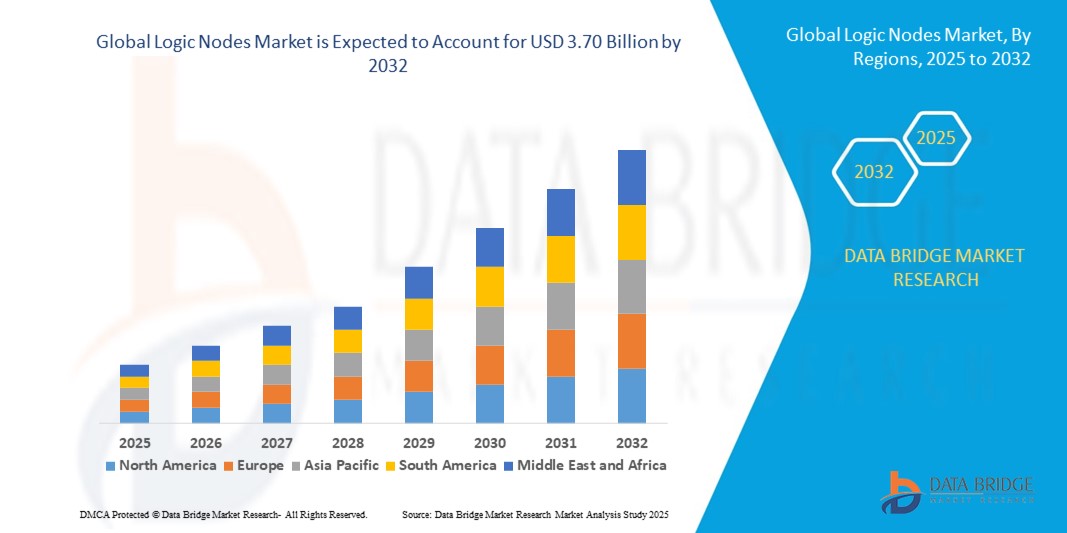
Logic Nodes Market Size
- The global logic nodes market size was valued at USD 2.88 billion in 2024 and is expected to reach USD 3.70 billion by 2032, at a CAGR of 3.20% during the forecast period
- The market growth is primarily driven by increasing demand for high-performance computing in data centers, rising adoption of low-power logic nodes in mobile devices, and growing integration of advanced semiconductor technologies in automotive and industrial applications
- Rising consumer awareness regarding energy-efficient electronics and the need for advanced processing capabilities in AI, IoT, and 5G technologies is further propelling the demand for logic nodes across OEM and aftermarket channels
Logic Nodes Market Analysis
- The logic nodes market is experiencing robust growth due to the rising need for advanced semiconductor solutions to support high-performance computing and energy-efficient applications
- Growing demand from consumer electronics, automotive electronics, and industrial sectors is encouraging manufacturers to innovate with customized and standard logic node solutions to meet diverse performance requirements
- Asia-Pacific dominated the logic nodes market with the largest revenue share of 38.5% in 2024, driven by a well-established semiconductor manufacturing ecosystem and high demand for consumer electronics in countries such as China, Japan, and South Korea
- North America is expected to be the fastest-growing region during the forecast period, fueled by rapid advancements in AI, data centers, and automotive electronics, particularly in the U.S. and Canada
- The high performance computing segment captured the largest market revenue share of 62.3% in 2024, driven by the increasing demand for advanced computing capabilities in AI, machine learning, and data centers. HPC logic nodes, characterized by smaller feature sizes enable faster processing and higher efficiency, making them ideal for applications requiring intensive computational power
Report Scope and Logic Nodes Market Segmentation
|
Attributes |
Logic Nodes Key Market Insights |
|
Segments Covered |
|
|
Countries Covered |
North America
Europe
Asia-Pacific
Middle East and Africa
South America
|
|
Key Market Players |
|
|
Market Opportunities |
|
|
Value Added Data Infosets |
In addition to the insights on market scenarios such as market value, growth rate, segmentation, geographical coverage, and major players, the market reports curated by the Data Bridge Market Research also include in-depth expert analysis, geographically represented company-wise production and capacity, network layouts of distributors and partners, detailed and updated price trend analysis and deficit analysis of supply chain and demand. |
Logic Nodes Market Trends
Increasing Integration of AI and Advanced Semiconductor Technologies
- The global logic nodes market is experiencing a significant trend toward the integration of Artificial Intelligence (AI) and advanced semiconductor technologies
- These technologies enable enhanced processing capabilities, allowing for faster and more efficient data handling in applications such as high-performance computing and low-power devices
- AI-driven logic nodes are being developed to optimize performance for specific tasks, such as real-time data processing in automotive electronics or predictive analytics in industrial automation
- For instances, companies are leveraging AI to design logic nodes that improve energy efficiency in consumer electronics or enhance processing speeds for complex algorithms in data centers
- This trend is increasing the appeal of logic nodes for a wide range of industries, including consumer electronics, automotive, and industrial applications, by delivering tailored, high-efficiency solutions
- Advanced logic nodes can process vast amounts of data, supporting applications such as machine learning, IoT integration, and real-time analytics, driving innovation across multiple sectors
Logic Nodes Market Dynamics
Driver
Rising Demand for High-Performance and Energy-Efficient Electronics
- The growing consumer and industrial demand for high-performance and energy-efficient electronic devices is a key driver for the global logic nodes market
- Logic nodes enable advanced functionalities in consumer electronics, such as smartphones and wearables, and in automotive electronics, including advanced driver-assistance systems (ADAS) and infotainment systems
- Government initiatives and regulations, particularly in Asia-Pacific, are promoting the adoption of advanced semiconductor technologies to support smart infrastructure and green energy solutions
- The proliferation of 5G technology and IoT applications is further accelerating the need for logic nodes, offering faster data processing and lower latency for connected devices
- Manufacturers are increasingly incorporating customized and standard logic nodes as core components in their products to meet evolving market demands and enhance device performance
Restraint/Challenge
High Development Costs and Data Security Concerns
- The high costs associated with the research, development, and manufacturing of advanced logic nodes, particularly for smaller process nodes pose a significant barrier to market growth, especially for smaller players in emerging markets
- Integrating advanced logic nodes into existing systems can be complex and resource-intensive, requiring substantial investment in design and fabrication processes
- Data security and privacy concerns are a major challenge, as logic nodes in connected devices process sensitive data, raising risks of breaches or unauthorized access, particularly in automotive and IoT applications
- The fragmented global regulatory landscape for semiconductor data handling and intellectual property protection complicates compliance for manufacturers operating across multiple regions
- These factors can limit market expansion, particularly in cost-sensitive regions or where concerns about data security and regulatory compliance are heightened
Logic Nodes market Scope
The market is segmented on the basis of performance requirement, application, and type
- By Performance Requirement
On the basis of performance requirement, the global logic nodes market is segmented into High Performance Computing (HPC) and Low Power Applications. The HPC segment captured the largest market revenue share of 62.3% in 2024, driven by the increasing demand for advanced computing capabilities in AI, machine learning, and data centers. HPC logic nodes, characterized by smaller feature sizes enable faster processing and higher efficiency, making them ideal for applications requiring intensive computational power. Their adoption is fueled by the need for real-time data processing in industries such as telecommunications and scientific research, supported by advancements in semiconductor manufacturing.
The Low Power Applications segment is expected to register the fastest growth rate from 2025 to 2032, as the demand for energy-efficient devices surges in consumer electronics and IoT applications. Low-power logic nodes are critical for mobile devices, wearables, and edge computing, where battery life and thermal efficiency are paramount. The shift toward sustainable technologies and regulatory pressures for energy efficiency further drive the adoption of low-power logic nodes, particularly in smart home devices and automotive electronics.
- By Application
On the basis of application, the global logic nodes market is segmented into into Consumer Electronics, Automotive Electronics, Industrial, and Others. The Consumer Electronics segment held the highest revenue share in 2024, propelled by the proliferation of smartphones, tablets, and smart home devices. Logic nodes are integral to enabling high-speed processing, enhanced graphics, and low-power consumption in these devices. The rise in demand for feature-rich, compact electronics and the integration of AI and IoT technologies further solidify this segment’s dominance.
The Automotive Electronics segment is anticipated to grow at the fastest CAGR from 2025 to 2032, driven by the increasing adoption of electric vehicles (EVs), advanced driver-assistance systems (ADAS), and autonomous driving technologies. Logic nodes are essential for real-time data processing, battery management, and in-vehicle networking, supporting the automotive industry’s shift toward electrification and smart mobility. The growing emphasis on safety, connectivity, and energy efficiency in vehicles accelerates the demand for advanced logic nodes in this sector.
- By Type
On the basis of type, the global logic nodes market is segmented into into Customized and Standard logic nodes. The Customized segment accounted for the largest revenue share in 2024, attributed to its tailored solutions for specific applications, such as AI chips and automotive domain controllers. Customized logic nodes, including application-specific integrated circuits (ASICs), offer optimized performance and efficiency, making them the preferred choice for high-volume manufacturers seeking competitive differentiation. Their flexibility in meeting unique design requirements drives their adoption across various industries.
The Standard segment is projected to grow at the fastest rate from 2025 to 2032, as standardized logic nodes provide cost-effective and scalable solutions for a wide range of applications. Standard logic nodes, such as general-purpose logic ICs and programmable logic devices (PLDs), are increasingly adopted in consumer electronics and industrial automation due to their versatility and shorter development cycles. The growing demand for rapid prototyping and flexible hardware solutions in emerging tech segments further supports this segment’s growth.
Logic Nodes Market Regional Analysis
- Asia-Pacific dominated the logic nodes market with the largest revenue share of 38.5% in 2024, driven by a well-established semiconductor manufacturing ecosystem and high demand for consumer electronics in countries such as China, Japan, and South Korea
- Consumers and industries prioritize logic nodes for enhanced performance, power efficiency, and scalability, catering to diverse applications such as consumer electronics, automotive electronics, and industrial automation
- Market growth is propelled by advancements in semiconductor fabrication technologies, including smaller node sizes and high-performance computing (HPC) capabilities, alongside rising adoption in both customized and standard logic node segments
Japan Logic Nodes Market Insight
Japan’s logic nodes market is expected to witness rapid growth due to strong consumer and industry preference for high-quality, technologically advanced logic nodes that enhance performance and efficiency. The presence of major semiconductor manufacturers and the integration of logic nodes in OEM electronics accelerate market penetration. Rising interest in aftermarket customization for consumer and automotive electronics also contributes to growth.
China Logic Nodes Market Insight
China holds the largest share of the Asia-Pacific logic nodes market, propelled by rapid urbanization, rising electronics consumption, and increasing demand for high-performance and low-power solutions. The country’s growing middle class and focus on smart technology support the adoption of advanced logic nodes. Strong domestic semiconductor manufacturing capabilities and competitive pricing enhance market accessibility.
U.S. Logic Nodes Market Insight
The U.S. logic nodes market is expected to witness significant growth, fueled by strong demand for advanced logic nodes in consumer electronics, automotive, and AI-driven applications. Growing consumer awareness of energy efficiency and performance benefits, coupled with the rise of smart vehicle technologies, boosts market growth. The presence of leading semiconductor companies and increasing R&D investments further enhance market penetration.
Europe Logic Nodes Market Insight
The Europe logic nodes market is expected to experience significant growth, supported by a focus on automotive electronics and industrial automation. Consumers and industries prioritize logic nodes that offer high performance and low power consumption. Growth is notable in countries such as Germany and France, where environmental regulations and the push for smart manufacturing drive demand for advanced logic node technologies in both new and retrofit applications.
U.K. Logic Nodes Market Insight
The U.K. market for logic nodes is expected to witness rapid growth, driven by increasing demand for high-performance computing and energy-efficient solutions in urban and industrial settings. Rising interest in smart devices and IoT applications encourages adoption. Evolving regulations promoting energy efficiency and performance standards influence consumer choices, balancing advanced functionality with compliance.
Germany Logic Nodes Market Insight
Germany is expected to witness rapid growth in the logic nodes market, attributed to its advanced semiconductor and automotive manufacturing sectors. German industries prioritize technologically advanced logic nodes that enhance performance and reduce power consumption. The integration of these nodes in premium automotive electronics and industrial applications, along with strong aftermarket demand, supports sustained market growth.
Logic Nodes Market Share
The logic nodes industry is primarily led by well-established companies, including:
- Taiwan Semiconductor Manufacturing Company Limited (Tawian)
- Samsung (South Korea)
- GLOBALFOUNDRIES (U.S.)
- SMIC (China)
- Texas Instruments (U.S.)
- IBM (U.S.)
- Advanced Micro Devices, Inc. (U.S.)
- Picosun Oy (Finland)
- Intel (U.S.)
- United Microelectronics Corporation (Taiwan)
- Qualcomm Incorporated (U.S.)
- Broadcom Inc. (U.S.)
- MediaTek Inc. (Taiwan)
- NXP Semiconductors (Netherlands)
What are the Recent Developments in Global Logic Nodes Market?
- In May 2025, the Government of India approved a joint venture between HCL Group and Foxconn to establish a semiconductor manufacturing facility in Uttar Pradesh, near the upcoming Noida International Airport at Jewar. With an investment of the plant will produce display driver chips for mobile phones, laptops, automobiles, and other devices, supporting a monthly capacity of 20,000 wafers. This initiative is a key milestone under the "India Semiconductor Mission," reflecting the country’s strategic push to build a resilient domestic chip supply chain and align with global trends in securing semiconductor infrastructure
- In March 2025, AMD announced the USD4.9 billion acquisition of ZT Systems, a leading provider of AI and general-purpose compute infrastructure for hyperscale data centers. This strategic move underscores the urgency among major chipmakers to scale their portfolios and meet surging demand for AI infrastructure. By integrating ZT Systems’ rack-level expertise with AMD’s CPUs, GPUs, networking silicon, and open-source ROCm software, the company aims to deliver end-to-end AI solutions optimized for cloud deployment. The acquisition reflects a broader industry trend of M&A activity focused on building comprehensive AI capabilities across the semiconductor landscape
- In February 2025, NXP Semiconductors announced a definitive agreement to acquire Kinara, Inc. for USD 307 million in an all-cash transaction. Kinara specializes in high-performance, energy-efficient neural processing units (NPUs) and AI software tailored for edge applications. This acquisition is part of NXP’s strategy to build a vertically integrated platform that enhances its control over critical layers of the AI-enabled mobility ecosystem. By integrating Kinara’s technology, NXP aims to deliver scalable, secure, and cost-effective AI solutions for industrial and automotive markets, bringing advanced AI capabilities closer to the edge
- In October 2024, MediaTek and TSMC announced their collaboration on MediaTek’s first 3 nm chip, marking a major milestone in advanced semiconductor development. The chip, based on TSMC’s cutting-edge 3 nm process, is expected to enter volume production in 2025 and will power next-generation smartphones, tablets, and intelligent vehicles. This partnership reflects the growing synergy between chip designers and foundries to push the boundaries of logic node technology. TSMC’s 3 nm platform offers up to 18% speed improvement or 32% power reduction compared to its N5 process, enabling high-performance, energy-efficient processors for consumer electronics
- In December 2023, ASML delivered its first High Numerical Aperture (High NA) EUV lithography system, the TWINSCAN EXE:5000, to Intel, marking a major leap in semiconductor manufacturing technology. This next-generation machine enables volume production of sub-2 nm logic nodes by offering a critical dimension (CD) of just 8 nm—nearly 1.7 times smaller than previous EUV systems. The enhanced resolution is achieved by increasing the numerical aperture from 0.33 to 0.55, allowing for 2.9 times higher transistor density. This development is pivotal for advancing geometric chip scaling and powering future AI and high-performance computing applications

- Interactive Data Analysis Dashboard
- Company Analysis Dashboard for high growth potential opportunities
- Research Analyst Access for customization & queries
- Competitor Analysis with Interactive dashboard
- Latest News, Updates & Trend analysis
- Harness the Power of Benchmark Analysis for Comprehensive Competitor Tracking
Global Logic Nodes Market, Supply Chain Analysis and Ecosystem Framework
To support market growth and help clients navigate the impact of geopolitical shifts, DBMR has integrated in-depth supply chain analysis into its Global Logic Nodes Market research reports. This addition empowers clients to respond effectively to global changes affecting their industries. The supply chain analysis section includes detailed insights such as Global Logic Nodes Market consumption and production by country, price trend analysis, the impact of tariffs and geopolitical developments, and import and export trends by country and HSN code. It also highlights major suppliers with data on production capacity and company profiles, as well as key importers and exporters. In addition to research, DBMR offers specialized supply chain consulting services backed by over a decade of experience, providing solutions like supplier discovery, supplier risk assessment, price trend analysis, impact evaluation of inflation and trade route changes, and comprehensive market trend analysis.
Data collection and base year analysis are done using data collection modules with large sample sizes. The stage includes obtaining market information or related data through various sources and strategies. It includes examining and planning all the data acquired from the past in advance. It likewise envelops the examination of information inconsistencies seen across different information sources. The market data is analysed and estimated using market statistical and coherent models. Also, market share analysis and key trend analysis are the major success factors in the market report. To know more, please request an analyst call or drop down your inquiry.
The key research methodology used by DBMR research team is data triangulation which involves data mining, analysis of the impact of data variables on the market and primary (industry expert) validation. Data models include Vendor Positioning Grid, Market Time Line Analysis, Market Overview and Guide, Company Positioning Grid, Patent Analysis, Pricing Analysis, Company Market Share Analysis, Standards of Measurement, Global versus Regional and Vendor Share Analysis. To know more about the research methodology, drop in an inquiry to speak to our industry experts.
Data Bridge Market Research is a leader in advanced formative research. We take pride in servicing our existing and new customers with data and analysis that match and suits their goal. The report can be customized to include price trend analysis of target brands understanding the market for additional countries (ask for the list of countries), clinical trial results data, literature review, refurbished market and product base analysis. Market analysis of target competitors can be analyzed from technology-based analysis to market portfolio strategies. We can add as many competitors that you require data about in the format and data style you are looking for. Our team of analysts can also provide you data in crude raw excel files pivot tables (Fact book) or can assist you in creating presentations from the data sets available in the report.













