


What is the Lotus Leaf Extract Market Size and Growth Rate?
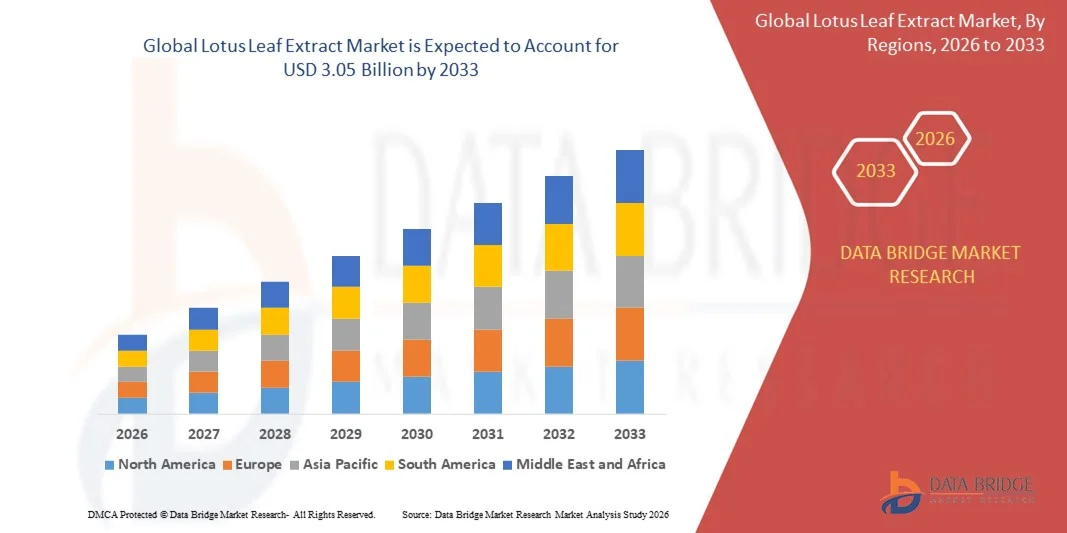
- As per Data Bridge Market Research Analysis the global lotus leaf extract market size was valued at USD 1.00 billion in 2025 and is expected to reach USD 3.05 billion by 2033, at a CAGR of 15.00% during the forecast period
- The market growth is largely fueled by the increasing consumer preference for natural, plant-based supplements and functional ingredients, leading to higher adoption of lotus leaf extract in dietary supplements, functional foods, and beverages
- Furthermore, rising awareness of weight management, cardiovascular health, and overall wellness is positioning lotus leaf extract as a preferred herbal ingredient in health-focused products. These converging factors are accelerating the incorporation of lotus leaf extract into nutraceutical and personal care formulations, thereby significantly boosting the industry's growth
Market Size & Forecast
- Global Market Value (2025): USD 1.00 billion
- Expected Market Value (2033): USD 3.05 billion
- Forecast CAGR (2026–2033): 15.00%
What are the Major Takeaways of Lotus Leaf Extract Market?
- Lotus leaf extract, derived from the leaves of Nelumbo nucifera, is increasingly recognized for its antioxidant properties, ability to support weight management, and potential benefits in cardiovascular and metabolic health. This is driving its integration into dietary supplements, functional beverages, and cosmetic formulations in both domestic and international markets
- The escalating demand for lotus leaf extract is primarily fueled by growing health-consciousness among consumers, the rising popularity of herbal and plant-based ingredients, and increasing preference for natural alternatives over synthetic additives, which is strengthening its adoption across nutraceutical, food, and personal care industries
- Asia-Pacific dominated the lotus leaf extract market with a share of 45.5% in 2025, due to increasing adoption of herbal supplements, growing awareness of natural weight management solutions, and a strong presence of nutraceutical manufacturing hubs
- North America is expected to be the fastest growing region in the lotus leaf extract market during the forecast period due to rising adoption of natural weight management solutions, increasing use of botanical extracts in functional foods and beverages, and growing health-conscious consumer base
- Dietary supplements segment dominated the market with a market share of 50.5% in 2025, due to the rising consumer awareness of herbal supplements for weight management and overall wellness. Lotus leaf extract is highly sought in dietary supplements for its potential benefits in supporting metabolism, regulating blood lipids, and providing antioxidant activity. Health supplement manufacturers prefer incorporating lotus leaf extract due to its natural origin, compatibility with other herbal ingredients, and consumer trust in plant-based formulations
 Report Scope and Lotus Leaf Extract Market Segmentation
|
Attributes |
Lotus Leaf Extract Key Market Insights |
|
Segments Covered |
|
|
Countries Covered |
North America
Europe
Asia-Pacific
Middle East and Africa
South America
|
|
Key Market Players |
|
|
Market Opportunities |
|
|
Value Added Data Infosets |
|
What is the Key Trend in the Lotus Leaf Extract Market?
Rising Consumer Preference for Natural and Plant-Based Supplements
- A significant trend in the lotus leaf extract market is the growing consumer inclination toward natural and plant-based supplements, driven by increased health awareness and preference for herbal alternatives in daily wellness routines. This trend is encouraging manufacturers to develop products with clean-label formulations, emphasizing natural bioactive compounds such as flavonoids and alkaloids
- For instance, NOW Foods and GNC have expanded their herbal supplement portfolios to include lotus leaf-based capsules and teas, catering to health-conscious consumers seeking natural weight management solutions. Such initiatives are supporting broader adoption of lotus leaf extracts in functional foods, beverages, and nutraceuticals
- The rise of e-commerce and online retail platforms has made lotus leaf-based products more accessible, enhancing market penetration in regions with growing health supplement demand. Direct-to-consumer sales are also enabling smaller herbal supplement brands to reach a global audience efficiently
- Lotus leaf extract is increasingly incorporated into functional beverages, teas, and dietary powders due to its perceived metabolism-boosting and antioxidant properties. This integration is positioning lotus leaf extracts as key ingredients in health-focused consumables
- Consumers are showing higher interest in plant-based and organic certifications, which is influencing product formulation and marketing strategies. Manufacturers are responding by sourcing certified organic lotus leaves and highlighting natural processing methods
- The market is witnessing innovation in dosage forms and blends, such as combination herbal teas and capsules with complementary botanical ingredients. This trend is reinforcing the perception of lotus leaf extract as a versatile and health-promoting supplement in the nutraceutical industry
Lotus Leaf Extract Market Dynamics
Driver
Growing Awareness of Weight Management and Wellness Benefits
- The increasing consumer focus on weight management and holistic wellness is driving demand for lotus leaf extract, as it is associated with metabolism support and fat reduction properties. Health-conscious populations are incorporating these supplements into daily routines to complement diet and exercise programs
- For instance, Nature’s Way promotes lotus leaf extract in its herbal supplement range for weight management and cardiovascular wellness. Such initiatives highlight the functional benefits of lotus leaf extract and educate consumers on its applications
- Rising prevalence of obesity and lifestyle-related health concerns is intensifying interest in natural herbal remedies. Lotus leaf extract, with its antioxidant and lipid-regulating properties, is gaining traction among individuals seeking preventive health solutions
- Fitness and wellness centers are increasingly recommending plant-based supplements, including lotus leaf extract, as part of dietary and weight management regimens. This trend is contributing to steady market growth in the nutraceutical and dietary supplement sectors
- Government and health organization campaigns promoting herbal and natural supplements are further boosting awareness of lotus leaf extract benefits. The focus on preventive healthcare is positioning the ingredient as a trusted component in functional nutrition products
Restraint/Challenge
Supply Chain Dependence on High-Quality Lotus Leaf Raw Material
- The lotus leaf extract market faces challenges due to the dependence on sourcing high-quality lotus leaves, which are affected by seasonal cultivation, regional climatic conditions, and agricultural practices. This reliance creates potential supply volatility and cost fluctuations for manufacturers
- For instance, HerbaLife and Swisse rely on sustainable sourcing agreements and controlled farming practices to maintain consistent lotus leaf quality for their herbal supplements. Such dependencies highlight the operational complexities involved in ensuring supply reliability
- Limited availability of standardized and certified raw materials can hinder large-scale production of lotus leaf extracts with consistent bioactive content. Variability in raw leaf quality directly impacts extract efficacy and consumer trust
- The extraction and processing methods require specialized equipment and skilled labor to preserve active compounds, adding complexity and cost to manufacturing operations. Maintaining quality throughout the supply chain is crucial to product effectiveness
- The market continues to face challenges related to raw material traceability, regulatory compliance, and maintaining sustainable agricultural practices. These factors collectively constrain expansion and necessitate strategic sourcing partnerships to ensure long-term growth
How is the Lotus Leaf Extract Market Segmented?
The market is segmented on the basis of type and application.
- By Type
On the basis of type, the Lotus Leaf Extract market is segmented into capsules, tablets, powder, and other forms. The powder segment dominated the market with the largest market revenue share in 2025, driven by its versatility and ease of incorporation into beverages, dietary supplements, and functional foods. Manufacturers and consumers favor powder formulations due to their higher concentration of bioactive compounds and flexibility in dosage customization. The market also witnesses strong demand for lotus leaf powder because it can be easily blended with other herbal or nutraceutical ingredients, enhancing health benefits such as weight management, antioxidant support, and lipid regulation. Powder formulations are widely preferred by both the food and pharmaceutical industries due to their stable shelf life and compatibility with various production processes. The convenience of standardizing dosage and formulation further reinforces its market dominance.
The capsules segment is anticipated to witness the fastest growth rate from 2026 to 2033, fueled by increasing consumer preference for ready-to-consume dietary supplements and functional nutraceuticals. For instance, companies such as NOW Foods and Swanson Health Products are expanding their lotus leaf capsule offerings to meet rising demand for convenient, pre-measured dosages. Capsules provide ease of consumption, precise dosing, and portability, making them particularly appealing to health-conscious individuals and busy professionals. In addition, the growing trend of integrating lotus leaf extract into wellness routines for weight management, metabolism support, and general health is accelerating the adoption of capsule forms. The perceived efficacy and professional endorsement of capsules further contribute to their rapid market growth.
- By Application
On the basis of application, the Lotus Leaf Extract market is segmented into cosmetics, food industry, dietary supplements, pharmaceutical, and other applications. The dietary supplements segment dominated the market with the largest revenue share of 50.5% in 2025, driven by the rising consumer awareness of herbal supplements for weight management and overall wellness. Lotus leaf extract is highly sought in dietary supplements for its potential benefits in supporting metabolism, regulating blood lipids, and providing antioxidant activity. Health supplement manufacturers prefer incorporating lotus leaf extract due to its natural origin, compatibility with other herbal ingredients, and consumer trust in plant-based formulations. The segment benefits from strong distribution networks across health stores, e-commerce platforms, and pharmacy chains, ensuring widespread availability and convenience for consumers. Its inclusion in daily wellness routines reinforces repeat consumption, further solidifying its market dominance.
The cosmetics segment is expected to witness the fastest growth rate from 2026 to 2033, driven by the rising demand for natural and plant-based skincare products. For instance, companies such as Innisfree and The Body Shop have launched lotus leaf-based face masks and creams to capitalize on consumer interest in botanical ingredients with antioxidant and anti-inflammatory properties. Lotus leaf extract offers benefits such as skin hydration, soothing effects, and protection against oxidative stress, making it ideal for cosmetics applications. In addition, the shift toward clean-label, herbal, and sustainable ingredients in personal care is encouraging manufacturers to incorporate lotus leaf extract in serums, lotions, and masks. The growing trend of natural skincare routines among millennials and Gen Z consumers is expected to accelerate adoption further.
Lotus Leaf Extract Market Regional Analysis
- Asia-Pacific dominated the lotus leaf extract market with the largest revenue share of 45.5% in 2025, driven by increasing adoption of herbal supplements, growing awareness of natural weight management solutions, and a strong presence of nutraceutical manufacturing hubs
- The region’s cost-effective cultivation practices, rising investments in plant-based ingredient production, and growing exports of herbal extracts are accelerating market expansion
- The availability of skilled labor, favorable government policies supporting herbal farming, and rapid industrialization across developing economies are contributing to increased consumption of lotus leaf extract in both dietary supplements and functional foods
China Lotus Leaf Extract Market Insight
China held the largest share in the Asia-Pacific lotus leaf extract market in 2025, owing to its status as a global leader in herbal ingredient production and nutraceutical manufacturing. The country's strong agricultural base, government initiatives supporting traditional medicine and herbal cultivation, and extensive export capabilities for botanical extracts are major growth drivers. Demand is further bolstered by increasing investments in functional foods and beverages for both domestic and international markets.
India Lotus Leaf Extract Market Insight
India is witnessing the fastest growth in the Asia-Pacific region, fueled by a rapidly expanding herbal supplement sector, growing consumer preference for natural wellness products, and rising investments in botanical ingredient processing. For instance, Himalaya Wellness has increased production capacities to meet domestic and international demand for lotus leaf extract. In addition, supportive government policies promoting Ayurvedic and herbal product exports, coupled with enhanced R&D in plant-based nutraceuticals, are contributing to robust market expansion.
Europe Lotus Leaf Extract Market Insight
The Europe lotus leaf extract market is expanding steadily, supported by high consumer awareness of plant-based health solutions, growing demand for natural weight management products, and strict quality and safety regulations. The region places strong emphasis on certified organic and standardized extracts, particularly in dietary supplements and functional foods. Increasing use of herbal ingredients in sports nutrition and preventive healthcare products is further enhancing market growth.
Germany Lotus Leaf Extract Market Insight
Germany’s lotus leaf extract market is driven by its leadership in high-quality nutraceutical manufacturing, stringent regulatory compliance, and robust R&D infrastructure. The country has well-established collaborations between academic institutions and herbal ingredient manufacturers, fostering continuous innovation in botanical extracts. Demand is particularly strong for standardized lotus leaf extract used in dietary supplements, functional beverages, and weight management formulations.
U.K. Lotus Leaf Extract Market Insight
The U.K. market is supported by a mature dietary supplement industry, growing consumer interest in plant-based wellness products, and increasing efforts to source herbal ingredients sustainably. With rising focus on clinical research, academic-industry collaborations, and investment in high-purity botanical extracts, the U.K. continues to play a significant role in the European lotus leaf extract market.
North America Lotus Leaf Extract Market Insight
North America is projected to grow at the fastest CAGR from 2026 to 2033, driven by rising adoption of natural weight management solutions, increasing use of botanical extracts in functional foods and beverages, and growing health-conscious consumer base. A strong focus on preventive healthcare, scientific validation of herbal ingredients, and innovation in supplement formulations are boosting demand. In addition, rising interest in plant-based dietary supplements and collaborations between nutraceutical companies and herbal extract manufacturers are supporting market expansion.
U.S. Lotus Leaf Extract Market Insight
The U.S. accounted for the largest share in the North America market in 2025, underpinned by its expansive dietary supplement industry, strong R&D infrastructure, and significant investment in herbal ingredient processing. The country’s focus on clinical efficacy, regulatory compliance, and high-quality extraction methods is encouraging the use of lotus leaf extract in weight management, cardiovascular health, and wellness products. Presence of key players such as NOW Foods and GNC, along with a mature distribution network, further solidify the U.S.'s leading position in the region.
Which are the Top Companies in Lotus Leaf Extract Market?
The lotus leaf extract industry is primarily led by well-established companies, including:
- Nanjing Zelang Medical Technology Co., Ltd. (China)
- Nutra Green Biotechnology Co., Ltd. (China)
- Pioneer Herb (India)
- Evergreen Biosciences, Inc. (U.S.)
- extractspowder.com (U.S.)
- World-Way Biotech Inc. (U.S.)
- Blue Sky Botanics Ltd. (U.K.)
- Indesso (U.S.)
- Synergy Flavors (U.S.)
- Kuber Impex Ltd. (India)
- Haldin (Malaysia)
- Kalsec Inc. (U.S.)
- Dohler GmbH (Germany)
- Nexira (France)
- Green Source Organics (India)
- Organic Herb Inc. (U.S.)
- International (U.S.)
- Futureceuticals (U.S.)
What are Latest Developments in Lotus Leaf Extract Market?
- In early 2025, Herbalife Nutrition Ltd. expanded its lotus leaf extract supplement offerings by rolling out new dietary products aimed at global wellness markets, strengthening its position in weight management and natural health segments. This product expansion has increased consumer accessibility to lotus leaf extract in mainstream nutraceutical retail channels, boosted consumer awareness of botanical wellness benefits, and encouraged competitor brands to diversify their ingredient portfolios to remain competitive
- In 2025, Naturex S.A. significantly expanded production capabilities for lotus leaf extract in response to rising demand from cosmetics and personal care formulators. By scaling up capacity and ensuring consistent extract quality, the company has enabled more beauty and skincare brands to utilize lotus leaf bioactives, accelerating broader ingredient adoption and supporting price stability for high‑purity herbal extracts in the supply chain
- In 2024, ABC Extracts invested in enhancing extraction quality and industry engagement, participating in major botanical ingredient conferences and sharing best practices on production standards. This move has elevated the overall quality benchmark of lotus leaf extract products, encouraged higher process transparency across the industry, and contributed to stronger confidence among manufacturers integrating lotus leaf extract into functional foods and beverages
- In 2024, XYZ Naturals expanded its lotus leaf extract product line into the functional drinks and healthy snack segment, responding to rising consumer interest in plant‑based wellness products. This strategic product diversification has opened new application avenues beyond supplements, driving cross‑industry usage of lotus leaf extract and encouraging other ingredient producers to explore broader end‑use categories
- In 2024, BioLotus Extracts enhanced its global e‑commerce distribution and biotechnological extraction methods, enabling them to supply higher‑purity lotus leaf extracts with improved bioactivity. The company’s move into direct online sales and biotech‑driven quality improvements has widened market reach, increased price competitiveness, and supported demand growth from both small‑scale brands and large formulators seeking consistent, high‑value natural ingredients

- Interactive Data Analysis Dashboard
- Company Analysis Dashboard for high growth potential opportunities
- Research Analyst Access for customization & queries
- Competitor Analysis with Interactive dashboard
- Latest News, Updates & Trend analysis
- Harness the Power of Benchmark Analysis for Comprehensive Competitor Tracking
Global Lotus Leaf Extract Market, Supply Chain Analysis and Ecosystem Framework
To support market growth and help clients navigate the impact of geopolitical shifts, DBMR has integrated in-depth supply chain analysis into its Global Lotus Leaf Extract Market research reports. This addition empowers clients to respond effectively to global changes affecting their industries. The supply chain analysis section includes detailed insights such as Global Lotus Leaf Extract Market consumption and production by country, price trend analysis, the impact of tariffs and geopolitical developments, and import and export trends by country and HSN code. It also highlights major suppliers with data on production capacity and company profiles, as well as key importers and exporters. In addition to research, DBMR offers specialized supply chain consulting services backed by over a decade of experience, providing solutions like supplier discovery, supplier risk assessment, price trend analysis, impact evaluation of inflation and trade route changes, and comprehensive market trend analysis.
Data collection and base year analysis are done using data collection modules with large sample sizes. The stage includes obtaining market information or related data through various sources and strategies. It includes examining and planning all the data acquired from the past in advance. It likewise envelops the examination of information inconsistencies seen across different information sources. The market data is analysed and estimated using market statistical and coherent models. Also, market share analysis and key trend analysis are the major success factors in the market report. To know more, please request an analyst call or drop down your inquiry.
The key research methodology used by DBMR research team is data triangulation which involves data mining, analysis of the impact of data variables on the market and primary (industry expert) validation. Data models include Vendor Positioning Grid, Market Time Line Analysis, Market Overview and Guide, Company Positioning Grid, Patent Analysis, Pricing Analysis, Company Market Share Analysis, Standards of Measurement, Global versus Regional and Vendor Share Analysis. To know more about the research methodology, drop in an inquiry to speak to our industry experts.
Data Bridge Market Research is a leader in advanced formative research. We take pride in servicing our existing and new customers with data and analysis that match and suits their goal. The report can be customized to include price trend analysis of target brands understanding the market for additional countries (ask for the list of countries), clinical trial results data, literature review, refurbished market and product base analysis. Market analysis of target competitors can be analyzed from technology-based analysis to market portfolio strategies. We can add as many competitors that you require data about in the format and data style you are looking for. Our team of analysts can also provide you data in crude raw excel files pivot tables (Fact book) or can assist you in creating presentations from the data sets available in the report.













