


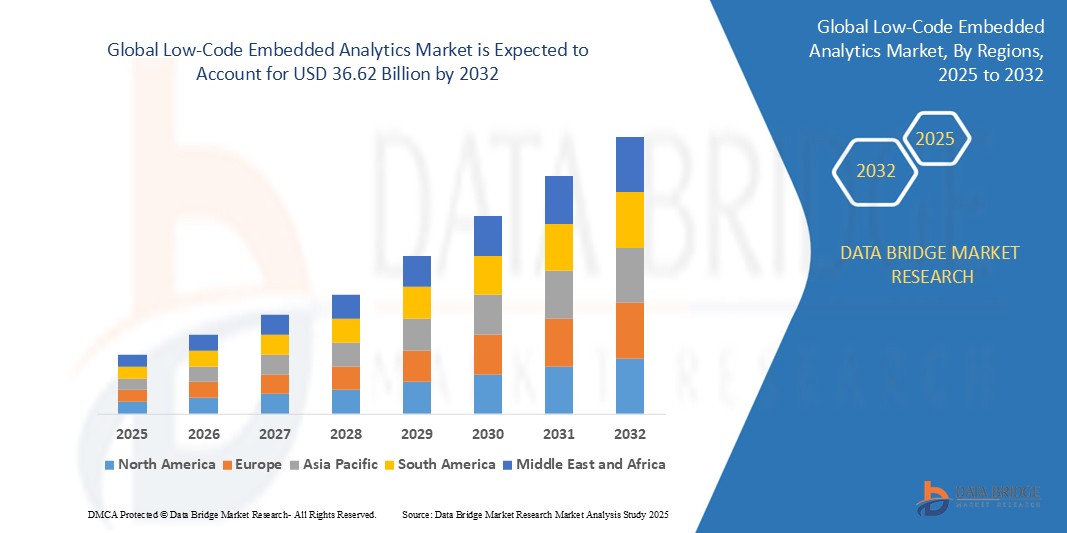
Low-Code Embedded Analytics Market Size
- The global low-code embedded analytics market size was valued at USD 15.44 billion in 2024 and is expected to reach USD 36.62 billion by 2032, at a CAGR of 11.40% during the forecast period
- This growth is driven by factors such as the increasing demand for data-driven decision-making, operational efficiency, and user-friendly analytics solutions.
Low-Code Embedded Analytics Market Analysis
- The low-code embedded analytics market is witnessing rapid adoption as businesses increasingly prefer integrated analytics solutions that require minimal coding expertise. This trend is leading to the emergence of more user-friendly platforms that enable a wider range of professionals to build and utilize analytics tools
- As organizations focus on enhancing operational efficiency, the market for low-code embedded analytics is evolving with more innovative features such as real-time data processing and advanced customization options. These capabilities are driving the adoption of such solutions across various industries
- North America is expected to dominate the low-code embedded analytics market due to advanced digital infrastructure, strong enterprise adoption, and presence of major tech players
- Asia-Pacific is expected to be the fastest growing region in the low-code embedded analytics market during the forecast period due to rapid digitalization, supportive government initiatives, and expanding SME sector
- The cloud-based platforms segment is expected to dominate the low-code embedded analytics market with the largest share of 65.5% in 2025 due to its scalability, lower infrastructure costs, ease of integration, and accessibility for businesses of all sizes, especially small and medium enterprises
Report Scope and Low-Code Embedded Analytics Market Segmentation
|
Attributes |
Low-Code Embedded Analytics Key Market Insights |
|
Segments Covered |
|
|
Countries Covered |
North America
Europe
Asia-Pacific
Middle East and Africa
South America
|
|
Key Market Players |
|
|
Market Opportunities |
|
|
Value Added Data Infosets |
In addition to the market insights such as market value, growth rate, market segments, geographical coverage, market players, and market scenario, the market report curated by the Data Bridge Market Research team includes in-depth expert analysis, import/export analysis, pricing analysis, production consumption analysis, and pestle analysis. |
Low-Code Embedded Analytics Market Trends
“Rising Integration of Artificial Intelligence with Low-Code Embedded Analytics”
- The integration of artificial intelligence with low-code embedded analytics platforms is becoming a significant trend, enhancing the capabilities of these solutions. AI enables the automatic generation of insights from large datasets without the need for manual intervention.
- AI-powered low-code platforms allow businesses to leverage machine learning algorithms for predictive analytics, improving decision-making processes
- For instance, predictive sales analytics can forecast trends, helping companies plan better.
- Many low-code platforms now feature AI tools that automatically suggest insights, allowing users to discover patterns and trends they may not have noticed. This reduces the need for data scientists and empowers non-technical users.
- The combination of AI with low-code analytics is helping organizations with real-time data processing, making it possible to quickly analyze and act on insights as they arise
- For instance, real-time customer behavior analytics can influence marketing campaigns instantly
- As the trend continues, more low-code platforms are expected to incorporate AI-driven analytics, making advanced data processing accessible to a broader audience across industries
Low-Code Embedded Analytics Market Dynamics
Driver
“Growing Need for Data-Driven Business Decisions”
- The demand for faster and more accurate decision-making is driving businesses to adopt low-code embedded analytics, reducing reliance on technical teams and accelerating access to insights
- For instance, a logistics company can monitor delivery performance in real time without waiting for IT to generate reports, and a retail manager can adjust pricing strategies instantly based on live sales data
- Low-code platforms democratize data access by allowing users across departments to generate reports and analyze information directly within the tools they already use
- For instance, A marketing team can create custom campaign performance dashboards within their CRM, and finance staff can track real-time expenses from accounting software
- Seamless integration with everyday business applications improves workflow efficiency and enables faster responses to changing business conditions
- For instance, Sales professionals can view customer insights within their pipeline management tools, and operations teams can receive real-time alerts on inventory changes in their ERP systems
- Real-time data processing and analytics are becoming essential for strategic planning and operational improvement in highly competitive environments
- The rise of cloud computing and digital transformation is accelerating the shift toward low-code analytics as businesses seek scalable and agile solutions
Opportunity
“Expansion into Small and Medium Enterprises”
- Low-code embedded analytics is becoming increasingly attractive to small and medium enterprises due to its affordability and ease of use, breaking the traditional barriers of high cost and technical complexity
- For instance, a local boutique can use these tools to analyze customer preferences, and a small law firm can track case data trends without hiring IT staff
- These platforms empower non-technical business users to generate actionable insights by embedding analytics directly into the applications they use daily
- For instance, An HR manager in a growing company can monitor employee performance within their HR software, and a sales supervisor can track regional sales performance inside their CRM
- SMEs are turning to data to enhance productivity, customer experience, and operational efficiency, and low-code platforms provide a practical way to do this at scale
- For instance, A regional healthcare clinic can assess patient flow to improve appointment scheduling, and a logistics startup can optimize delivery routes using real-time data
- The cloud-based nature of many low-code solutions enables SMEs to access powerful analytics without needing to invest in heavy infrastructure or large IT departments
- As digital transformation becomes more widespread among smaller businesses, the demand for intuitive, scalable analytics tools is growing, creating a vast opportunity for vendors to serve this segment
Restraint/Challenge
“Data Security and Integration Concerns”
- Data security remains a critical challenge in the adoption of low-code embedded analytics, as user-friendly tools may lead to security oversights or misconfigurations by non-technical users
- For instance, a small retail business may accidentally expose customer data due to incorrect access settings, and an education platform might overlook encryption settings when embedding analytics
- Integrating data from diverse sources such as cloud services, on-premise systems, and third-party apps introduces complexity and potential vulnerabilities in the analytics pipeline
- For instance, a healthcare provider must ensure secure connections between their patient database and analytics tools, and a financial firm integrating legacy systems needs robust encryption and compliance controls
- Organizations in regulated industries face heightened risk if low-code platforms do not meet standards such as the General Data Protection Regulation or the Health Insurance Portability and Accountability Act
- The fast-paced development enabled by low-code tools can lead to insufficient security testing, increasing the chances of unintentional data exposure before launch
- Without proper IT governance, businesses risk damaging their reputation and facing legal consequences, making secure integration and vendor reliability crucial for long-term success
Low-Code Embedded Analytics Market Scope
The market is segmented on the basis of deployment, application, industry, and enterprise size.
|
Segmentation |
Sub-Segmentation |
|
By Deployment |
|
|
By Application |
|
|
By Industry |
|
|
By Enterprise Size |
|
In 2025, the cloud-based platforms is projected to dominate the market with a largest share in deployment segment
The cloud-based platforms segment is expected to dominate the low-code embedded analytics market with the largest share of 65.5% in 2025 due to its scalability, lower infrastructure costs, ease of integration, and accessibility for businesses of all sizes, especially small and medium enterprises
The CRM analytics is expected to account for the largest share during the forecast period in application segment
In 2025, the CRM analytics segment is expected to dominate the market with the largest market share of 25-30% due to its ability to provide deep customer insights, enhance personalization strategies, and support data-driven customer relationship management across industries
Low-Code Embedded Analytics Market Regional Analysis
“North America Holds the Largest Share in the Low-Code Embedded Analytics Market”
- North America is the dominating region in the low-code embedded analytics market, holding a significant share of 38.5%, due to its early adoption of digital transformation and strong presence of key market players
- The region's robust technological infrastructure and high demand for data-driven insights across various industries drive the adoption of low-code embedded analytics solutions
- Organizations in sectors such as healthcare, finance, and retail leverage these platforms to streamline operations and enhance decision-making processes
- The presence of major players such as Microsoft, Tableau, and Qlik further strengthens North America's position in the market
“Asia-Pacific is Projected to Register the Highest CAGR in the Low-Code Embedded Analytics Market”
- Asia-Pacific is the fastest-growing region in the low-code embedded analytics market, experiencing rapid digitalization and increasing adoption of cloud-based analytics platforms
- Countries such as Japan and South Korea are also witnessing significant growth, with increasing investments in digital infrastructure and innovation
- The region's vast population and growing demand for data analytics solutions contribute to its rapid market expansion
Low-Code Embedded Analytics Market Share
The market competitive landscape provides details by competitor. Details included are company overview, company financials, revenue generated, market potential, investment in research and development, new market initiatives, global presence, production sites and facilities, production capacities, company strengths and weaknesses, product launch, product width and breadth, application dominance. The above data points provided are only related to the companies' focus related to market.
The Major Market Leaders Operating in the Market Are:
- Looker (Google Cloud) (U.S.)
- Domo, Inc. (U.S.)
- TIBCO Software Inc. (U.S.)
- GoodData Corporation (U.S.)
- Logi Analytics (Insight Software) (U.S.)
- Zoho Analytics (India)
- MicroStrategy Incorporated (U.S.)

- Interactive Data Analysis Dashboard
- Company Analysis Dashboard for high growth potential opportunities
- Research Analyst Access for customization & queries
- Competitor Analysis with Interactive dashboard
- Latest News, Updates & Trend analysis
- Harness the Power of Benchmark Analysis for Comprehensive Competitor Tracking
Data collection and base year analysis are done using data collection modules with large sample sizes. The stage includes obtaining market information or related data through various sources and strategies. It includes examining and planning all the data acquired from the past in advance. It likewise envelops the examination of information inconsistencies seen across different information sources. The market data is analysed and estimated using market statistical and coherent models. Also, market share analysis and key trend analysis are the major success factors in the market report. To know more, please request an analyst call or drop down your inquiry.
The key research methodology used by DBMR research team is data triangulation which involves data mining, analysis of the impact of data variables on the market and primary (industry expert) validation. Data models include Vendor Positioning Grid, Market Time Line Analysis, Market Overview and Guide, Company Positioning Grid, Patent Analysis, Pricing Analysis, Company Market Share Analysis, Standards of Measurement, Global versus Regional and Vendor Share Analysis. To know more about the research methodology, drop in an inquiry to speak to our industry experts.
Data Bridge Market Research is a leader in advanced formative research. We take pride in servicing our existing and new customers with data and analysis that match and suits their goal. The report can be customized to include price trend analysis of target brands understanding the market for additional countries (ask for the list of countries), clinical trial results data, literature review, refurbished market and product base analysis. Market analysis of target competitors can be analyzed from technology-based analysis to market portfolio strategies. We can add as many competitors that you require data about in the format and data style you are looking for. Our team of analysts can also provide you data in crude raw excel files pivot tables (Fact book) or can assist you in creating presentations from the data sets available in the report.













