


What is the Low Cost Airlines Market Size and Growth Rate?
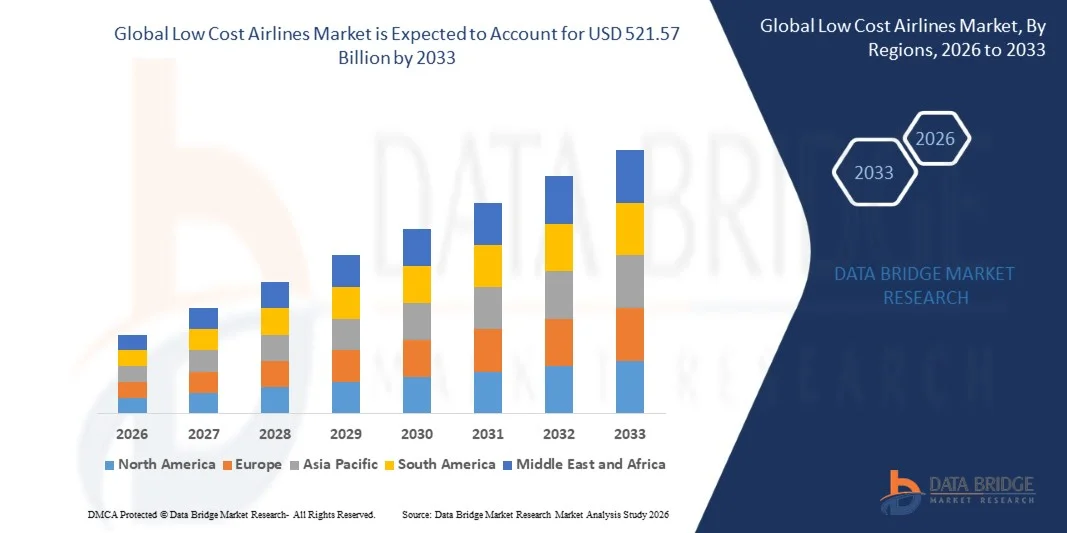
- As per Data Bridge Market Research analysis, the low cost airlines market was valued at USD 301.30 billion in 2025 and is projected to reach USD 521.57 billion by 2033, growing at a CAGR of 7.10% from 2026 to 2033.
- The market is experiencing consistent growth driven by increasing demand for affordable air travel, expanding low-cost carrier networks, rising passenger traffic, and growing adoption of efficient airline operating models. The expansion of domestic and international routes, particularly across emerging aviation markets, is enabling low-cost carriers to reach price-sensitive travelers and underserved destinations.
- The increasing preference for budget-friendly travel, expansion of regional air connectivity, and rapid digitalization of airline booking and customer-service platforms are encouraging low-cost carriers to expand their operations. Airlines are increasingly using narrow-body and fuel-efficient aircraft, direct online booking channels, streamlined airport operations, and ancillary services such as baggage, seat selection, and onboard sales to maintain low base fares while improving revenue generation and operational efficiency.
Market Size & Forecast
- Global Market Value (2025): USD 301.30 Billion
- Expected Market Value (2033): USD 521.57 Billion
- Forecast CAGR (2026–2033): 7.10%
- Leading Region in 2025: North America
- Fastest Growing Region: Asia Pacific
What are the Major Takeaways of the Low Cost Airlines Market?
- North America dominated the low cost airlines market with the largest revenue share of 36% in 2025, supported by strong domestic air connectivity, established low-cost carrier networks, high passenger volumes, and the widespread use of secondary airports that enable carriers to maintain competitive fares and efficient operations
- Asia-Pacific is expected to be the fastest-growing region at a CAGR of 8.7% from 2026 to 2033, fueled by rising middle-class populations, increasing passenger traffic, expanding domestic and regional connectivity, and growing adoption of low-cost carriers across India and Southeast Asia.
- The passenger service segment led the market with a 75% share in 2025, driven by the core focus of low-cost carriers on affordable passenger transportation.
- Cargo service are the fastest-growing service type, projected to register a CAGR of 9.0%, reflecting the surge in e-commerce activity, demand for rapid freight transportation, and growing efforts by airlines to diversify revenue sources
- The leisure travel segment dominated the purpose category with a 55% revenue share in 2025, led by strong demand for affordable vacations, weekend trips, and tourism-related journeys.
- Narrow-body accounted for 86.2% of the market share in 2025, preferred by its strong suitability for short- and medium-haul low-cost airline operations.
- The hybrid low-cost carrier segment is the fastest-growing business model category, with a CAGR of 8.5%, driven by the growing demand for affordable fares combined with selected premium services.
Report Scope and Low Cost Airlines Market Segmentation
|
Attributes |
Low Cost Airlines Key Market Insights |
|
Segments Covered |
|
|
Countries Covered |
North America
Europe
Asia-Pacific
Middle East and Africa
South America
|
|
Key Market Players |
|
|
Market Opportunities |
|
|
Value Added Data Infosets |
In addition to the market insights such as market value, growth rate, market segments, geographical coverage, market players, and market scenario, the market report curated by the Data Bridge Market Research team includes in-depth expert analysis, import/export analysis, pricing analysis, production consumption analysis, and pestle analysis. |
What is the Key Trend in the Low Cost Airlines Market?
- Low-cost carriers are increasingly expanding regional and international route networks to capture growing demand for affordable air travel, particularly across emerging aviation markets where secondary cities are gaining connectivity.
- For instance, in March 2025, AirAsia announced plans to launch more than 30 new routes across Malaysia, Thailand, Indonesia, the Philippines, and Cambodia, targeting stronger domestic and ASEAN connectivity.
- Digital-first booking and mobile travel services are becoming increasingly important as passengers increasingly use smartphones for flight searches, bookings, check-in, payments, and travel-related services.
- Ancillary revenue strategies are expanding as low-cost carriers increasingly monetize baggage, seat selection, priority boarding, onboard services, and other optional products while maintaining attractive base ticket prices.
- For instance, in March 2025, Ryanair reported carrying 200 million passengers during 2024/2025, highlighting the scale of its low-fare model and its ability to combine high passenger volumes with competitive pricing.
- As low-cost carriers continue expanding networks, digitalizing passenger services, and developing additional revenue streams, these trends are expected to strengthen their competitive position and support continued growth in affordable air travel.
What are the Key Drivers of the Low Cost Airlines Market?
- The rising global passenger traffic and demand for affordable air transportation are significantly increasing opportunities for low-cost carriers, particularly as consumers prioritize lower fares for domestic, regional, and leisure travel.
- For instance, IATA reported that global passenger demand increased 4.0% year-on-year in July 2025, while international passenger demand increased 5.3%, demonstrating continued expansion in air travel volumes.
- The expansion of middle-class populations, tourism activity, urbanization, and disposable incomes is encouraging more consumers to travel by air, particularly in developing economies across Asia-Pacific and other emerging markets.
- For instance, in February 2025, IATA reported that global passenger demand increased 10.0% year-on-year in January 2025, while 70% of surveyed travelers preferred paying the lowest fare and customizing additional services, highlighting strong demand for low-cost airline offerings.
- With passenger mobility increasing and demand for cost-efficient transportation remaining strong, low-cost airlines are expected to benefit from expanding route networks, higher aircraft utilization, competitive fares, and growing demand for short-haul and regional air connectivity.
Which Factors are Challenging the Growth of the Low Cost Airlines Market?
- Volatile aviation fuel prices remain a major challenge because fuel represents a substantial operating expense for airlines, while low-cost carriers have limited flexibility to increase fares without affecting their price-sensitive customer base.
- For instance, in January 2024, IndiGo removed its fuel charge on domestic and international routes after a reduction in Aviation Turbine Fuel (ATF) prices, highlighting the sensitivity of low-cost carriers’ fares and operating economics to fuel-price volatility.
- Aircraft delivery delays and aerospace supply-chain constraints can restrict fleet expansion, limit available capacity, and prevent low-cost carriers from opening planned routes or achieving targeted growth.
- · For instance, in April 2025, easyJet announced five new routes from Rome Fiumicino and a 35% increase in capacity at the airport compared with the previous year, demonstrating continued low-cost carrier expansion despite competitive and operational cost pressures
- These fuel-cost pressures, combined with aircraft availability constraints, airport charges, labor expenses, and intense fare competition, can compress airline margins and make it difficult for low-cost carriers to maintain profitability while preserving their low-fare positioning.
How is the Low Cost Airlines Market Segmented?
The low cost airlines market is segmented on the basis of service type, purpose, aircraft type, business model, and distribution channel.
- By Service Type
On the basis of service type, the low cost airlines market is segmented into passenger service and cargo service. The passenger service segment dominated the market with 75% share in 2025, owing to the core focus of low-cost carriers on affordable passenger transportation. Low-cost airlines primarily operate high-frequency domestic, regional, and short-haul passenger routes where cost efficiency and high aircraft utilization are essential. The segment benefits from increasing demand for economical air travel among leisure travelers, visiting friends and relatives, and price-sensitive business passengers. Expansion of route networks and rising passenger volumes are further supporting passenger-service demand.
The cargo service segment is projected to register the fastest growth at 9.0% CAGR during forecast period, supported by increasing e-commerce activity, demand for rapid freight transportation, and growing efforts by airlines to diversify revenue sources. Low-cost carriers can utilize available aircraft belly capacity to transport goods without substantially changing their passenger-focused operating structures. The expansion of cross-border e-commerce is increasing demand for faster connections between production centers and consumer markets. Cargo operations also provide carriers with an additional revenue stream during periods of weaker passenger demand. Growing demand for time-sensitive shipments is creating new opportunities for low-cost airlines with extensive regional networks.
- By Purpose
On the basis of purpose, the low cost airlines market is segmented into leisure travel, visiting friends & relatives (VFR), and business travel. The leisure travel segment dominated the market with 55% share in 2025, driven by strong demand for affordable vacations, weekend trips, and tourism-related journeys. Low-cost airlines are particularly attractive to leisure travelers because their unbundled pricing enables passengers to select only the services they require. The expansion of tourism activity and affordable regional routes is increasing the accessibility of leisure destinations. Promotional fares and digital booking platforms are also encouraging consumers to travel more frequently. Growing disposable incomes and increasing preference for budget travel are further strengthening leisure demand.
The business travel segment is projected to witness the fastest growth at 8.0% CAGR during forecast period, as companies and individual business travelers increasingly consider low-cost carriers for short-haul and regional journeys. Corporate cost-control initiatives are encouraging greater use of lower-fare airline options where journey duration and connectivity are suitable. Low-cost carriers are also introducing flexible fare structures, priority services, and improved digital interfaces to attract business passengers. Expanding connections between commercial centers and secondary cities is increasing the usefulness of low-cost services for corporate travel. The recovery and expansion of regional business activity are expected to provide additional passenger demand. Increasing acceptance of low-cost airlines among corporate travelers is therefore supporting the growth of this segment.
- By Aircraft Type
On the basis of aircraft type, the low cost airlines market is segmented into narrow-body, wide-body, and regional jets. The narrow-body segment dominated the market with an 86.2% share in 2025, supported by its strong suitability for short- and medium-haul low-cost airline operations. Aircraft such as the Boeing 737 and Airbus A320 families provide high passenger capacity while supporting efficient fuel consumption and simplified operations. Standardized narrow-body fleets also reduce complexity in crew training, maintenance, spare-parts management, and airport handling. Their flexibility enables low-cost carriers to operate between major hubs, secondary cities, and emerging regional destinations. Increasing deployment of fuel-efficient next-generation narrow-body aircraft is further supporting segment demand. The combination of operating efficiency and route flexibility continues to make narrow-body aircraft the preferred fleet choice for low-cost carriers.
The wide-body segment is projected to register the fastest growth at a 9.2% CAGR during forecast period, driven by increasing interest in long-haul low-cost operations and expanding opportunities for international passenger and cargo services. Improvements in aircraft fuel efficiency are making selected long-distance low-cost routes increasingly feasible. Wide-body aircraft provide greater passenger capacity and can support high-demand international markets where traffic volumes justify larger aircraft. Their deployment can also help airlines expand into destinations beyond the traditional short-haul low-cost network. Growing international tourism and affordable long-haul travel demand are creating additional opportunities for these aircraft.
- By Business Model
On the basis of business model, the low cost airlines market is segmented into pure low-cost carrier and hybrid low-cost carrier. The pure low-cost carrier segment dominated the market with 70% share in 2025, supported by its highly streamlined operating structure and strong focus on maintaining low base fares. Pure low-cost carriers generally emphasize standardized fleets, high aircraft utilization, rapid turnaround times, and point-to-point route structures. Their simplified service models help reduce operating complexity while allowing airlines to compete aggressively on price. Extensive use of ancillary services can also complement ticket revenue without changing the basic low-cost proposition. Strong consumer acceptance of no-frills travel continues to support the segment across major aviation markets.
The hybrid low-cost carrier segment is projected to register the fastest growth at 8.5% CAGR during forecast period, supported by the growing demand for affordable fares combined with selected premium services. Hybrid carriers can appeal to a broader passenger base by combining low-cost operating principles with features such as flexible fares, enhanced seating, loyalty benefits, and additional connectivity. This model allows airlines to target both leisure passengers and travelers with greater willingness to pay for convenience. Increasing competition between traditional full-service airlines and low-cost carriers is encouraging greater service differentiation. Hybrid models can also provide additional opportunities to improve revenue per passenger through carefully selected optional services.
- By Distribution Channel
On the basis of distribution channel, the low cost airlines market is segmented into online, travel agencies, and direct sales. The online segment dominated the market with a 68.2% share in 2025, supported by widespread use of airline websites, mobile applications, online travel platforms, and digital payment systems. Online channels allow passengers to compare fares, complete bookings, manage reservations, and purchase ancillary services conveniently. Direct digital distribution also enables low-cost carriers to reduce dependence on intermediaries and retain greater control over customer relationships. Mobile applications are increasingly supporting booking, check-in, boarding passes, and additional service purchases.
The travel agencies segment is projected to register the fastest growth at 6.5% CAGR during forecast period, supported by increasing demand for packaged travel, customized itineraries, and assistance with multi-destination bookings. Travel agencies remain particularly relevant for international leisure travelers and customers purchasing flights together with accommodation or other travel services. Agencies can also help travelers compare different low-cost carrier options and manage more complex itineraries. Growing tourism activity in emerging markets is creating additional demand for intermediary travel services. Partnerships between airlines and travel agencies can expand market reach beyond direct digital channels.
Which Region Holds the Largest Share of the Low Cost Airlines Market?
- North America dominated the low cost airlines market with the largest revenue share of 36% in 2025, supported by strong domestic air connectivity, established low-cost carrier networks, high passenger volumes, and the widespread use of secondary airports that enable carriers to maintain competitive fares and efficient operations
- The region also benefits from strong airline infrastructure, high air-travel penetration, extensive secondary-airport connectivity, and well-established low-cost carrier operations, particularly in the U.S. and Canada. The presence of major budget airlines and continued consumer demand for affordable domestic travel further supports the region’s leading position. However, increasing competition from network airlines offering unbundled basic-economy fares is intensifying pressure on low-cost carriers in North America.
U.S. Low Cost Airlines Market Insight
The U.S. low cost airlines market is witnessing strong growth due to rising demand for affordable domestic air travel, extensive low-cost carrier networks, and high passenger traffic across major and secondary cities. The country’s mature aviation infrastructure, along with the strong presence of established budget airlines, is driving demand across leisure, visiting friends and relatives, and business travel segments. In addition, growing consumer preference for competitive airfares, expanding route networks, and increasing adoption of digital booking platforms are supporting low-cost airline expansion across the country.
Asia-Pacific Low Cost Airlines Market Insight
The Asia-Pacific low cost airlines market is expected to witness rapid growth, driven by expanding middle-class populations, increasing air passenger traffic, and rising investments in aviation infrastructure across countries such as India, China, and Southeast Asian economies. Growing demand for affordable domestic and international travel, expanding tourism activity, and increasing low-cost carrier penetration are supporting regional market expansion. In addition, the development of new routes connecting secondary cities and emerging destinations is accelerating low-cost airline adoption across the region.
Japan Low Cost Airlines Market Insight
The Japan low cost airlines market is witnessing consistent growth due to rising demand for economical domestic and regional air travel, increasing tourism activity, and expanding low-cost carrier operations. Airlines are increasingly offering competitive fares and expanding connectivity between major metropolitan areas, regional destinations, and nearby international markets. Moreover, growing passenger preference for budget travel, increasing digital booking adoption, and continued development of regional tourism are further contributing to market growth.
China Low Cost Airlines Market Insight
The China low cost airlines market is growing rapidly, driven by expanding domestic passenger traffic, increasing tourism activity, and rising demand for affordable air transportation. Growing connectivity between major cities and developing regional destinations is creating additional opportunities for low-cost carriers to expand their networks. In addition, increasing consumer preference for budget-friendly travel, improving airport infrastructure, and rapid adoption of digital airline booking platforms are supporting market development and positioning China as an important growth market for low-cost airlines.
U.K. Low Cost Airlines Market Insight
The U.K. low cost airlines market is experiencing steady growth, supported by strong demand for affordable domestic and European travel, extensive short-haul route networks, and established low-cost carrier operations. Increasing passenger preference for competitive fares and flexible travel options is contributing to sustained demand across leisure and visiting friends and relatives travel. Furthermore, expanding international connectivity, digital ticket booking, and continued growth in tourism activity are supporting low-cost airline operations and strengthening the U.K.'s position as a major European budget aviation market.
Germany Low Cost Airlines Market Insight
The Germany low cost airlines market is expanding steadily due to increasing demand for affordable European travel, strong tourism activity, and extensive connectivity with major regional destinations. Low-cost carriers are increasingly serving price-sensitive leisure travelers through competitive fares, flexible booking options, and expanded short-haul networks. Continuous adoption of online booking platforms, growing passenger mobility, and demand for cost-efficient international travel are further supporting market growth in Germany.
Which are the Top Companies in Low Cost Airlines Market?
The low cost airlines industry is primarily led by well-established companies, including:
- Ryanair DAC (Ireland)
- easyJet plc (U.K.)
- Southwest Airlines Co. (U.S.)
- Frontier Airlines, Inc. (U.S.)
- Spirit Airlines, Inc. (U.S.)
- JetBlue Airways (U.S.)
- Allegiant Travel Company (U.S.)
- Wizz Air Hungary Airlines Ltd. (Hungary)
- Norwegian Air Shuttle ASA (Norway)
- Transavia Airlines C.V. (Netherlands)
- Vueling Airlines, S.A. (Spain)
- AirAsia Group Berhad (Malaysia)
- InterGlobe Aviation Ltd (India)
- Cebu Air, Inc. (Philippines)
- Scoot Tigerair Pte Ltd (Singapore)
- Peach Aviation Limited (Japan)
- Air Arabia PJSC (U.A.E.)
- Dubai Aviation Corporation (U.A.E.)
- flynas (Saudi Arabia)
What are Latest Developments in Low Cost Airlines Market?
- In March 2025, Ryanair announced four new routes and a record Summer 2025 schedule for Budapest, expanding its network to 68 routes with more than 640 weekly flights. The airline also added 10 based aircraft at Budapest, representing a reported USD 1 billion investment, while targeting approximately 5.6 million passengers annually. The expansion included new connections to Castellón, Katowice, Liverpool, and Toulouse, strengthening Budapest as a major low-cost aviation hub. The development demonstrates continued route expansion and fleet investment by low-cost carriers to capture demand for affordable regional travel.
- In October 2024, AirAsia announced the expansion of Kuala Lumpur International Airport as a global low-cost carrier megahub, including five new routes planned for the fourth quarter. AirAsia stated that KLIA offered more than 14,500 possible low-cost connections across 137 destinations, while the airline operated up to 236 daily departures from the airport. The expansion was designed to strengthen connectivity across Asia and support the airline’s growth into emerging destinations. The development highlights the increasing importance of strategic megahubs and extensive regional networks to low-cost airline expansion.
- In December 2023, Ryanair announced a USD 1.4 billion investment in Morocco for its 2024 operations, including 35 new routes and a new base in Tangier. The expansion introduced low-cost domestic services on 11 Moroccan routes for the first time and added two aircraft at the new Tangier base. Ryanair planned more than 1,100 weekly flights across 175 routes in its record Moroccan summer schedule. The move significantly expanded low-cost connectivity within Morocco while strengthening links between the country and European destinations.
- In July 2022, easyJet announced 21 new routes and additional frequencies from Lisbon after receiving 18 new daily airport slots. The expansion included three additional Airbus A321neo aircraft based in Lisbon and more than half a million additional seats for the winter season. The airline planned to increase its Lisbon network to 32 routes serving 10 countries and become the second-largest airline at the airport by capacity. This development demonstrated how access to airport slots and additional aircraft can enable low-cost carriers to rapidly expand their route networks.
- In June 2021, easyJet announced 12 new domestic routes across the U.K. to support the recovery of domestic air travel and reconnect regional markets. The expansion included the airline’s first Belfast City–London Gatwick service and new or resumed connections involving East Midlands and Leeds Bradford airports. easyJet also added 60,000 seats to existing routes from Belfast to Birmingham, Manchester, Edinburgh, and Glasgow. The development demonstrated how low-cost airlines were rapidly redeploying capacity toward domestic and regional routes during the post-pandemic recovery period.

- Interactive Data Analysis Dashboard
- Company Analysis Dashboard for high growth potential opportunities
- Research Analyst Access for customization & queries
- Competitor Analysis with Interactive dashboard
- Latest News, Updates & Trend analysis
- Harness the Power of Benchmark Analysis for Comprehensive Competitor Tracking
Data collection and base year analysis are done using data collection modules with large sample sizes. The stage includes obtaining market information or related data through various sources and strategies. It includes examining and planning all the data acquired from the past in advance. It likewise envelops the examination of information inconsistencies seen across different information sources. The market data is analysed and estimated using market statistical and coherent models. Also, market share analysis and key trend analysis are the major success factors in the market report. To know more, please request an analyst call or drop down your inquiry.
The key research methodology used by DBMR research team is data triangulation which involves data mining, analysis of the impact of data variables on the market and primary (industry expert) validation. Data models include Vendor Positioning Grid, Market Time Line Analysis, Market Overview and Guide, Company Positioning Grid, Patent Analysis, Pricing Analysis, Company Market Share Analysis, Standards of Measurement, Global versus Regional and Vendor Share Analysis. To know more about the research methodology, drop in an inquiry to speak to our industry experts.
Data Bridge Market Research is a leader in advanced formative research. We take pride in servicing our existing and new customers with data and analysis that match and suits their goal. The report can be customized to include price trend analysis of target brands understanding the market for additional countries (ask for the list of countries), clinical trial results data, literature review, refurbished market and product base analysis. Market analysis of target competitors can be analyzed from technology-based analysis to market portfolio strategies. We can add as many competitors that you require data about in the format and data style you are looking for. Our team of analysts can also provide you data in crude raw excel files pivot tables (Fact book) or can assist you in creating presentations from the data sets available in the report.













