


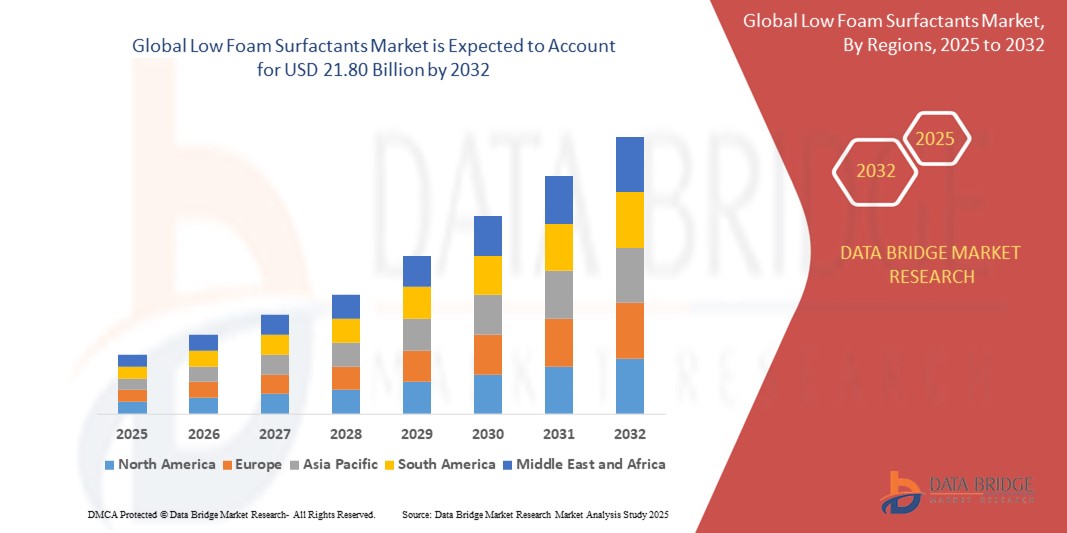
Low Foam Surfactants Market Size
- The global low foam surfactants market size was valued at USD 14.98 billion in 2024 and is expected to reach USD 21.80 billion by 2032, at a CAGR of 4.8% during the forecast period
- The market growth is primarily driven by the increasing demand for sustainable and bio-based surfactants, heightened consumer awareness of hygiene, and the expanding use of low foam surfactants in various industries such as home and personal care, agrochemicals, and industrial cleaning
- The rising preference for eco-friendly and biodegradable cleaning solutions, coupled with stringent environmental regulations, is accelerating the adoption of low foam surfactants as a sustainable alternative to conventional surfactants
Low Foam Surfactants Market Analysis
- Low foam surfactants, characterized by their ability to minimize foam formation while maintaining excellent detergency, wetting, and emulsification properties, are essential in applications where excessive foam can interfere with processes, such as industrial cleaning, dishwashing, and agrochemical formulations
- The growing demand for low foam surfactants is fueled by the widespread adoption of sustainable cleaning solutions, increased hygiene awareness post-COVID-19, and the need for efficient, eco-friendly products in industries such as home care, agriculture, and textiles
- North America dominated the low foam surfactants market with the largest revenue share of 44.8% in 2024, driven by stringent environmental regulations, a strong industrial base, and high consumer demand for eco-friendly cleaning products
- Asia-Pacific is expected to be the fastest-growing region in the low foam surfactants market during the forecast period, with a projected CAGR of 5.9%, attributed to rapid urbanization, rising disposable incomes, and increasing demand for personal care and home care products in countries such as China and India
- The non-ionic segment dominated the largest market revenue share of 48.5% in 2024, primarily driven by its versatility and broad range of applications in household detergents, hard surface cleaners, and industrial processes
Report Scope and Low Foam Surfactants Market Segmentation
|
Attributes |
Low Foam Surfactants Key Market Insights |
|
Segments Covered |
|
|
Countries Covered |
North America
Europe
Asia-Pacific
Middle East and Africa
South America
|
|
Key Market Players |
|
|
Market Opportunities |
|
|
Value Added Data Infosets |
In addition to the insights on market scenarios such as market value, growth rate, segmentation, geographical coverage, and major players, the market reports curated by the Data Bridge Market Research also include import export analysis, production capacity overview, production consumption analysis, price trend analysis, climate change scenario, supply chain analysis, value chain analysis, raw material/consumables overview, vendor selection criteria, PESTLE Analysis, Porter Analysis, and regulatory framework |
Low Foam Surfactants Market Trends
“Increasing Integration of AI and Big Data Analytics”
- The global low foam surfactants market is experiencing a notable trend toward the integration of Artificial Intelligence (AI) and Big Data analytics
- These technologies enable advanced formulation optimization, predictive manufacturing, and real-time quality control by analyzing vast datasets related to surfactant performance and application efficiency
- AI-powered solutions are being developed to predict optimal surfactant formulations for specific applications, such as reducing foam in industrial cleaning processes or improving stability in personal care products
- For instances, companies are leveraging AI to analyze production data and consumer preferences to create customized, eco-friendly low foam surfactants tailored to specific industrial or household needs
- This trend enhances the efficiency and sustainability of low foam surfactants, making them more appealing to industries such as home care, industrial cleaning, and agriculture
- Big Data analytics helps manufacturers monitor supply chain dynamics, predict demand fluctuations, and optimize production processes, reducing waste and improving cost-effectiveness
Low Foam Surfactants Market Dynamics
Driver
“Rising Demand for Sustainable and High-Performance Cleaning Solutions”
- Increasing consumer and industrial demand for eco-friendly and high-performance cleaning products, such as biodegradable detergents and industrial cleaners, is a key driver for the global low foam surfactants market
- Low foam surfactants enhance cleaning efficiency by minimizing foam interference in processes such as automatic dishwashing, industrial degreasing, and textile processing
- Stringent environmental regulations, particularly in North America and Europe, are promoting the adoption of bio-based and sustainable low foam surfactants
- The proliferation of advanced manufacturing technologies and the expansion of industries such as agriculture, food processing, and personal care in the Asia-Pacific region are further boosting the demand for low foam surfactants
- Manufacturers are increasingly incorporating low foam surfactants as standard components in formulations to meet regulatory standards and consumer expectations for sustainable products
Restraint/Challenge
“High Production Costs and Regulatory Compliance”
- The high initial costs associated with developing and producing bio-based or specialized low foam surfactants can be a significant barrier, particularly for small and medium-sized enterprises in emerging markets
- Formulating low foam surfactants with consistent performance across diverse applications, such as hard water conditions or extreme temperatures, can be complex and resource-intensive
- Data security and environmental compliance concerns also pose challenges, as the production and application of surfactants involve handling sensitive chemical data and adhering to strict environmental regulations
- The varying regulatory frameworks across regions, such as differences in chemical safety standards between North America and Asia-Pacific, create operational complexities for global manufacturers
- These factors may deter adoption in cost-sensitive markets or regions with stringent regulatory oversight, potentially limiting market growth
Low Foam Surfactants market Scope
The market is segmented on the basis of type and application.
- By Type
On the basis of type, the global low foam surfactants market is segmented into non-ionic, amphoteric, and cationic. The non-ionic segment dominated the largest market revenue share of 48.5% in 2024, primarily driven by its versatility and broad range of applications in household detergents, hard surface cleaners, and industrial processes. Their ability to function across various temperatures without compromising performance further contributes to their dominance.
The amphoteric segment is expected to witness the fastest growth rate from 2025 to 2032, driven by their mildness, lower irritation potential, and growing adoption in personal care products such as shampoos, body washes, and facial cleansers, as well as in applications requiring mild detergency and conditioning properties.
- By Application
On the basis of application, the global low foam surfactants market is segmented into home & personal care, agrochemicals, oil field chemicals, textiles, pulp & paper, metal cleaning, food & dairy process cleaners, detergents & cleaning agents, and others. The home & personal care segment is expected to hold the largest market revenue share of 32% in 2024. This is driven by the increasing consumer awareness regarding hygiene and changing lifestyles, leading to higher demand for low foam surfactants in laundry detergents, dishwashing liquids, fabric softeners, and various personal care products.
The detergents & cleaning agents segment is anticipated to experience robust growth from 2025 to 2032. This is fueled by the rising demand for effective cleaning solutions in industrial and institutional settings, where minimal foam is crucial for efficient operations in automated cleaning systems such as spray washers and commercial dishwashers.
Low Foam Surfactants Market Regional Analysis
- North America dominated the low foam surfactants market with the largest revenue share of 44.8% in 2024, driven by stringent environmental regulations, a strong industrial base, and high consumer demand for eco-friendly cleaning products
- Consumers prioritize low foam surfactants for their ability to enhance cleaning efficiency, reduce environmental impact, and comply with stringent regulations, particularly in personal care and industrial applications
- Growth is supported by advancements in surfactant technology, including bio-based and non-ionic formulations, alongside rising adoption in both consumer and industrial segments
U.S. Low Foam Surfactants Market Insight
The U.S. low foam surfactants market captured the largest revenue share of 87.9% in 2024 within North America, fueled by strong demand in personal care, home care, and industrial cleaning sectors. Growing consumer awareness of sustainability and the benefits of bio-based surfactants drives market expansion. The trend towards eco-friendly formulations and increasing regulations promoting greener products further boost market growth. The integration of low foam surfactants in premium cleaning products complements both industrial and consumer applications, creating a robust market ecosystem.
Europe Low Foam Surfactants Market Insigh
The European low foam surfactants market is expected to witness significant growth, supported by regulatory emphasis on sustainability and environmental safety. Consumers seek surfactants that offer effective cleaning with minimal ecological impact. The growth is prominent in both industrial and consumer applications, with countries such as Germany and France showing significant uptake due to rising environmental concerns and advanced manufacturing capabilities.
U.K. Low Foam Surfactants Market Insight
The U.K. market for low foam surfactants is expected to witness rapid growth, driven by demand for sustainable cleaning solutions and eco-friendly personal care products in urban and suburban settings. Increased interest in green formulations and rising awareness of environmental benefits encourage adoption. Evolving regulations promoting sustainable products influence consumer choices, balancing performance with compliance.
Germany Low Foam Surfactants Market Insight
Germany is expected to witness rapid growth in the low foam surfactants market, attributed to its advanced industrial sector and high consumer focus on sustainability and efficiency. German consumers prefer technologically advanced surfactants that reduce environmental impact and enhance cleaning performance. The integration of these surfactants in premium personal care and industrial products supports sustained market growth.
Asia-Pacific Low Foam Surfactants Market Insight
The Asia-Pacific region is expected to witness the fastest growth rate, driven by expanding industrial production and rising disposable incomes in countries such as China, India, and Japan. Increasing awareness of sustainability, hygiene, and environmental benefits is boosting demand. Government initiatives promoting eco-friendly products and industrial efficiency further encourage the use of advanced low foam surfactants.
Japan Low Foam Surfactants Market Insight
Japan’s low foam surfactants market is expected to witness rapid growth due to strong consumer preference for high-quality, technologically advanced surfactants that enhance cleaning efficiency and sustainability. The presence of major manufacturers and the integration of low foam surfactants in consumer and industrial products accelerate market penetration. Rising interest in green formulations also contributes to growth.
China Low Foam Surfactants Market Insight
China holds the largest share of the Asia-Pacific low foam surfactants market, propelled by rapid industrialization, rising consumer demand for personal care and home care products, and increasing focus on sustainability. The country’s growing middle class and emphasis on eco-friendly solutions support the adoption of advanced low foam surfactants. Strong domestic manufacturing capabilities and competitive pricing enhance market accessibility.
Low Foam Surfactants Market Share
The low foam surfactants industry is primarily led by well-established companies, including:
- BASF SE (Germany)
- Clariant AG (Switzerland)
- Evonik Industries AG (Germany)
- Croda International Plc (U.K.)
- Stepan Company (U.S.)
- Huntsman International LLC (U.S.)
- Kao Corporation (Japan)
- Galaxy Surfactants Ltd (India)
- Dow Chemical Company (U.S.)
- Solvay (Belgium)
- Akzo Nobel N.V. (Netherlands)
- Air Products and Chemicals, Inc (U.S.)
- Nufarm (Australia)
- Colonial Chemical (U.S.)
- Innospec (U.S.)
- Nouryon (Netherlands)
- The Lubrizol Corporation (U.S.)
What are the Recent Developments in Global Low Foam Surfactants Market?
- In May 2024, Evonik officially inaugurated the world’s first industrial-scale rhamnolipid biosurfactant plant in Slovenská Ľupča, Slovakia. This state-of-the-art facility uses a fermentation-based process to produce biodegradable surfactants from renewable corn feedstocks, offering a sustainable alternative to conventional surfactants derived from fossil fuels or tropical oils. The rhamnolipids are non-toxic, high-performing, and suitable for a wide range of applications—from personal care and cleaning to agriculture and animal nutrition. This milestone underscores Evonik’s broader strategy to invest over €3 billion in Next Generation Solutions by 2030, driving sustainability across industries through biotechnology and circular systems
- In April 2024, Nouryon launched Structure® M3, a biodegradable co-surfactant designed to elevate personal care formulations by improving mildness, cleansing, and foaming performance. Introduced at the in-cosmetics Global event in Paris, this polysaccharide-based innovation significantly reduces irritation from conventional surfactant systems. Available as a waterless, free-flowing powder with 85% natural origin content, Structure M3 is cold-water processable and compatible with both sulfate and sulfate-free systems—making it ideal for shampoos, facial cleansers, and body washes. It reflects Nouryon’s commitment to sustainable, high-performance ingredients that align with consumer demand for clean-label, eco-friendly products
- In January 2024, Evonik Industries AG received the prestigious European Responsible Care® Award in the “Safe and Sustainable Chemicals” category from the European Chemical Industry Council (Cefic). The recognition highlights Evonik’s groundbreaking achievement in developing the first IP-protected, industrial-scale biotechnological process for producing biodegradable rhamnolipid biosurfactants. These glycolipids, derived from renewable feedstocks via fermentation, offer a sustainable alternative to conventional surfactants and are used in personal care, home care, and agricultural applications. The award also celebrates Evonik’s collaborative innovation model and its commitment to driving the transition toward eco-friendly, high-performance chemical solutions
- In October 2023, Sasol Chemicals introduced CARINEX and LIVINEX, two biosurfactant brands aimed at advancing sustainable solutions in personal care and home cleaning markets. The first offerings under these brands—CARINEX SL and LIVINEX SL—are derived from fermentation-based sophorolipids, developed in partnership with Holiferm Ltd. These biodegradable, palm-free surfactants are produced using natural oils and sugars, offering a significantly lower carbon footprint without compromising performance. CARINEX targets applications like shampoos and conditioners, while LIVINEX is tailored for detergents, degreasers, and industrial cleaning products
- In October 2023, Ashland launched the Easy-Wet™ portfolio—an innovative line of silicone-free substrate wetting agents designed for premium industrial coatings. These oligomeric alkyl polyether polyols deliver exceptional substrate wetting, very low foam stabilization, and defect-free film formation, even in waterborne systems. The Easy-Wet™ agents are biodegradable, VOC-compliant, and tailored for applications across wood, metal, automotive, plastic coatings, and printing inks. With grades like Easy-Wet™ 200, 210, and 300, the platform gives formulators precise control over performance and sustainability—without relying on silicones or fluorocarbons

- Interactive Data Analysis Dashboard
- Company Analysis Dashboard for high growth potential opportunities
- Research Analyst Access for customization & queries
- Competitor Analysis with Interactive dashboard
- Latest News, Updates & Trend analysis
- Harness the Power of Benchmark Analysis for Comprehensive Competitor Tracking
Global Low Foam Surfactants Market, Supply Chain Analysis and Ecosystem Framework
To support market growth and help clients navigate the impact of geopolitical shifts, DBMR has integrated in-depth supply chain analysis into its Global Low Foam Surfactants Market research reports. This addition empowers clients to respond effectively to global changes affecting their industries. The supply chain analysis section includes detailed insights such as Global Low Foam Surfactants Market consumption and production by country, price trend analysis, the impact of tariffs and geopolitical developments, and import and export trends by country and HSN code. It also highlights major suppliers with data on production capacity and company profiles, as well as key importers and exporters. In addition to research, DBMR offers specialized supply chain consulting services backed by over a decade of experience, providing solutions like supplier discovery, supplier risk assessment, price trend analysis, impact evaluation of inflation and trade route changes, and comprehensive market trend analysis.
Data collection and base year analysis are done using data collection modules with large sample sizes. The stage includes obtaining market information or related data through various sources and strategies. It includes examining and planning all the data acquired from the past in advance. It likewise envelops the examination of information inconsistencies seen across different information sources. The market data is analysed and estimated using market statistical and coherent models. Also, market share analysis and key trend analysis are the major success factors in the market report. To know more, please request an analyst call or drop down your inquiry.
The key research methodology used by DBMR research team is data triangulation which involves data mining, analysis of the impact of data variables on the market and primary (industry expert) validation. Data models include Vendor Positioning Grid, Market Time Line Analysis, Market Overview and Guide, Company Positioning Grid, Patent Analysis, Pricing Analysis, Company Market Share Analysis, Standards of Measurement, Global versus Regional and Vendor Share Analysis. To know more about the research methodology, drop in an inquiry to speak to our industry experts.
Data Bridge Market Research is a leader in advanced formative research. We take pride in servicing our existing and new customers with data and analysis that match and suits their goal. The report can be customized to include price trend analysis of target brands understanding the market for additional countries (ask for the list of countries), clinical trial results data, literature review, refurbished market and product base analysis. Market analysis of target competitors can be analyzed from technology-based analysis to market portfolio strategies. We can add as many competitors that you require data about in the format and data style you are looking for. Our team of analysts can also provide you data in crude raw excel files pivot tables (Fact book) or can assist you in creating presentations from the data sets available in the report.













