


Low Friction Coating Market Size
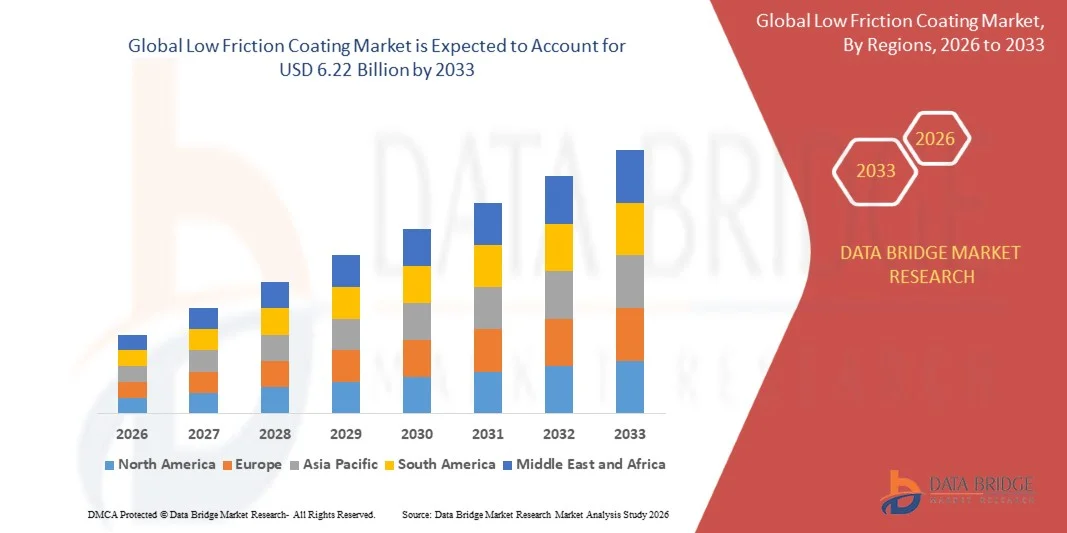
- The global low friction coating market size was valued at USD 3.82 billion in 2025 and is expected to reach USD 6.22 billion by 2033, at a CAGR of 6.30% during the forecast period
- The market growth is largely fueled by the increasing demand for energy-efficient and high-performance industrial components, driving the adoption of low friction coatings across automotive, aerospace, and machinery applications to reduce wear, enhance durability, and improve operational efficiency
- Furthermore, rising emphasis on reducing maintenance costs, improving equipment lifespan, and complying with stringent environmental and emission regulations is accelerating the adoption of advanced coating technologies. These converging factors are significantly boosting the demand for low friction coatings across multiple end-use industries
Low Friction Coating Market Analysis
- Low friction coatings, designed to minimize surface resistance and reduce wear between moving components, are becoming essential in modern industrial systems due to their ability to enhance performance, reduce energy consumption, and extend equipment life across demanding operating conditions
- The escalating demand for low friction coatings is primarily driven by increasing industrial automation, rising automotive production, and growing need for advanced surface engineering solutions that support efficiency, reliability, and sustainability across diverse applications
- Asia-Pacific dominated the low friction coating market with a share of 36.90% in 2025, due to strong demand from automotive, industrial machinery, aerospace, and transportation industries
- North America is expected to be the fastest growing region in the low friction coating market during the forecast period due to rising demand from aerospace, automotive, and industrial machinery industries
- Polytetrafluoroethylene (PTFE) segment dominated the market with a market share of 42.1% in 2025, due to its exceptional non-stick properties, chemical resistance, and low coefficient of friction across diverse operating conditions. Industries increasingly rely on PTFE coatings to reduce wear, extend component lifespan, and enhance energy efficiency in high-performance applications
Report Scope and Low Friction Coating Market Segmentation
|
Attributes |
Low Friction Coating Key Market Insights |
|
Segments Covered |
|
|
Countries Covered |
North America · U.S. · Canada · Mexico Europe · Germany · France · U.K. · Netherlands · Switzerland · Belgium · Russia · Italy · Spain · Turkey · Rest of Europe Asia-Pacific · China · Japan · India · South Korea · Singapore · Malaysia · Australia · Thailand · Indonesia · Philippines · Rest of Asia-Pacific Middle East and Africa · Saudi Arabia · U.A.E. · South Africa · Egypt · Israel · Rest of Middle East and Africa South America · Brazil · Argentina · Rest of South America |
|
Key Market Players |
· DuPont (U.S.) · Endura Coatings (U.S.) · VITRACOAT (U.S.) · Poeton (U.K.) · Whitford Limited (U.K.) · CARL BECHEM GMBH (Germany) · GMM Coatings Private Limited (India) · ASV Multichemie Private Limited (India) · HARVES Co. Ltd (South Korea) · AGC Chemicals (Japan) · IKV (Germany) · The Chemours Company (U.S.) · Gujarat Fluorochemicals Ltd. (India) · DAIKIN INDUSTRIES, Ltd. (Japan) · Everlube Products (U.S.) · Micro Surface Corp. (U.S.) · MBI Coatings (U.S.) · KECO Coatings (U.S.) · Honeywell International Inc. (U.S.) · PolyOne Corporation (U.S.) · BASF SE (Germany) |
|
Market Opportunities |
· Growing Application in Electric Vehicles and Battery Systems · Expansion in Aerospace and Defense High-Performance Coating Applications |
|
Value Added Data Infosets |
In addition to the insights on market scenarios such as market value, growth rate, segmentation, geographical coverage, and major players, the market reports curated by the Data Bridge Market Research also include import export analysis, production capacity overview, production consumption analysis, price trend analysis, climate change scenario, supply chain analysis, value chain analysis, raw material/consumables overview, vendor selection criteria, PESTLE Analysis, Porter Analysis, and regulatory framework. |
Low Friction Coating Market Trends
“Rising Adoption of Environmentally Sustainable and Low-Emission Coating Technologies”
- A significant trend in the low friction coating market is the increasing shift toward environmentally sustainable and low-emission coating solutions, driven by stringent environmental regulations and the need to reduce harmful chemical usage across industries. This transition is strengthening the role of advanced coatings in achieving compliance while maintaining high performance in industrial applications
- For instance, PPG Industries introduced copper-free antifouling coatings such as NEXEON 810, which deliver ultra-low friction while reducing environmental impact in marine operations. Such innovations support regulatory compliance and enhance fuel efficiency in shipping applications
- The automotive sector is adopting eco-friendly low friction coatings to reduce emissions and improve fuel efficiency by minimizing mechanical losses in engines and transmission systems. This is encouraging manufacturers to replace conventional lubricants with advanced coating technologies that offer both sustainability and performance benefits
- Aerospace and defense industries are increasingly focusing on coatings that can perform under extreme conditions while meeting environmental safety standards. This trend is accelerating the development of high-performance, non-toxic coating materials that enhance durability and operational reliability
- Industrial machinery applications are witnessing growing adoption of dry lubrication coatings that eliminate the need for oil-based lubricants, thereby reducing contamination and maintenance requirements. This is supporting cleaner manufacturing processes and improved equipment efficiency
- The market is experiencing a steady transition toward sustainable material innovation where coatings are designed to balance performance, durability, and environmental responsibility. This trend is reinforcing the long-term shift toward greener industrial solutions and advanced surface engineering technologies
Low Friction Coating Market Dynamics
Driver
“Increasing Demand for Energy Efficiency and Component Durability Across Industries”
- The increasing demand for energy efficiency and enhanced durability in mechanical systems is a major driver for the low friction coating market, as industries seek to reduce energy losses and extend equipment lifespan. These coatings play a critical role in minimizing friction, lowering wear, and improving operational performance across automotive, aerospace, and industrial sectors
- For instance, DuPont offers MOLYKOTE low friction coatings that are widely used in automotive and industrial components to improve efficiency and reduce maintenance frequency. These solutions help manufacturers achieve better performance while lowering operational costs
- The automotive industry is increasingly integrating low friction coatings in engine components, pistons, and transmission systems to improve fuel economy and reduce emissions. This is driving large-scale adoption as manufacturers focus on meeting regulatory standards and enhancing vehicle performance
- In industrial machinery, coatings are used to enhance reliability and reduce downtime by protecting components from wear and corrosion under high-load conditions. This is particularly important in sectors where continuous operation and efficiency are critical
- The growing focus on operational efficiency and cost optimization across industries continues to strengthen this driver. The need for durable, high-performance, and energy-efficient solutions is significantly accelerating the adoption of low friction coatings globally
Restraint/Challenge
“High Cost of Advanced Coating Materials and Application Processes”
- The low friction coating market faces challenges due to the high cost associated with advanced coating materials and specialized application processes required to achieve optimal performance. These coatings often involve complex formulations and precision techniques, increasing overall production and implementation expenses
- For instance, BASF SE develops high-performance coating materials that require advanced processing technologies, which can elevate manufacturing costs and limit affordability for small and medium-scale industries. This cost factor can restrict widespread adoption in price-sensitive markets
- The application of low friction coatings often requires specialized equipment such as vacuum deposition or thermal spraying systems, which adds to capital investment requirements. This makes it challenging for smaller manufacturers to adopt these technologies at scale
- Raw material costs for high-performance compounds such as fluoropolymers and solid lubricants can fluctuate, further impacting pricing stability and overall cost structures. This creates uncertainty for manufacturers and end-users planning long-term investments
- The market continues to face pressure to balance performance benefits with cost efficiency. Overcoming these challenges will be essential for expanding adoption and ensuring broader accessibility of advanced low friction coating solutions across industries
Low Friction Coating Market Scope
The market is segmented on the basis of type, end-user industry, and application.
- By Type
On the basis of type, the low friction coating market is segmented into Molybdenum Disulphide, Tungsten Disulphide, Polytetrafluoroethylene (PTFE), and Others. The Polytetrafluoroethylene (PTFE) segment dominated the market with the largest market revenue share of 42.1% in 2025, driven by its exceptional non-stick properties, chemical resistance, and low coefficient of friction across diverse operating conditions. Industries increasingly rely on PTFE coatings to reduce wear, extend component lifespan, and enhance energy efficiency in high-performance applications. Its strong adoption across automotive, industrial machinery, and food processing equipment further strengthens its dominance due to compliance with safety and performance standards. The versatility of PTFE in both dry lubrication and corrosion protection applications supports its widespread industrial usage and consistent demand growth.
The Tungsten Disulphide segment is anticipated to witness the fastest growth rate from 2026 to 2033, fueled by its superior performance under extreme pressure and temperature conditions compared to conventional coatings. It is gaining traction in aerospace, defense, and high-load industrial environments where reliability and durability are critical. The material’s ability to function effectively in vacuum and harsh environments enhances its adoption in advanced engineering applications. Increasing investments in high-performance materials and precision engineering are accelerating demand for tungsten disulphide coatings across specialized sectors.
- By End-User Industry
On the basis of end-user industry, the low friction coating market is segmented into Automotive, Aerospace, Healthcare, Transportation, Construction, and Others. The Automotive segment dominated the market with the largest market revenue share in 2025, driven by rising demand for fuel-efficient vehicles and the need to reduce mechanical wear in engine and drivetrain components. Low friction coatings play a critical role in improving component efficiency, lowering emissions, and extending maintenance cycles in vehicles. Growing production of passenger and commercial vehicles, along with the shift toward electric mobility, is further increasing the application scope of these coatings. Manufacturers are increasingly adopting advanced coating technologies to meet regulatory standards and enhance vehicle performance.
The Aerospace segment is expected to witness the fastest CAGR from 2026 to 2033, driven by the increasing need for high-performance materials capable of withstanding extreme temperatures, pressures, and environmental conditions. Low friction coatings are widely used in aircraft components to reduce wear, prevent corrosion, and ensure operational reliability. Rising air traffic and expansion of aircraft fleets are accelerating demand for durable and lightweight materials. Continuous advancements in aerospace engineering and defense modernization programs are further supporting the growth of this segment.
- By Application
On the basis of application, the low friction coating market is segmented into Bearings, Automotive Parts, Power Transmission Items, Valve Components and Actuators, Ammunition Components, and Others. The Bearings segment dominated the market with the largest market revenue share in 2025, driven by the critical need to minimize friction, reduce energy loss, and enhance the operational efficiency of rotating equipment. Low friction coatings in bearings significantly improve durability, reduce maintenance requirements, and enable smoother performance across industrial machinery and automotive systems. The widespread use of bearings in multiple industries such as manufacturing, automotive, and energy contributes to consistent demand for advanced coating solutions. Increasing industrial automation and machinery upgrades are further reinforcing the dominance of this segment.
The Automotive Parts segment is anticipated to witness the fastest growth rate from 2026 to 2033, fueled by the growing emphasis on vehicle efficiency, emission reduction, and component longevity. Low friction coatings are increasingly applied to engine parts, pistons, and transmission systems to enhance performance and reduce wear under high stress conditions. The rapid transition toward electric and hybrid vehicles is also expanding the scope of coating applications in new component designs. Continuous innovation in automotive materials and engineering is driving the adoption of advanced coating technologies in this segment.
Low Friction Coating Market Regional Analysis
- Asia-Pacific dominated the low friction coating market with the largest revenue share of 36.90% in 2025, driven by strong demand from automotive, industrial machinery, aerospace, and transportation industries
- The region benefits from large-scale manufacturing capacity, cost-efficient production base, and increasing adoption of advanced coating technologies across high-performance industrial applications
- Rapid industrialization, expanding automotive production, and growing investments in precision engineering and material technologies are accelerating market expansion
China Low Friction Coating Market Insight
China held the largest share in the Asia-Pacific low friction coating market in 2025, supported by its strong manufacturing ecosystem for automotive, heavy machinery, and industrial equipment production. The country has a well-established materials and coatings industry that enables large-scale production and application of advanced lubrication solutions. Strong domestic demand from automotive and industrial sectors is further reinforcing market growth. In addition, government support for manufacturing expansion and technological advancements is strengthening China’s leadership in coating production and exports.
India Low Friction Coating Market Insight
India is witnessing the fastest growth in the Asia-Pacific region, driven by expanding automotive manufacturing, rising industrial machinery demand, and increasing infrastructure development. Government initiatives promoting domestic manufacturing and industrial growth are significantly boosting the adoption of advanced coating solutions. The transportation and construction sectors are also contributing to growing demand for low friction coatings. In addition, rising investments in specialty chemicals and industrial modernization are accelerating long-term market expansion.
Europe Low Friction Coating Market Insight
The Europe low friction coating market is expanding steadily, supported by strong demand from automotive engineering, aerospace applications, and industrial equipment manufacturing. The region places strong emphasis on high-performance and environmentally sustainable coating solutions. Strict environmental regulations are encouraging the adoption of low-emission and durable coating technologies. In addition, continuous advancements in material science are enhancing the application scope across precision engineering and mobility sectors.
Germany Low Friction Coating Market Insight
Germany accounted for the largest share in the Europe low friction coating market in 2025, driven by its strong automotive and industrial manufacturing base. The country has extensive use of low friction coatings in engine components, machinery, and high-performance equipment. Advanced R&D capabilities and strong industrial automation support continuous innovation in coating technologies. In addition, export-oriented manufacturing and collaboration between industry players and research institutions are reinforcing Germany’s leadership in advanced coatings.
U.K. Low Friction Coating Market Insight
The U.K. market is supported by strong demand from aerospace, healthcare, and industrial equipment sectors. Increasing focus on advanced material coatings is driving adoption across high-precision applications. The country’s research-driven ecosystem supports innovation in surface engineering and lubrication technologies. In addition, growing efforts to strengthen domestic manufacturing and specialty chemical production are further supporting market expansion.
North America Low Friction Coating Market Insight
North America is projected to grow at the fastest CAGR from 2026 to 2033, driven by rising demand from aerospace, automotive, and industrial machinery industries. Strong adoption of advanced coating technologies is supporting high-performance, durable, and energy-efficient applications. Continuous innovation in surface engineering is further expanding industrial usage. In addition, increasing investments in advanced manufacturing and material science are accelerating regional growth.
U.S. Low Friction Coating Market Insight
The U.S. accounted for the largest share in the North America low friction coating market in 2025, supported by strong demand from aerospace, automotive, and defense industries. The country benefits from a highly advanced R&D ecosystem and strong presence of leading coating manufacturers. Low friction coatings are widely used in high-performance machinery, aircraft components, and industrial systems. In addition, continuous technological innovation and strong industrial infrastructure are reinforcing the U.S. leadership position in the regional market.
Low Friction Coating Market Share
The low friction coating industry is primarily led by well-established companies, including:
- DuPont (U.S.)
- Endura Coatings (U.S.)
- VITRACOAT (U.S.)
- Poeton (U.K.)
- Whitford Limited (U.K.)
- CARL BECHEM GMBH (Germany)
- GMM Coatings Private Limited (India)
- ASV Multichemie Private Limited (India)
- HARVES Co. Ltd (South Korea)
- AGC Chemicals (Japan)
- IKV (Germany)
- The Chemours Company (U.S.)
- Gujarat Fluorochemicals Ltd. (India)
- DAIKIN INDUSTRIES, Ltd. (Japan)
- Everlube Products (U.S.)
- Micro Surface Corp. (U.S.)
- MBI Coatings (U.S.)
- KECO Coatings (U.S.)
- Honeywell International Inc. (U.S.)
- PolyOne Corporation (U.S.)
- BASF SE (Germany)
Latest Developments in Global Low Friction Coating Market
- In May 2024, DuPont launched MOLYKOTE D-6804 and MOLYKOTE D-6818 low-friction coatings designed for enhanced wear resistance and compatibility with alternative fuels, strengthening its portfolio in sustainable and high-performance lubrication solutions. This development supports industries transitioning toward alternative energy sources by ensuring component durability under new fuel conditions while improving operational efficiency and reducing maintenance requirements across automotive and industrial applications
- In April 2024, AkzoNobel introduced advanced low-friction marine coatings focused on reducing drag and improving fuel efficiency, reinforcing its position in the marine coatings segment. This innovation is driving wider adoption among shipping operators aiming to lower fuel consumption and emissions, thereby aligning with stringent environmental regulations and enhancing long-term cost savings in maritime operations
- In March 2024, PPG introduced PPG NEXEON 810, a copper-free antifouling coating offering ultra-low friction and improved vessel fuel efficiency, enhancing its competitive positioning in sustainable marine coatings. The product addresses regulatory pressures to eliminate harmful substances while improving vessel performance, which is encouraging shipowners to adopt next-generation coatings that deliver both environmental compliance and operational benefits
- In January 2024, PPG’s earlier acquisition of Arsonsisi, an Italy-based industrial coatings company, continued to strengthen its low-friction coatings capabilities by expanding its European footprint. This strategic move is improving PPG’s access to regional customers and advanced coating technologies, enabling the company to enhance product offerings and strengthen its market position in high-growth industrial and specialty coating segments
- In February 2023, Klüber Lubrication partnered with IHI Hauzer to develop low-friction coatings for marine applications, enabling advancements in surface engineering technologies that reduce fuel consumption and emissions. This collaboration is accelerating innovation in coating deposition technologies and expanding application scope in marine environments where durability and efficiency are critical performance parameters

- Interactive Data Analysis Dashboard
- Company Analysis Dashboard for high growth potential opportunities
- Research Analyst Access for customization & queries
- Competitor Analysis with Interactive dashboard
- Latest News, Updates & Trend analysis
- Harness the Power of Benchmark Analysis for Comprehensive Competitor Tracking
Global Low Friction Coating Market, Supply Chain Analysis and Ecosystem Framework
To support market growth and help clients navigate the impact of geopolitical shifts, DBMR has integrated in-depth supply chain analysis into its Global Low Friction Coating Market research reports. This addition empowers clients to respond effectively to global changes affecting their industries. The supply chain analysis section includes detailed insights such as Global Low Friction Coating Market consumption and production by country, price trend analysis, the impact of tariffs and geopolitical developments, and import and export trends by country and HSN code. It also highlights major suppliers with data on production capacity and company profiles, as well as key importers and exporters. In addition to research, DBMR offers specialized supply chain consulting services backed by over a decade of experience, providing solutions like supplier discovery, supplier risk assessment, price trend analysis, impact evaluation of inflation and trade route changes, and comprehensive market trend analysis.
Data collection and base year analysis are done using data collection modules with large sample sizes. The stage includes obtaining market information or related data through various sources and strategies. It includes examining and planning all the data acquired from the past in advance. It likewise envelops the examination of information inconsistencies seen across different information sources. The market data is analysed and estimated using market statistical and coherent models. Also, market share analysis and key trend analysis are the major success factors in the market report. To know more, please request an analyst call or drop down your inquiry.
The key research methodology used by DBMR research team is data triangulation which involves data mining, analysis of the impact of data variables on the market and primary (industry expert) validation. Data models include Vendor Positioning Grid, Market Time Line Analysis, Market Overview and Guide, Company Positioning Grid, Patent Analysis, Pricing Analysis, Company Market Share Analysis, Standards of Measurement, Global versus Regional and Vendor Share Analysis. To know more about the research methodology, drop in an inquiry to speak to our industry experts.
Data Bridge Market Research is a leader in advanced formative research. We take pride in servicing our existing and new customers with data and analysis that match and suits their goal. The report can be customized to include price trend analysis of target brands understanding the market for additional countries (ask for the list of countries), clinical trial results data, literature review, refurbished market and product base analysis. Market analysis of target competitors can be analyzed from technology-based analysis to market portfolio strategies. We can add as many competitors that you require data about in the format and data style you are looking for. Our team of analysts can also provide you data in crude raw excel files pivot tables (Fact book) or can assist you in creating presentations from the data sets available in the report.













