What is the Low-Migration Packaging Inks Market Size and Growth Rate?
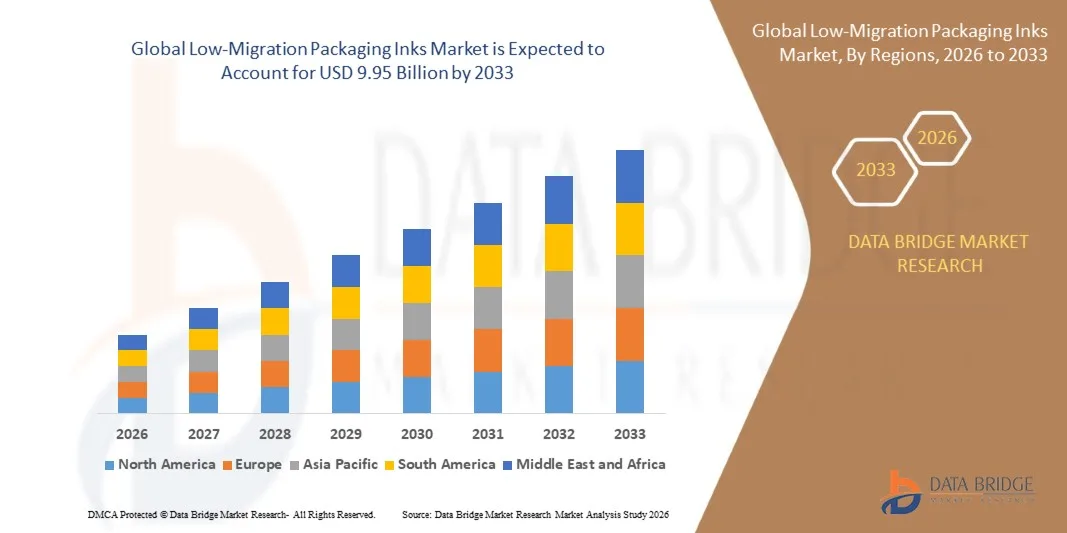
- As per Data Bridge Market Research analysis, the low-migration packaging inks market was valued at USD 6.60 billion in 2025 and is projected to reach USD 9.95 billion by 2033, growing at a CAGR of 7.60% from 2026 to 2033.
- The market is experiencing consistent growth driven by rising demand for safe and compliant food packaging, increasing pharmaceutical packaging requirements, and advancements in low-migration ink formulations and printing technologies.
- Growing awareness of chemical migration risks, combined with stricter packaging safety requirements, is compelling packaging manufacturers, printing companies, and brand owners to adopt low-migration ink solutions. Flexographic and digital printing technologies are supporting the production of high-quality, compliant packaging for food, beverages, and pharmaceuticals, helping manufacturers minimize the transfer of potentially harmful substances while maintaining print quality and production efficiency.
Market Size & Forecast
- Global Market Value (2025): USD 6.60 Billion
- Expected Market Value (2033): USD 9.95 Billion
- Forecast CAGR (2026–2033): 7.60%
- Leading Region in 2025: North America
- Fastest Growing Region: Asia Pacific
What are the Major Takeaways of the Low-Migration Packaging Inks Market?
- North America dominated the low-migration packaging inks market with the largest revenue share of 38.7% in 2025, supported by stringent packaging safety regulations, advanced printing infrastructure, and strong demand from the food, beverage, and pharmaceutical industries
- Asia-Pacific is expected to be the fastest-growing region at a CAGR of 6.7% from 2026 to 2033, fueled by rising packaged food consumption, pharmaceutical manufacturing expansion, and increasing adoption of compliant packaging technologies.
- The UV-curable low-migration inks segment led the market with a 42.3% share in 2025, driven by its widespread use in packaging labels, folding cartons, and selected flexible packaging applications.
- Electron beam-curable inks are the fastest-growing type, projected to register a CAGR of 6.9%, reflecting the surge in interest in photoinitiator-free curing technologies.
- The flexographic printing technology segment dominated the technology category with 55% revenue share in 2025, led by its extensive use in food, beverage, and pharmaceutical packaging
- Food packaging accounted for 43.0% of the market share in 2025, preferred by high packaged-food consumption and stringent packaging safety requirements.
- The pharmaceutical packaging segment is the fastest-growing application category, with a CAGR of 6.5%, driven by stringent product safety requirements and increasing pharmaceutical production.
Report Scope and Low-Migration Packaging Inks Market Segmentation
|
Attributes |
Low-Migration Packaging Inks Key Market Insights |
|
Segments Covered |
|
|
Countries Covered |
North America
Europe
Asia-Pacific
Middle East and Africa
South America
|
|
Key Market Players |
|
|
Market Opportunities |
|
|
Value Added Data Infosets |
In addition to the insights on market scenarios such as market value, growth rate, segmentation, geographical coverage, and major players, the market reports curated by the Data Bridge Market Research also include import export analysis, production capacity overview, production consumption analysis, price trend analysis, climate change scenario, supply chain analysis, value chain analysis, raw material/consumables overview, vendor selection criteria, PESTLE Analysis, Porter Analysis, and regulatory framework. |
What is the Key Trend in the Low-Migration Packaging Inks Market?
- Packaging manufacturers are increasingly adopting low-migration inks to improve food contact safety, meet regulatory requirements, and reduce the risk of ink components transferring into packaged products.
- For instance, in December 2024, INX International announced an expansion of its INXhrc RC natural-based ink range with a UV/LED dual-cure low-migration formulation for plastic and foam packaging. The company stated that the inks use renewable ingredients, contain no VOC solvents, and can reduce packaging carbon footprint by up to 30%
- Advances in low-migration ink formulations are enabling packaging converters to maintain print quality while addressing chemical migration concerns across flexible packaging, labels, and folding cartons.
- Packaging companies are increasingly evaluating water-based, UV-curable, and electron-beam-curable ink systems to meet application-specific safety requirements and sustainability targets.
- For instance, in October 2024, Packaging South Asia reported on Siegwerk India's developments in sustainable inks and coatings, highlighting low-migration inks for food packaging and growing interest in water-based inks for gravure and central-impression flexographic printing on films and laminates.
- As food safety expectations and packaging compliance requirements continue to evolve, demand for specialized low-migration inks is expected to increase, strengthening their role in food, beverage, and pharmaceutical packaging.
What are the Key Drivers of the Low-Migration Packaging Inks Market?
- The growing demand for safer food packaging and stricter food-contact material requirements are increasing adoption of low-migration inks designed to reduce the transfer of potentially harmful substances into packaged products.
- For instance, in February 2022, Siegwerk launched its VEGA range of mineral-oil-free inks in India and announced that its Bhiwadi plant would become fully mineral-oil-free from May 2022. The initiative addressed concerns about mineral oil hydrocarbons migrating from packaging into food, supporting demand for safer printing inks.
- Food producers, packaging converters, and ink manufacturers are prioritizing risk assessment and suitable ink formulations to protect product quality while meeting increasingly demanding packaging safety expectations.
- For instance, in July 2025, Flint Group announced its Flexocure LEAP UV flexographic ink range, developed with a new resin system designed to significantly reduce photoinitiator migration in food packaging. The launch demonstrates how packaging safety requirements are driving innovation in low-migration ink formulations.
- As food safety regulations and consumer expectations continue to shape packaging decisions, demand for specialized low-migration inks is expected to increase across food, beverage, and pharmaceutical applications.
What Factors are Challenging the Growth of the Low-Migration Packaging Inks Market?
- Low-migration packaging inks require specialized formulations, careful production controls, and application-specific validation, increasing manufacturing complexity and compliance costs.
- For instance, in April 2024, the European Carton Makers Association (ECMA) highlighted the challenges of assessing migration from cartons stored for extended periods, noting that appropriate testing conditions are essential for demonstrating food-contact safety. The need for specialized testing and compliance assessment can increase costs and complexity for packaging manufacturers.
- These requirements can limit adoption among smaller packaging converters, particularly when migration testing, substrate compatibility, and process validation demand additional technical expertise.
- Packaging manufacturers must evaluate ink formulations alongside substrates, curing conditions, storage environments, and packaging structures to demonstrate that the finished package meets applicable food-contact safety requirements.
- For instance, in September 2024, researchers published an article in Foods examining chemical migration from packaging materials into food. The study highlighted the complexity of migration mechanisms, including diffusion, permeation, and set-off, as well as the challenges of identifying and assessing potentially migrating substances. These issues can complicate safety testing and increase compliance burdens for low-migration ink manufacturers
- The technical complexity and cost of migration testing, combined with varying application requirements and regulatory frameworks, continue to challenge manufacturers seeking consistent, cost-effective low-migration packaging solutions.
How is the Low-Migration Packaging Inks Market Segmented?
The low-migration packaging inks market is segmented on the basis of type, technology, application, and distribution channel.
- By Type
On the basis of type, the low-migration packaging inks market is segmented into solvent-based low-migration inks, water-based low-migration inks, UV-curable low-migration inks, electron beam (EB)-curable inks, low-migration flexographic inks, and low-migration gravure inks. UV-curable low-migration inks: The UV-curable low-migration inks segment dominated the market with 42.3% share in 2025, supported by its widespread use in packaging labels, folding cartons, and selected flexible packaging applications. These inks provide rapid curing and high-quality print results when appropriately formulated and processed. They are used in packaging applications requiring controlled migration and consistent print performance. Advances in resin chemistry and photoinitiator selection are improving their suitability for sensitive packaging. Packaging converters value their production efficiency and compatibility with established printing equipment.
The electron beam-curable inks segment is projected to register the fastest growth at CAGR of 6.9% from 2026 to 2033, driven by increasing interest in photoinitiator-free curing technologies. EB curing can provide rapid polymerization and effective curing in suitable packaging systems. These inks are attracting attention for selected food packaging and multilayer flexible packaging applications. Growing emphasis on chemical migration control is encouraging converters to evaluate EB-based printing solutions. The technology can support high-speed production and consistent print quality. However, investment in curing equipment and specialized production infrastructure can restrict adoption.
- By Technology
On the basis of technology, the low-migration packaging inks market is segmented into flexographic printing technology, gravure printing technology, offset printing technology, digital inkjet printing technology, UV/LED-UV curing technology, and electron beam curing technology. The flexographic printing technology segment dominated the market with 55.0% share in 2025, supported by its extensive use in food, beverage, and pharmaceutical packaging. Flexographic printing offers high production speeds and consistent print quality across different packaging substrates. It is widely used for flexible films, labels, paperboard, and multilayer packaging materials. The technology supports specialized ink formulations designed for sensitive packaging requirements. Its compatibility with established production lines helps converters manage equipment costs. Improvements in plate technology, ink transfer, and curing systems are further enhancing printing efficiency
The digital inkjet printing technology segment is projected to register the fastest growth at CAGR of 6.7% from 2026 to 2033, driven by increasing demand for customized packaging and shorter production runs. Digital printing enables frequent artwork changes without extensive plate preparation. It supports personalized labels, variable-data printing, and product-specific packaging designs. Advances in low-migration inkjet formulations are expanding its suitability for food and pharmaceutical packaging applications. The technology can reduce setup waste and improve production flexibility for smaller batches. Growing demand for e-commerce packaging and premium consumer products is supporting adoption.
- By Application
On the basis of application, the low-migration packaging inks market is segmented into food packaging, pharmaceutical packaging, beverage packaging, dairy packaging, confectionery packaging, personal care and cosmetic packaging, and healthcare and medical packaging. The food packaging segment dominated the market with 43.0% share in 2025, supported by high packaged-food consumption and stringent packaging safety requirements. Low-migration inks help minimize the transfer of ink constituents into food through direct contact, set-off, or migration through packaging materials. They are used in flexible pouches, wrappers, folding cartons, and labels. Food manufacturers and packaging converters prioritize compliant formulations to protect product quality and consumer safety. Regulatory requirements and brand-owner specifications encourage investment in migration testing and suitable printing systems. Growing demand for convenience foods, ready-to-eat meals, and packaged snacks further supports adoption.
The pharmaceutical packaging segment is projected to register the fastest growth at CAGR of 6.5% from 2026 to 2033, driven by stringent product safety requirements and increasing pharmaceutical production. Low-migration inks are used on medicine cartons, labels, leaflets, and selected packaging components. Pharmaceutical manufacturers require printing solutions that minimize contamination risks and preserve information legibility throughout storage and distribution. Growing production of medicines, vaccines, and specialty pharmaceuticals is strengthening demand for compliant packaging materials. Product identification, dosage information, traceability, and anti-counterfeiting requirements further support advanced printing technologies. Manufacturers are also investing in testing and documentation to demonstrate packaging suitability.
- By Distribution Channel
On the basis of distribution channel, the low-migration packaging inks market is segmented into direct sales, specialty chemical distributors, packaging ink distributors, and online sales channels. The direct sales segment is estimated to account for 45.0% share in 2025, reflecting the importance of long-term supply relationships between ink manufacturers and large packaging converters. Direct sales enable manufacturers to provide customized formulations and application-specific technical support. This channel facilitates quality assurance, migration compliance documentation, and production trials. Large-volume customers often require consistent product specifications and dependable supply arrangements. Direct relationships also help suppliers respond to evolving regulatory requirements and resolve printing challenges. Manufacturers can work closely with customers to optimize ink performance for specific substrates and curing conditions.
The online sales channel segment is projected to register the fastest growth at CAGR of 7.0% from 2026 to 2033, supported by the expansion of digital procurement and business-to-business ordering platforms. Online channels simplify product discovery, technical-document access, quotation requests, and repeat purchasing. They can help smaller printing businesses identify specialized ink products and connect with suppliers. Digital ordering systems also improve procurement efficiency and extend distributors' geographic reach. Increasing adoption of online business purchasing is expected to support this channel's development. However, low-migration inks often require technical consultation and application-specific compliance verification before selection.
Which Region Holds the Largest Share of the Low-Migration Packaging Inks Market?
- North America dominated the low-migration packaging inks market with the largest revenue share of 38.7% in 2025, supported by stringent packaging safety regulations, advanced printing infrastructure, and strong demand from the food, beverage, and pharmaceutical industries
- The region also benefits from advanced packaging technologies, growing adoption of specialized printing inks, and increasing emphasis on compliance with food-contact safety standards. Strong demand for packaged products, continuous innovation in low-migration ink formulations, and investments in sustainable packaging solutions continue to support North America's prominent position in the global market.
U.S. Low-Migration Packaging Inks Market Insight
The U.S. low-migration packaging inks market is witnessing steady growth due to rising demand for safe food packaging, stringent food-contact safety requirements, and increasing adoption of specialized printing technologies. The country’s established food and beverage industry, advanced packaging infrastructure, and strong pharmaceutical manufacturing base are driving demand for low-migration ink formulations. In addition, growing emphasis on reducing chemical migration, improving packaging compliance, and adopting sustainable printing solutions is accelerating the use of specialized inks across packaging applications.
Asia-Pacific Low-Migration Packaging Inks Market Insight
The Asia-Pacific low-migration packaging inks market is expected to witness rapid growth, driven by expanding food and beverage production, rising pharmaceutical manufacturing, and increasing demand for packaged consumer goods across China, India, and Japan. Growing awareness of packaging safety, evolving food-contact regulations, and investments in advanced printing infrastructure are supporting regional market expansion. In addition, increasing adoption of flexible packaging, folding cartons, and specialized printing inks is strengthening demand across food processing, healthcare, and consumer goods industries.
Japan Low-Migration Packaging Inks Market Insight
The Japan low-migration packaging inks market is witnessing consistent growth due to rising demand for high-quality food packaging, stringent product safety expectations, and technological advancements in printing and packaging materials. Food manufacturers, pharmaceutical companies, and packaging converters are increasingly prioritizing inks that minimize migration risks while maintaining print quality and packaging integrity. Moreover, growing interest in sustainable packaging, advanced curing technologies, and improved quality-control processes is contributing to the adoption of specialized low-migration ink formulations across the country.
China Low-Migration Packaging Inks Market Insight
The China low-migration packaging inks market is growing rapidly, driven by expanding packaged food consumption, increasing pharmaceutical production, and continuous development of the country's packaging industry. Growing adoption of flexible packaging, printed labels, and folding cartons is boosting demand for inks designed to meet application-specific safety requirements. In addition, rising awareness of food-contact compliance, investments in modern printing equipment, and increasing emphasis on packaging quality are encouraging manufacturers to adopt advanced ink formulations, positioning China as an important market for low-migration packaging inks.
U.K. Low-Migration Packaging Inks Market Insight
The U.K. low-migration packaging inks market is experiencing steady growth, supported by demand for compliant food packaging, increasing pharmaceutical packaging requirements, and the adoption of advanced printing technologies. Packaging manufacturers and brand owners are increasingly focusing on ink formulations that minimize chemical migration and support applicable food-contact safety requirements. Furthermore, growing interest in recyclable packaging materials, sustainable printing processes, and improved supply-chain compliance is encouraging innovation in low-migration inks, strengthening the U.K.'s role in the European packaging industry.
Germany Low-Migration Packaging Inks Market Insight
The Germany low-migration packaging inks market is expanding steadily due to the country's established printing industry, advanced packaging manufacturing capabilities, and strong food and pharmaceutical sectors. Packaging converters are increasingly adopting specialized ink formulations to address migration concerns and meet demanding product safety requirements. Continuous developments in water-based inks, UV-curable formulations, and electron beam curing technologies are supporting innovation in packaging production. In addition, growing emphasis on packaging sustainability, regulatory compliance, and high-performance printing solutions is further contributing to market development in Germany.
Which are the Top Companies in Low-Migration Packaging Inks Market?
The low-migration packaging inks industry is primarily led by well-established companies, including:
- ACTEGA GmbH (Germany)
- Agfa-Gevaert NV (Belgium)
- ALTANA AG (Germany)
- Epple Druckfarben AG (Germany)
- Flint Group GmbH (Germany)
- FUJIFILM Corporation (Japan)
- DIC Corporation (Japan)
- HP Inc. (U.S.)
- hubergroup Deutschland GmbH (Germany)
- INX International Ink Co. (U.S.)
- Marabu GmbH & Co. KG (Germany)
- Nazdar Company, Inc. (U.S.)
- RUCO Druckfarben A.M. Ramp & Co. GmbH (Germany)
- Sakata INX Corporation (Japan)
- Seiko Epson Corporation (Japan)
- Siegwerk Druckfarben AG & Co. KGaA (Germany)
- Sun Chemical Corporation (U.S.)
- T&K TOKA Co., Ltd. (Japan)
- artience Co., Ltd. (Japan)
- Wikoff Color Corporation (U.S.)
What are Latest Developments in Low-Migration Packaging Inks Market?
- In July 2025, Sun Chemical launched SunCure EcoPlast, a UV offset ink range designed for sustainable plastic cup decoration. The inks combine low-migration properties, high adhesion, and fast curing with wash-off capabilities that support plastic recycling. The launch highlights the industry's focus on combining food packaging safety with improved recyclability
- In December 2024, INX International expanded its INXhrc RC natural-based ink portfolio with a UV/LED dual-cure low-migration formulation for rigid plastic and foam packaging. The new formulation uses renewable ingredients, avoids VOC solvents, and is designed to deliver high-quality printing for sensitive packaging applications. This development reflects increasing demand for packaging inks that combine migration control with sustainability benefits.
- In November 2023, Sun Chemical launched SunPak FSP EcoPace, a new sheetfed offset ink technology based on an innovative binder system for food packaging applications. The development focused on improving printing productivity, reducing ink application costs, and supporting sustainability goals while maintaining the low-migration performance required for food packaging.
- In May 2023, Fujifilm announced its first range of LED IDFC low-migration analogue inks and varnishes for labels and flexible packaging. The new products were designed to reduce energy consumption, eliminate ozone emissions associated with conventional UV curing, and improve printing efficiency while meeting the needs of sensitive packaging applications.
- In September 2022, ACTEGA launched its ACTExact SafeShield UV-LED low-migration ink range at Labelexpo Americas. The inks were developed for applications such as indirect food-contact packaging, cosmetics, and nutraceuticals, with extensive testing and regulatory compliance checks to support packaging safety. This launch highlighted the growing importance of certified ink formulations for sensitive packaging applications.

- Interactive Data Analysis Dashboard
- Company Analysis Dashboard for high growth potential opportunities
- Research Analyst Access for customization & queries
- Competitor Analysis with Interactive dashboard
- Latest News, Updates & Trend analysis
- Harness the Power of Benchmark Analysis for Comprehensive Competitor Tracking
Global Low Migration Packaging Inks Market, Supply Chain Analysis and Ecosystem Framework
To support market growth and help clients navigate the impact of geopolitical shifts, DBMR has integrated in-depth supply chain analysis into its Global Low Migration Packaging Inks Market research reports. This addition empowers clients to respond effectively to global changes affecting their industries. The supply chain analysis section includes detailed insights such as Global Low Migration Packaging Inks Market consumption and production by country, price trend analysis, the impact of tariffs and geopolitical developments, and import and export trends by country and HSN code. It also highlights major suppliers with data on production capacity and company profiles, as well as key importers and exporters. In addition to research, DBMR offers specialized supply chain consulting services backed by over a decade of experience, providing solutions like supplier discovery, supplier risk assessment, price trend analysis, impact evaluation of inflation and trade route changes, and comprehensive market trend analysis.
Data collection and base year analysis are done using data collection modules with large sample sizes. The stage includes obtaining market information or related data through various sources and strategies. It includes examining and planning all the data acquired from the past in advance. It likewise envelops the examination of information inconsistencies seen across different information sources. The market data is analysed and estimated using market statistical and coherent models. Also, market share analysis and key trend analysis are the major success factors in the market report. To know more, please request an analyst call or drop down your inquiry.
The key research methodology used by DBMR research team is data triangulation which involves data mining, analysis of the impact of data variables on the market and primary (industry expert) validation. Data models include Vendor Positioning Grid, Market Time Line Analysis, Market Overview and Guide, Company Positioning Grid, Patent Analysis, Pricing Analysis, Company Market Share Analysis, Standards of Measurement, Global versus Regional and Vendor Share Analysis. To know more about the research methodology, drop in an inquiry to speak to our industry experts.
Data Bridge Market Research is a leader in advanced formative research. We take pride in servicing our existing and new customers with data and analysis that match and suits their goal. The report can be customized to include price trend analysis of target brands understanding the market for additional countries (ask for the list of countries), clinical trial results data, literature review, refurbished market and product base analysis. Market analysis of target competitors can be analyzed from technology-based analysis to market portfolio strategies. We can add as many competitors that you require data about in the format and data style you are looking for. Our team of analysts can also provide you data in crude raw excel files pivot tables (Fact book) or can assist you in creating presentations from the data sets available in the report.