


What is the Low-Temperature Co-Fired Ceramic (LTCC) and High-Temperature Co-Fired Ceramic (HTCC) Market Size and Growth Rate ?
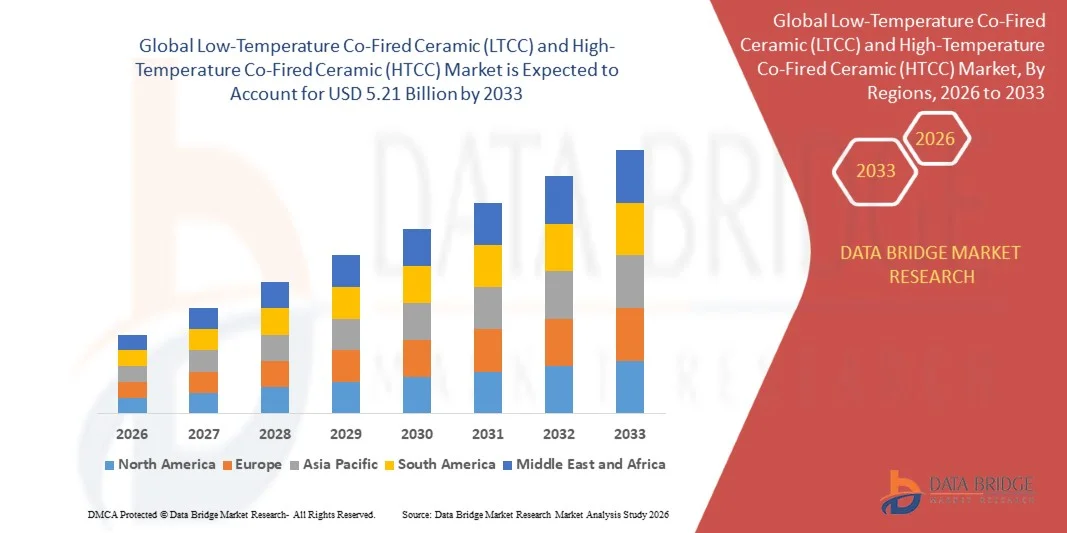
The Low-Temperature Co-Fired Ceramic (LTCC) and High-Temperature Co-Fired Ceramic (HTCC) Market was valued at USD 3.49 billion in 2025 and is projected to reach USD 5.21 billion by 2033, growing at a CAGR of 5.10% from 2026 to 2033. The market is witnessing steady growth driven by increasing demand for miniaturized, high-performance electronic components, rising adoption of advanced packaging technologies in semiconductors, and expanding applications across automotive electronics, telecommunications, aerospace, and defense industries.
The growing shift toward high-frequency communication systems, 5G infrastructure, and advanced radar technologies is accelerating the adoption of LTCC and HTCC substrates due to their superior thermal stability, high reliability, and excellent electrical performance. In addition, increasing use of compact electronic devices in electric vehicles, medical implants, and aerospace systems is further supporting market expansion, as these ceramics enable efficient integration of multilayer circuits in harsh operating environments while ensuring long-term durability and performance consistency.
Market Size & Forecast
- Global Market Value (2025): USD 3.49 Billion
- Expected Market Value (2033): USD 5.21 Billion
- Forecast CAGR (2026–2033): 5.10%
- Leading Region in 2025: North America
- Fastest Growing Region: Asia-Pacific
What are the Major Takeaways of Low-Temperature Co-Fired Ceramic (LTCC) and High-Temperature Co-Fired Ceramic (HTCC) Market ?
- North America dominated the low-temperature co-fired ceramic (LTCC) and high-temperature co-fired ceramic (HTCC) market with the largest revenue share of 36.7% in 2025, supported by strong presence of advanced semiconductor manufacturing, high defense electronics spending, and rapid adoption of RF modules and high-performance communication infrastructure across commercial and military sectors.
- Asia-Pacific is expected to be the fastest-growing region, recording a CAGR of 6.4% from 2026 to 2033. Growth is driven by expanding electronics manufacturing ecosystem, large-scale 5G deployment, and increasing production of consumer electronics, automotive electronics, and semiconductor components in countries such as China, Japan, and South Korea.
- The LTCC segment held the largest market revenue share of approximately 58.4% in 2025 driven by its extensive use in 5G communication modules, RF components, automotive radar systems, and compact electronic devices. LTCC is preferred due to its low dielectric loss, multilayer integration capability, and strong suitability for high-frequency applications in miniaturized electronics.
- The HTCC segment is projected to register the fastest growth at a CAGR of 5.9% from 2026 to 2033, driven by increasing demand in aerospace, defense electronics, and high-power semiconductor packaging applications. Its superior thermal resistance, mechanical strength, and reliability in extreme operating conditions are accelerating adoption in mission-critical systems.
- The Ceramic Material segment accounted for the largest market revenue share of approximately 63.7% in 2025 driven by its widespread use in high-frequency electronic packaging, multilayer substrates, and advanced circuit integration applications. Ceramic materials are preferred due to their excellent thermal stability, electrical insulation properties, and compatibility with both LTCC and HTCC manufacturing processes.
- The Glass-Ceramic Material segment is expected to register the fastest growth at a CAGR of 5.6% from 2026 to 2033, driven by increasing demand for low-temperature processing, improved structural flexibility, and cost-efficient manufacturing in consumer electronics and automotive applications.
- The Telecommunications segment held the largest market revenue share of approximately 34.2% in 2025 driven by rapid expansion of 5G infrastructure, increasing deployment of RF modules, and rising demand for high-frequency communication devices. LTCC-based components are widely used in antennas, filters, and base station modules for improved signal performance and miniaturization.
- The Aerospace and Defence segment is projected to register the fastest growth at a CAGR of 6.3% from 2026 to 2033, driven by increasing adoption of HTCC components in satellite systems, radar electronics, missile guidance systems, and high-reliability avionics. Growing defense modernization programs and rising demand for ruggedized electronic systems are further accelerating segment expansion.
Report Scope and Low-Temperature Co-Fired Ceramic (LTCC) and High-Temperature Co-Fired Ceramic (HTCC) Market Segmentation
|
Attributes |
Low-Temperature Co-Fired Ceramic (LTCC) and High-Temperature Co-Fired Ceramic (HTCC) Key Market Insights |
|
Segments Covered |
· By Process Type: High-Temperature Co-Fired Ceramic (HTCC), Low-Temperature Co-Fired Ceramic (LTCC) · By Material Type: Glass-Ceramic Material, and Ceramic Material · By End-User Industry: Automotive, Telecommunications, Aerospace and Defence, Medical, and Others |
|
Countries Covered |
North America · U.S. · Canada · Mexico Europe · Germany · France · U.K. · Netherlands · Switzerland · Belgium · Russia · Italy · Spain · Turkey · Rest of Europe Asia-Pacific · China · Japan · India · South Korea · Singapore · Malaysia · Australia · Thailand · Indonesia · Philippines · Rest of Asia-Pacific Middle East and Africa · Saudi Arabia · U.A.E. · South Africa · Egypt · Israel · Rest of Middle East and Africa South America · Brazil · Argentina · Rest of South America |
|
Key Market Players |
|
|
Market Opportunities |
• API Technologies (UK) Limited (U.K.) |
|
Value Added Data Infosets |
In addition to the insights on market scenarios such as market value, growth rate, segmentation, geographical coverage, and major players, the market reports curated by the Data Bridge Market Research also include import export analysis, production capacity overview, production consumption analysis, price trend analysis, climate change scenario, supply chain analysis, value chain analysis, raw material/consumables overview, vendor selection criteria, PESTLE Analysis, Porter Analysis, and regulatory framework. |
What is the Key Trend in the Low-Temperature Co-Fired Ceramic (LTCC) and High-Temperature Co-Fired Ceramic (HTCC) Market ?
Trend: Increasing Adoption Of Miniaturized High-Frequency And High-Reliability Electronic Packaging Solutions
Rising demand for compact, high-performance, and thermally stable electronic components across telecommunications, automotive electronics, aerospace, and defense sectors is driving the adoption of LTCC and HTCC technologies. Conventional PCB-based interconnect systems face limitations in high-frequency operation, thermal stress resistance, and miniaturization, encouraging manufacturers to shift toward co-fired ceramic substrates that offer superior signal integrity and long-term reliability.
In modern electronic systems, manufacturers are increasingly integrating LTCC and HTCC substrates, For instance in 5G communication modules, automotive radar systems, GPS devices, and implantable medical electronics, to achieve high-frequency performance, reduced signal loss, and enhanced durability under extreme operating conditions. LTCC technology is widely used in RF modules and antenna systems, while HTCC is preferred in aerospace sensors, missile guidance systems, and high-power semiconductor packaging due to its superior mechanical strength and thermal resistance.
The rapid expansion of 5G infrastructure, electric vehicles, and advanced driver-assistance systems is also increasing demand for highly integrated multi-layer ceramic packages capable of supporting miniaturized and high-density circuit designs. In addition, aerospace and defense modernization programs are accelerating the adoption of HTCC-based components for mission-critical applications requiring stability in high-temperature and high-vibration environments. Industry deployment studies in 2025 across South Korea and the U.S. indicated that LTCC-based RF modules improved signal stability by approximately 15–25% in high-frequency communication systems while reducing overall device footprint by nearly 20% compared to conventional packaging solutions
Global LTCC and HTCC Market Dynamics
Key Market Driver: Rising Demand For High-Frequency Communication And Advanced Electronic Miniaturization
The electronics industry is increasingly focused on developing compact, high-speed, and thermally stable components to support next-generation communication systems, advanced automotive electronics, and defense-grade applications. Traditional semiconductor packaging solutions often struggle to meet the performance requirements of high-frequency operation and harsh environmental conditions, creating strong demand for LTCC and HTCC-based ceramic technologies.
Industries such as telecommunications, automotive, aerospace, and healthcare are increasingly deploying co-fired ceramic substrates for RF modules, sensors, and integrated circuits to improve signal integrity and thermal performance. LTCC is widely used in 5G base stations and wireless communication devices, For instance in antenna-in-package and filter modules, to enhance high-frequency efficiency and reduce interference losses. HTCC is extensively used in aerospace electronics, engine control units, and high-power sensors requiring extreme temperature stability.
Similarly, the expansion of electric vehicles and autonomous driving systems is increasing the use of ceramic-based electronic packaging in radar sensors, LiDAR systems, and battery management modules. Real-world industrial deployments in 2024 across Germany and Japan integrating LTCC-based automotive radar systems demonstrated approximately 18–22% improvement in detection accuracy and system reliability under high-temperature automotive operating conditions
Key Restraint/Challenge: High Manufacturing Complexity And Cost-Intensive Fabrication Processes
The production of LTCC and HTCC components involves complex multi-layer stacking, precision alignment, and high-temperature sintering processes, which significantly increase manufacturing costs and production time. The requirement for specialized raw materials and advanced fabrication equipment further adds to capital expenditure, limiting adoption among cost-sensitive manufacturers.
In addition, design limitations related to thermal shrinkage control, material compatibility, and process sensitivity can create challenges in scaling production for complex multilayer architectures. Limited flexibility in post-fabrication modifications and longer development cycles also restrict rapid customization for emerging electronic applications.
Commercial benchmarking studies indicate that LTCC and HTCC manufacturing processes can increase production costs by approximately 25–40% compared to conventional PCB-based packaging solutions, while defect rates during high-temperature sintering processes may impact yield efficiency in large-scale manufacturing environments
Key Market Opportunity: Expansion In 5G, EV Electronics, And Aerospace-Grade Applications
Modern electronic systems increasingly require high-density integration, thermal stability, and high-frequency performance, creating strong opportunities for LTCC and HTCC technologies across next-generation industries. Conventional electronic packaging solutions are often unable to support miniaturization and extreme environment operation, driving demand for advanced ceramic-based architectures.
Manufacturers are increasingly utilizing LTCC and HTCC components, For instance in 5G infrastructure, satellite communication systems, electric vehicle radar units, and medical implantable devices, to improve performance, reliability, and integration density while reducing system footprint. In aerospace applications, HTCC-based components are widely used in jet engine sensors and spacecraft electronics due to their ability to withstand extreme thermal and mechanical stress conditions.
In addition, advancements in multilayer ceramic design, low-loss dielectric materials, and additive manufacturing techniques are improving production efficiency and design flexibility, opening opportunities across Asia-Pacific and North America. Industry testing programs conducted in 2025 across China and the U.S. reported approximately 20–30% improvement in signal transmission efficiency and up to 25% reduction in module size when replacing conventional packaging systems with LTCC-based RF and communication modules
How is the Low-Temperature Co-Fired Ceramic (LTCC) and High-Temperature Co-Fired Ceramic (HTCC) Market Segmented ?
The market is segmented on the basis of process type, material type, and end-user industry.
- By Process Type
On the basis of process type, the LTCC and HTCC market is segmented into High-Temperature Co-Fired Ceramic (HTCC) and Low-Temperature Co-Fired Ceramic (LTCC). The LTCC segment held the largest market revenue share of approximately 58.4% in 2025 driven by its extensive use in 5G communication modules, RF components, automotive radar systems, and compact electronic devices. LTCC is preferred due to its low dielectric loss, multilayer integration capability, and strong suitability for high-frequency applications in miniaturized electronics.
The HTCC segment is projected to register the fastest growth at a CAGR of 5.9% from 2026 to 2033, driven by increasing demand in aerospace, defense electronics, and high-power semiconductor packaging applications. Its superior thermal resistance, mechanical strength, and reliability in extreme operating conditions are accelerating adoption in mission-critical systems.
- By Material Type
On the basis of material type, the market is segmented into Glass-Ceramic Material and Ceramic Material. The Ceramic Material segment accounted for the largest market revenue share of approximately 63.7% in 2025 driven by its widespread use in high-frequency electronic packaging, multilayer substrates, and advanced circuit integration applications. Ceramic materials are preferred due to their excellent thermal stability, electrical insulation properties, and compatibility with both LTCC and HTCC manufacturing processes.
The Glass-Ceramic Material segment is expected to register the fastest growth at a CAGR of 5.6% from 2026 to 2033, driven by increasing demand for low-temperature processing, improved structural flexibility, and cost-efficient manufacturing in consumer electronics and automotive applications.
- By End-User Industry
On the basis of end-user industry, the market is segmented into Automotive, Telecommunications, Aerospace and Defence, Medical, and Others. The Telecommunications segment held the largest market revenue share of approximately 34.2% in 2025 driven by rapid expansion of 5G infrastructure, increasing deployment of RF modules, and rising demand for high-frequency communication devices. LTCC-based components are widely used in antennas, filters, and base station modules for improved signal performance and miniaturization.
The Aerospace and Defence segment is projected to register the fastest growth at a CAGR of 6.3% from 2026 to 2033, driven by increasing adoption of HTCC components in satellite systems, radar electronics, missile guidance systems, and high-reliability avionics. Growing defense modernization programs and rising demand for ruggedized electronic systems are further accelerating segment expansion.
Which Region Holds the Largest Share of the Low-Temperature Co-Fired Ceramic (LTCC) and High-Temperature Co-Fired Ceramic (HTCC) Market?
North America LTCC and HTCC Market Insight
North America dominated the LTCC and HTCC market with the largest revenue share of 37.9% in 2025, supported by strong demand for advanced electronic packaging solutions, rapid expansion of 5G infrastructure, and increasing adoption of high-reliability ceramic components in automotive, aerospace, and defense applications. Manufacturers in the region highly value the thermal stability, miniaturization capability, and high-frequency performance offered by LTCC and HTCC technologies. This widespread adoption is further supported by strong semiconductor ecosystem presence, high R&D investments, and increasing deployment of advanced radar, satellite, and communication systems across commercial and military sectors.
U.S. LTCC and HTCC Market Insight
The U.S. LTCC and HTCC market captured the largest revenue share in 2025 within North America, fueled by rapid growth in defense electronics, aerospace avionics, and 5G communication infrastructure. Companies are increasingly prioritizing miniaturized, high-performance ceramic packaging solutions for RF modules, sensors, and mission-critical systems. The growing demand for advanced driver-assistance systems, satellite communications, and high-frequency networking equipment is further propelling market expansion. Moreover, strong presence of leading semiconductor and electronics manufacturers is significantly contributing to innovation and commercialization of LTCC and HTCC technologies.
Europe LTCC and HTCC Market Insight
The Europe LTCC and HTCC market is expected to witness the fastest growth rate from 2026 to 2033, primarily driven by increasing adoption of advanced automotive electronics, strong aerospace manufacturing base, and rising investments in 5G and IoT infrastructure. European manufacturers are increasingly shifting toward high-reliability ceramic substrates for energy-efficient and compact electronic systems. The region is also experiencing significant demand from defense modernization programs and industrial automation applications, with strong emphasis on durability, performance stability, and regulatory compliance in electronic components.
U.K. LTCC and HTCC Market Insight
The U.K. LTCC and HTCC market is expected to witness steady growth from 2026 to 2033, driven by expanding aerospace and defense electronics sector and increasing adoption of advanced communication systems. Rising demand for miniaturized RF components and high-frequency modules is encouraging adoption of LTCC-based technologies. In addition, the country’s strong focus on innovation in satellite communication and defense-grade electronics is expected to continue stimulating market growth.
Germany LTCC and HTCC Market Insight
The Germany LTCC and HTCC market is expected to witness strong growth from 2026 to 2033, fueled by advanced automotive electronics manufacturing, industrial automation expansion, and increasing integration of high-performance ceramic components in electric vehicles. Germany’s strong engineering base and emphasis on precision electronics are promoting adoption of LTCC and HTCC in radar systems, power electronics, and sensor modules. The integration of ceramic-based components in Industry 4.0 applications is also becoming increasingly prevalent across manufacturing sectors.
Asia-Pacific LTCC and HTCC Market Insight
The Asia-Pacific LTCC and HTCC market is expected to witness the fastest growth rate from 2026 to 2033, supported by rapid expansion of semiconductor manufacturing, growing 5G deployment, and increasing demand for consumer electronics in countries such as China, Japan, and South Korea. The region’s strong electronics production ecosystem and rising investments in automotive electronics are driving large-scale adoption of ceramic packaging technologies. In addition, growing government support for domestic semiconductor and telecommunications infrastructure is significantly accelerating market growth.
Japan LTCC and HTCC Market Insight
The Japan LTCC and HTCC market is expected to witness strong growth from 2026 to 2033 due to the country’s advanced electronics industry, strong automotive technology base, and high demand for miniaturized and reliable electronic components. Japanese manufacturers are increasingly adopting LTCC and HTCC technologies in automotive radar systems, industrial sensors, and medical electronics. The integration of ceramic-based components in robotics and precision instrumentation is further fueling market expansion across high-tech sectors.
China LTCC and HTCC Market Insight
The China LTCC and HTCC market accounted for the largest market revenue share in Asia Pacific in 2025, attributed to rapid expansion of 5G infrastructure, strong domestic electronics manufacturing base, and increasing adoption of advanced packaging technologies in consumer electronics and automotive applications. China’s growing semiconductor industry and government-led initiatives in advanced communication systems are significantly driving demand for LTCC and HTCC components. The push toward smart cities, electric vehicles, and high-frequency communication networks is further propelling market growth across the country.
Which are the Top Companies in Low-Temperature Co-Fired Ceramic (LTCC) and High-Temperature Co-Fired Ceramic (HTCC) Market?
The Low-Temperature Co-Fired Ceramic (LTCC) and High-Temperature Co-Fired Ceramic (HTCC) industry is primarily led by well-established companies, including:
• API Technologies (UK) Limited (U.K.)
• SoarTech (U.S.)
• KYOCERA Corporation (Japan)
• Micro Systems Technologies (Switzerland)
• NIKKO COMPANY (Japan)
• ACX Corp. (Japan)
• NEOTech (U.S.)
• KOA Speer Electronics, Inc. (U.S.)
• AdTech Ceramics (U.S.)
• EGIDE (France)
• Murata Manufacturing Co., Ltd. (Japan)
• Hitachi Metals, Ltd. (Japan)
• TDK Corporation (Japan)
• Yokowo Co., Ltd. (Japan)
• NGK SPARK PLUG CO., LTD. (Japan)
• MARUWA Co., Ltd. (Japan)
What are Latest Developments in Low-Temperature Co-Fired Ceramic (LTCC) and High-Temperature Co-Fired Ceramic (HTCC) Market?
In March 2023, Kyocera Corporation introduced its advanced LTCC and HTCC-based ceramic packaging solutions at OFC 2023, marking a key product demonstration and technology showcase development in the optoelectronics segment. The company highlighted high-speed optical interconnect solutions designed to support next-generation data transmission systems, enabling performance improvements exceeding 5,000 times in optical data rates. These ceramic packages are engineered to enhance thermal stability, signal integrity, and mechanical reliability in demanding environments. The development is expected to strengthen co-packaged optics and silicon photonics applications across data centers and high-performance computing systems. This advancement is contributing to increased adoption of advanced ceramic technologies in high-speed communication infrastructure and accelerating innovation in photonic integration markets globally.

- Interactive Data Analysis Dashboard
- Company Analysis Dashboard for high growth potential opportunities
- Research Analyst Access for customization & queries
- Competitor Analysis with Interactive dashboard
- Latest News, Updates & Trend analysis
- Harness the Power of Benchmark Analysis for Comprehensive Competitor Tracking
Global Ltcc And Htcc Market, Supply Chain Analysis and Ecosystem Framework
To support market growth and help clients navigate the impact of geopolitical shifts, DBMR has integrated in-depth supply chain analysis into its Global Ltcc And Htcc Market research reports. This addition empowers clients to respond effectively to global changes affecting their industries. The supply chain analysis section includes detailed insights such as Global Ltcc And Htcc Market consumption and production by country, price trend analysis, the impact of tariffs and geopolitical developments, and import and export trends by country and HSN code. It also highlights major suppliers with data on production capacity and company profiles, as well as key importers and exporters. In addition to research, DBMR offers specialized supply chain consulting services backed by over a decade of experience, providing solutions like supplier discovery, supplier risk assessment, price trend analysis, impact evaluation of inflation and trade route changes, and comprehensive market trend analysis.
Data collection and base year analysis are done using data collection modules with large sample sizes. The stage includes obtaining market information or related data through various sources and strategies. It includes examining and planning all the data acquired from the past in advance. It likewise envelops the examination of information inconsistencies seen across different information sources. The market data is analysed and estimated using market statistical and coherent models. Also, market share analysis and key trend analysis are the major success factors in the market report. To know more, please request an analyst call or drop down your inquiry.
The key research methodology used by DBMR research team is data triangulation which involves data mining, analysis of the impact of data variables on the market and primary (industry expert) validation. Data models include Vendor Positioning Grid, Market Time Line Analysis, Market Overview and Guide, Company Positioning Grid, Patent Analysis, Pricing Analysis, Company Market Share Analysis, Standards of Measurement, Global versus Regional and Vendor Share Analysis. To know more about the research methodology, drop in an inquiry to speak to our industry experts.
Data Bridge Market Research is a leader in advanced formative research. We take pride in servicing our existing and new customers with data and analysis that match and suits their goal. The report can be customized to include price trend analysis of target brands understanding the market for additional countries (ask for the list of countries), clinical trial results data, literature review, refurbished market and product base analysis. Market analysis of target competitors can be analyzed from technology-based analysis to market portfolio strategies. We can add as many competitors that you require data about in the format and data style you are looking for. Our team of analysts can also provide you data in crude raw excel files pivot tables (Fact book) or can assist you in creating presentations from the data sets available in the report.













