


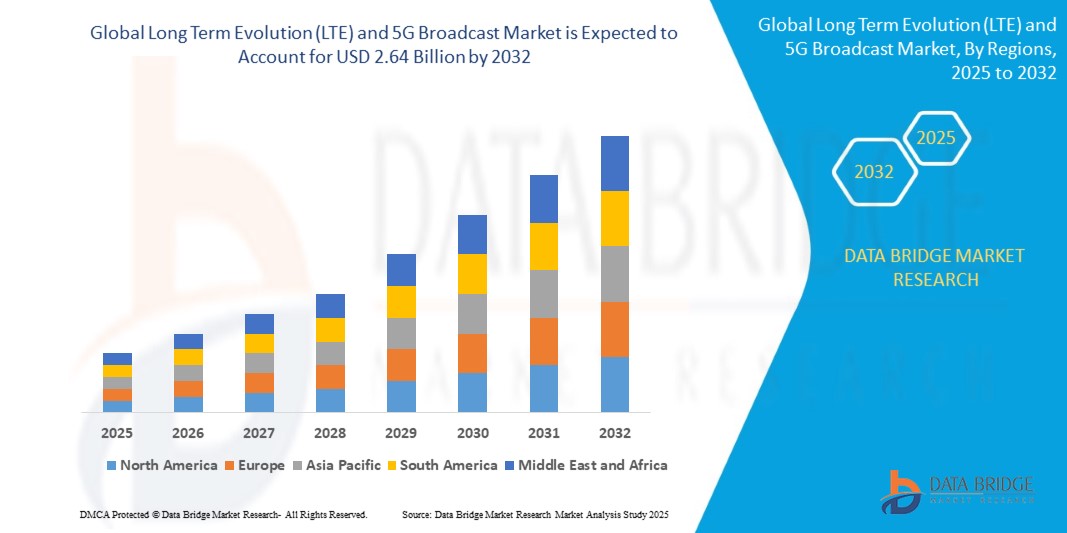
Long Term Evolution (LTE) and 5G Broadcast Market Size
- The Global LTE and 5G Broadcast Market was valued at USD 0.74 billion in 2024 and is projected to reach USD 2.64 billion by 2032, growing at a robust CAGR of 19.93% during the forecast period.
- Market growth is driven by increasing demand for high-quality mobile video streaming, network efficiency, and the evolution of next-generation mobile broadcasting standards.
Long Term Evolution (LTE) and 5G Broadcast Market Analysis
- LTE and 5G Broadcast technologies enable one-to-many transmission, allowing operators to simultaneously deliver content (such as video, alerts, and software updates) to multiple users without congesting the network.
- The shift from traditional unicast models to broadcast/multicast-based delivery is revolutionizing how data-heavy services like live sports, public warnings, and connected car infotainment systems operate over mobile networks.
- With the rollout of 5G infrastructure, telecom providers are investing in 5G Broadcast trials to address latency-sensitive applications like mobile TV, real-time navigation updates, and immersive media.
- Government agencies are exploring 5G Broadcast for emergency alerting, particularly in natural disaster zones or dense urban populations, to ensure mass communication in low-coverage or high-demand scenarios.
- The convergence of edge computing, AI, and broadcast networks is also enabling personalized broadcast content, enhancing user engagement while minimizing bandwidth use.
Report Scope and Long Term Evolution (LTE) and 5G Broadcast Market Segmentation
|
Attributes |
Long Term Evolution (LTE) and 5G Broadcast Market Key Market Insights |
|
Segments Covered |
|
|
Countries Covered |
North America
Europe
Asia-Pacific
Middle East and Africa
South America
|
|
Key Market Players |
|
|
Market Opportunities |
|
|
Value Added Data Infosets |
In addition to the insights on market scenarios such as market value, growth rate, segmentation, geographical coverage, and major players, the market reports curated by the Data Bridge Market Research also include import export analysis, production capacity overview, production consumption analysis, price trend analysis, climate change scenario, supply chain analysis, value chain analysis, raw material/consumables overview, vendor selection criteria, PESTLE Analysis, Porter Analysis, and regulatory framework. |
Long Term Evolution (LTE) and 5G Broadcast Market Trends
Convergence of Broadcast and Telecom Networks through Virtualization, AI, and Edge
- Virtualized and Cloud-Native Core Broadcast Solutions: Telecom providers are adopting cloud-native 5G broadcast cores with network function virtualization (NFV) to enable scalable, software-based media delivery across diverse user devices.
- Integration of AI and Analytics in Broadcast: AI is being used to predict broadcast demand, optimize spectrum usage, and personalize user experiences. Predictive analytics also supports dynamic switching between broadcast and unicast modes.
- 5G Broadcast Trials for Mass Media Delivery: Operators in Europe, Asia, and North America are running pilot deployments of 5G Broadcast, targeting applications such as live mobile TV, interactive learning, and public warning systems.
- Edge-Powered Content Delivery Networks (CDNs): Combining MEC (Multi-access Edge Computing) with 5G Broadcast allows ultra-fast, localized content delivery—minimizing latency for VR/AR, mobile gaming, and immersive experiences.
- Rise of Mobile-Only Media Consumption: The broadcast industry is shifting toward mobile-first strategies, leveraging LTE/5G Broadcast to deliver high-quality, buffer-free video and live news in areas with fluctuating data bandwidth.
Long Term Evolution (LTE) and 5G Broadcast Market Dynamics
Driver
Surging Demand for Seamless Video Delivery and Emergency Communication Infrastructure
- With mobile video expected to account for over 70% of global mobile data traffic, LTE and 5G broadcast provide an efficient way to offload data-intensive content, improving network throughput and user satisfaction.
- Governments are investing in next-generation public alerting systems that leverage LTE and 5G Broadcast to deliver emergency notifications, even when mobile networks are congested or offline.
- Growth in smart mobility, connected vehicles, and infotainment systems is creating new use cases for broadcasting maps, firmware, and traffic alerts to millions of vehicles simultaneously
- The ability to monetize broadcast channels via advertising and premium content delivery—especially for sports, concerts, and e-learning modules—offers telecom operators new revenue streams.
Restraint/Challenge
Spectrum Allocation, Infrastructure Costs, and Device Compatibility Gaps
- Limited availability of UHF spectrum in many regions restricts wide-scale 5G Broadcast deployment, particularly in countries where legacy TV or military spectrum usage dominates.
- High initial capital expenditure for infrastructure upgrades, including broadcast towers, transmitters, and cloud integration, can deter smaller telecom operators from adoption.
- Device ecosystem readiness remains a barrier, as not all smartphones or connected devices support 5G Broadcast reception or related middleware.
- Regulatory fragmentation across countries in terms of broadcast licensing, spectrum sharing, and network neutrality creates deployment hurdles for global operators.
Long Term Evolution (LTE) and 5G Broadcast Market Scope
The market is segmented by technology, deployment mode, end use, and application, reflecting evolving use cases across telecom, public safety, and infotainment.
• By Technology
Includes LTE Broadcast and 5G Broadcast. 5G Broadcast is expected to witness the fastest growth from 2025 to 2032, driven by enhanced spectral efficiency, support for ultra-HD content, and broadcast over unlicensed bands. LTE Broadcast remains relevant for legacy systems and existing carrier networks.
• By Deployment Mode
Segmented into In-Band and Out-of-Band. In-band deployment dominates the market in 2025, as it allows use of existing LTE/5G spectrum for broadcast without additional infrastructure. However, out-of-band deployment is gaining traction for use cases like public alerting and media broadcasting on dedicated frequencies.
• By End Use
Covers Video on Demand, Emergency Alerts, Radio Broadcasting, Mobile TV, Connected Vehicles, and Others. Mobile TV and Video on Demand lead in 2025 due to rising smartphone usage, OTT content consumption, and demand for uninterrupted streaming. Connected Vehicles is a high-growth segment, leveraging broadcast for navigation, firmware updates, and real-time road condition alerts.
• By Application
Includes Media & Entertainment, Government, Transportation, Education, Energy & Utilities, and Others. Media & entertainment dominates due to the sector’s reliance on live streaming, interactive content, and sports broadcasting. Government applications, including emergency alerting and disaster response, are accelerating with national 5G deployments.
Long Term Evolution (LTE) and 5G Broadcast Market Regional Analysis
- North America leads the global market in 2025, driven by the early deployment of 5G infrastructure, ongoing public alerting modernization efforts, and partnerships among telecom giants and broadcasters (e.g., AT&T, Verizon, Sinclair Broadcast Group).
- Europe sees strong adoption led by countries like Germany, the U.K., and France, where 5G Broadcast trials, EU media distribution initiatives, and smart mobility projects are driving demand.
- Asia-Pacific is the fastest-growing region due to rapid urbanization, mobile-first content consumption, and aggressive spectrum planning in China, South Korea, India, and Japan. Telecom operators are exploring out-of-band 5G broadcasting for national alerting and e-learning.
- Middle East & Africa (MEA) is expanding its 5G footprint, with UAE, Saudi Arabia, and South Africa integrating LTE/5G broadcast into e-government services, emergency preparedness, and Hajj crowd management systems.
- South America, particularly Brazil and Mexico, is testing LTE-based broadcasting for rural education programs, digital TV augmentation, and disaster response coordination, amid 5G spectrum auctions.
United States
The U.S. leads in 2025 with ongoing deployments in smart cities, first responder networks, and automotive infotainment systems. The FCC actively supports trials of ATSC 3.0 and 5G Broadcast for public safety.
Germany
Germany is driving the European market through 5G Broadcast pilots for media streaming and transport alerts, supported by public-private collaborations and government-funded research.
South Korea
South Korea is a pioneer in 5G Broadcast integration, using it for real-time public transportation updates, live entertainment streaming, and school broadcast systems in smart campuses.
India
India is accelerating LTE Broadcast deployment across state disaster response units, rural TV distribution, and mobile government service delivery, particularly in underserved areas.
Brazil
Brazil is investing in broadcast spectrum utilization for agricultural content distribution, disaster warning, and mobile TV, with national policies supporting 5G spectrum reallocation.
Long Term Evolution (LTE) and 5G Broadcast Market Share
The Long Term Evolution (LTE) and 5G Broadcast industry is primarily led by well-established companies, including:
- Qualcomm Technologies, Inc. (U.S.)
- Huawei Technologies Co., Ltd. (China)
- Samsung Electronics Co., Ltd. (South Korea)
- Cisco Systems, Inc. (U.S.)
- AT&T Inc. (U.S.)
- Telefonaktiebolaget LM Ericsson (Sweden)
- ZTE Corporation (China)
- Nokia Corporation (Finland)
- Kaltura Inc. (U.S.)
- ENENSYS Technologies (France)
Latest Developments in Global Long Term Evolution (LTE) and 5G Broadcast Market
- In April 2025, Qualcomm Technologies Inc. announced the successful trial of 5G Broadcast technology over unlicensed spectrum, in collaboration with European broadcasters, paving the way for global commercial deployment in mobile TV and public safety applications.
- In March 2025, Rohde & Schwarz and Kathrein Broadcast GmbH launched a joint 5G Broadcast transmission system in Germany, aimed at enabling seamless over-the-air content delivery across rural and urban zones without requiring SIM cards or data plans.
- In February 2025, Huawei Technologies introduced a broadcast-as-a-service platform based on 5G NR, offering telecom operators a cloud-hosted suite for multimedia broadcasting, vehicle alerts, and localized education content.
- In January 2025, ENENSYS Technologies deployed a complete 5G Broadcast system with a public broadcaster in South Korea, supporting use cases such as video streaming, automotive updates, and mobile news services.
- In December 2024, Nokia Corporation partnered with an Asian telco to launch edge-powered 5G Broadcast trials for live sports streaming, improving bandwidth management during peak viewership hours at stadiums and public venues.

- Interactive Data Analysis Dashboard
- Company Analysis Dashboard for high growth potential opportunities
- Research Analyst Access for customization & queries
- Competitor Analysis with Interactive dashboard
- Latest News, Updates & Trend analysis
- Harness the Power of Benchmark Analysis for Comprehensive Competitor Tracking
Global Lte And 5g Broadcast Market, Supply Chain Analysis and Ecosystem Framework
To support market growth and help clients navigate the impact of geopolitical shifts, DBMR has integrated in-depth supply chain analysis into its Global Lte And 5g Broadcast Market research reports. This addition empowers clients to respond effectively to global changes affecting their industries. The supply chain analysis section includes detailed insights such as Global Lte And 5g Broadcast Market consumption and production by country, price trend analysis, the impact of tariffs and geopolitical developments, and import and export trends by country and HSN code. It also highlights major suppliers with data on production capacity and company profiles, as well as key importers and exporters. In addition to research, DBMR offers specialized supply chain consulting services backed by over a decade of experience, providing solutions like supplier discovery, supplier risk assessment, price trend analysis, impact evaluation of inflation and trade route changes, and comprehensive market trend analysis.
Data collection and base year analysis are done using data collection modules with large sample sizes. The stage includes obtaining market information or related data through various sources and strategies. It includes examining and planning all the data acquired from the past in advance. It likewise envelops the examination of information inconsistencies seen across different information sources. The market data is analysed and estimated using market statistical and coherent models. Also, market share analysis and key trend analysis are the major success factors in the market report. To know more, please request an analyst call or drop down your inquiry.
The key research methodology used by DBMR research team is data triangulation which involves data mining, analysis of the impact of data variables on the market and primary (industry expert) validation. Data models include Vendor Positioning Grid, Market Time Line Analysis, Market Overview and Guide, Company Positioning Grid, Patent Analysis, Pricing Analysis, Company Market Share Analysis, Standards of Measurement, Global versus Regional and Vendor Share Analysis. To know more about the research methodology, drop in an inquiry to speak to our industry experts.
Data Bridge Market Research is a leader in advanced formative research. We take pride in servicing our existing and new customers with data and analysis that match and suits their goal. The report can be customized to include price trend analysis of target brands understanding the market for additional countries (ask for the list of countries), clinical trial results data, literature review, refurbished market and product base analysis. Market analysis of target competitors can be analyzed from technology-based analysis to market portfolio strategies. We can add as many competitors that you require data about in the format and data style you are looking for. Our team of analysts can also provide you data in crude raw excel files pivot tables (Fact book) or can assist you in creating presentations from the data sets available in the report.













