


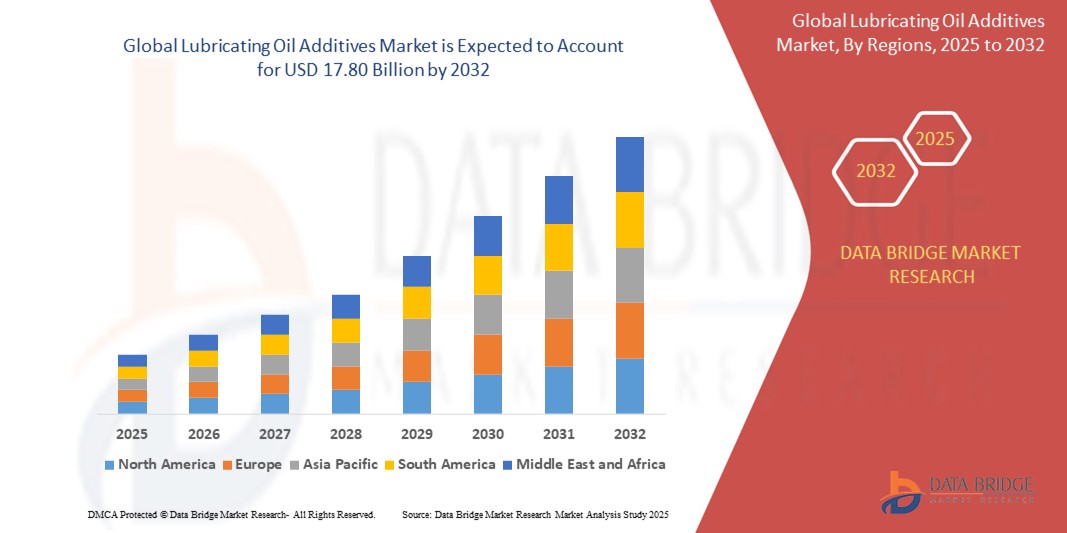
Lubricating Oil Additives Market Size
- The global lubricating oil additives market size was valued at USD 12.25 billion in 2024 and is projected to reach USD 17.80 billion by 2032, growing at a CAGR of 4.73% during the forecast period.
- The market's growth is primarily attributed to increasing automotive production, rising demand for high-performance lubricants, and the need for fuel efficiency and extended engine life in internal combustion engines.
Lubricating Oil Additives Market Analysis
- Lubricating oil additives are crucial chemical compounds blended with base oils to improve the performance and longevity of lubricants. They enhance properties such as viscosity, oxidation resistance, corrosion protection, and cleanliness, thereby improving engine efficiency and lifespan.
- The market is witnessing consistent growth, driven by the rising automotive fleet, increasing industrial machinery deployment, and stricter emissions and fuel economy regulations that necessitate high-quality lubricants.
- Asia-Pacific dominates the global lubricating oil additives market with a market share of 43.65%, attributed to rapid industrialization, growing automotive manufacturing, and high lubricant consumption in countries like China and India.
- North America is expected to witness significant growth during the forecast period due to increasing technological advancements in engine systems, demand for synthetic lubricants, and regulatory pressure to improve fuel efficiency.
- The Detergents segment is expected to lead the market with a share of 24.81%, owing to their critical role in neutralizing acidic contaminants and preventing deposit formation, especially in automotive and heavy-duty engine oils used in commercial transportation and industrial equipment.
Report Scope and Lubricating Oil Additives Market Segmentation
|
Attributes |
Lubricating Oil Additives Market Insights |
|
Segments Covered |
|
|
Countries Covered |
North America
Europe
Asia-Pacific
Middle East and Africa
South America
|
|
Key Market Players |
|
|
Market Opportunities |
|
|
Value Added Data Infosets |
In addition to the insights on market scenarios such as market value, growth rate, segmentation, geographical coverage, and major players, the market reports curated by the Data Bridge Market Research also include in-depth expert analysis, pricing analysis, brand share analysis, consumer survey, demography analysis, supply chain analysis, value chain analysis, raw material/consumables overview, vendor selection criteria, PESTLE Analysis, Porter Analysis, and regulatory framework. |
Lubricating Oil Additives Market Trends
“Growing Shift Toward Fuel-Efficient and Low-Emission Additive Formulations”
- One prominent trend in the global lubricating oil additives market is the growing shift toward fuel-efficient and low-emission additive formulations.
- This trend is driven by increasingly stringent emission norms globally, the automotive industry's push for enhanced fuel economy, and consumer demand for greener, cleaner lubricants.
- For instance, companies such as Chevron Oronite and Infineum are developing next-generation additive packages that reduce friction, minimize wear, and lower particulate emissions, supporting regulatory compliance and improving engine performance.
- The shift toward additive technologies that help extend drain intervals, improve oxidation stability, and enhance low-temperature performance is shaping innovation in the market.
- As OEMs adopt downsized engines and hybrid technologies, lubricating oil additives are being reformulated to maintain compatibility while delivering superior protection—positioning advanced, eco-conscious additive blends as a key growth driver.
Lubricating Oil Additives Market Dynamics
Driver
“Rising Demand for High-Performance Automotive Lubricants”
- The rising demand for high-performance automotive lubricants is a significant growth driver in the lubricating oil additives market.
- With modern engines requiring enhanced protection under higher operating temperatures and pressures, lubricant manufacturers are increasingly using advanced additives to meet performance benchmarks.
- This demand is particularly high in the passenger vehicle, commercial vehicle, and motorcycle segments, where longer oil change intervals, superior engine cleanliness, and low viscosity oils are becoming standard.
- For instance, Afton Chemical has introduced new friction modifiers and dispersants for passenger car motor oils (PCMO) that enhance fuel economy and reduce sludge formation under severe driving conditions.
- Similarly, Lubrizol Corporation offers high-performance anti-wear and antioxidant additives that improve the thermal stability and durability of engine oils used in commercial fleets.
- As the focus on engine efficiency, emission reduction, and longevity increases globally, the role of advanced additive systems in lubricant formulations is expected to expand significantly.
Restraint/Challenge
“Volatility in Raw Material Prices”
- Volatility in raw material prices poses a key challenge for the lubricating oil additives market.
- Many essential additive components—such as sulfurized olefins, zinc dialkyldithiophosphates (ZDDPs), and polyisobutenes—are derived from petrochemical feedstocks, making their costs sensitive to fluctuations in crude oil prices and global supply chains.
- For instance, the sharp rise in base oil and chemical input costs in recent years has pressured additive manufacturers and lubricant blenders, leading to pricing volatility and margin compression.
- Moreover, as manufacturers pursue more sustainable additive chemistries, the shift toward bio-based or less toxic alternatives increases production complexity and cost, limiting adoption in price-sensitive markets.
- Industries like construction equipment, marine, and agriculture, which often operate under tight cost controls, may find it challenging to adopt premium additive-enhanced lubricants, slowing market penetration.
- As cost efficiency remains a crucial buying factor, especially in emerging economies, managing raw material price volatility will be essential for sustaining long-term market growth.
Lubricating Oil Additives Market Scope
The market is segmented on the basis of type, application, and end-use industry.
- By Type
On the basis of type, the Lubricating Oil Additives market is segmented into Detergents, Dispersants, Viscosity Index Improvers, Anti-Wear Agents, Antioxidants, Corrosion Inhibitors, Friction Modifiers, Emulsifiers, and Others. The Detergents segment accounted for the largest market revenue share of 25.3% in 2025, driven by their critical role in neutralizing acidic contaminants and preventing deposit formation in engines and machinery. The widespread use of detergents in both automotive and industrial lubricants contributes to their dominance.
However, the Friction Modifiers segment is expected to register the highest CAGR of 6.87% during the forecast period (2025–2032). This projected growth is fueled by the increasing demand for fuel-efficient engine oils that reduce internal friction, enhance energy efficiency, and support emission reduction targets. The shift toward low-viscosity lubricants in modern engines further accelerates the adoption of advanced friction-modifying additives.
- By Application
On the basis of application, the Lubricating Oil Additives market is segmented into Automotive Oils, Industrial Oils, Hydraulic Fluids, Metalworking Fluids, and Others. The Automotive Oils segment held the largest market share of 38.4% in 2025, due to the extensive use of additive-enhanced lubricants in passenger cars, commercial vehicles, and motorcycles. The ongoing shift toward high-performance engine oils that meet stringent emission norms and extended drain intervals continues to drive segment growth.
Meanwhile, the Hydraulic Fluids segment is projected to witness the highest CAGR of 6.93% during 2025–2032, as industries increasingly demand high-pressure systems with reliable fluid stability and anti-wear performance. The use of additives in hydraulic fluids to enhance viscosity control, reduce wear, and prevent oxidation is contributing to rapid growth in this segment, particularly across industrial automation and heavy machinery applications.
- By End-Use Industry
On the basis of end-use industry, the Lubricating Oil Additives market is categorized into Automotive, Industrial Manufacturing, Marine, Aviation, and Others. The Automotive segment dominates the market with the largest revenue share of 41.6% in 2025, supported by the robust demand for fuel-efficient, low-emission lubricants in internal combustion engines and hybrid powertrains. The rising global vehicle parc and increasing focus on vehicle maintenance are key factors driving this segment.
However, the Marine segment is anticipated to record the highest CAGR of 7.01% during the forecast period, as maritime regulations, such as IMO 2020, push ship operators to adopt high-performance lubricants with enhanced deposit control, wear protection, and cleaner combustion. The transition to low-sulfur fuels and environmentally acceptable lubricants (EALs) is further boosting the use of specialized additive formulations in the marine sector.
Global Lubricating Oil Additives Market Regional Analysis
North America Lubricating Oil Additives Market Insight
North America holds a prominent share in the global lubricating oil additives market, supported by a mature automotive industry, well-established industrial base, and stringent regulations surrounding fuel economy and emission standards. The region’s focus on enhancing engine performance and extending oil drain intervals is driving significant demand for additive-enhanced lubricants across various applications. Increasing demand for premium-quality lubricants in automotive and heavy-duty machinery, along with rising adoption of synthetic and semi-synthetic oils, continues to propel market growth.
- U.S. Lubricating Oil Additives Market Insight
The U.S. dominates the North American lubricating oil additives market in terms of revenue share in 2025, driven by strong demand for high-performance automotive and industrial lubricants. Regulatory mandates from EPA and fuel efficiency standards by CAFE have encouraged the widespread use of advanced additives such as antioxidants, detergents, and friction modifiers. Additionally, the presence of major lubricant and additive manufacturers in the U.S. supports domestic innovation and product development.
- Canada Lubricating Oil Additives Market Insight
The Canadian market is projected to expand steadily over the forecast period, aided by the growing penetration of synthetic lubricants in automotive and industrial applications. Canada’s mining, oil & gas, and manufacturing sectors rely heavily on machinery that requires robust lubrication solutions, supporting the adoption of additive-rich formulations. Moreover, the country’s focus on environmental compliance is increasing demand for biodegradable and low-toxicity lubricating oil additives.
Europe Lubricating Oil Additives Market Insight
The European lubricating oil additives market is anticipated to grow at a moderate yet steady CAGR, backed by tightening emission norms, rising demand for energy-efficient vehicles, and a strong emphasis on sustainability. As electric and hybrid vehicle adoption rises, lubricant formulations are evolving, creating a need for specialized additives that improve thermal stability and reduce wear under high-load, low-viscosity environments. Europe’s industrial automation and high-end manufacturing are also contributing to the demand for lubricants with improved oxidative stability and corrosion resistance.
- Germany Lubricating Oil Additives Market Insight
Germany represents a key market in Europe, driven by its advanced automotive and engineering sectors. German OEMs are at the forefront of innovation, demanding customized lubricant solutions with optimal performance. The strong focus on R&D, combined with increasing production of energy-efficient vehicles, is accelerating the demand for additives like viscosity index improvers, dispersants, and anti-wear agents.
- France Lubricating Oil Additives Market Insight
France is witnessing growing demand for lubricating oil additives, particularly in the automotive aftermarket and industrial maintenance segments. The country’s commitment to carbon neutrality and cleaner transportation has prompted the use of low-emission lubricants. Moreover, developments in wind, rail, and public transport infrastructure are driving the adoption of heavy-duty lubricants that require multifunctional additive packages for extended operational life.
Asia-Pacific Lubricating Oil Additives Market Insight
Asia-Pacific is expected to record the fastest CAGR exceeding 7.5% during 2025–2032, fueled by rapid industrialization, vehicle fleet expansion, and infrastructure growth across emerging economies. Increasing consumption of lubricants in both automotive and industrial machinery is creating robust demand for additive formulations that enhance oil performance under diverse climatic and operating conditions. The shift toward higher-quality engine oils, rising awareness of maintenance practices, and increasing use of automated machinery are boosting additive adoption across the region.
- China Lubricating Oil Additives Market Insight
China dominates the Asia-Pacific lubricating oil additives market, supported by the country's expansive automotive, construction, and industrial sectors. Government initiatives to reduce carbon emissions and boost fuel efficiency are driving the use of advanced lubricants containing multi-functional additives. Moreover, the rise of hybrid and electric vehicles is pushing innovation in additive technology to meet the evolving needs of new-age drivetrains.
- India Lubricating Oil Additives Market Insight
India is projected to experience significant growth in the lubricating oil additives market, driven by a rising vehicle population, expanding manufacturing base, and increased awareness of engine maintenance. As the country adopts stricter emission norms (e.g., BS-VI standards), demand is growing for additive-enhanced oils that improve combustion efficiency and reduce particulate matter. The emergence of local blending facilities and partnerships with global additive suppliers are further supporting market expansion.
Lubricating Oil Additives Market Share
The Lubricating Oil Additives industry is primarily led by well-established companies, including:
- Lubrizol Corporation (U.S.)
- Infineum International Ltd. (UK)
- Chevron Oronite Company LLC (U.S.
- Afton Chemical Corporation (U.S.)
- BASF SE (Germany)
- Evonik Industries AG (Germany)
- Croda International Plc (UK)
- Lanxess AG (Germany)
- Jiangsu Tianyin Chemical Industry Co., Ltd. (China)
- Sanyo Chemical Industries, Ltd. (Japan)
- Shenyang Tiancheng Chemical Co., Ltd. (China)
- MidContinental Chemical Company, Inc. (MCC) (U.S.)
- Kusalava International Ltd. (India)
- Wuxi South Petroleum Additive Co., Ltd. (China)
Latest Developments in Global Lubricating Oil Additives Market
- March 2025 – BASF (Germany) and Sika (Switzerland) jointly launched a new amine building block for epoxy resin curing under the Baxxodur EC 151 brand. This product addresses increasing demand in flooring applications across industrial and commercial environments—such as production facilities, warehouses, and parking structures—offering superior performance and reliability. The collaboration enhances both companies’ positions in the epoxy Lubricating Oil Additives segment.
- September 2024 – Evonik Industries AG (Germany) expanded its curing agent product line in the Americas with the introduction of Ancamide 2853 and Ancamide 2865, two polyamide-based epoxy Lubricating Oil Additives. These products offer improved flexibility, mechanical strength, and environmental safety, enabling Evonik to strengthen its market share in the coatings sector and better serve regulatory and performance demands in the region.
- April 2024 – Evonik Industries AG (Germany) launched Ancamine 2844, a high-functionality aliphatic amine hardener developed for multi-component spray applications. Known for its ultra-fast curing under low temperatures and high humidity, Ancamine 2844 is tailored for marine and protective coatings where quick turnaround and surface durability are essential. This innovation reinforces Evonik’s leadership in performance-oriented curing agent solutions.

- Interactive Data Analysis Dashboard
- Company Analysis Dashboard for high growth potential opportunities
- Research Analyst Access for customization & queries
- Competitor Analysis with Interactive dashboard
- Latest News, Updates & Trend analysis
- Harness the Power of Benchmark Analysis for Comprehensive Competitor Tracking
Global Lubricating Oil Additives Market, Supply Chain Analysis and Ecosystem Framework
To support market growth and help clients navigate the impact of geopolitical shifts, DBMR has integrated in-depth supply chain analysis into its Global Lubricating Oil Additives Market research reports. This addition empowers clients to respond effectively to global changes affecting their industries. The supply chain analysis section includes detailed insights such as Global Lubricating Oil Additives Market consumption and production by country, price trend analysis, the impact of tariffs and geopolitical developments, and import and export trends by country and HSN code. It also highlights major suppliers with data on production capacity and company profiles, as well as key importers and exporters. In addition to research, DBMR offers specialized supply chain consulting services backed by over a decade of experience, providing solutions like supplier discovery, supplier risk assessment, price trend analysis, impact evaluation of inflation and trade route changes, and comprehensive market trend analysis.
Data collection and base year analysis are done using data collection modules with large sample sizes. The stage includes obtaining market information or related data through various sources and strategies. It includes examining and planning all the data acquired from the past in advance. It likewise envelops the examination of information inconsistencies seen across different information sources. The market data is analysed and estimated using market statistical and coherent models. Also, market share analysis and key trend analysis are the major success factors in the market report. To know more, please request an analyst call or drop down your inquiry.
The key research methodology used by DBMR research team is data triangulation which involves data mining, analysis of the impact of data variables on the market and primary (industry expert) validation. Data models include Vendor Positioning Grid, Market Time Line Analysis, Market Overview and Guide, Company Positioning Grid, Patent Analysis, Pricing Analysis, Company Market Share Analysis, Standards of Measurement, Global versus Regional and Vendor Share Analysis. To know more about the research methodology, drop in an inquiry to speak to our industry experts.
Data Bridge Market Research is a leader in advanced formative research. We take pride in servicing our existing and new customers with data and analysis that match and suits their goal. The report can be customized to include price trend analysis of target brands understanding the market for additional countries (ask for the list of countries), clinical trial results data, literature review, refurbished market and product base analysis. Market analysis of target competitors can be analyzed from technology-based analysis to market portfolio strategies. We can add as many competitors that you require data about in the format and data style you are looking for. Our team of analysts can also provide you data in crude raw excel files pivot tables (Fact book) or can assist you in creating presentations from the data sets available in the report.













