


Luminescent Solar Concentrator Cell (Lsc) Market Overview
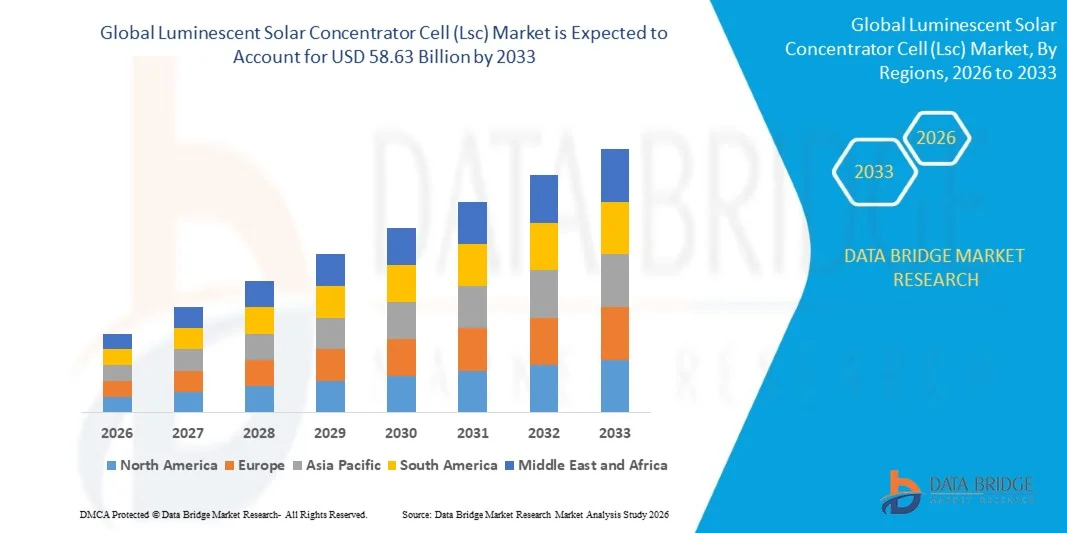
As per Data Bridge Market Research Analysis the luminescent solar concentrator cell (Lsc) market was valued at USD 7.55 billion in 2025 and is projected to reach USD 58.63 billion by 2033, growing at a CAGR of 29.20% from 2026 to 2033. The market is experiencing rapid expansion fueled by the increasing demand for building-integrated photovoltaics (BIPV), technological advancements in luminescent materials, and growing investments in sustainable energy infrastructure. The ability of LSCs to capture both direct and diffuse light makes them particularly attractive for urban settings where space for traditional solar panels is limited.
A significant competitive advantage of LSCs lies in their unique capacity to harness both direct sunlight and diffuse, scattered light. This inherent capability makes them exceptionally well-suited for dense urban environments, where rooftop space for conventional solar panels is often scarce or non-existent. By seamlessly integrating into windows, facades, and other building surfaces, LSCs offer a versatile and aesthetically pleasing solution, effectively turning entire cityscapes into potential solar energy harvesting zones without competing for valuable land use.
Market Size & Forecast
- Market Value (2025): USD 7.55 Billion
- Expected Market Value (2033): USD 58.63 Billion
- Forecast CAGR (2026–2033): 29.20%
- Leading Region in 2025: Asia-Pacific
- Fastest Growing Region: North America
Key Market Trends & Insights
- Asia-Pacific dominated the luminescent solar concentrator cell (LSC) market with the largest revenue share of 43% in 2025, supported by rapid urbanization, increasing renewable energy investments, and expanding green building initiatives across China, Japan, South Korea, and India.
- North America luminescent solar concentrator cell (LSC) market is expected to witness the fastest growth rate from 2026 to 2033, supported by strong investments in advanced photovoltaic technologies, increasing deployment of building-integrated photovoltaics (BIPV), and growing demand for sustainable building materials.
- The plastic/glass segment held the largest market revenue share in 2025, driven by its role as the primary light-guiding substrate in LSC systems and its extensive adoption in building-integrated photovoltaic (BIPV) glazing applications. High optical transparency, durability, and compatibility with architectural installations continue to support the dominance of this segment.
- The dye molecules segment is projected to register the fastest growth at a CAGR from 2026 to 2033, driven by continuous advancements in organic dyes, quantum dots, and perovskite luminescent materials that improve light absorption efficiency and energy conversion performance. Increasing research investments in next-generation luminescent materials are further accelerating segment growth.
- The construction companies/consortiums segment accounted for the largest market revenue share in 2025, driven by rising adoption of transparent photovoltaic façades, energy-efficient buildings, and commercial BIPV projects. Growing investments in green construction and net-zero buildings continue to strengthen demand from this segment.
- The national and local governments segment is expected to witness the fastest CAGR during the forecast period of 2026 to 2033, supported by increasing investments in renewable energy infrastructure, sustainable public buildings, and government-backed clean energy demonstration projects aimed at achieving carbon neutrality goals.
Report Scope and Luminescent Solar Concentrator Cell (Lsc) Market Segmentation
|
Attributes |
Luminescent Solar Concentrator Cell (Lsc) Key Market Insights |
|
Segments Covered |
|
|
Countries Covered |
North America
Europe
Asia-Pacific
Middle East and Africa
South America
|
|
Key Market Players |
|
|
Market Opportunities |
|
|
Value Added Data Infosets |
In addition to the insights on market scenarios such as market value, growth rate, segmentation, geographical coverage, and major players, the market reports curated by the Data Bridge Market Research also include in-depth expert analysis, geographically represented company-wise production and capacity, network layouts of distributors and partners, detailed and updated price trend analysis and deficit analysis of supply chain and demand. |
Luminescent Solar Concentrator Cell (Lsc) Market Trends
Trend: Rising Adoption Of Building-Integrated Photovoltaics And Transparent Solar Technologies
Growing demand for energy-efficient buildings, net-zero construction, and aesthetically integrated renewable energy systems is accelerating the adoption of luminescent solar concentrator (LSC) technologies across the construction and architectural sectors. Developers and building owners are increasingly exploring transparent and semi-transparent photovoltaic glazing that can generate electricity while maintaining daylight transmission, supporting green building certifications and reducing overall building energy consumption. Continuous advancements in quantum dots, luminescent materials, and transparent photovoltaic technologies are further improving the commercial viability of LSC-based solutions.
The rapid expansion of building-integrated photovoltaics (BIPV), smart windows, and sustainable urban infrastructure is creating sustained demand for LSC technologies worldwide. For instance, in May 2024, UbiQD announced a strategic collaboration with First Solar to explore the use of quantum dot technology in advanced photovoltaic applications, strengthening commercialization efforts for next-generation solar materials. The collaboration reflects increasing industry investment in advanced light-harvesting technologies that support higher photovoltaic efficiency and broader solar deployment.
The increasing adoption of transparent solar technologies and continued investments in advanced photovoltaic materials are expected to reinforce long-term demand for luminescent solar concentrator cells, positioning manufacturers to benefit from the growing deployment of energy-generating building materials.
Luminescent Solar Concentrator Cell (LSC) Market Dynamics
Key Market Driver: Increasing Demand For Building-Integrated Renewable Energy Solutions
Governments, commercial developers, and the construction industry continue to prioritize low-carbon buildings and distributed renewable energy generation. Building owners are increasingly adopting photovoltaic façade systems, solar glazing, and energy-generating windows to improve building sustainability while complying with stringent energy-efficiency regulations. These trends are encouraging technology developers to accelerate commercialization of luminescent solar concentrator solutions for architectural applications.
Major industry participants continue investing in transparent photovoltaic innovation to meet evolving market requirements. For instance, in January 2024, Ubiquitous Energy announced the commercial launch of UE Power, its transparent photovoltaic glass technology designed for windows that generate renewable electricity while preserving transparency for buildings. The commercialization demonstrates growing industry confidence in transparent solar technologies and their role in the future of sustainable construction.
As investment in green buildings and energy-efficient infrastructure continues to expand globally, LSC manufacturers are expected to benefit from sustained demand driven by building-integrated photovoltaics, transparent solar glazing, and increasing renewable energy adoption.
Key Restraint/Challenge: High Commercialization Costs And Technology Scaling Challenges
Luminescent solar concentrator manufacturers continue to face challenges associated with scaling advanced materials, improving long-term durability, and reducing production costs. Commercial deployment requires significant investment in material development, manufacturing optimization, and compliance with building performance standards, while achieving competitive efficiencies compared with conventional photovoltaic technologies remains a critical challenge.
In addition, manufacturers must improve product longevity and manufacturing scalability before widespread market adoption. According to the International Energy Agency (IEA), building-integrated photovoltaics continue to face commercialization barriers related to higher installation costs, product standardization, and integration into existing construction practices despite strong long-term growth prospects.
Despite growing interest in transparent solar technologies, high manufacturing costs, material optimization challenges, and commercialization barriers are expected to remain significant restraints, limiting large-scale deployment throughout the forecast period.
Key Market Opportunity: Expansion Of Net-Zero Buildings And Smart Glass Applications
Governments, urban planners, and private developers are increasingly investing in net-zero buildings and sustainable infrastructure, creating substantial opportunities for transparent photovoltaic technologies. Luminescent solar concentrator cells offer strong potential due to their ability to integrate into windows, façades, skylights, and other architectural glass without significantly affecting aesthetics, supporting the transition toward energy-positive buildings.
Leading companies continue expanding investments in transparent photovoltaic commercialization. For instance, in September 2024, Glass to Power announced the launch of its first industrial production line for transparent photovoltaic glass designed for building-integrated applications, representing an important milestone in scaling LSC-related technologies for commercial markets.
As demand for energy-generating buildings and smart architectural materials continues to accelerate, expanding applications of luminescent solar concentrator cells across commercial buildings, residential projects, and urban infrastructure are expected to create substantial long-term growth opportunities for the global market.
Luminescent Solar Concentrator Cell (Lsc) Market Scope
The market is segmented on the basis of component, end-user, and application.
- By Component
On the basis of component, the luminescent solar concentrator cell (LSC) market is segmented into plastic/glass, dye molecules, solar cells, cables, frame, and LSC plates. The plastic/glass segment held the largest market revenue share in 2025, driven by its role as the primary light-guiding substrate in LSC systems and its extensive adoption in building-integrated photovoltaic (BIPV) glazing applications. High optical transparency, durability, and compatibility with architectural installations continue to support the dominance of this segment.
The dye molecules segment is projected to register the fastest growth at a CAGR from 2026 to 2033, driven by continuous advancements in organic dyes, quantum dots, and perovskite luminescent materials that improve light absorption efficiency and energy conversion performance. Increasing research investments in next-generation luminescent materials are further accelerating segment growth.
- By End-User
On the basis of end-user, the luminescent solar concentrator cell (LSC) market is segmented into national and local governments, municipalities, and construction companies/consortiums. The construction companies/consortiums segment accounted for the largest market revenue share in 2025, driven by rising adoption of transparent photovoltaic façades, energy-efficient buildings, and commercial BIPV projects. Growing investments in green construction and net-zero buildings continue to strengthen demand from this segment.
The national and local governments segment is expected to witness the fastest CAGR during the forecast period of 2026 to 2033, supported by increasing investments in renewable energy infrastructure, sustainable public buildings, and government-backed clean energy demonstration projects aimed at achieving carbon neutrality goals.
- By Application
On the basis of application, the luminescent solar concentrator cell (LSC) market is segmented into noise barrier, renewable energy generation, and others. The renewable energy generation segment dominated the market with the largest revenue share in 2025, driven by increasing deployment of LSC technology in building-integrated photovoltaics, smart windows, greenhouse roofs, and energy-generating glass systems. Growing demand for distributed solar energy solutions continues to support segment leadership.
The noise barrier segment is anticipated to register the fastest CAGR from 2026 to 2033, driven by increasing installation of photovoltaic noise barriers along highways and railways, particularly across Europe and Asia-Pacific, where governments are integrating renewable energy generation with transportation infrastructure development.
Luminescent Solar Concentrator Cell (Lsc) Market Regional Analysis
Asia-Pacific Luminescent Solar Concentrator Cell (LSC) Market Insight
The Asia-Pacific dominated the luminescent solar concentrator cell (LSC) market with the largest revenue share of 43% in 2025, supported by rapid urbanization, increasing renewable energy investments, and expanding green building initiatives across China, Japan, South Korea, and India. Rising construction of smart cities, favorable government policies promoting solar energy, and growing manufacturing capabilities for photovoltaic components are accelerating regional market growth.
Japan Luminescent Solar Concentrator Cell (LSC) Market Insight
Japan luminescent solar concentrator cell (LSC) market is expected to witness the fastest growth rate from 2026 to 2033 due to the country's strong focus on advanced materials research, energy-efficient buildings, and next-generation photovoltaic technologies. Increasing deployment of smart buildings, investments in transparent solar windows, and government initiatives supporting carbon-neutral infrastructure are expected to drive demand for LSC technologies across commercial and institutional applications.
China Luminescent Solar Concentrator Cell (LSC) Market Insight
The China luminescent solar concentrator cell (LSC) market accounted for the largest market revenue share in Asia-Pacific in 2025, attributed to the country's dominant photovoltaic manufacturing industry, expanding green building sector, and significant investments in renewable energy infrastructure. Strong government support for clean energy deployment, rapid urban development, and increasing adoption of building-integrated photovoltaic technologies continue to position China as the leading regional market for luminescent solar concentrator cell applications.
North America Luminescent Solar Concentrator Cell (LSC) Market
North America luminescent solar concentrator cell (LSC) market is expected to witness the fastest growth rate from 2026 to 2033, supported by strong investments in advanced photovoltaic technologies, increasing deployment of building-integrated photovoltaics (BIPV), and growing demand for sustainable building materials. The region benefits from extensive research and development activities, favorable clean energy policies, and the presence of leading innovators developing transparent photovoltaic and quantum dot technologies. Rising adoption of net-zero energy buildings and smart infrastructure projects continues to strengthen market growth across commercial and institutional sectors.
U.S. Luminescent Solar Concentrator Cell (LSC) Market Insight
The U.S. luminescent solar concentrator cell (LSC) market is expected to witness the fastest growth rate from 2026 to 2033, driven by rapid commercialization of transparent solar technologies and increasing investments in energy-efficient buildings. Strong collaboration between technology developers, universities, and clean energy companies is accelerating product innovation. Growing adoption of photovoltaic glass, supportive federal clean energy incentives, and expanding investments in sustainable construction continue to propel market expansion across residential and commercial applications.
Europe Luminescent Solar Concentrator Cell (LSC) Market Insight
Europe luminescent solar concentrator cell (LSC) market is expected to witness the fastest growth rate from 2026 to 2033, primarily driven by ambitious carbon neutrality targets, stringent building energy regulations, and increasing adoption of building-integrated photovoltaic systems. Rising investments in smart cities, green construction, and renewable energy infrastructure are accelerating the deployment of transparent solar glazing and advanced photovoltaic materials across residential and commercial developments.
U.K. Luminescent Solar Concentrator Cell (LSC) Market Insight
The U.K. luminescent solar concentrator cell (LSC) market is expected to witness the fastest growth rate from 2026 to 2033, driven by increasing investments in low-carbon buildings, net-zero construction initiatives, and sustainable urban development. Government support for renewable energy technologies, coupled with rising demand for energy-efficient commercial buildings and innovative glazing solutions, is expected to encourage wider adoption of LSC technologies throughout the forecast period.
Germany Luminescent Solar Concentrator Cell (LSC) Market Insight
Germany luminescent solar concentrator cell (LSC) market is expected to witness the fastest growth rate from 2026 to 2033, fueled by the country's leadership in photovoltaic innovation, advanced manufacturing capabilities, and strong emphasis on sustainable construction. Growing deployment of energy-generating façades, increasing investment in building-integrated photovoltaics, and continuous research into advanced luminescent materials are supporting market expansion across residential, commercial, and public infrastructure projects.
Luminescent Solar Concentrator Cell (Lsc) Market Share
The luminescent solar concentrator cell (Lsc) industry is primarily led by well-established companies, including:
- UbiQD, Inc. (U.S.)
- Glass to Power S.p.A. (Italy)
- Ubiquitous Energy, Inc. (U.S.)
- Soliculture, Inc. (U.S.)
- Exeger Operations AB (Sweden)
- AGC Inc. (Japan)
- Covestro AG (Germany)
- Merck KGaA (Germany)
- Saint-Gobain S.A. (France)
- Solvay S.A. (Belgium)
- Solaronix SA (Switzerland)
- LightnTec GmbH (Germany)
- Lucent Optics, Inc. (U.S.)
- Onyx Solar Group S.L. (Spain)
- aqmaterials GmbH (Germany)
Latest Developments in Luminescent Solar Concentrator Cell (Lsc) Market
- In October 2025, A comprehensive review on liquid luminescent solar concentrators was published in the journal Small, highlighting liquid LSCs as a promising alternative to conventional solid-state systems. The review emphasized their unique benefits including solution-processability, large-area coverage capability, self-healing potential, and material reusability, while addressing ongoing challenges such as stability, leakage, and contamination.
- In October 2025, A review article titled "Emerging Trends in Liquid Luminescent Solar Concentrators: Progress and Prospects" was published, providing comprehensive analysis of recent developments in liquid LSCs covering fundamental operating principles, key performance metrics, and major advances in luminescent materials, matrix design, and device architectures.
- In September 2025, Research on plasmon-coupled luminescent solar concentrators was conducted by the University of Cambridge through the EU-funded PLECTRA project. The project aims to understand, control, and harness light scattering mechanisms to design more efficient LSCs for building-integrated photovoltaics using plasmon-enhanced photoluminescence technology.
- In September 2025, A study on high-performance photovoltaic roof systems incorporating efficient LSCs was published in Energy Science & Engineering. The research demonstrated an optoelectronic conversion efficiency of 10.89% for an LSC device with dimensions of 32×32 cm², showing promising applications for building-integrated photovoltaics. The photovoltaic roof system achieved an annual power generation capacity of 22,152 kWh.
- In August 2025, A review on luminescent solar concentrators for light concentration was published, focusing on perovskite nanocrystals as luminophores due to their tunable optical properties, high photoluminescence quantum yield, and broad absorption spectrum. The research discussed challenges such as reabsorption losses, photodegradation, stability issues, and strategies to overcome them through dual-doping techniques and advanced fabrication methods.

- Interactive Data Analysis Dashboard
- Company Analysis Dashboard for high growth potential opportunities
- Research Analyst Access for customization & queries
- Competitor Analysis with Interactive dashboard
- Latest News, Updates & Trend analysis
- Harness the Power of Benchmark Analysis for Comprehensive Competitor Tracking
Global Luminescent Solar Concentrator Cell Lsc Market, Supply Chain Analysis and Ecosystem Framework
To support market growth and help clients navigate the impact of geopolitical shifts, DBMR has integrated in-depth supply chain analysis into its Global Luminescent Solar Concentrator Cell Lsc Market research reports. This addition empowers clients to respond effectively to global changes affecting their industries. The supply chain analysis section includes detailed insights such as Global Luminescent Solar Concentrator Cell Lsc Market consumption and production by country, price trend analysis, the impact of tariffs and geopolitical developments, and import and export trends by country and HSN code. It also highlights major suppliers with data on production capacity and company profiles, as well as key importers and exporters. In addition to research, DBMR offers specialized supply chain consulting services backed by over a decade of experience, providing solutions like supplier discovery, supplier risk assessment, price trend analysis, impact evaluation of inflation and trade route changes, and comprehensive market trend analysis.
Data collection and base year analysis are done using data collection modules with large sample sizes. The stage includes obtaining market information or related data through various sources and strategies. It includes examining and planning all the data acquired from the past in advance. It likewise envelops the examination of information inconsistencies seen across different information sources. The market data is analysed and estimated using market statistical and coherent models. Also, market share analysis and key trend analysis are the major success factors in the market report. To know more, please request an analyst call or drop down your inquiry.
The key research methodology used by DBMR research team is data triangulation which involves data mining, analysis of the impact of data variables on the market and primary (industry expert) validation. Data models include Vendor Positioning Grid, Market Time Line Analysis, Market Overview and Guide, Company Positioning Grid, Patent Analysis, Pricing Analysis, Company Market Share Analysis, Standards of Measurement, Global versus Regional and Vendor Share Analysis. To know more about the research methodology, drop in an inquiry to speak to our industry experts.
Data Bridge Market Research is a leader in advanced formative research. We take pride in servicing our existing and new customers with data and analysis that match and suits their goal. The report can be customized to include price trend analysis of target brands understanding the market for additional countries (ask for the list of countries), clinical trial results data, literature review, refurbished market and product base analysis. Market analysis of target competitors can be analyzed from technology-based analysis to market portfolio strategies. We can add as many competitors that you require data about in the format and data style you are looking for. Our team of analysts can also provide you data in crude raw excel files pivot tables (Fact book) or can assist you in creating presentations from the data sets available in the report.













