What is the Luxury Activewear Market Size and Growth Rate ?
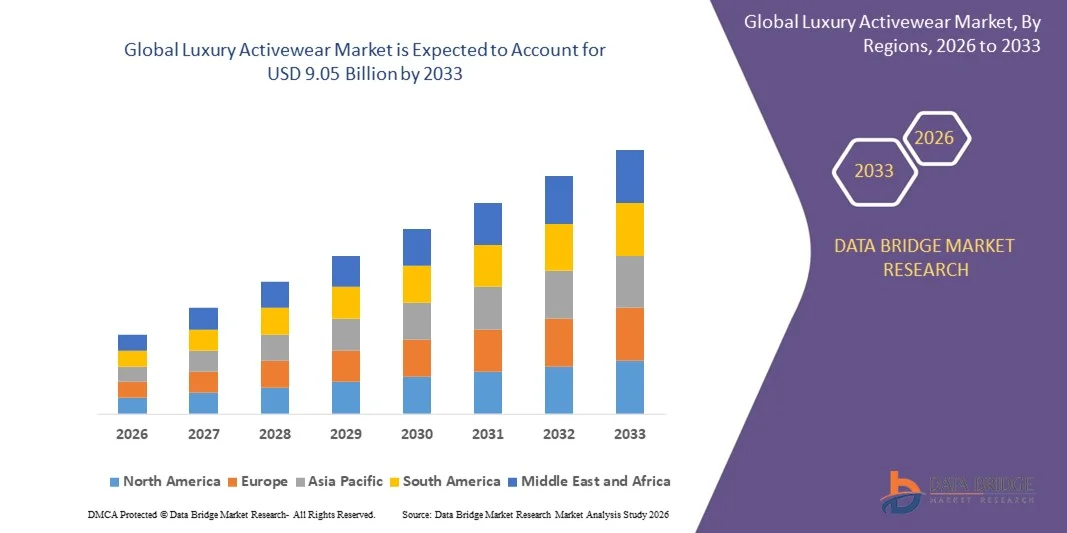
- As per Data Bridge Market Research Analysis the Global luxury activewear market size was valued at USD 5.89 billion in 2025 and is expected to reach USD 9.05 billion by 2033, at a CAGR of 5.5% during the forecast period
- The market growth is largely fueled by the growing adoption of athleisure trends and the rising focus on health, fitness, and wellness among consumers, leading to increased demand for premium, stylish, and functional activewear across urban and metropolitan areas
- Furthermore, rising consumer preference for high-performance, comfortable, and fashion-forward apparel is establishing luxury activewear as a wardrobe staple for both workout and casual lifestyle purposes. These converging factors are accelerating the uptake of premium activewear, thereby significantly boosting the industry’s growth.
Market Size & Forecast
- Global Market Value (2025): USD 5.89 Billion
- Expected Market Value (2033): USD 9.05 Billion
- Forecast CAGR (2026–2033): 5.5%
Luxury Activewear Market Analysis
- Luxury activewear, offering high-quality fabrics, advanced performance features, and stylish designs, is increasingly becoming an essential component of both fitness and everyday fashion for men, women, and kids due to its blend of functionality, comfort, and aesthetics
- The escalating demand for luxury activewear is primarily fueled by increasing health consciousness, growing disposable incomes, and the influence of social media and celebrity endorsements, which are driving consumer preference for branded, premium, and sustainable activewear options
- North America dominated luxury activewear market with a share of over 40% in 2025, due to rising fitness awareness, the growing athleisure trend, and high disposable incomes among consumers
- Asia-Pacific is expected to be the fastest growing region in the luxury activewear market during the forecast period due to rising urbanization, increasing disposable incomes, and growing health and fitness awareness in countries such as China, Japan, and India
- Top activewear segment dominated the market with a market share of 39% in 2025, due to its essential role in consumers’ workout routines and the rising trend of athleisure. Tops such as performance t-shirts, sports bras, and hoodies are widely preferred for their versatility, comfort, and style appeal. Consumers increasingly prioritize moisture-wicking, stretchable, and breathable tops, enhancing workout efficiency and everyday wearability. Brands focusing on premium fabric technologies and stylish designs contribute to the high adoption of top activewear. The market also benefits from collaborations with celebrities and influencers promoting luxury active tops, further increasing consumer demand. Overall, tops remain a core product category sustaining market revenue growth.
Report Scope and Luxury Activewear Market Segmentation
|
Attributes |
Luxury Activewear Key Market Insights |
|
Segments Covered |
|
|
Countries Covered |
North America
Europe
Asia-Pacific
Middle East and Africa
South America
|
|
Key Market Players |
|
|
Market Opportunities |
|
|
Value Added Data Infosets |
In addition to the insights on market scenarios such as market value, growth rate, segmentation, geographical coverage, and major players, the market reports curated by the Data Bridge Market Research also include in-depth expert analysis, pricing analysis, brand share analysis, consumer survey, demography analysis, supply chain analysis, value chain analysis, raw material/consumables overview, vendor selection criteria, PESTLE Analysis, Porter Analysis, and regulatory framework. |
What is the Key Trend in Luxury Activewear Market ?
Rising Adoption of Athleisure and Lifestyle-Oriented Activewear
- A major trend shaping the global luxury activewear market is the increasing consumer preference for athleisure and lifestyle-oriented activewear, which blends performance, comfort, and fashion for both workouts and casual wear. This shift is driving demand for versatile, high-quality garments that can be used across multiple occasions and settings
- For instance, Lululemon’s ABC Pant and Align collection have gained widespread popularity for combining technical performance with stylish everyday wear, appealing to both fitness enthusiasts and fashion-conscious consumers. Such launches are setting new standards for design and functionality in luxury activewear
- The growing interest in multifunctional activewear is encouraging brands to innovate with fabrics and design features that enhance comfort, flexibility, and durability. Consumers are increasingly seeking breathable, stretchable, and moisture-wicking garments that support both high-intensity exercise and daily lifestyle activities
- Collaborations between luxury fashion designers and activewear brands are further fueling this trend, as limited-edition collections create aspirational appeal and attract new consumer segments. These partnerships are enabling brands to differentiate themselves and strengthen their positioning in the competitive luxury segment
- The integration of social media and influencer marketing is amplifying visibility and adoption of athleisure products, with consumers often inspired by fitness and lifestyle influencers promoting both functionality and style. This digital influence is accelerating market penetration across online and offline channels
- The sustained preference for athleisure and lifestyle-oriented activewear is reshaping consumer expectations and encouraging continuous innovation in design, materials, and functionality, thereby supporting long-term growth in the luxury activewear market
Luxury Activewear Market Dynamics
Driver
Growing Health and Fitness Consciousness Among Consumers
- The increasing focus on health, wellness, and fitness among consumers is a significant driver of the luxury activewear market, as individuals seek apparel that supports active lifestyles and physical performance
- For instance, Nike’s premium training lines, including Nike Pro and Dri-FIT collections, have attracted health-conscious consumers looking for high-performance garments that enhance comfort and mobility during exercise. Such targeted offerings are boosting demand for luxury activewear
- The rise in participation across fitness activities such as yoga, running, and gym workouts is motivating consumers to invest in premium activewear that combines style with functional performance
- In addition, the growing awareness of the importance of quality fabrics, ergonomics, and sweat-management features is encouraging brands to develop innovative products that align with consumer expectations for performance and comfort
- Increasing disposable income and urban lifestyle trends are enabling consumers to spend on high-quality, branded activewear, supporting higher market growth and the expansion of the luxury segment
Restraint/Challenge
High Production Costs and Premium Pricing
- The high cost of sourcing premium fabrics, advanced materials, and incorporating innovative technologies significantly increases production expenses for luxury activewear, which can limit accessibility to price-sensitive consumers
- For instance, the use of sustainable fabrics such as recycled polyester and organic cotton by PUMA in its eco-conscious collections raises production costs while maintaining brand positioning in the premium segment. Such strategies, while enhancing brand value, can restrict mass-market penetration
- Maintaining a balance between performance, style, and affordability remains challenging for manufacturers, as high-quality materials and advanced designs contribute to higher retail prices
- The premium pricing associated with luxury activewear can hinder adoption in developing markets or among consumers prioritizing cost over brand or performance
- Overcoming these challenges requires strategic pricing, targeted marketing, and innovation in cost-efficient production techniques to sustain growth while retaining the perceived luxury appeal
Luxury Activewear Market Scope
The market is segmented on the basis of product type, material type, distribution channel, and end user.
- By Product Type
On the basis of product type, the luxury activewear market is segmented into top activewear, bottom activewear, innerwear, swimwear, and outerwear. The top activewear segment dominated the market with the largest market revenue share of 38.5% in 2025, driven by its essential role in consumers’ workout routines and the rising trend of athleisure. Tops such as performance t-shirts, sports bras, and hoodies are widely preferred for their versatility, comfort, and style appeal. Consumers increasingly prioritize moisture-wicking, stretchable, and breathable tops, enhancing workout efficiency and everyday wearability. Brands focusing on premium fabric technologies and stylish designs contribute to the high adoption of top activewear. The market also benefits from collaborations with celebrities and influencers promoting luxury active tops, further increasing consumer demand. Overall, tops remain a core product category sustaining market revenue growth.
The bottom activewear segment is anticipated to witness the fastest growth rate of 22.1% from 2026 to 2033, fueled by rising demand for high-performance leggings, joggers, and shorts in fitness and casual settings. For instance, Lululemon’s innovative leggings with advanced stretch and moisture control have driven consumer interest in premium bottom wear. The growing popularity of athleisure trends, coupled with the comfort and style appeal of luxury bottoms, supports this segment’s expansion. Bottom activewear is increasingly adopted across genders and age groups due to its versatility for gym workouts, outdoor activities, and leisurewear. Innovative designs and eco-friendly fabrics also contribute to the rising sales of bottoms. The segment’s growth is further supported by digital marketing campaigns and collaborations with fitness influencers, enhancing visibility and adoption in both online and offline channels.
- By Material Type
On the basis of material type, the luxury activewear market is segmented into nylon, polyester, cotton, neoprene, polypropylene, and spandex. The polyester segment dominated the market with the largest market revenue share of 36.7% in 2025, driven by its high durability, quick-drying properties, and suitability for performance apparel. Consumers often prefer polyester fabrics for their resistance to wear and tear, moisture-wicking capabilities, and ease of maintenance, making them ideal for both high-intensity workouts and casual athleisure. The popularity of polyester is further enhanced by its compatibility with prints, color variations, and fabric blends that offer enhanced comfort and style. Leading brands invest in advanced polyester technologies such as recycled and sustainable fibers, boosting consumer perception and demand. The segment also benefits from the growing interest in eco-conscious luxury activewear collections. Overall, polyester remains a preferred choice among consumers seeking performance, style, and longevity.
The spandex segment is expected to witness the fastest CAGR from 2026 to 2033, fueled by its exceptional stretchability and flexibility for workout apparel. For instance, Nike’s high-performance leggings and compression wear utilize spandex blends to offer maximum comfort and mobility during training. The increasing popularity of yoga, pilates, and high-intensity interval training supports the growing demand for spandex-based activewear. Its body-conforming properties, combined with durability and lightweight design, make it an ideal choice for both casual and performance-oriented consumers. Spandex is also gaining traction due to its compatibility with other premium fabrics, enhancing garment functionality and aesthetics. The segment’s growth is further bolstered by consumer preference for stylish, figure-enhancing activewear, particularly in women’s and unisex categories.
- By Distribution Channel
On the basis of distribution channel, the luxury activewear market is segmented into online stores and offline stores. The online stores segment dominated the market with the largest market revenue share in 2025, driven by the convenience of home delivery, wide product availability, and access to global luxury brands. Online retail platforms allow consumers to explore product variants, compare prices, and access exclusive collections not always available in physical stores. For instance, platforms such as Farfetch and Net-a-Porter have expanded their luxury activewear offerings, attracting a tech-savvy, convenience-seeking customer base. The online channel also benefits from virtual sizing tools, detailed product descriptions, and influencer marketing that drives engagement and sales. Enhanced e-commerce experiences, including loyalty programs and flexible returns, contribute to sustained online growth. In addition, the ongoing digital transformation and increasing smartphone penetration strengthen online sales.
The offline stores segment is expected to witness the fastest CAGR from 2026 to 2033, fueled by the experiential shopping trend and the desire for tactile evaluation of premium fabrics. Physical stores provide personalized services, in-store fittings, and interactive brand experiences that online channels cannot fully replicate. For instance, Lululemon’s flagship stores offer community fitness events and expert consultations, encouraging brand loyalty and repeat purchases. Consumers increasingly value the sensory experience of feeling fabric quality and trying products before purchase. The growth is further supported by premium retail expansions in metropolitan areas and luxury shopping districts. Offline stores also benefit from collaborations with fitness studios and wellness centers, increasing brand visibility and consumer engagement.
- By End User
On the basis of end user, the luxury activewear market is segmented into men, women, and kids. The women’s segment dominated the market with the largest market revenue share in 2025, driven by the increasing participation of women in fitness activities and the rising popularity of stylish, performance-oriented athleisure. Women’s activewear encompasses tops, bottoms, sports bras, and outerwear designed for both functionality and aesthetics. For instance, Adidas by Stella McCartney offers premium collections that combine high-performance fabrics with luxury design, attracting female consumers seeking both style and utility. The segment also benefits from social media influence, fashion collaborations, and rising health-consciousness among women. Luxury brands continuously innovate to cater to body diversity, comfort, and style preferences, boosting adoption. Overall, women remain the primary consumer group driving revenue growth in the luxury activewear segment.
The men’s segment is anticipated to witness the fastest CAGR from 2026 to 2033, fueled by increasing interest in fitness, gym culture, and athleisure fashion among male consumers. For instance, Under Armour’s premium performance wear for men, including compression tops and joggers, has expanded market penetration and popularity. Male consumers are increasingly seeking stylish, functional, and durable activewear for workouts, outdoor activities, and casual wear. The growth is also supported by marketing campaigns targeting male fitness enthusiasts and collaborations with sports personalities. Rising awareness of wellness trends and premium lifestyle choices further boosts adoption. The segment benefits from innovations in fabric technology, comfort, and modern aesthetics tailored to men’s preferences.
Luxury Activewear Market Regional Analysis
- North America dominated the luxury activewear market with the largest revenue share of over 40% in 2025, driven by rising fitness awareness, the growing athleisure trend, and high disposable incomes among consumers
- Consumers in the region highly value premium quality fabrics, stylish designs, and brand reputation, which influence purchasing decisions in both online and offline channels
- This widespread adoption is further supported by fitness-focused lifestyles, the popularity of boutique gyms and wellness centers, and increasing participation in outdoor and indoor sports, establishing luxury activewear as a preferred choice among health-conscious consumers
U.S. Luxury Activewear Market Insight
The U.S. luxury activewear market captured the largest revenue share in 2025 within North America, fueled by increasing interest in premium athleisure and activewear for both workout and casual wear. Consumers are prioritizing high-performance materials, comfort, and style, often seeking products that combine functionality with fashion appeal. For instance, brands offering moisture-wicking fabrics, stretchable leggings, and designer collaborations are witnessing strong demand. The rise of influencer-led marketing, social media fitness trends, and the integration of activewear into everyday lifestyle wardrobes further propels the market. In addition, the expanding e-commerce penetration and availability of exclusive online collections contribute to the growth of luxury activewear in the U.S.
Europe Luxury Activewear Market Insight
The Europe luxury activewear market is projected to expand at a substantial CAGR throughout the forecast period, primarily driven by increasing health consciousness and urban lifestyle trends. Consumers are seeking high-quality, sustainable, and fashionable activewear suitable for both fitness routines and casual outings. The growth is supported by the adoption of premium brands, expansion of luxury fitness studios, and rising participation in sports and wellness activities. European consumers also value sustainable and ethically produced fabrics, driving innovation in material technologies and eco-friendly activewear collections. The market is witnessing strong growth across countries such as France, Germany, and Italy, where style-conscious consumers are integrating luxury activewear into daily life.
U.K. Luxury Activewear Market Insight
The U.K. luxury activewear market is anticipated to grow at a noteworthy CAGR during the forecast period, driven by increasing fitness engagement and athleisure adoption among urban populations. Concerns regarding health, wellness, and lifestyle aesthetics are encouraging consumers to invest in premium activewear products. For instance, collaborations between luxury brands and fitness influencers have amplified visibility and consumer interest. The U.K.’s robust retail infrastructure, strong e-commerce presence, and trend-driven culture are expected to continue fueling market growth. Consumers increasingly prefer products that offer performance, comfort, and fashion appeal in one package, boosting the demand for top and bottom activewear segments.
Germany Luxury Activewear Market Insight
The Germany luxury activewear market is expected to expand at a considerable CAGR during the forecast period, fueled by increasing health consciousness, sports participation, and preference for premium quality fabrics. Consumers are inclined towards technologically advanced, sustainable, and functional activewear that aligns with their active lifestyles. The presence of well-established brands, high disposable income, and urban fitness culture promotes market growth. Integration of luxury activewear into daily casual and professional wardrobes is also contributing to the adoption of premium tops, bottoms, and outerwear. Germany’s emphasis on quality, innovation, and sustainability is encouraging brands to focus on eco-friendly fabrics and performance-enhancing apparel.
Asia-Pacific Luxury Activewear Market Insight
The Asia-Pacific luxury activewear market is poised to grow at the fastest CAGR during the forecast period of 2026 to 2033, driven by rising urbanization, increasing disposable incomes, and growing health and fitness awareness in countries such as China, Japan, and India. The region’s young and affluent population is highly influenced by global fashion trends and celebrity endorsements, supporting premium athleisure adoption. The rapid expansion of e-commerce platforms and luxury retail stores improves product accessibility to a wider audience. Governments promoting wellness and fitness initiatives are further encouraging consumer spending on high-quality activewear. Luxury activewear brands are increasingly localizing designs and materials to suit regional preferences, driving adoption across residential and commercial urban centers.
Japan Luxury Activewear Market Insight
The Japan luxury activewear market is gaining momentum due to the country’s fashion-conscious urban population, high disposable income, and increasing interest in fitness and wellness activities. Consumers are seeking stylish, functional, and comfortable activewear suitable for gyms, outdoor activities, and everyday wear. For instance, collaborations between domestic luxury brands and international fitness labels have enhanced product offerings and market visibility. Japan’s affinity for technology and innovation also drives demand for fabrics with advanced features such as moisture-wicking, stretchability, and durability. In addition, the growing participation of women and elderly populations in fitness routines supports market growth across multiple product segments.
China Luxury Activewear Market Insight
The China luxury activewear market accounted for the largest revenue share in Asia-Pacific in 2025, attributed to increasing health consciousness, rapid urbanization, and high adoption of premium lifestyle products. Consumers are increasingly investing in branded and high-performance activewear for fitness, leisure, and casual wear. The emergence of domestic and international luxury activewear brands, combined with strong e-commerce penetration, is enhancing market reach. For instance, local brands offering innovative designs, sustainable fabrics, and celebrity endorsements are rapidly gaining popularity. Government-led fitness initiatives and the growing influence of social media trends further propel market growth in China, making it a key regional contributor.
Luxury Activewear Market Share
The luxury activewear industry is primarily led by well-established companies, including:
- Adidas AG (Germany)
- ASICS Corporation (Japan)
- Columbia Sportswear Company (U.S.)
- DICK's Sporting Goods Inc. (U.S.)
- Forever 21 (U.S.)
- Gap Inc. (U.S.)
- Nike Inc. (U.S.)
- Puma SE (Germany)
- PVH Corp. (U.S.)
- Skechers USA Inc. (U.S.)
- The North Face (U.S.)
- Under Armour Inc. (U.S.)
Latest Developments in Global Luxury Activewear Market
- In September 2025, Lululemon launched its “Lab Collection,” featuring high-tech fabrics, limited-edition designs, and performance-enhancing features. This move strengthened its market presence by targeting premium consumers seeking exclusive and functional activewear. The collection drove both online and offline sales, boosted brand perception, and positioned Lululemon as a pioneer in blending fashion with innovation. By creating a sense of scarcity and exclusivity, the launch also encouraged faster purchase decisions among affluent consumers. The development underscored the importance of innovation and exclusivity in the luxury activewear market, setting benchmarks for competitors in the segment
- In June 2025, Nike expanded its sustainable activewear portfolio by introducing garments made from recycled ocean plastics, organic cotton, and eco-friendly dyes. This reinforced the brand’s commitment to environmental sustainability while appealing to conscious consumers in the luxury segment. The initiative increased consumer trust and loyalty, positioning Nike as a leader in responsible luxury athleisure. The availability of eco-friendly options across premium lines also stimulated higher adoption rates in metropolitan and digitally connected markets. By integrating sustainability with high-performance features, Nike enhanced both the functional and emotional value of its activewear, driving incremental sales in the luxury segment
- In March 2024, Adidas collaborated with designer Stella McCartney to launch a high-performance luxury athleisure line that combined fashion-forward designs with premium technical fabrics. This strategic partnership attracted style-conscious consumers and established a niche for designer-focused activewear. The collaboration elevated brand visibility in the premium market, encouraged cross-category purchases, and strengthened consumer engagement. By linking luxury fashion with performance, Adidas tapped into lifestyle-driven purchasing behaviors and expanded its market share in urban, affluent regions. The launch highlighted the growing role of designer collaborations in driving both aspirational appeal and commercial growth in the luxury activewear segment
- In December 2023, PUMA launched innovative collections that merged style with performance, integrating sustainable materials such as recycled polyester and organic cotton. These developments catered to environmentally conscious consumers seeking luxury activewear that balances fashion and functionality. Expanded collaborations with high-profile designers amplified brand prestige and consumer engagement, while new product launches drove higher adoption across urban and online markets. The collections reinforced PUMA’s position as a leader in eco-friendly, stylish activewear and increased visibility in premium channels. By addressing both sustainability and trend-driven demands, PUMA strengthened its competitive advantage and market share within the luxury segment
- In August 2023, Under Armour unveiled its “UA HOVR Infinite” premium running apparel line, incorporating advanced cushioning, breathable fabrics, and ergonomic designs. This line targeted high-performance athletes and affluent fitness enthusiasts seeking luxury activewear with technical excellence. The launch enhanced Under Armour’s presence in the luxury segment, boosting brand differentiation and increasing adoption among urban, health-conscious consumers. By emphasizing both innovation and style, the brand reinforced its commitment to high-performance apparel while appealing to consumers who value aesthetics alongside functionality. The development highlighted the growing demand for technology-driven, premium activewear that supports both fitness and lifestyle objectives

- Interactive Data Analysis Dashboard
- Company Analysis Dashboard for high growth potential opportunities
- Research Analyst Access for customization & queries
- Competitor Analysis with Interactive dashboard
- Latest News, Updates & Trend analysis
- Harness the Power of Benchmark Analysis for Comprehensive Competitor Tracking
Data collection and base year analysis are done using data collection modules with large sample sizes. The stage includes obtaining market information or related data through various sources and strategies. It includes examining and planning all the data acquired from the past in advance. It likewise envelops the examination of information inconsistencies seen across different information sources. The market data is analysed and estimated using market statistical and coherent models. Also, market share analysis and key trend analysis are the major success factors in the market report. To know more, please request an analyst call or drop down your inquiry.
The key research methodology used by DBMR research team is data triangulation which involves data mining, analysis of the impact of data variables on the market and primary (industry expert) validation. Data models include Vendor Positioning Grid, Market Time Line Analysis, Market Overview and Guide, Company Positioning Grid, Patent Analysis, Pricing Analysis, Company Market Share Analysis, Standards of Measurement, Global versus Regional and Vendor Share Analysis. To know more about the research methodology, drop in an inquiry to speak to our industry experts.
Data Bridge Market Research is a leader in advanced formative research. We take pride in servicing our existing and new customers with data and analysis that match and suits their goal. The report can be customized to include price trend analysis of target brands understanding the market for additional countries (ask for the list of countries), clinical trial results data, literature review, refurbished market and product base analysis. Market analysis of target competitors can be analyzed from technology-based analysis to market portfolio strategies. We can add as many competitors that you require data about in the format and data style you are looking for. Our team of analysts can also provide you data in crude raw excel files pivot tables (Fact book) or can assist you in creating presentations from the data sets available in the report.