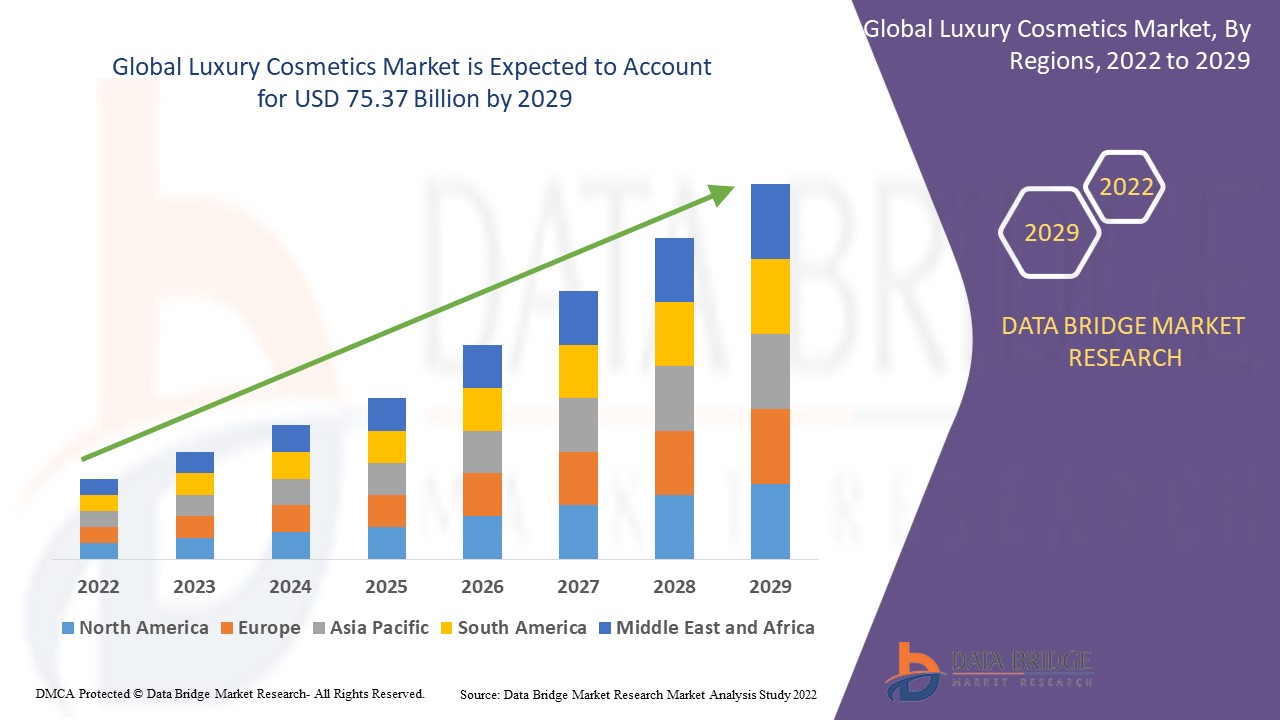
Market Analysis and Size
There are two consumer demographics competing for the best in personal care and cosmetics. The incorporation of luxury cosmetics and personal care products into the lives of the general urban population has only been made possible in large part due to the consumer pool's increasing disposable income. Previously aimed only at the wealthy and elite, the global luxury personal care and cosmetics market is now filling up with products aimed at the urban elite and even the general population.
Data Bridge Market Research analyses that the luxury cosmetics market was valued at USD 45.88 billion in 2021 and is expected to reach the value of USD 75.37 billion by 2029, and is likely to grow at a CAGR of 6.40% during the forecast period during the forecast period of 2022 to 2029. Growth in the market is being driven by an increase in the disposable income of the population in developing countries. In addition to the market insights such as market value, growth rate, market segments, geographical coverage, market players, and market scenario, the market report curated by the Data Bridge Market Research team includes in-depth expert analysis, import/export analysis, pricing analysis, production consumption analysis, and consumer behavior.
Market Definition
Cosmetics are products that are used to clean and beautify the physical features of humans. Luxury cosmetics are products that are manufactured with premium and organic quality ingredients and are sold at a higher price than drugstore products.
Report Scope and Market Segmentation
|
Report Metric |
Details |
|
Forecast Period |
2022 to 2029 |
|
Base Year |
2021 |
|
Historic Years |
2020 (Customizable to 2019 - 2014) |
|
Quantitative Units |
Revenue in USD Billion, Volumes in Units, Pricing in USD |
|
Segments Covered |
Type (Organic and Convectional Products), Product Type (Skincare, Haircare, Makeup and Fragrance), End-User (Male and Female), Distribution Channel (Supermarkets and Hypermarkets, Speciality and Monobrand Stores, E-Commerce and Others) |
|
Countries Covered |
U.S., Canada and Mexico in North America, Germany, France, U.K., Netherlands, Switzerland, Belgium, Russia, Italy, Spain, Turkey, Rest of Europe in Europe, China, Japan, India, South Korea, Singapore, Malaysia, Australia, Thailand, Indonesia, Philippines, Rest of Asia-Pacific (APAC) in the Asia-Pacific (APAC), Saudi Arabia, U.A.E, Israel, Egypt, South Africa, Rest of Middle East and Africa (MEA) as a part of Middle East and Africa (MEA), Brazil, Argentina and Rest of South America as part of South America. |
|
Market Players Covered |
L’Oréal, (France), Shiseido Company, Limited (Japan), Christian Dior (France), Puig (Spain), Coty Inc. (U.S.), Kao Corporation (Japan), Revlon (U.S.), The Estée Lauder Companies Inc. (U.S.), Oriflame Cosmetics AG (Switzerland), KOSÉ Corporation (Japan), CHANEL (U.K.) |
|
Market Opportunities |
|
Luxury cosmetics Market Dynamics
This section deals with understanding the market drivers, advantages, opportunities, restraints and challenges. All of this is discussed in detail as below:
Drivers
- Increasing demand for healthy products
Growing health concerns are a critical factor driving market growth, as is the expansion of e-commerce through the infiltration of the internet, which has created international reach and allows consumers to choose from a variety of options, among other factors driving the luxury cosmetics market.
- Rise in the demand for halal cosmetics
Demand for halal cosmetics, particularly from Middle Eastern countries, will drive the growth of the luxury cosmetics market during the forecast period.
Opportunities
Furthermore, due to the development of various e-commerce companies, major vendors in this industry are choosing to sell through online platforms in order to secure a more diverse customer base, as it allows them to advertise their products with large discounts and offers to entice consumers.
Restraints
On the other hand, the availability of counterfeit products will act as a restraint, further challenging the growth of the luxury cosmetics market during the forecast period.
This luxury cosmetics market report provides details of new recent developments, trade regulations, import-export analysis, production analysis, value chain optimization, market share, impact of domestic and localized market players, analyses opportunities in terms of emerging revenue pockets, changes in market regulations, strategic market growth analysis, market size, category market growths, application niches and dominance, product approvals, product launches, geographic expansions, technological innovations in the market. To gain more info on the luxury cosmetics market contact Data Bridge Market Research for an Analyst Brief, our team will help you take an informed market decision to achieve market growth.
COVID-19 Impact on Luxury Cosmetics Market
The COVID-19 pandemic has had a negative impact on several industries around the world, including the luxury cosmetics industry. With consumption at a halt and inventories piling up in warehouses, business priorities have shifted to liquidation strategies and inventory management while assessing post-pandemic consumer habit changes. Given the combined effect of outlet closures and frugality as a result of the rapidly deteriorating economic situation, the discretionary nature of luxury cosmetics made it one of the most severely affected industries by the pandemic. Furthermore, brands reported a decline in consumer demand for athletic luxury cosmetics as consumers reduced or delayed discretionary spending in response to the effects of COVID-19, owing to higher unemployment rates and lower consumer confidence.
Global Luxury Cosmetics Market Scope
The luxury cosmetics market is segmented on the basis of type, product type, end-user and distribution channel. The growth amongst these segments will help you analyze meagre growth segments in the industries and provide the users with a valuable market overview and market insights to help them make strategic decisions for identifying core market applications.
Type
- Organic
- Convectional Products
Product Type
- Skincare
- Haircare
- Makeup
- Fragrance
End user
- Male
- Female
Distribution channel
- Hypermarkets
- Online Channels
- Specialty Stores
- Monobrands tores
- E-commerce
- Others
Luxury Cosmetics Market Regional Analysis/Insights
The Luxury cosmetics market is analysed and market size insights and trends are provided by country, type, product type, end-user and distribution channel as referenced above.
The countries covered in the Luxury cosmetics market report are U.S., Canada and Mexico in North America, Germany, France, U.K., Netherlands, Switzerland, Belgium, Russia, Italy, Spain, Turkey, Rest of Europe in Europe, China, Japan, India, South Korea, Singapore, Malaysia, Australia, Thailand, Indonesia, Philippines, Rest of Asia-Pacific (APAC) in the Asia-Pacific (APAC), Saudi Arabia, U.A.E, Israel, Egypt, South Africa, Rest of Middle East and Africa (MEA) as a part of Middle East and Africa (MEA), Brazil, Argentina and Rest of South America as part of South America..
Europe holds the largest market share of the luxury cosmetics market, particularly in the skincare category. Consumers in this region are very picky about their skin care regimens and prefer products made with high-quality ingredients.
On the other hand, the Asia-Pacific region, is expected to grow rapidly during the forecast period of 2022 to 2029 because of the rapid urbanization as well as the rising consumer interest in different and premium products.
The country section of the report also provides individual market impacting factors and changes in market regulation that impact the current and future trends of the market. Data points like down-stream and upstream value chain analysis, technical trends and porter's five forces analysis, case studies are some of the pointers used to forecast the market scenario for individual countries. Also, the presence and availability of global brands and their challenges faced due to large or scarce competition from local and domestic brands, impact of domestic tariffs and trade routes are considered while providing forecast analysis of the country data.
Competitive Landscape and Luxury Cosmetics Market Share Analysis
The luxury cosmetics market competitive landscape provides details by competitor. Details included are company overview, company financials, revenue generated, market potential, investment in research and development, new market initiatives, global presence, production sites and facilities, production capacities, company strengths and weaknesses, product launch, product width and breadth, application dominance. The above data points provided are only related to the companies' focus related to luxury cosmetics market.
Some of the major players operating in the luxury cosmetics market are:
- L’Oréal, (France)
- Shiseido Company, Limited (Japan)
- Christian Dior (France)
- Puig (Spain)
- Coty Inc. (U.S.)
- Kao Corporation (Japan)
- Revlon (U.S.)
- The Estée Lauder Companies Inc. (U.S.)
- Oriflame Cosmetics AG (Switzerland)
- KOSÉ Corporation (Japan)
- CHANEL (U.K.)

- Interactive Data Analysis Dashboard
- Company Analysis Dashboard for high growth potential opportunities
- Research Analyst Access for customization & queries
- Competitor Analysis with Interactive dashboard
- Latest News, Updates & Trend analysis
- Harness the Power of Benchmark Analysis for Comprehensive Competitor Tracking
Table of Content
1 INTRODUCTION
1.1 ODDBJECTIVES OF THE STUDY
1.2 MARKET DEFINITION
1.3 OVERVIEW OF GLOBAL LUXURY COSMETICS MARKET
1.4 CURRENCY AND PRICING
1.5 LIMITATION
1.6 MARKETS COVERED
2 MARKET SEGMENTATION
2.1 KEY TAKEAWAYS
2.2 ARRIVING AT THE GLOBAL LUXURY COSMETICS MARKET SIZE
2.3 VENDOR POSITIONING GRID
2.4 MARKETS COVERED
2.5 GEOGRAPHIC SCOPE
2.6 YEARS CONSIDERED FOR THE STUDY
2.7 RESEARCH METHODOLOGY
2.8 TECHNOLOGY LIFE LINE CURVE
2.9 MULTIVARIATE MODELLING
2.1 PRIMARY INTERVIEWS WITH KEY OPINION LEADERS
2.11 DBMR MARKET POSITION GRID
2.12 MARKET APPLICATION COVERAGE GRID
2.13 DBMR MARKET CHALLENGE MATRIX
2.14 IMPORT AND EXPORT DATA
2.15 SECONDARY SOURCES
2.16 GLOBAL LUXURY COSMETICS MARKET: RESEARCH SNAPSHOT
2.17 ASSUMPTIONS
3 MARKET OVERVIEW
3.1 DRIVERS
3.2 RESTRAINTS
3.3 OPPORTUNITIES
3.4 CHALLENGES
4 EXECUTIVE SUMMARY
5 PREMIUM INSIGHTS
5.1 CONSUMER BUYING BEHAVIOUR
5.2 FACTORS AFFECTING BUYING DECISION
5.3 PRODUCT ADOPTION SCENARIO
5.4 PORTER’S FIVE FORCES
5.5 REGULATION COVERAGE
5.6 RAW MATERIAL SOURCING ANALYSIS
5.7 IMPORT EXPORT SCENARIO
5.8 INDUSTRY POLICIES AND REGULATIONS
5.9 TECHNOLOGICAL ADVANCEMENTS
6 BRAND OUTLOOK GRID
7 IMPACT OF ECONOMIC SLOWDOWN
7.1 IMPACT ON PRICES
7.2 IMPACT ON SUPPLY CHAIN
7.3 IMPACT ON SHIPMENT
7.4 IMPACT ON DEMAND
7.5 IMPACT ON STRATEGIC DECISIONS
8 SUPPLY CHAIN ANALYSIS
8.1 OVERVIEW
8.2 LOGISTIC COST SCENARIO
8.3 IMPORTANCE OF LOGISTICS SERVICE PROVIDERS
9 GLOBAL LUXURY COSMETICS MARKET, BY TYPE, 2021-2030, (USD MILLION)
9.1 OVERVIEW
9.2 SKIN CARE
9.2.1 FACIAL CARE PRODUCTS
9.2.1.1. BY CATEGORY
9.2.1.1.1. FACIAL CLEANSER
9.2.1.1.2. TONER
9.2.1.1.3. FACIAL MOISTURIZER
9.2.1.1.4. FACIAL SERUM
9.2.1.1.5. EYE CREAMS
9.2.1.1.6. LIP CARE PRODUCTS
9.2.1.1.7. OTHERS
9.2.2 SUN CARE PRODUCTS
9.2.3 OTHER SKIN CARE PRODUCTS
9.3 HAIR CARE
9.3.1 SHAMPOO
9.3.2 HAIR COLOR
9.3.2.1. HAIR COLOR, BY TYPE
9.3.2.1.1. HAIR DYES AND COLORS
9.3.2.1.2. HAIR TINTS
9.3.2.1.3. HAIR BLEACHES
9.3.2.1.4. OTHERS
9.3.2.2. HAIR COLOR, BY HAIR TYPE
9.3.2.2.1. NORMAL
9.3.2.2.2. DRY
9.3.2.2.3. OILY
9.3.3 CONDITIONERS
9.3.4 SERUMS
9.3.5 SPRAYS
9.3.6 OILS
9.3.7 OTHERS
9.4 BATH & SHOWER
9.5 DEODRANTS & ANTI-PERSPIRANTS
9.5.1 SPRAY
9.5.2 ROLL-ON
9.5.3 STICK
9.5.4 OTHERS
9.6 OTHERS
10 GLOBAL LUXURY COSMETICS MARKET, BY CATEGORY, 2021-2030, (USD MILLION)
10.1 OVERVIEW
10.2 CONVENTIONAL
10.3 ORGANIC
11 GLOBAL LUXURY COSMETICS MARKET, BY END-USER, 2021-2030, (USD MILLION)
11.1 OVERVIEW
11.2 MALE
11.3 FEMALE
12 GLOBAL LUXURY COSMETICS MARKET, BY DISTRIBUTION CHANNEL, 2021-2030, (USD MILLION)
12.1 OVERVIEW
12.2 ONLINE
12.2.1 E-COMMERCE WEBSITES
12.2.2 COMPANY OWNED WEBSITES
12.3 OFFLINE
12.3.1 SUPERMARKETS/HYPERMARKETS
12.3.2 CONVENIENCE STORES
12.3.3 SINGLE BRAND STORES
12.3.4 MULTI-BRAND STORES
12.3.5 DRUG STORES/PHARMACIES
12.3.6 OTHERS
13 GLOBAL LUXURY COSMETICS MARKET, BY GEOGRAPHY, 2021-2030, (USD MILLION)
GLOBAL LUXURY COSMETICS MARKET, (ALL SEGMENTATION PROVIDED ABOVE IS REPRESENTED IN THIS CHAPTER BY COUNTRY)
13.1 NORTH AMERICA
13.1.1 U.S.
13.1.2 CANADA
13.1.3 MEXICO
13.2 EUROPE
13.2.1 GERMANY
13.2.2 U.K.
13.2.3 ITALY
13.2.4 FRANCE
13.2.5 SPAIN
13.2.6 RUSSIA
13.2.7 SWITZERLAND
13.2.8 TURKEY
13.2.9 BELGIUM
13.2.10 NETHERLANDS
13.2.11 DENMARK
13.2.12 SWEDEN
13.2.13 POLAND
13.2.14 NORWAY
13.2.15 FINLAND
13.2.16 REST OF EUROPE
13.3 ASIA-PACIFIC
13.3.1 JAPAN
13.3.2 CHINA
13.3.3 SOUTH KOREA
13.3.4 INDIA
13.3.5 SINGAPORE
13.3.6 THAILAND
13.3.7 INDONESIA
13.3.8 MALAYSIA
13.3.9 PHILIPPINES
13.3.10 AUSTRALIA
13.3.11 NEW ZEALAND
13.3.12 VIETNAM
13.3.13 TAIWAN
13.3.14 MALAYSIA
13.3.15 REST OF ASIA-PACIFIC
13.4 SOUTH AMERICA
13.4.1 BRAZIL
13.4.2 ARGENTINA
13.4.3 REST OF SOUTH AMERICA
13.5 MIDDLE EAST AND AFRICA
13.5.1 SOUTH AFRICA
13.5.2 EGYPT
13.5.3 SAUDI ARABIA
13.5.4 UNITED ARAB EMIRATES
13.5.5 ISRAEL
13.5.6 BAHRAIN
13.5.7 KUWAIT
13.5.8 OMAN
13.5.9 QATAR
13.5.10 REST OF MIDDLE EAST AND AFRICA
14 GLOBAL LUXURY COSMETICS MARKET, COMPANY LANDSCAPE
14.1 COMPANY SHARE ANALYSIS: GLOBAL
14.2 COMPANY SHARE ANALYSIS: NORTH AMERICA
14.3 COMPANY SHARE ANALYSIS: EUROPE
14.4 COMPANY SHARE ANALYSIS: ASIA-PACIFIC
14.5 MERGERS AND ACQUISITIONS
14.6 NEW PRODUCT DEVELOPMENT AND APPROVALS
14.7 EXPANSIONS
14.8 PARTNERSHIP AND OTHER STRATEGIC DEVELOPMENTS
15 SWOT AND DATA BRIDGE MARKET RESEARCH ANALYSIS
16 GLOBAL LUXURY COSMETICS MARKET- COMPANY PROFILE
(NOTE: THE COMPANIES PROFILED IS NOT EXHAUSTIVE LIST AND IS AS PER OUR PREVIOUS CLIENT REQUIREMENT. WE PROFILE MORE THAN 100 COMPANIES IN OUR STUDY AND HENCE THE LIST OF COMPANIES CAN BE MODIFIED OR REPLACED ON REQUEST)
16.1 L’ORÉAL
16.1.1 COMPANY SNAPSHOT
16.1.2 PRODUCT PORTFOLIO
16.1.3 SWOT ANALYSIS
16.1.4 REVENUE ANALYSIS
16.1.5 RECENT UPDATES
16.2 SHISEIDO COMPANY LIMITED
16.2.1 COMPANY SNAPSHOT
16.2.2 PRODUCT PORTFOLIO
16.2.3 SWOT ANALYSIS
16.2.4 REVENUE ANALYSIS
16.2.5 RECENT UPDATES
16.3 CHRISTIAN DIOR
16.3.1 COMPANY SNAPSHOT
16.3.2 PRODUCT PORTFOLIO
16.3.3 SWOT ANALYSIS
16.3.4 REVENUE ANALYSIS
16.3.5 RECENT UPDATES
16.4 PUIG
16.4.1 COMPANY SNAPSHOT
16.4.2 PRODUCT PORTFOLIO
16.4.3 SWOT ANALYSIS
16.4.4 REVENUE ANALYSIS
16.4.5 RECENT UPDATES
16.5 COTY INC.
16.5.1 COMPANY SNAPSHOT
16.5.2 PRODUCT PORTFOLIO
16.5.3 SWOT ANALYSIS
16.5.4 REVENUE ANALYSIS
16.5.5 RECENT UPDATES
16.6 KAO CORPORATION
16.6.1 COMPANY SNAPSHOT
16.6.2 PRODUCT PORTFOLIO
16.6.3 SWOT ANALYSIS
16.6.4 REVENUE ANALYSIS
16.6.5 RECENT UPDATES
16.7 REVLON
16.7.1 COMPANY SNAPSHOT
16.7.2 PRODUCT PORTFOLIO
16.7.3 SWOT ANALYSIS
16.7.4 REVENUE ANALYSIS
16.7.5 RECENT UPDATES
16.8 ORIFLAME COSMETICS AG
16.8.1 COMPANY SNAPSHOT
16.8.2 PRODUCT PORTFOLIO
16.8.3 SWOT ANALYSIS
16.8.4 REVENUE ANALYSIS
16.8.5 RECENT UPDATES
16.9 KOSÉ CORPORATION
16.9.1 COMPANY SNAPSHOT
16.9.2 PRODUCT PORTFOLIO
16.9.3 SWOT ANALYSIS
16.9.4 REVENUE ANALYSIS
16.9.5 RECENT UPDATES
16.1 CHANEL
16.10.1 COMPANY SNAPSHOT
16.10.2 PRODUCT PORTFOLIO
16.10.3 SWOT ANALYSIS
16.10.4 REVENUE ANALYSIS
16.10.5 RECENT UPDATES
16.11 AVON PRODUCTS INC.
16.11.1 COMPANY SNAPSHOT
16.11.2 PRODUCT PORTFOLIO
16.11.3 SWOT ANALYSIS
16.11.4 REVENUE ANALYSIS
16.11.5 RECENT UPDATES
16.12 ESTÉE LAUDER COMPANIES INC
16.12.1 COMPANY SNAPSHOT
16.12.2 PRODUCT PORTFOLIO
16.12.3 SWOT ANALYSIS
16.12.4 REVENUE ANALYSIS
16.12.5 RECENT UPDATES
16.13 LVMH
16.13.1 COMPANY SNAPSHOT
16.13.2 PRODUCT PORTFOLIO
16.13.3 SWOT ANALYSIS
16.13.4 REVENUE ANALYSIS
16.13.5 RECENT UPDATES
16.14 REVLON INC.
16.14.1 COMPANY SNAPSHOT
16.14.2 PRODUCT PORTFOLIO
16.14.3 SWOT ANALYSIS
16.14.4 REVENUE ANALYSIS
16.14.5 RECENT UPDATES
16.15 NARS
16.15.1 COMPANY SNAPSHOT
16.15.2 PRODUCT PORTFOLIO
16.15.3 SWOT ANALYSIS
16.15.4 REVENUE ANALYSIS
16.15.5 RECENT UPDATES
16.16 LANCOME
16.16.1 COMPANY SNAPSHOT
16.16.2 PRODUCT PORTFOLIO
16.16.3 SWOT ANALYSIS
16.16.4 REVENUE ANALYSIS
16.16.5 RECENT UPDATES
16.17 LAURA MERCIER
16.17.1 COMPANY SNAPSHOT
16.17.2 PRODUCT PORTFOLIO
16.17.3 SWOT ANALYSIS
16.17.4 REVENUE ANALYSIS
16.17.5 RECENT UPDATES
16.18 CHARLOTTE TILBURY
16.18.1 COMPANY SNAPSHOT
16.18.2 PRODUCT PORTFOLIO
16.18.3 SWOT ANALYSIS
16.18.4 REVENUE ANALYSIS
16.18.5 RECENT UPDATES
16.19 ARMANI
16.19.1 COMPANY SNAPSHOT
16.19.2 PRODUCT PORTFOLIO
16.19.3 SWOT ANALYSIS
16.19.4 REVENUE ANALYSIS
16.19.5 RECENT UPDATES
16.2 UNILEVER PLC
16.20.1 COMPANY SNAPSHOT
16.20.2 PRODUCT PORTFOLIO
16.20.3 SWOT ANALYSIS
16.20.4 REVENUE ANALYSIS
16.20.5 RECENT UPDATES
*NOTE: THE COMPANIES PROFILED IS NOT EXHAUSTIVE LIST AND IS AS PER OUR PREVIOUS CLIENT REQUIREMENT. WE PROFILE MORE THAN 100 COMPANIES IN OUR STUDY AND HENCE THE LIST OF COMPANIES CAN BE MODIFIED OR REPLACED ON REQUEST
17 RELATED REPORTS
18 QUESTIONNAIRE
19 CONCLUSION
20 ABOUT DATA BRIDGE MARKET RESEARCH

Data collection and base year analysis are done using data collection modules with large sample sizes. The stage includes obtaining market information or related data through various sources and strategies. It includes examining and planning all the data acquired from the past in advance. It likewise envelops the examination of information inconsistencies seen across different information sources. The market data is analysed and estimated using market statistical and coherent models. Also, market share analysis and key trend analysis are the major success factors in the market report. To know more, please request an analyst call or drop down your inquiry.
The key research methodology used by DBMR research team is data triangulation which involves data mining, analysis of the impact of data variables on the market and primary (industry expert) validation. Data models include Vendor Positioning Grid, Market Time Line Analysis, Market Overview and Guide, Company Positioning Grid, Patent Analysis, Pricing Analysis, Company Market Share Analysis, Standards of Measurement, Global versus Regional and Vendor Share Analysis. To know more about the research methodology, drop in an inquiry to speak to our industry experts.
Data Bridge Market Research is a leader in advanced formative research. We take pride in servicing our existing and new customers with data and analysis that match and suits their goal. The report can be customized to include price trend analysis of target brands understanding the market for additional countries (ask for the list of countries), clinical trial results data, literature review, refurbished market and product base analysis. Market analysis of target competitors can be analyzed from technology-based analysis to market portfolio strategies. We can add as many competitors that you require data about in the format and data style you are looking for. Our team of analysts can also provide you data in crude raw excel files pivot tables (Fact book) or can assist you in creating presentations from the data sets available in the report.