


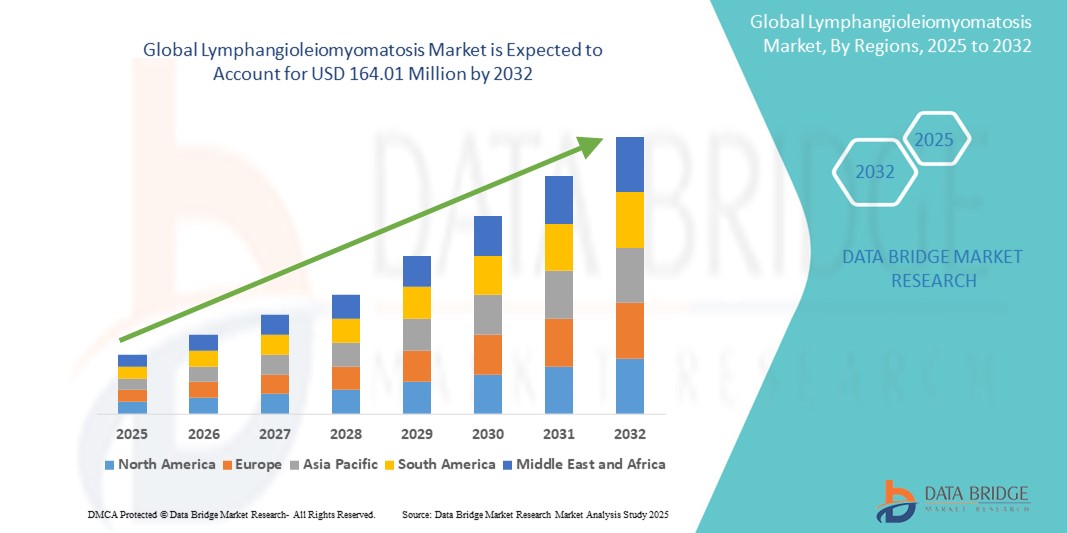
Lymphangioleiomyomatosis Market Size
- The global lymphangioleiomyomatosis market size was valued at USD 118.01 Million in 2024 and is expected to reach USD 164.01 Million by 2032, at a CAGR of4.20% during the forecast period
- The market growth is largely fueled by the increasing awareness and diagnosis rates of rare diseases, including lymphangioleiomyomatosis (LAM), alongside advancements in medical imaging and diagnostic technologies that enable earlier and more accurate detection of the condition
- Furthermore, rising research funding, development of targeted therapies such as mTOR inhibitors, and growing patient advocacy are accelerating the uptake of Lymphangioleiomyomatosis treatment solutions, thereby significantly boosting the industry's growth and improving long-term patient outcomes
Lymphangioleiomyomatosis Market Analysis
- Lymphangioleiomyomatosis (LAM), a rare progressive lung disease, is gaining increasing clinical attention due to improved awareness, earlier diagnosis, and advances in targeted therapies such as mTOR inhibitors, which are transforming the treatment landscape for affected patients
- The growing demand for effective LAM treatments is primarily fueled by rising investments in orphan drug development, ongoing clinical research, and the emergence of precision medicine. These converging factors are accelerating the uptake of lymphangioleiomyomatosis therapies, thereby significantly boosting the industry's growth
- North America dominated the lymphangioleiomyomatosis market with the largest revenue share of 41.3% in 2024, driven by robust healthcare infrastructure, high rates of diagnosis, access to advanced therapies, and active support from patient advocacy groups such as The LAM Foundation in the U.S
- Asia-Pacific is expected to be the fastest growing region in the lymphangioleiomyomatosis market, projected to grow at a CAGR of 8.7% from 2025 to 2032, due to increasing disease awareness, rising healthcare access, and expanding clinical trials in countries such as China, Japan, and South Korea
- The Sporadic LAM segment dominated the lymphangioleiomyomatosis market with a market share of 68.4% in 2024, driven by its higher prevalence compared to Tuberous Sclerosis Complex LAM and improved access to diagnostic tools that facilitate early identification and intervention
Report Scope and Lymphangioleiomyomatosis Market Segmentation
|
Attributes |
Lymphangioleiomyomatosis Key Market Insights |
|
Segments Covered |
|
|
Countries Covered |
North America
Europe
Asia-Pacific
Middle East and Africa
South America
|
|
Key Market Players |
|
|
Market Opportunities |
|
|
Value Added Data Infosets |
In addition to the insights on market scenarios such as market value, growth rate, segmentation, geographical coverage, and major players, the market reports curated by the Data Bridge Market Research also include in-depth expert analysis, pricing analysis, brand share analysis, consumer survey, demography analysis, supply chain analysis, value chain analysis, raw material/consumables overview, vendor selection criteria, PESTLE Analysis, Porter Analysis, and regulatory framework. |
Lymphangioleiomyomatosis Market Trends
“Advancements in Targeted Therapies and Personalized Medicine”
- A significant and accelerating trend in the global Lymphangioleiomyomatosis market is the development of targeted therapies and personalized medicine approaches. These innovations are improving disease management by offering more effective and tailored treatment options to patients with this rare lung condition
- For instance, the use of mTOR inhibitors such as sirolimus has shown significant clinical benefits in stabilizing lung function and reducing tumor size in LAM patients. Such therapies mark a shift from generalized treatment toward condition-specific intervention
- In addition, ongoing genetic and molecular research is enabling healthcare providers to better understand disease mechanisms, paving the way for novel drug development focused on specific biomarkers and patient subgroups. This approach not only enhances therapeutic outcomes but also minimizes side effects
- Increasing global clinical trial activity and regulatory support for orphan drug development are contributing to an expanding treatment pipeline. Companies are investing in advanced formulations and delivery mechanisms that ensure better bioavailability and patient adherence
- Furthermore, the growing emphasis on patient registries and real-world evidence is helping researchers identify unmet needs and optimize treatment protocols for long-term disease management
- These advancements are transforming the landscape of Lymphangioleiomyomatosis treatment and are expected to continue driving market growth by offering improved quality of life and disease control for patients worldwide
Lymphangioleiomyomatosis Market Dynamics
Driver
“Growing Need Due to Rising Disease Awareness and Advancements in Targeted Therapies”
- The increasing awareness about rare diseases such as lymphangioleiomyomatosis (LAM), driven by advocacy groups and healthcare campaigns, is significantly contributing to earlier diagnosis and treatment, thereby boosting the market
- For instance, initiatives by organizations such as the LAM Foundation are playing a key role in spreading awareness, funding research, and supporting patient communities, which in turn is expanding the patient pool eligible for diagnosis and care
- As clinicians become more familiar with LAM and diagnostic tools such as high-resolution CT scans improve, the rate of early detection has increased. This has led to better disease management and a higher demand for effective therapies
- Moreover, advances in targeted treatments — particularly mTOR inhibitors such as sirolimus (Rapamune) — have shown efficacy in stabilizing lung function and improving quality of life for patients, further driving market growth
- Ongoing clinical trials exploring gene therapies and combination drug treatments are expected to expand therapeutic options, adding to the momentum of innovation in the LAM treatment space
Restraint/Challenge
“Limited Patient Population and High Treatment Costs”
- One of the most significant challenges facing the LAM market is the disease’s rarity, which limits the number of diagnosed cases and, consequently, the commercial incentive for pharmaceutical companies to invest heavily in R&D
- With fewer than 5 cases per million women globally, the market remains niche, making it challenging to secure funding for large-scale clinical trials and infrastructure
- Another restraint is the high cost associated with long-term therapies, particularly mTOR inhibitors, which require consistent use to manage disease progression. This poses a financial burden for both patients and healthcare systems, especially in regions with limited insurance coverage or healthcare reimbursement
- In addition, the lack of curative treatment and the chronic nature of the disease make patient compliance and long-term management difficult, further complicating market expansion
- Overcoming these limitations will depend on continued investment in orphan drug development, improved global access to treatment, and supportive regulatory frameworks that encourage innovation in rare disease therapeutics
Lymphangioleiomyomatosis Market Scope
The global Lymphangioleiomyomatosis (LAM) market is segmented into six notable segments based on disease type, type, complications, route of administration, end user, and distribution channel.
• By Disease Type
On the basis of disease type, the market is segmented into tuberous sclerosis complex LAM and Sporadic LAM. The Sporadic LAM segment held the largest market revenue share of 68.4% in 2024, driven by its higher prevalence and better diagnostic access.
The tuberous sclerosis complex LAM segment is expected to witness the fastest CAGR of 5.9% from 2025 to 2032, fueled by increasing awareness and improved access to genetic testing and rare disease management programs.
• By Type
On the basis of type, the market is segmented into diagnosis and treatment. The treatment segment dominated the market with a revenue share of 72.1% in 2024, due to the growing use of mTOR inhibitors such as sirolimus.
The diagnosis segment is projected to register the fastest CAGR of 6.2% from 2025 to 2032, driven by technological advancements in imaging and biomarker testing.
• By Complications
On the basis of complications, the market is segmented into pneumothorax, chylothorax, kidney tumor, pleural effusions, swelling and fluid build-up, and others. The pneumothorax segment accounted for the largest market share of 39.7% in 2024, due to its frequent occurrence in LAM patients.
The kidney tumor segment is expected to grow at the fastest CAGR of 6.8% from 2025 to 2032, supported by increased screening in TSC-LAM and greater availability of surgical and non-surgical treatment options.
• By Route of Administration
On the basis of route of administration, the market is segmented into oral, parenteral, and others. The Oral segment held the largest share of 76.5% in 2024, driven by the convenience and widespread use of oral mTOR inhibitors.
The parenteral segment is projected to record the fastest CAGR of 5.6% from 2025 to 2032, particularly with the increasing development of intravenous therapies for advanced or refractory cases.
• By End User
On the basis of end user, the market is segmented into hospitals, specialty clinics, diagnostic centers, home healthcare, and others. The hospitals segment led the market with a share of 45.8% in 2024, owing to comprehensive care services and advanced diagnostics.
The specialty clinics segment is expected to witness the fastest CAGR of 7.1% from 2025 to 2032, due to increasing specialization in rare lung diseases and improved referral networks.
• By Distribution Channel
On the basis of distribution channel, the market is segmented into direct tender, hospital pharmacies, retail pharmacies, online pharmacies, and others. The hospital pharmacies segment accounted for the largest market revenue share of 38.9% in 2024, supported by institutional dispensing of high-cost therapies.
The online pharmacies segment is anticipated to grow at the fastest CAGR of 7.4% from 2025 to 2032, driven by expanding e-commerce adoption, especially for chronic disease medications and refills.
Lymphangioleiomyomatosis Market Regional Analysis
- North America dominated the Lymphangioleiomyomatosis (LAM) market with the largest revenue share of 41.3% in 2024, driven by the high prevalence of LAM cases, advanced healthcare infrastructure, and significant investments in rare disease research and patient care
- The region benefits from greater disease awareness, availability of orphan drugs such as sirolimus and everolimus, and active research institutions and advocacy groups supporting patient registries and clinical trials
- In addition, strong regulatory frameworks such as the U.S. Orphan Drug Act support innovation and access, accelerating therapeutic adoption and contributing to market dominance
U.S. Lymphangioleiomyomatosis (LAM) Market Insight
The U.S. Lymphangioleiomyomatosis market accounted for 83.2% of North America's revenue share in 2024, owing to a strong presence of clinical research centers, early diagnosis practices, and leading pharmaceutical players. Support from the LAM Foundation and NIH-funded research is enhancing treatment access and awareness. The country also leads in patient enrollment for clinical trials and offers insurance coverage for orphan drugs, driving treatment uptake.
Europe Lymphangioleiomyomatosis Market Insight
The Europe Lymphangioleiomyomatosis market is expected to expand at a steady CAGR of 5.7% from 2025 to 2032, driven by increasing focus on rare disease registries, access to biologics, and universal healthcare systems. Countries such as Germany, France, and the U.K. are investing in specialized care for rare lung diseases and improving early diagnosis through advanced imaging and genetic testing.EU frameworks for orphan drug designation and centralized approvals by the EMA continue to support market growth.
U.K. Lymphangioleiomyomatosis Market Insight
The U.K. Lymphangioleiomyomatosis market is projected to grow at a CAGR of 6.2% during the forecast period, supported by well-established rare disease policies, access to National Health Service (NHS)-funded treatments, and academic centers of excellence.The presence of national patient registries and LAM-focused clinical programs is improving disease tracking, patient engagement, and access to clinical trials.
Germany Lymphangioleiomyomatosis Market Insight
The Germany Lymphangioleiomyomatosis market is anticipated to grow at a CAGR of 5.9% during the forecast period, driven by rising demand for precision medicine, access to cutting-edge diagnostic tools, and a strong pharmaceutical manufacturing base. The country’s emphasis on personalized care and integrated electronic health records enhances early intervention and coordinated management of rare diseases such as LAM.
• Asia-Pacific Lymphangioleiomyomatosis Market Insight
The Asia-Pacific Lymphangioleiomyomatosis market is poised to grow at the fastest CAGR of 8.7% from 2025 to 2032, fueled by increasing LAM awareness, growing diagnostic capabilities, and rising healthcare investments in countries such as Japan, China, and India. Government-led rare disease programs and improved access to immunosuppressive therapies are fostering significant market opportunities. In addition, regional manufacturers are entering the LAM therapeutics space, increasing drug accessibility and affordability.
Japan Lymphangioleiomyomatosis Market Insight
The Japan's Lymphangioleiomyomatosis market is expanding steadily during the forecast period, supported by the country's national rare disease registry, strong government healthcare coverage, and a focus on aging-related respiratory conditions. The Japanese LAM Foundation and academic centers are actively involved in clinical research and advocacy, improving awareness and treatment uptake.
China Lymphangioleiomyomatosis Market Insight
The China Lymphangioleiomyomatosis market accounted for 46.5% of Asia-Pacific's revenue share in 2024, driven by rising awareness, diagnostic imaging advancements, and an expanding middle class with access to specialty care. Government reforms supporting rare disease coverage under national health insurance and increasing domestic production of generic sirolimus are boosting patient access to LAM therapies.
Lymphangioleiomyomatosis Market Share
The Lymphangioleiomyomatosis industry is primarily led by well-established companies, including:
- Pfizer Inc. (U.S.)
- Intas Pharmaceuticals Ltd. (India)
- Apotex Inc. (Canada)
- Amneal Pharmaceuticals LLC (U.S.)
- Dr. Reddy’s Laboratories Ltd (India)
- Novartis AG (Switzerland)
- Hikma Pharmaceuticals PLC (Jordan)
- Zydus Pharmaceuticals, Inc (India)
- TransMedics, Inc. (U.S.)
- Terumo Corporation (Japan)
- Home Oxygen Company (U.S.)
- Inogen, Inc. (U.S.)
- CareDx (U.S.)
- XVIVO (Sweden)
- Taj Pharmaceuticals Limited (India)
- Morgan Scientific Inc (U.S.)

- Interactive Data Analysis Dashboard
- Company Analysis Dashboard for high growth potential opportunities
- Research Analyst Access for customization & queries
- Competitor Analysis with Interactive dashboard
- Latest News, Updates & Trend analysis
- Harness the Power of Benchmark Analysis for Comprehensive Competitor Tracking
Data collection and base year analysis are done using data collection modules with large sample sizes. The stage includes obtaining market information or related data through various sources and strategies. It includes examining and planning all the data acquired from the past in advance. It likewise envelops the examination of information inconsistencies seen across different information sources. The market data is analysed and estimated using market statistical and coherent models. Also, market share analysis and key trend analysis are the major success factors in the market report. To know more, please request an analyst call or drop down your inquiry.
The key research methodology used by DBMR research team is data triangulation which involves data mining, analysis of the impact of data variables on the market and primary (industry expert) validation. Data models include Vendor Positioning Grid, Market Time Line Analysis, Market Overview and Guide, Company Positioning Grid, Patent Analysis, Pricing Analysis, Company Market Share Analysis, Standards of Measurement, Global versus Regional and Vendor Share Analysis. To know more about the research methodology, drop in an inquiry to speak to our industry experts.
Data Bridge Market Research is a leader in advanced formative research. We take pride in servicing our existing and new customers with data and analysis that match and suits their goal. The report can be customized to include price trend analysis of target brands understanding the market for additional countries (ask for the list of countries), clinical trial results data, literature review, refurbished market and product base analysis. Market analysis of target competitors can be analyzed from technology-based analysis to market portfolio strategies. We can add as many competitors that you require data about in the format and data style you are looking for. Our team of analysts can also provide you data in crude raw excel files pivot tables (Fact book) or can assist you in creating presentations from the data sets available in the report.












