


What is the Machine Tool Market Size and Growth Rate?
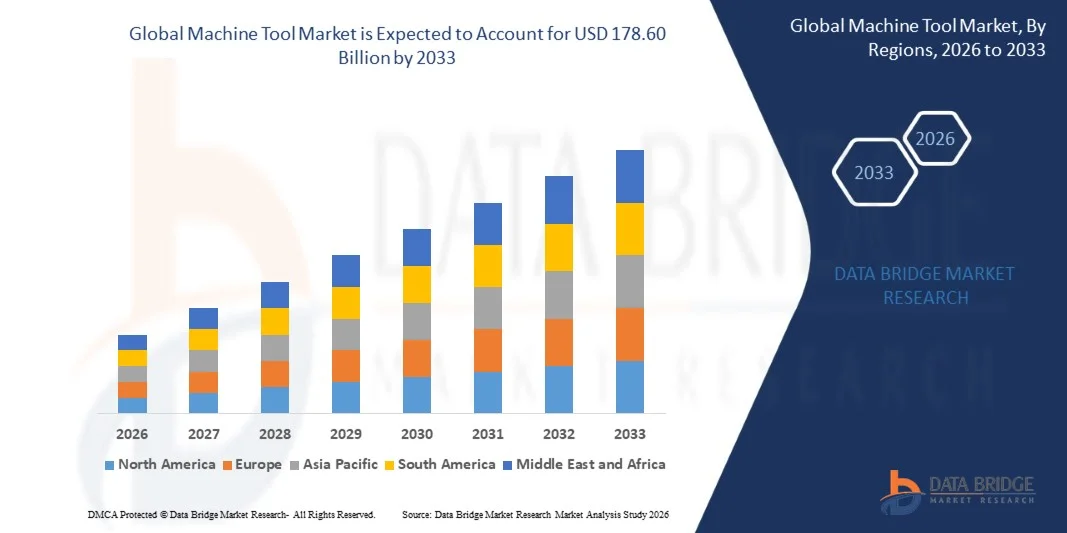
- As per Data Bridge Market Research analysis, the machine tool market was valued at USD 112.80 billion in 2025 and is projected to reach USD 178.60 billion by 2033, growing at a CAGR of 5.9% from 2026 to 2033.
- The market is experiencing consistent growth driven by increasing demand for high-precision manufacturing, rising investments in industrial automation, expanding automotive and aerospace production, and growing adoption of CNC machine tools for improving productivity, accuracy, and operational efficiency.
- The increasing adoption of smart manufacturing, Industry 4.0 technologies, electric vehicles, and advanced engineering components is encouraging manufacturers to invest in automated and digitally connected machine tools. CNC systems, multi-axis machining, real-time monitoring, and predictive maintenance technologies are gaining preference as they enable higher precision, reduced production time, improved resource utilization, and greater manufacturing flexibility.
Market Size & Forecast
- Global Market Value (2025): USD 112.80 Billion
- Expected Market Value (2033): USD 178.60 Billion
- Forecast CAGR (2026–2033): 5.9%
- Leading Region in 2025: North America
- Fastest Growing Region: Asia Pacific
What are the Major Takeaways of the Machine Tool Market?
- North America dominated the machine tool market with the largest revenue share of 56.2% in 2025, supported by strong manufacturing bases, rapid industrialization, expanding automotive production, and increasing adoption of advanced machine tools.
- Asia-Pacific is expected to be the fastest-growing region at a CAGR of 6.7% from 2026 to 2033, fueled by expanding manufacturing infrastructure, rising investments in industrial automation, increasing automotive production, and growing adoption of CNC machine tools.
- The metal cutting segment led the market with a 76.8% share in 2025, driven by its widespread application across automotive, mechanical engineering, metal working, and aerospace industries.
- Metal forming is the fastest-growing type, projected to register a CAGR of 5.4%, reflecting the surge in demand for advanced bending, pressing, shaping, and shearing solutions across automotive, aerospace, construction, energy, and electronics industries.
- The Computer Numerical Control (CNC) segment dominated the technology category with a 85.7% revenue share in 2025, led by its ability to provide high precision, automation, consistent production quality, and improved operational efficiency.
- The automotive segment accounted for a 41.9% share of the market in 2025, supported by large-scale production requirements and continuous demand for precision-engineered components.
- The electrical industry is the fastest-growing end-use category, with a CAGR of 7.3%, driven by rising demand for electronic devices, power equipment, electrical infrastructure, and high-precision components.
Report Scope and Machine Tool Market Segmentation
|
Attributes |
Machine Tool Key Market Insights |
|
Segments Covered |
|
|
Countries Covered |
North America
Europe
Asia-Pacific
Middle East and Africa
South America
|
|
Key Market Players |
|
|
Market Opportunities |
|
|
Value Added Data Infosets |
In addition to the market insights such as market value, growth rate, market segments, geographical coverage, market players, and market scenario, the market report curated by the Data Bridge Market Research team includes in-depth expert analysis, import/export analysis, pricing analysis, production consumption analysis, and pestle analysis. |
What is the Key Trend in the Machine Tool Market?
- Machine tool manufacturing is increasingly shifting toward high-precision and automated machining solutions, as manufacturers seek to improve production accuracy, reduce machining time, and lower operating costs across automotive, aerospace, electrical, and mechanical engineering applications.
- For instance, in March 2026, the German Machine Tool Builders’ Association reported that international demand for German machine tools increased by 3% in 2025, reflecting continued investment in advanced manufacturing technologies despite challenging industrial conditions.
- Manufacturers are increasingly focusing on CNC automation, IoT-enabled connectivity, predictive maintenance, and real-time monitoring to improve machine utilization, reduce downtime, and enhance production efficiency.
- ·The growing emphasis on smart manufacturing and Industry 4.0 is encouraging machine tool manufacturers to integrate artificial intelligence, data analytics, digital monitoring, and automated production systems rather than relying exclusively on conventional machining processes.
- Energy efficiency and lower operating costs are also gaining importance as manufacturers seek machine tools that can reduce energy consumption, minimize production errors, and support more sustainable manufacturing operations.
- For instance, in July 2025, the VDW highlighted digitalization and automation as important technological trends supporting the investment climate for the machine tool industry, particularly across metalworking and manufacturing sectors.
- Demand for advanced machining is also expanding across aerospace, electrical, automotive, and mechanical engineering applications, with manufacturers increasingly requiring high-precision equipment for complex components and tighter production tolerances.
What are the Key Drivers of the Machine Tool Market?
- The rapid expansion of automotive, aerospace, electrical, and mechanical engineering manufacturing is increasing demand for high-precision machine tools capable of producing complex components with tighter dimensional tolerances and consistent quality.
- For instance, in March 2026, the German Machine Tool Builders’ Association reported that aerospace, energy, defense, and medical technology increased their importance within the German machine tool industry, demonstrating broader demand beyond traditional automotive applications.
- Manufacturing industries are increasingly adopting CNC-based machine tools because automated machining enables higher productivity, improved accuracy, reduced human intervention, and consistent production quality across high-volume manufacturing operations.
- The increasing production of electric vehicles, lightweight components, and complex automotive parts is supporting demand for advanced machining technologies capable of processing specialized materials and producing precision-engineered components.
- For instance, in 2025, the German machine tool industry recorded automotive and component suppliers as major customer industries, while aerospace, energy, defense, and medical technology increased their contribution to industry demand.
- Manufacturers are increasingly investing in smart factories and Industry 4.0 technologies, including IoT connectivity, artificial intelligence, predictive maintenance, and real-time production monitoring, which is encouraging replacement of conventional equipment with technologically advanced machine tools.
- The expansion of manufacturing capacity across Asia Pacific, particularly in China, Japan, South Korea, and India, is further supporting demand for advanced machine tools as industrialization, automotive production, electronics manufacturing, and infrastructure development continue to expand.
Which Factors are Challenging the Growth of the Machine Tool Market?
- High machine acquisition costs and uncertain investment conditions can restrict market growth because advanced CNC and automated machine tools require substantial capital expenditure, particularly for small and medium-sized manufacturers.
- For instance, in January 2026, the German Machine Tool Builders’ Association reported that high costs and insufficient planning security had constrained investments in the machine tool industry during 2025, highlighting the impact of economic uncertainty on machinery purchases.
- Fluctuations in automotive manufacturing and other major end-use industries remain a significant challenge because weak demand from key customer sectors can reduce machine tool orders and delay capacity-expansion investments.
- Complex supply chains and geopolitical uncertainties can increase procurement costs and lead times because machine tools integrate numerous components, including CNC controls, drives, automation systems, sensors, and measurement technologies.
- For instance, in July 2025, the VDW highlighted that machine tool manufacturers face difficulties complying with the EU Cyber Resilience Act because of complex supply chains, long supplier lead times, and the need to integrate compliant components into customized machines.
- Rising competition from Asian manufacturers can create pricing pressure for established machine tool producers, particularly as Chinese manufacturers increasingly offer cost-competitive machines and expand their presence across international markets.
- The growing regulatory and cybersecurity requirements for connected machine tools can further increase development and compliance costs, as manufacturers must address software security, component compliance, risk assessment, and cybersecurity requirements throughout the machine lifecycle.
How is the Machine Tool Market Segmented?
The Machine Tool Market is segmented on the basis of type, technology, end use, and application.
- By Type
On the basis of type, the machine tool market is segmented into metal cutting and metal forming. The metal cutting segment dominated the market with 76.8% share in 2025, owing to its widespread application across automotive, mechanical engineering, metal working, and aerospace industries. Metal cutting machines are extensively used to manufacture components requiring high dimensional accuracy, complex geometries, and superior surface finishes. The increasing adoption of automated and CNC-based cutting systems is further supporting segment growth. Rising demand for precision-engineered components and shorter production cycles is strengthening the use of metal cutting equipment. Continued industrial automation and manufacturing expansion are expected to reinforce its leading position.
The metal forming segment is projected to register the fastest growth at a 5.4% CAGR from 2026 to 2033, driven by increasing demand for bending, pressing, shaping, and shearing operations across automotive, aerospace, construction, energy, and electronics industries. Metal forming machines enable efficient mass production while supporting reduced material waste and consistent component quality. Increasing adoption of press brake machinery is further contributing to segment expansion across sheet-metal manufacturing applications. Growing production of lightweight automotive and industrial components is creating additional demand for advanced forming equipment. Technological improvements in automated forming systems are also enhancing productivity and operational efficiency. Consequently, metal forming is expected to maintain steady growth during the forecast period.
- By Technology
On the basis of technology, the machine tool market is segmented into Computer Numerical Control (CNC) and conventional. The Computer Numerical Control (CNC) segment dominated the market with 85.7% share in 2025, supported by its ability to provide high precision, automation, and consistent production quality. CNC machine tools enable manufacturers to produce complex components with minimal human intervention while reducing machining errors and production time. The technology is extensively adopted across automotive, aerospace, electrical, and mechanical engineering applications. Integration with IoT, real-time monitoring, and smart manufacturing systems is further strengthening CNC adoption. Increasing demand for automated and digitally connected manufacturing is expected to maintain the segment's dominant position.
The conventional segment is projected to register a 4.8% CAGR from 2026 to 2033, driven by continued demand from small-scale manufacturers, workshops, repair facilities, and low-volume production operations. Conventional machine tools provide a cost-effective option where advanced automation may not be economically feasible. These machines remain suitable for basic machining, maintenance, repair, and general engineering activities. Their lower initial investment requirements continue to support adoption among cost-sensitive manufacturers. Developing manufacturing markets with comparatively lower automation penetration are also supporting demand. Consequently, conventional machine tools are expected to maintain steady growth throughout the forecast period.
- By End Use
On the basis of end use, the machine tool market is segmented into mechanical engineering, metal working, aerospace, electrical industry, automotive, and others. The automotive segment dominated the market with 41.9% share in 2025, owing to its large-scale production requirements and continuous demand for precision-engineered components. Machine tools are extensively used in manufacturing engine parts, transmission systems, chassis components, and other automotive components requiring high accuracy and consistency. Increasing vehicle production and growing adoption of automated manufacturing systems are further supporting demand. The transition toward electric and lightweight vehicles is also creating new requirements for advanced machining capabilities. The continued emphasis on production efficiency and precision is expected to sustain automotive demand for machine tools.
The electrical industry segment is projected to register the fastest growth at a 7.3% CAGR from 2026 to 2033, driven by rising demand for electrical equipment, electronic devices, renewable energy systems, and power infrastructure. Machine tools are increasingly used to manufacture precision components such as connectors, enclosures, housings, and other miniaturized parts. Growth in electronics manufacturing is creating demand for equipment capable of achieving tight tolerances and consistent production quality. Increasing investment in power-generation and distribution infrastructure is further supporting the segment. The expansion of renewable energy technologies is also creating additional demand for precision-manufactured components. Consequently, the electrical industry is expected to remain the fastest-growing end-use segment during the forecast period.
- By Application
On the basis of application, the machine tool market is segmented into automotive components, aerospace components, general machinery, precision engineering, and others. The automotive components segment dominated the application landscape with 34.5% share in 2025, supported by the extensive use of machine tools for manufacturing engine parts, transmission components, chassis systems, and lightweight structural components. High-volume automotive production requires consistent machining accuracy, productivity, and repeatability, increasing demand for advanced CNC machine tools. The growing adoption of electric vehicles is also creating new requirements for precision-machined components. Increasing automation across automotive manufacturing facilities is further supporting demand for advanced machining systems. As automotive manufacturers continue to prioritize productivity and component quality, the automotive components segment is expected to remain a major contributor to market growth.
The aerospace components segment is projected to register the fastest growth at a 6.8% CAGR from 2026 to 2033, driven by increasing demand for precision machining of lightweight and high-strength materials such as titanium and aluminum alloys. Aerospace components require extremely tight tolerances, complex geometries, and high surface quality, creating demand for advanced CNC and multi-axis machining systems. Growing aircraft production and increasing investment in aerospace manufacturing capacity are further supporting adoption. The expansion of defense and space-related manufacturing is also increasing demand for high-precision machining capabilities. Consequently, rising requirements for complex and lightweight aerospace components are expected to strengthen the use of machine tools in this application.
Which Region Holds the Largest Share of the Machine Tool Market?
- North America dominated the machine tool market with the largest revenue share of 56.2% in 2025, supported by strong manufacturing bases, rapid industrialization, expanding automotive and electronics production, and increasing adoption of advanced machining technologies.
- The region also benefits from growing investments in smart manufacturing, automation, infrastructure development, and domestic production capabilities across U.S., Canada, and Mexico. Increasing demand for high-precision components, combined with expanding CNC adoption and Industry 4.0 integration, continues to strengthen North America’s leadership position in the global market.
U.S. Machine Tool Market Insight
The U.S. machine tool market is witnessing steady growth due to rising investments in advanced manufacturing, aerospace, automotive, defense, and precision engineering. Increasing adoption of CNC machining, automation, and digitally connected manufacturing systems is driving demand for high-precision machine tools across industrial applications. In addition, growing requirements for complex components, shorter production cycles, and improved manufacturing efficiency are encouraging manufacturers to upgrade conventional equipment with advanced machining technologies.
Asia-Pacific Machine Tool Market Insight
The Asia-Pacific machine tool market is expected to witness rapid growth, driven by expanding manufacturing activities, increasing automotive and electronics production, and rising investments in automation and smart manufacturing across countries such as China, Japan, South Korea, and India. Growing demand for precision-engineered components and increasing adoption of CNC and digitally connected machine tools are supporting regional market expansion. In addition, government initiatives promoting domestic manufacturing, industrial modernization, and infrastructure development are accelerating the adoption of advanced machining technologies across the region.
Japan Machine Tool Market Insight
The Japan machine tool market is witnessing consistent growth due to the country's strong manufacturing base, advanced automotive industry, and established precision-engineering capabilities. Increasing adoption of CNC systems, automation, robotics, and smart manufacturing technologies is supporting demand for high-precision machine tools. Moreover, Japan's strong presence in automotive, aerospace, electronics, and industrial machinery manufacturing, along with continuous investments in advanced production technologies, is further contributing to market growth. Japan remains one of the key countries supporting the development of the Asia-Pacific machine tools market.
China Machine Tool Market Insight
The China Machine Tool Market is growing rapidly, driven by expanding automotive production, electronics manufacturing, infrastructure development, and government initiatives focused on strengthening domestic manufacturing capabilities. Increasing adoption of CNC machine tools, automation, and smart manufacturing technologies is significantly supporting market demand. In addition, rising investments in advanced industrial equipment, precision engineering, and domestic production are strengthening China's position as a leading machine tool market in Asia-Pacific. China led the Asia-Pacific machine tools market.
U.K. Machine Tool Market Insight
The U.K. Machine Tool Market is experiencing steady growth, supported by increasing investments in aerospace, automotive, defense, precision engineering, and advanced manufacturing. Growing adoption of CNC machining, automation, and digitally integrated production systems is contributing to demand for high-precision machine tools. Furthermore, increasing emphasis on manufacturing productivity, component quality, and advanced engineering capabilities is supporting the adoption of modern machining technologies across industrial applications.
Germany Machine Tool Market Insight
The Germany Machine Tool Market is expanding steadily due to the country's strong industrial manufacturing base and established expertise in automotive, aerospace, mechanical engineering, and precision manufacturing. Increasing adoption of CNC systems, automation, digitalization, and Industry 4.0 technologies is supporting demand for advanced machine tools. Continuous investments in high-precision manufacturing, production efficiency, and technologically advanced industrial equipment are further contributing to market growth in Germany.
Which are the Top Companies in Machine Tool Market?
The Machine Tool industry is primarily led by well-established companies, including:
- DMG MORI Co., Ltd. (Japan/Germany)
- Yamazaki Mazak Corporation (Japan)
- TRUMPF Group (Germany)
- FANUC Corporation (Japan)
- Okuma Corporation (Japan)
- Haas Automation, Inc. (U.S.)
- Makino Milling Machine Co., Ltd. (Japan)
- DN Solutions Co., Ltd. (South Korea)
- JTEKT Corporation (Japan)
- Amada Co., Ltd. (Japan)
- Hyundai WIA Corporation (South Korea)
- GF Machining Solutions AG (Switzerland)
- Hurco Companies, Inc. (U.S.)
- EMAG GmbH & Co. KG (Germany)
- Shenyang Machine Tool Co., Ltd. (China)
- Nidec Machine Tool Corporation (Japan)
- Shibaura Machine Co., Ltd. (Japan)
- CHIRON Group SE (Germany)
- GROB-Werke GmbH & Co. KG (Germany)
- Hardinge Inc. (U.S.)
What are Latest Developments in Machine Tool Market?
- In June 2026, the German Machine Tool Builders’ Association (VDW) reported that incoming orders for the machine tool industry increased by 15% in the first quarter of 2026, indicating early signs of stabilization after three difficult years. The improvement was supported by recovering demand, although production, exports, and employment remained under pressure. The development highlights improving investment conditions and renewed demand for machine tools across industrial manufacturing applications.
- In April 2026, German machine tool manufacturers showcased advanced CNC technologies and production solutions at CCMT 2026 in Shanghai, with around 140 German exhibitors participating. The event highlighted increasing demand for advanced production technologies across automotive, aerospace, medical technology, mechanical engineering, and energy applications. The development demonstrates continued technological innovation and expansion of advanced machine tool solutions in the Asia-Pacific market.
- In March 2026, VDW reported that global machine tool production remained concentrated among China, Germany, and Japan, which together accounted for 58% of global production in 2025. China accounted for 37%, followed by Germany at 12% and Japan at 10%. The development highlights the continued importance of major manufacturing economies and increasing competition within the global machine tool industry.
- In December 2025, VDW highlighted automation, artificial intelligence, digitalization, IoT-based applications, and data-driven production as major trends showcased at EMO Hannover 2025. Manufacturers demonstrated automated machine tools, robotics, intelligent process monitoring, and AI-supported production systems designed to improve productivity, quality, and resource efficiency. The development demonstrates the increasing integration of smart manufacturing technologies into machine tool systems.
- In January 2026, VDW reported that the German machine tool industry expected production to increase by 1% to EUR 13.7 billion in 2026, supported by anticipated recovery in domestic demand and investments in infrastructure, defense, climate protection, digitalization, and mobility. The development indicates improving investment prospects across several machine tool end-use industries and continued opportunities for advanced manufacturing technologies.

- Interactive Data Analysis Dashboard
- Company Analysis Dashboard for high growth potential opportunities
- Research Analyst Access for customization & queries
- Competitor Analysis with Interactive dashboard
- Latest News, Updates & Trend analysis
- Harness the Power of Benchmark Analysis for Comprehensive Competitor Tracking
Data collection and base year analysis are done using data collection modules with large sample sizes. The stage includes obtaining market information or related data through various sources and strategies. It includes examining and planning all the data acquired from the past in advance. It likewise envelops the examination of information inconsistencies seen across different information sources. The market data is analysed and estimated using market statistical and coherent models. Also, market share analysis and key trend analysis are the major success factors in the market report. To know more, please request an analyst call or drop down your inquiry.
The key research methodology used by DBMR research team is data triangulation which involves data mining, analysis of the impact of data variables on the market and primary (industry expert) validation. Data models include Vendor Positioning Grid, Market Time Line Analysis, Market Overview and Guide, Company Positioning Grid, Patent Analysis, Pricing Analysis, Company Market Share Analysis, Standards of Measurement, Global versus Regional and Vendor Share Analysis. To know more about the research methodology, drop in an inquiry to speak to our industry experts.
Data Bridge Market Research is a leader in advanced formative research. We take pride in servicing our existing and new customers with data and analysis that match and suits their goal. The report can be customized to include price trend analysis of target brands understanding the market for additional countries (ask for the list of countries), clinical trial results data, literature review, refurbished market and product base analysis. Market analysis of target competitors can be analyzed from technology-based analysis to market portfolio strategies. We can add as many competitors that you require data about in the format and data style you are looking for. Our team of analysts can also provide you data in crude raw excel files pivot tables (Fact book) or can assist you in creating presentations from the data sets available in the report.













